
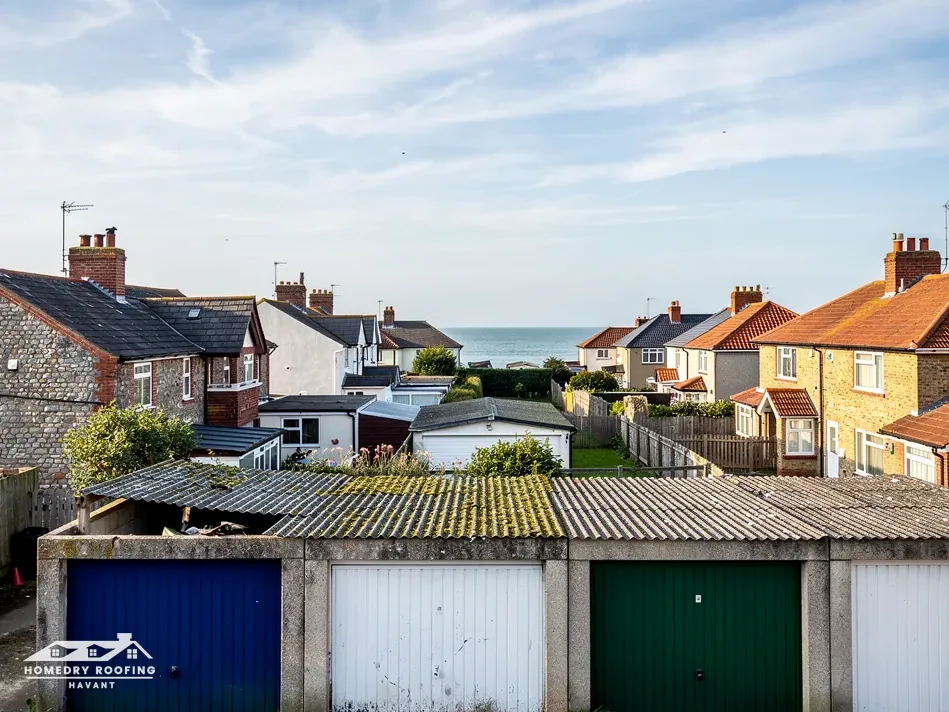
Selling a house raises questions you did not know you had. For anyone with a garage, shed or outbuilding under grey corrugated sheets, one of them is whether asbestos has to be mentioned to a buyer.
That is not a question a roofer answers. What a seller must say, and which form carries the answer, belongs to your solicitor or conveyancer, and the sensible move is to raise it with them early, before the listing goes live and a buyer's solicitor asks first. What we can tell you is the roofing side: what is likely to be on the roof, how to find out for certain, what removal involves and what outside sources have published about the cost.
This post follows that order. It sticks to what HSE publishes about older buildings and cement roofing, and to cost ranges that other organisations have printed with their dates. The legal part stays with your solicitor, who will put it in writing for your sale.
Where the legal question belongs
Selling a home involves several people, and each one answers a different part of the asbestos question. Mixing them up is how sellers end up with a confident answer from the wrong person.
A fair split looks like this:
- Your solicitor or conveyancer says what you are asked to disclose, how to answer the questions put to you and what to do if you are unsure of the answer.
- An asbestos surveyor, or a roofer who arranges one, says what the material is.
- A roofer says what condition the roof is in, whether it can stay, and what a removal or replacement would involve.
The order matters. If you start with the legal question, your solicitor will want to know what is actually on the roof, and nobody can say that from the kitchen window. If you start with the roof, you arrive at the solicitor with facts in hand instead of a guess.
A buyer's own survey may also raise the garage roof, so it helps to know the answer before anyone else asks. A written note of what you found, and when, gives your solicitor something solid to work from.
If you tell us a house is going on the market, we can look at the garage or outbuilding roof and say what we see. A visual look is not a lab result, but it tells you whether the next step is a survey, a repair or a quote for replacement. Everything after that point is a decision for you and your solicitor.
It also helps to have the roof looked at in good time. A sale has a date attached to it, and a survey, a result and a removal each take a little while to arrange, so the earlier the roof is looked at, the more routes stay open to you.
Why a roof built or refurbished before 2000 raises it
HSE gives the starting point in plain words. Its guidance says: "If the building was built or refurbished before 2000, assume that there is asbestos in it." That is an assumption to work from, not a finding about your particular garage, and it is wide on purpose. A building might have been put up before 2000, or it might have been refurbished before 2000, and either puts it inside the line.
Roofing is one place the material turns up. HSE lists asbestos cement products, and gives roof sheeting and rainwater goods as examples. Garages and outbuildings of that age can carry cement sheets of exactly that kind, and the same sheets can look much like a modern fibre-cement product.
Looking cannot settle it. Two sheets that appear the same from the drive can be different materials, and the date you remember the garage being built is not proof either. That is why the answer comes from testing, not from a photograph or a guess.
The same caution applies to other parts of an older building. HSE's location list names asbestos insulating board in white soffit panels under the eaves, which is a separate material with separate rules. A garage roof is one starting point, but it should not be the only place you ask about.
Why nobody should climb up to look
HSE's sheet A14 describes asbestos cement roofing as always fragile. A sheeted garage roof cannot be trusted to carry a person, so the first look is from the ground, or from properly set up access, and never by stepping on the sheets.
If you want to know how to tell a roof from the ground, our answer on how to tell if a garage roof is asbestos sets out what can and cannot be read by eye.
Finding out what is actually there
The reliable route is a survey with a sample sent for analysis, and it is worth doing before the sale instead of during it. MyJobQuote gives the average cost of an asbestos survey as around £325 in 2026. That figure is one guide's average, and your own quote will depend on the site and the number of samples.
Two rules keep you out of trouble while you wait for a result:
- Do not break a piece off to send away. HSE's non-licensed category assumes the material comes out intact, and snapping a sheet is the opposite of that.
- Do not drill, scrub or pressure wash the sheets. Leave them as they are until someone qualified has taken a sample.
When the result comes back, it will say what the material is, and that is the document your solicitor will find most useful. If it is asbestos cement, you move to the next question, which is whether it stays or goes. If it is something else, you have a short note that closes the question.
Our answer on an asbestos survey for a garage goes through what the visit involves. Keep the report with the house papers either way, because a buyer or their solicitor may ask for it, and finding it later is easier than commissioning it again.
Ask the surveyor to say in the report which parts of the building were sampled. A garage roof, a soffit and an old shed can each be a separate answer, and a report that names what was tested leaves no doubt about what it covers.
Leave it, repair it or take it off
Once you know what the roof is, there are three routes, and the right one depends on the condition of the sheets and on how soon you want to sell. Whether a buyer will care is a matter for your solicitor and your estate agent. The roofing side is about condition and cost.
| Route | What it means | What to weigh |
|---|---|---|
| Leave it | Sheets stay in place, with a record of what they are | Condition, leaks, and who will look at it next |
| Repair it | Local fixes to a sound roof | Whether the sheets are cracked or broken |
| Take it off | Sheets removed and a new roof fitted | Cost, waste route and timing |
HSE treats weathered cement sheeting differently from broken sheeting. Sheets that are merely weathered, without other serious damage, fall under non-licensed work. Sheets that have been substantially damaged or broken up sit in a different category, notifiable non-licensed work, which carries extra steps before anyone starts.
That is why the condition of the roof matters before anyone quotes. A garage roof with intact sheets is one job. A roof where sheets have cracked, slipped or been broken is another, and the written price after a survey will say which one yours is.
Where the roof is leaking, a repair that deals with the cause is worth knowing about whatever you decide, and a roofer can say whether the sheets can carry one.
What removal involves and what it costs
HSE's sheet A14 covers taking down a small structure such as a garage, as long as the cement stays intact. A14 draws the line at dust: once the cement breaks up, creating significant dust, the job turns into notifiable non-licensed work. For you that means whole sheets lifted out, handled carefully and not dropped, snapped or thrown.
The waste has rules of its own. HSE's guidance is to use a lockable skip for asbestos, and says it is not good enough to throw sheeting over a standard skip. Household asbestos is not covered by the government's consignment-note exemption for domestic hazardous waste, which excludes asbestos waste. When a roofer takes the sheets away, the waste leaves the site as trade waste on a consignment note, with a registered carrier.
If you are removing small amounts yourself, the recycling centre route is different again, and our post on where to take cement-bonded asbestos in Hampshire sets out its limits.
On cost, the published figures answer different questions:
- MyJobQuote (9 September 2026) gives the average asbestos removal cost for a roof in the UK as around £2,750.
- MyJobQuote (26 October 2026) gives the average garage roof replacement as between £750 and £3,500.
- Which? Trusted Traders, in November 2025, gave £1,400 to £3,500 excluding VAT for felt on a typical single garage of 6m by 3m, and added that it is likely to be at the upper end in the South East.
Each comes from a different source on a different basis, and none is our price. Our quote for the garage roof is a single written figure, set after a survey, and it covers the removal, the waste and the new roof together.
Questions to take to your solicitor and your roofer
A short list, put to the right people in the right order, saves a lot of back and forth once a buyer is involved.
For your solicitor
- What am I asked to disclose about a garage or outbuilding built or refurbished before 2000?
- If I do not know the material, how should I answer?
- Would a survey report, or a removal and a replacement roof, change what goes in the file?
For your roofer
- What do you think the sheets are made from, and what is your reason?
- Are any sheets cracked, broken or slipped?
- Does the written price cover the removal, the waste route and the new roof in a single figure, and does it show whether scaffold and VAT are counted in?
- Will I get paperwork for the waste once the work is done?
The last question in each list is the one to keep in mind. A roofer who removes asbestos sheeting should be able to say where it goes and show how it was moved. Ask for that in writing, and keep it with the survey.
None of this makes the sale slower if it starts early. A question that is answered before the listing is a line in the file. A question raised by a buyer's solicitor after an offer can hold up the whole chain. Start with the roof, because it is the part you can settle with facts, and let your solicitor tell you what to do with them.
Filed under Garage roofs