
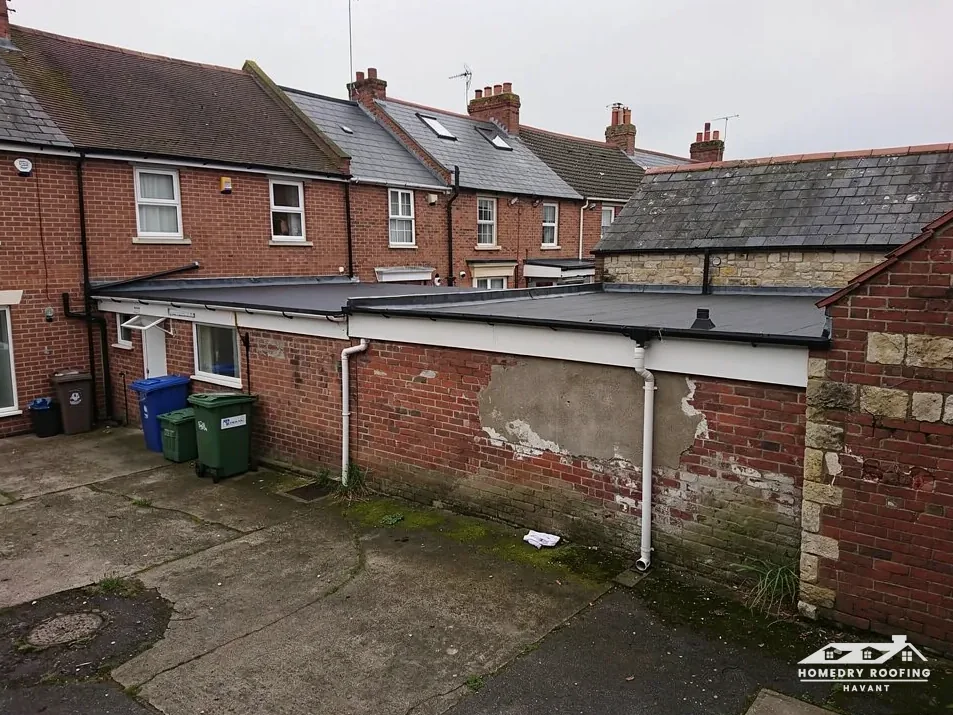
Soakers
Where little folded lead pieces lie hidden below the tiles at a wall or stack.
One that has slipped lets damp creep into the brick below.

Titchfield is 12.6 road miles west of Havant; lead flashings, valleys and the loft timber under the covering come first, and one written total comes only once they have been seen.
10-year workmanship guarantee, in writing
Where little folded lead pieces lie hidden below the tiles at a wall or stack.
One that has slipped lets damp creep into the brick below.
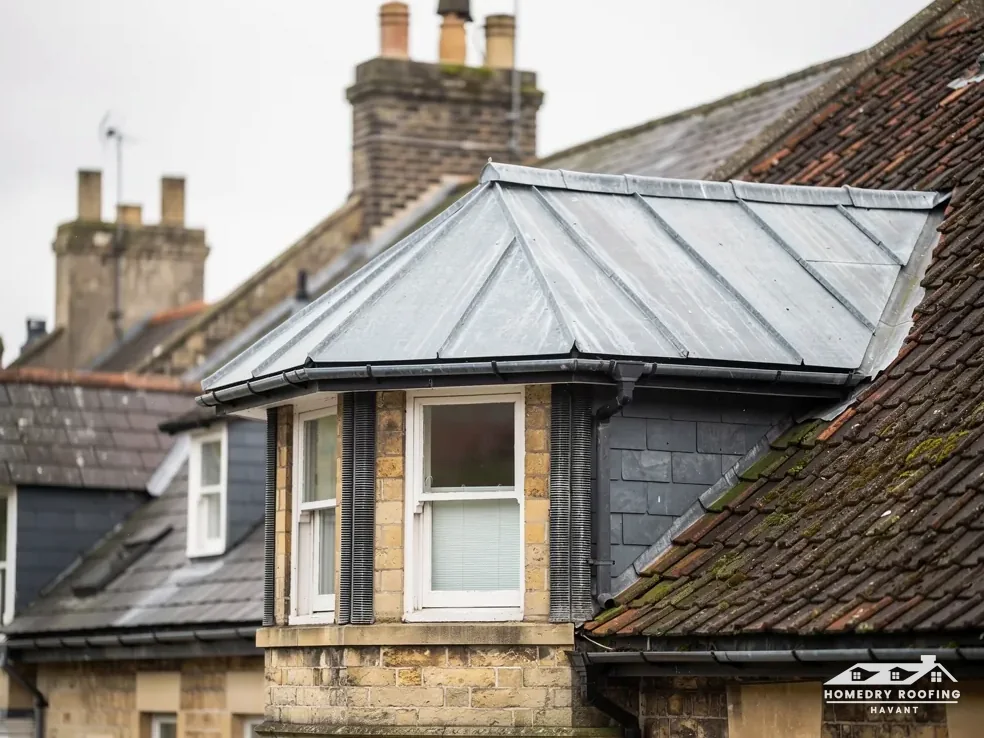
Where the roof folds inward between two slopes and a lead trough carries both flows.
A thin patch in that trough sends water sideways beneath the covering.
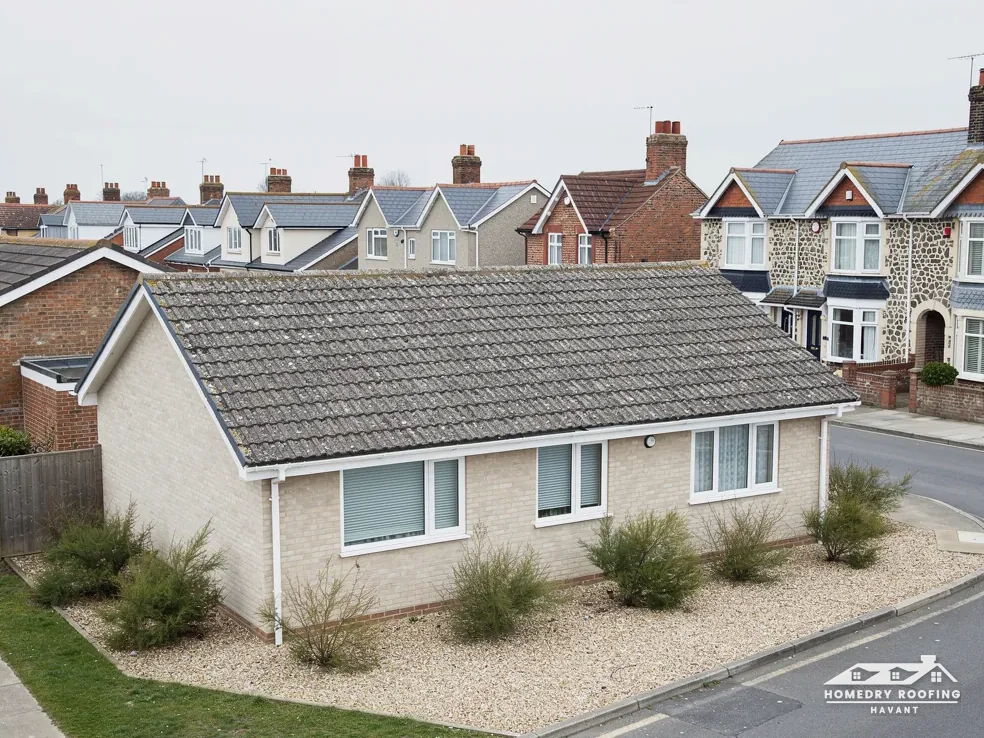
Where sloping timber in the loft carries the covering and keeps a record of damp.
A dark tide mark on one can be read back to the place the water came in.
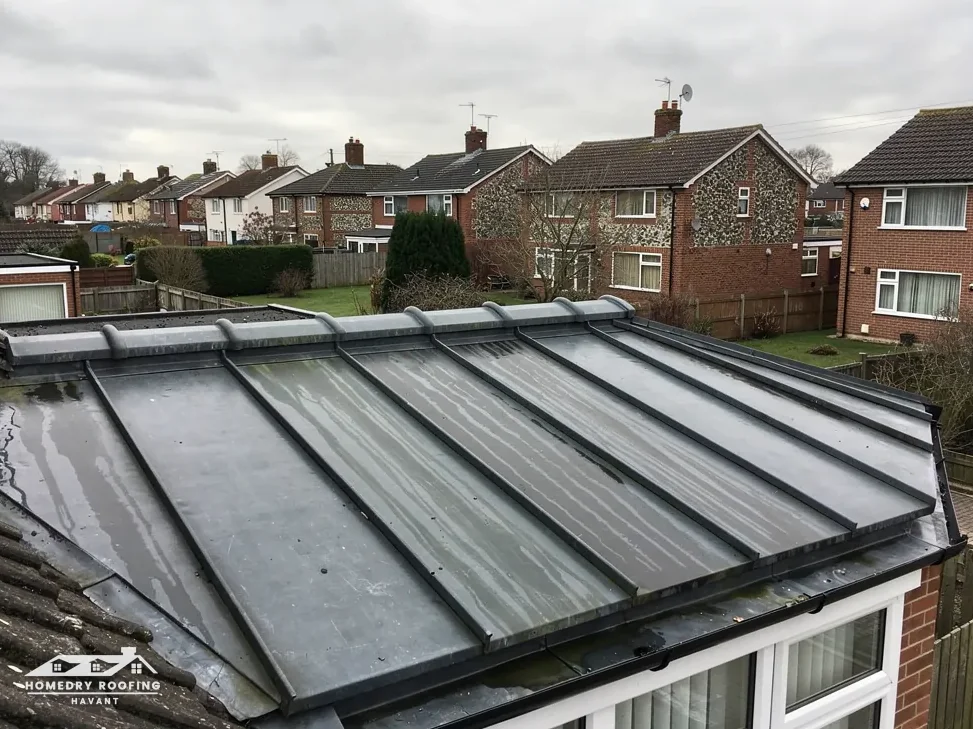
Where two slopes join, lead takes the work of both.
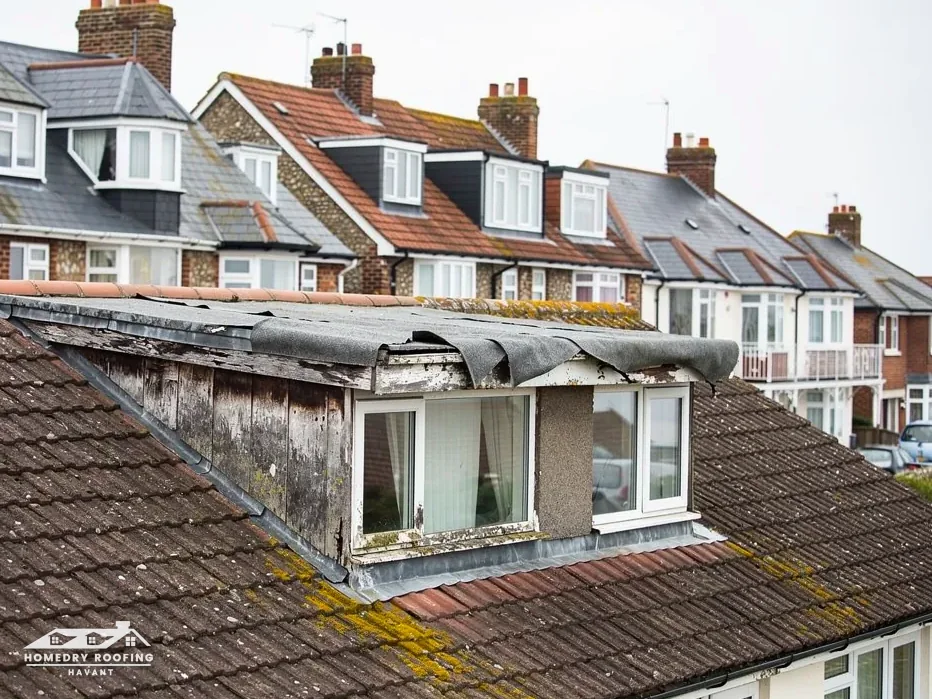
Wherever a Titchfield roof butts against another part of the building, a strip of lead does the sealing: beside a chimney, along a party wall, around a roof window, or down the fold between two slopes. Our survey reads each piece. We look for splits, for thinned metal in the bed of a valley, for flashing edges lifting from the brick, and for soakers, the small folded pieces laid under the covering beside a wall, that have slipped. MyJobQuote says correctly installed lead flashing can last for over 80 years, so a flashing in poor shape raises questions about its fixing as well as its age. Royston Lead's brochure lists Code 4 sheet for soakers, flashings and pitched valley gutters, with each detail calling for its own code, so the survey record states the code that applies. Our leadwork page explains how each piece is dressed, and our roof repairs page covers the repairs that follow from a survey.
Titchfield has 2 conservation areas near its centre, named Titchfield and Titchfield Abbey, and Fareham Borough Council publishes an Article 4 direction for the Titchfield conservation area. Because an Article 4 direction can pull further rights back from a house, the sensible first step is to ask Fareham Borough Council about your own road. Historic England lists the Parish Church of St Peter at Grade I and No 7 West Street at Grade II. St Peter's is a working Church of England church, so its repairs go through the faculty system, while a listed house needs listed building consent for any work that touches its character.
The planning guide for roof work covers the national position for houses, and it is worth a read before any decision about a roof on a house in a conservation area or beside a listed building.
The valley is where two slopes empty into one trough, and its lead carries more water than any other strip of the roof. We clear the debris, look at the metal beneath it for splits and thinned patches, and study the tile cuts on each side. If the lining has worn along its whole run, it is renewed along that run, because a patch halfway down leaves the rest of the trough to fail next.
A brown ring high on a bedroom wall beside a chimney, or damp plaster that comes back after every wet week.
A flashing edge that has come away from the brick, or a soaker that has slid out of place.
Tide marks on timber and felt lead back up the slope to the point of entry, which is not always where the ceiling is stained. Reading the underside first means the outside check starts in the right place, and a fault is found once.
The underside of a roof holds evidence the outside cannot give. With a torch in hand, we climb into the loft and read it in order: rafters and battens for dark tide marks, the felt for tears and wet patches, the insulation for stains, and the line below the ridge for pinpricks of daylight. A tide mark on a rafter can be traced up the slope to the spot where water entered, which may be some distance above the stain on the ceiling below. HSE advises treating every roof as fragile unless a competent person has judged otherwise, so the survey is made from inside the building and from a ladder before anyone steps onto the slope. Insulation lying over the eaves gets lifted gently where it hides the timber, and any cable or pipe in the way is left where it lies.
The Environment Agency maps land near Titchfield as Flood Zone 3. That describes flood risk on the ground and is silent on how a covering ought to be read, so the loft check is identical whichever zone a street falls in. A roof only has to shed the rain that lands on it, and the survey judges whether it does.
Roof windows and flat extensions are looked at from underneath too. Mist inside a double-glazed unit, a damp reveal or a stained lining board gives an early hint of where to look outside. Our roof windows and skylights page explains what replacing a unit involves. After the survey you have a set of photographs from the loft and from the ladder, each fault marked, and the written total price sits next to them. Repair is offered first wherever the existing roof can carry one, and for every item in the notes there is a stated reason, so you can weigh it for yourself.
A ceiling stain marks the end of the water's journey, never its start.
A ring of staining on the plaster marks where the water arrived, and it may have travelled a long way to get there. It can run along a rafter, down a chimney breast or across the top of the insulation before it shows. We follow it uphill in the loft and photograph the first point where the timber is wet, since that is where the repair has to be made.
Map of Titchfield and the places around it, with the dashed line of our 30-mile service area from Havant. The same places are listed below the map.
First the valley is cleared of debris, then we go over its lining for cracks and worn lead, and read how the tiles have been cut along both sides. Flashings are looked at along their edges for lift and along the mortar line for crumbling. Soakers, the folded lead pieces under the covering beside a wall or chimney, are checked for slip and for corrosion at their exposed edges. MyJobQuote says correctly installed lead flashing can last for over 80 years, so an early failure raises a question about the fixing. Each finding is photographed and given a reason in plain words, so you can compare the record with what you see from the ground.
Scale decides it. The Planning Portal sets two limits, 25 per cent of the building envelope and 50 per cent of the roof, and a re-cover under both normally proceeds without a building regulations application. Over either limit, or with a covering 15 per cent or more heavier, approval enters the picture, and the Partnership is the body to ask. Titchfield addresses are served by the Building Control Partnership, on 01329 824823. We contact the Partnership before work begins, give you its reply without jargon, and file that reply alongside the survey notes, so a question about the route a year on can be answered from the file.
Section 169 of the Highways Act 1980 makes a licence compulsory for any scaffold in the way of the highway, and in Titchfield Hampshire County Council grants it. Hampshire County Council charges £211.90 on application for the first 2 weeks and £72 for each additional 2-week period, while the application date must fall ten clear working days before the first pole goes up. Hampshire County Council states that "Scaffolding companies must apply on behalf of their customers." We arrange it with our scaffolder. The proposed dates come to you first, because a scaffold across a footway affects neighbours as well as the house, and nothing goes to the council until you have agreed them.
Not from the council. Historic England lists the Parish Church of St Peter at Grade I, and since it is still a working Church of England church, its repairs follow the faculty system, with no listed building consent from the council. A private house on the list, such as No 7 West Street at Grade II, is on the other route: work affecting its character needs listed building consent from Fareham Borough Council, and the full list entry for the property is the place to start reading, before a tile is ordered or a quote is accepted.
Titchfield and Titchfield Abbey are the 2 conservation areas close to Titchfield's centre, and Fareham Borough Council holds their boundaries. Within either boundary a plain re-cover is normally still permitted development. The wrinkle is the Article 4 direction the council publishes for the Titchfield conservation area, since such a direction can take further rights from a house. Whether it reaches your property is the council's call, so check with Fareham Borough Council before you commit. Our planning guide gives the national rules for house roofs, and the council's reply on your road can be attached to your survey so that it stays with the roof.
It shows what the outside hides. Dark tide marks on rafters and battens trace water back up the slope, torn or wet felt marks a failed covering above it, and stained insulation shows where drips have landed. Daylight along the ridge or at a lap shows an opening. With a torch we photograph each finding and mark its position on the roof, so the ladder work outside starts at the right spot, and you can look at exactly what we looked at. The cause may be found some distance from the stain, which is why the underside is read first.
No. Land near Titchfield falls in Flood Zone 3 on the Environment Agency's flood map, but that is a statement about flood risk on the ground and does not alter how a covering, a flashing or a valley is read. At every address the survey traces the rain from ridge to drain. Should flood risk to the house itself worry you, that is a separate matter for the Environment Agency and Fareham Borough Council, and it falls outside what a roofing survey can answer. The roof questions stay the same: where the water enters, and what closes it.
Once the roof has been seen, the work and the covering are described in one written total, with the findings printed alongside. The total spells out if VAT and scaffold are covered by it, which lets you hold a second quote against it on fair terms. Where a rival leaves scaffold or VAT unmentioned, get that settled in writing first. A repair is put forward in preference to a replacement when the roof allows it, and prices stay good and fair, each tied to the work described in the notes, so the total can be read against the findings that produced it.
You'll get one written total price.
Fill in what you like. It opens WhatsApp with your message ready to send.