
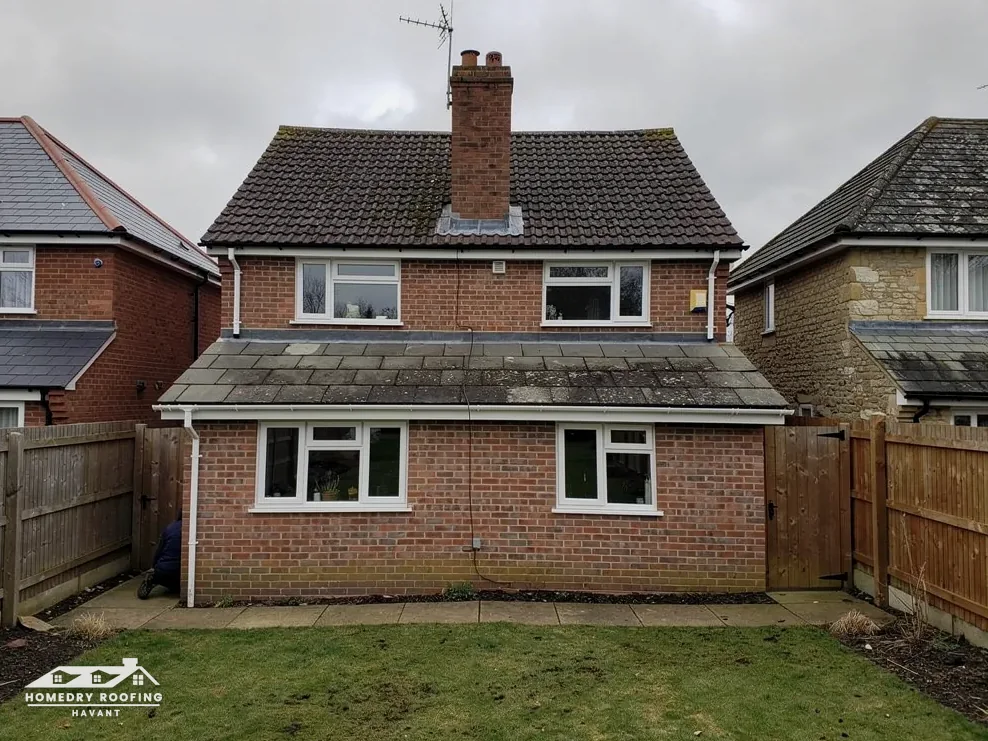
Underlay
Where a membrane lies on the rafters beneath the battens and catches whatever slips past the tiles.
Where the sheet is torn or sagging, that water can reach the timber and the ceiling below.

Wickham is 13.3 road miles west of Havant; underlays, battens, gutters and downpipes there are read before any repair, and a written total price follows.
10-year workmanship guarantee, in writing
Where a membrane lies on the rafters beneath the battens and catches whatever slips past the tiles.
Where the sheet is torn or sagging, that water can reach the timber and the ceiling below.
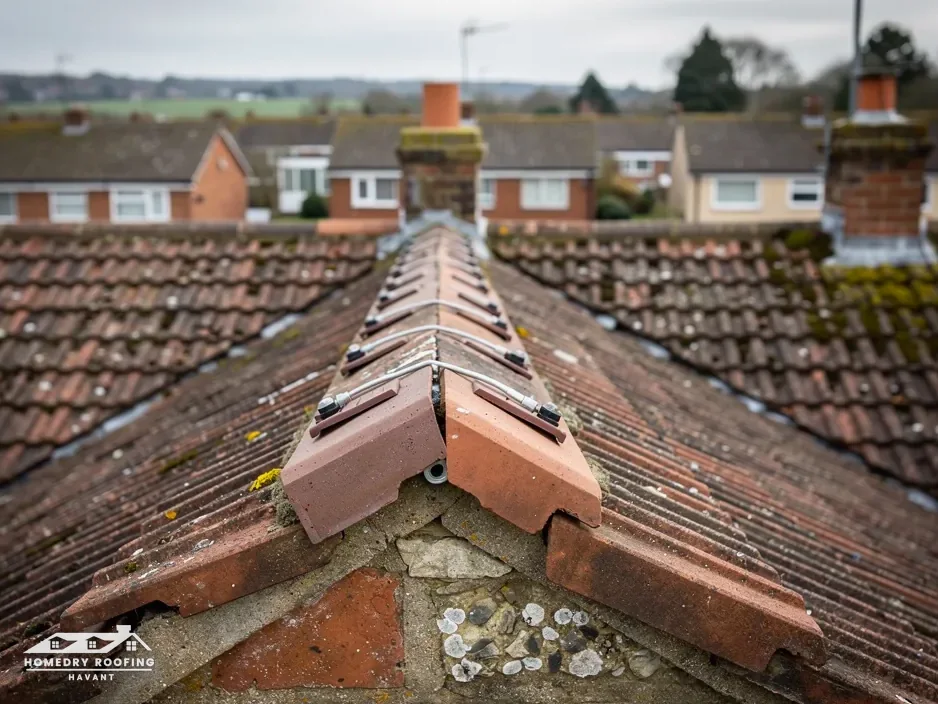
Where slim timber laths cross the rafters, each course of the covering resting on them.
A lath that has softened or split can no longer hold the tile above it.
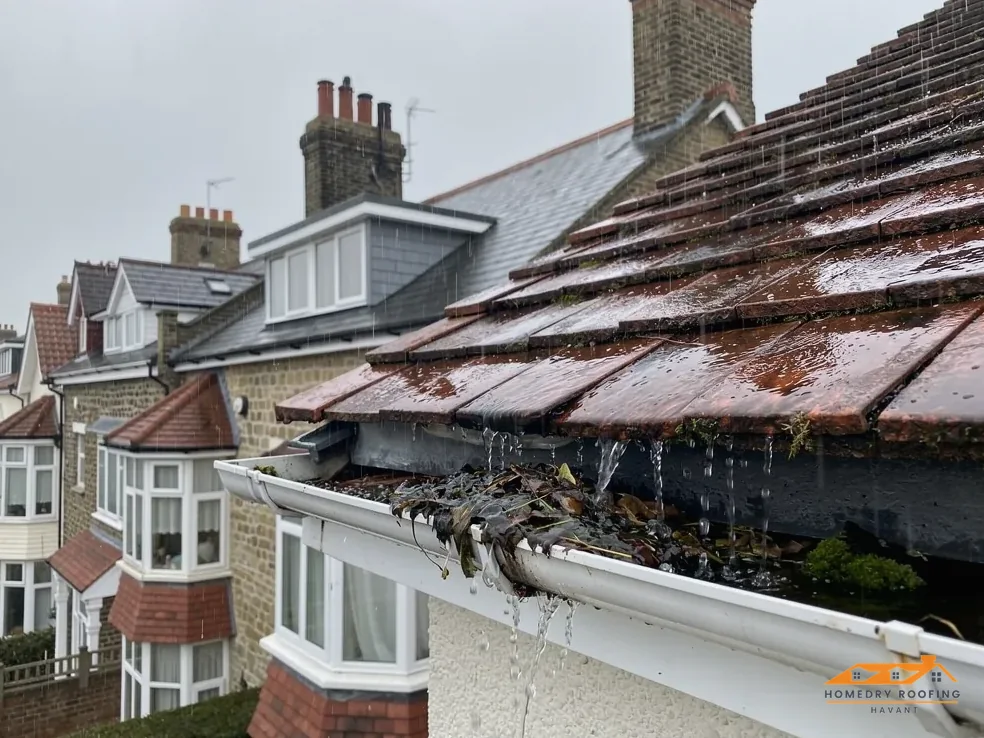
Where a gutter empties into a vertical pipe, and the pipe takes the water to a drain.
A pipe that finishes against a wall sends that flow into the brickwork instead.
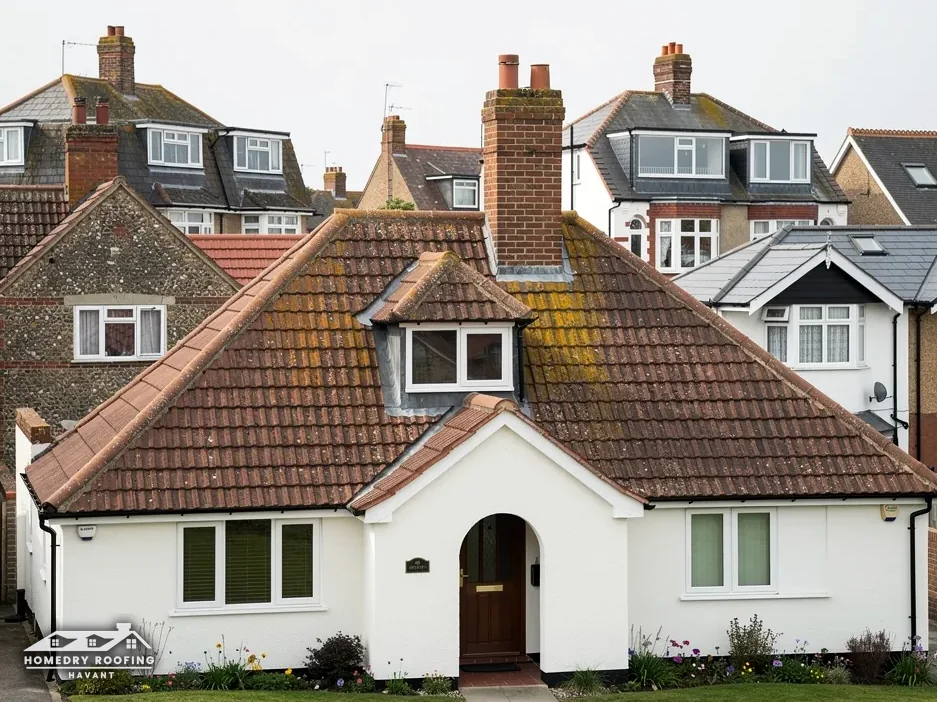
By the pattern. A leak marks the line of the water's path and grows after rain, while condensation spreads wider and follows cold nights. We read the position of the mark, the eaves airflow and the underlay together, then report which one it is.
Below the tiles of a pitched roof sit two layers hidden from the ground. The underlay is a membrane stretched across the rafters, and the battens are timber laths fixed on top of it to carry the covering. Together they catch whatever slips past a tile. During a Wickham survey we raise a few tiles where the roof allows and read the membrane for tears, sag between rafters and ends that have slid at the eaves. Marley points out that a high-resistance (HR) underlay is not vapour-permeable, so a cold roof laid with one needs 25 mm of ventilation along the eaves at pitches of 15° or less, and 10 mm above 15°. Our pitched roofing page covers what a re-cover involves.
From inside, the loft supplies the rest of the evidence. Wet marks on the boards, dark rings round nail points and drops hanging from the rafters can come from a leak, and they can also come from moist air condensing on cold timber. The remedies differ, so we compare where the marks sit, how air reaches the eaves and whether the dampness follows rain or frost. Our roof inspections page describes that survey, and the findings name the cause instead of guessing at it. If ventilation at the eaves is the trouble, the fix may be as small as clearing blocked gaps.
Wickham's parish church, the Church of St Nicholas, is listed Grade II* and has an active Church of England congregation, which puts its repairs under that church's own faculty system. The Old House Hotel and Wickham House are also Grade II* on the Historic England list. The Wickham conservation area is Winchester City Council's, and its planning team can confirm on a map whether your road lies inside the boundary, a fact to have in hand before you choose a roofer. Our planning guide for roof work holds the rules.
Beneath every tile sits a second layer that nobody sees until it fails.
A stain under the roof can mean two different faults. Rain that has got past the covering leaves a mark in line with the entry point, and it grows after wet days. Condensation leaves a spread of damp over a wider area, and it follows cold nights and poor airflow. We note where the mark sits, how the eaves are ventilated and what the weather has been doing, then say which fault it is and what closes it.
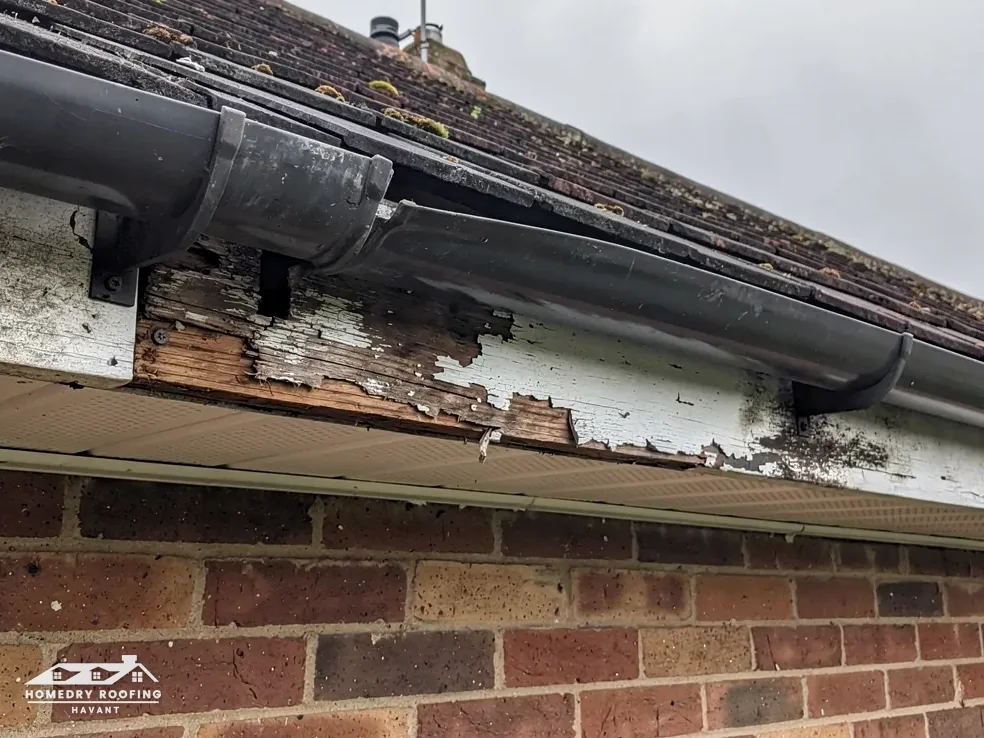
A roof only finishes its job when the water has reached the drain.
The route ends at the rainwater system. Brett Martin advises a fall of 1 mm for every 600 mm towards a gutter's outlet, which is gentle enough to lose when one bracket works loose, and a run that has dipped keeps water standing in it. We go along the brackets, joints, stop ends and outlets, then trace every downpipe down to its foot. A pipe finishing against a wall, or a shoe knocked off at ground level, puts the roof's water into the brickwork. Our gutters, soffits and fascias page lists the work.
Look up Wickham on the Environment Agency flood map and its mapped centre falls in Flood Zone 3. Read that for what it is: a zone for ground flooding at a single mapped point, which says nothing about how any roof is built and gives no reason to expect a leak. It does give a reason to look at where roof water goes afterwards, so each pipe's discharge point goes into the survey, and a pipe that empties beside a footing is reported to you with a suggested alternative.
Putting up an access scaffold over a pavement or verge brings in Hampshire County Council as highway authority. Hampshire County Council tells scaffolding companies to apply on behalf of their customers, charges £211.90 on application for the first 2 weeks and £72 for each additional 2-week period, and wants 10 clear working days before the work begins; we arrange it with our scaffolder. A re-cover of the roof is another matter and goes to Winchester City Council's building control team (01962 848 176) first. Because the scaffold stands on your road for the length of the job, dates are fixed with you before any application goes in.
The ground-level half of a gutter survey is a walk round the house. We stop at every downpipe to see where it finishes, whether on a drain, a soakaway, a path or bare brick. Roof water that lands on a wall footing causes damp that looks like a roof leak but is not one. Noting these points on your report means the cause of a wet wall is named correctly, whatever the repair.
Green streaks under the gutter, or damp plaster inside, low on the same wall.
A seam that weeps, a loose bracket that lets the run dip, or a pipe whose foot has broken away.
Map of Wickham and the places around it, with the dashed line of our 30-mile service area from Havant. The same places are listed below the map.
Because the tiles show only the outside of the roof. The membrane beneath them is where a slow leak leaves its first mark, and a tile that looks perfect can sit over an underlay that has torn. Where the roof allows, we raise tiles near the eaves and a few in the middle of a slope, check the membrane for splits, sag and slipped ends, and look at the battens in the same moment. Photographs of what lies under the tiles go into the findings for you to judge why a patch or a wider job is recommended, and the same pictures stay yours to keep.
Not at all. The Environment Agency has mapped the centre of Wickham as Flood Zone 3, which describes flooding of the ground at that one point and says nothing about the condition of a roof. A ceiling stain after rain comes from the roof, from the gutters or from condensation, and the survey sorts out which. We do note where each downpipe empties, since roof water discharged beside a footing is a drainage fault in its own right, and a pipe that should finish elsewhere is reported to you with a suggested change and a sketch of where it would go.
Planning Portal guidance has two parts. A re-cover that stays under 25 per cent of the building envelope and under 50 per cent of the roof escapes a building regulations application, in the usual way, while a covering whose weight rises by 15 per cent or more needs approval. Winchester City Council's building control team (01962 848 176) is the body to ask for a Wickham address. We take your roof to that team before any tile is lifted and bring the reply back in ordinary language, so the route is settled before anything is ordered or booked.
A scaffold standing on the highway falls under section 169 of the Highways Act 1980, and for Wickham the issuing body is Hampshire County Council. Hampshire County Council's wording is "Scaffolding companies must apply on behalf of their customers", and it charges £211.90 on application for the first 2 weeks, then £72 for each additional 2-week period, with 10 clear working days required before the work begins. It offers no extensions, so the full length of the job goes into a single application. We arrange it with our scaffolder, and you agree the start date in advance, which keeps the licence dates and the roof dates in step.
Not while it is being used for worship. The Church of St Nicholas is listed Grade II*, and a Church of England church that is still a place of worship goes through the faculty system rather than listed building consent. A Wickham house with a list entry in its own name gets no such exemption: any roof work changing its special character needs listed building consent from Winchester City Council. Look the address up on the Historic England list, and put the question to the council early, with photographs of the roof and a short note of what you hope to change.
A house can ordinarily be re-covered as permitted development even inside a conservation area, yet an Article 4 direction may withdraw more rights than that. The Wickham conservation area falls to Winchester City Council, so ask that council about the house in question before any date is fixed. The rest is set out in the guide to planning for roofs, and we raise the address with the council ahead of any price, so the figure reflects the answer you receive. Put the question in writing and file the reply with your papers.
Stand back on a dry day and look along the run. A line that bows between brackets, or a joint with a dark stain beneath it, points to a run that is holding water. Brett Martin advises a fall of 1 mm for every 600 mm towards the outlet, a slope so gentle that a single loose bracket can undo it. On a survey we test the fall properly from a ladder, pouring water along the gutter and watching where it lingers, and the result goes into your findings with a picture of the lowest stretch, so you can see the dip for yourself.
Put the same two questions to each firm in writing: does the total cover scaffold and VAT, and has anyone been up on the roof before the figure was set down? Ours is a single written total, handed over once the survey is done, findings alongside, and where the roof is sound a repair comes before a replacement. A lower-looking total can leave out something you would meet later. Our price is good and fair. A short covering note explains the findings, and you can read both at your own pace before answering.
You'll get one written total price.
Fill in what you like. It opens WhatsApp with your message ready to send.