
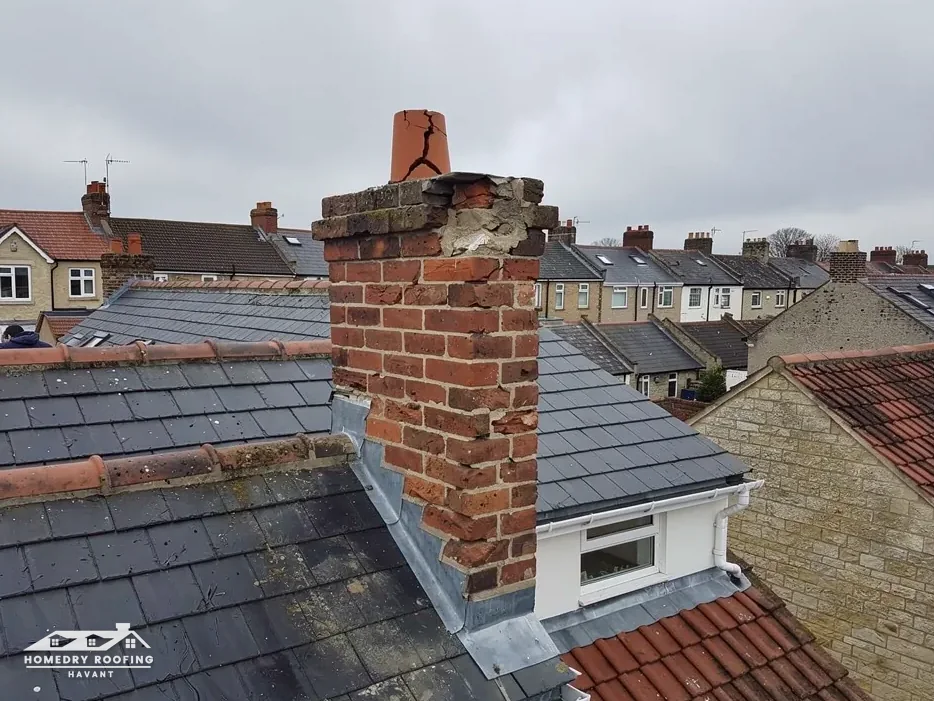
Stacks
Where a Waltham Chase chimney climbs out of the slope and its flashing closes the gap.
Damp on the chimney breast upstairs can begin in the pots, the joints or the lead.

Chimney stacks, flat extension roofs and garage roofs at Waltham Chase, 14.8 road miles north-west of Havant, are traced to their cause before anything is priced.
10-year workmanship guarantee, in writing
Where a Waltham Chase chimney climbs out of the slope and its flashing closes the gap.
Damp on the chimney breast upstairs can begin in the pots, the joints or the lead.
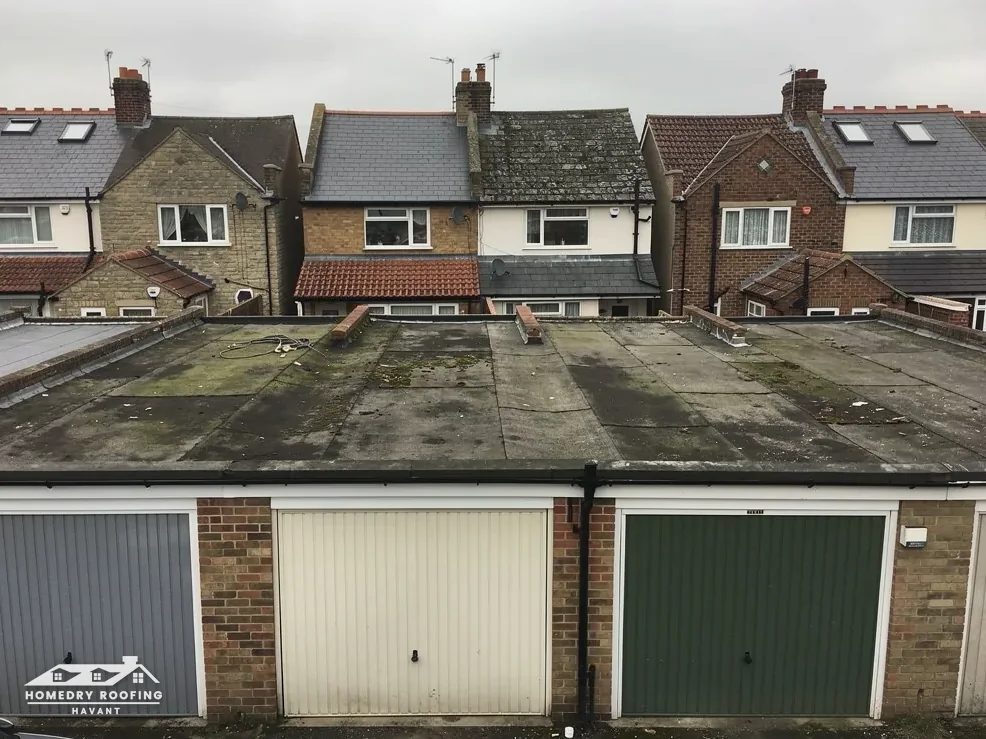
The join at a house wall, with the covering of a flat extension roof dressed up against it.
A single split in that upstand sends rain behind the covering and on into the plaster.
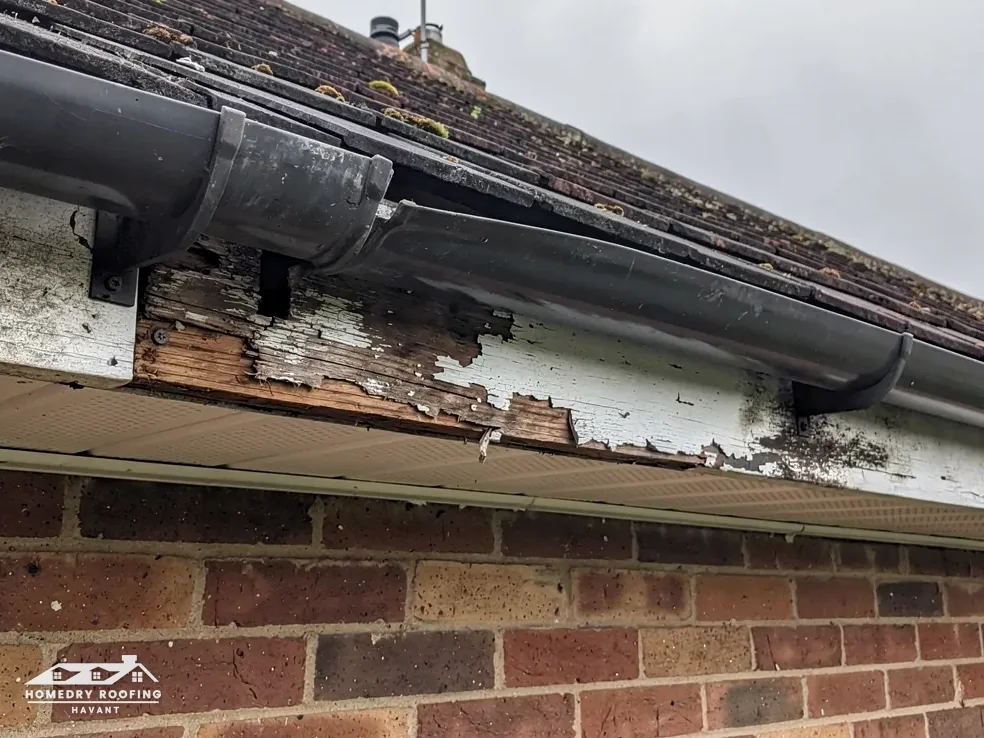
Where a downpipe hands the roof's rain to the drain at ground level.
A gully clogged with leaves pushes that water back across the path towards the wall.
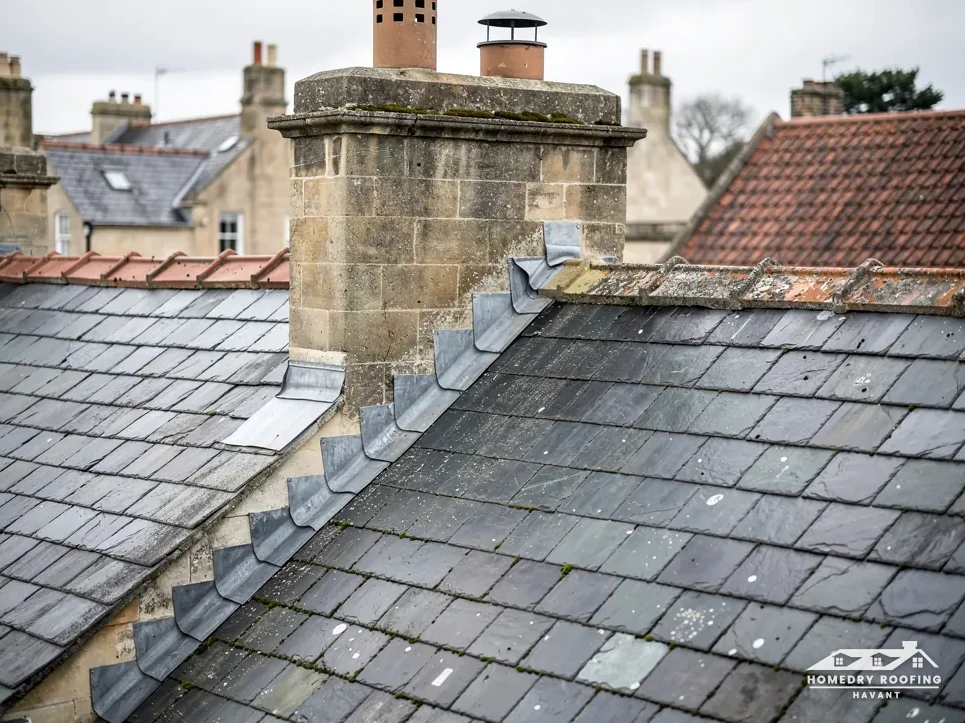
A stack takes the weather on four sides and needs all four closed.
Rain reaches a chimney stack from every side, so the survey climbs it from the top down. First come the pots and their flaunching, the mortar cap that carries rain outward off the stack, where a hairline crack is enough to let moisture in. Then the brick joints, then the lead at the base, where a back gutter or stepped flashing should sit snug in a raked-out joint. An upstairs ceiling with a brown ring on it can lead back to any of those four places, which is why the stack is checked before the slope around it. Our chimney repairs page deals with repointing, fresh flaunching and full rebuilds, and the choice between them.
Waltham Chase is in Shedfield parish, within Winchester City Council's boundaries. Shedfield and Bishops Waltham are conservation areas not far from the village, and whether a given house stands inside either one is for Winchester City Council to say. Whether an Article 4 direction reaches a single road here is another question to put to Winchester City Council, and it is best asked before any materials are ordered, since the answer depends on the address. Listing works house by house: a home that appears on the National Heritage List brings listed building consent into play whenever roof work would alter what makes it special, and a search by address takes a minute.
Our guide to planning permission and roof work keeps the permitted-development detail in one place, so this page does not repeat it. Here the job is the survey: a written account of the stack, the flashing and the joints, photographs taken from the ladder, and a plain view on whether repointing and new flaunching will do or the whole stack needs to come down and go back up.
A mark below a chimney is blamed on the roof around it, yet the stack itself may be the entry: a cracked bed under the pots, an open joint in the brickwork, or lead lifted at the back where the slope runs up to it. We look from ladder and loft, then show you photographs of what is there, so the repair is made at the entry itself, not the stain. A sound stack is left alone.
A faint ring on the ceiling next to the chimney breast, darker after a long wet spell and paler once the weather turns dry.
A cracked bed at the pots, an open joint in the brickwork, or a back flashing lifted clear of the stack.
Rainwater lying there a full day after the shower has nowhere to go. Either the outlet is choked or the fall is gone, and each has a different cure. We clear and watch first, then measure, and tell you which it is.
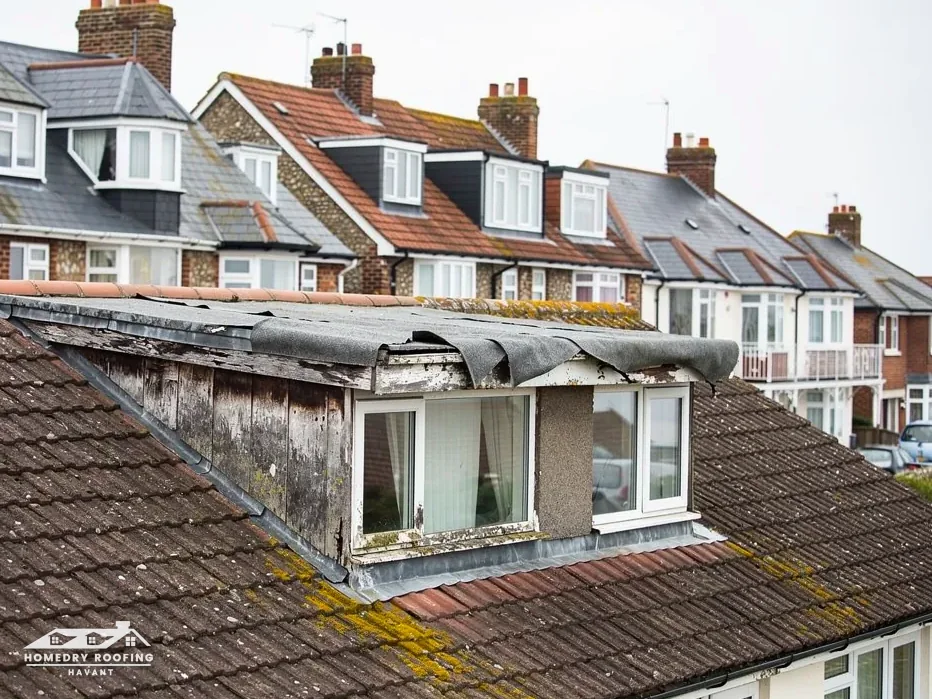
Flat roofs get their survey the morning after rain, when the evidence is still sitting on the surface. Standing water has two likely explanations, a slack fall or a clogged outlet, and the cure for each is different, so we establish which one it is before suggesting a repair. Next we trace the upstand, the strip of covering turned up the house wall, for splits, lifted edges and any gap behind the cover flashing at the top of it. Pitch, deck and outlet are all measured, never guessed from the ground. BS 6229:2025 sets a minimum finished fall of 1:80 for membrane flat roofs, and a design steeper than that leaves room for tolerances. Our flat roofing page describes the coverings, while the survey itself decides whether an extension or garage roof can be mended or must be relaid.
From the slope, the rain still has to reach the ground somehow. Gutters and downpipes are examined from the ladder: a weeping joint, a bracket letting a run droop, a pipe ending hard against the wall instead of over a gully. Brett Martin advises a fall of 1 mm for every 600 mm towards the outlet. Our gutters, soffits and fascias page gives the options, whether that is one refixed bracket or a complete new run.
The Environment Agency places land near Waltham Chase in Flood Zone 2. That zone describes the land beneath, not anything overhead, which is why we follow every downpipe to where it empties and note what is there. Waltham Chase gets the same trace as anywhere else we work, covering to drain, with a set of pictures taken above and below the covering, and one written total price at the end of it.
A choked outlet can hold rain across a whole flat roof.
A pool on a flat roof gets pinned on the covering, when a leaf-choked outlet or a sagging deck may be holding the water there. First we clear the outlet, then see where the water settles, and measure the fall before suggesting new felt or membrane. A blocked outlet is a small job; a lost fall means relaying the covering. You learn which of the two it is, and the photographs of the surface back that up.
The top, because the pots and flaunching shed rain away from the brickwork and a cracked bed lets it straight in. From there we work down the stack, taking in the joints, the flashing at its foot, and the stepped lead along each side. Inside the loft we look over the brickwork for dark staining. A stack needing nothing more than fresh pointing and flaunching gets exactly that, while a leaning or crumbling one is described as a rebuild, with photographs of the reasons. Findings arrive in writing before any price is mentioned, and the price then arrives in writing too, as one total.
For Waltham Chase the building control route runs through Winchester City Council's building control team, on 01962 848 176. The Planning Portal gives a two-part test: a re-roof normally stays outside the application route while less than 25 per cent of the building envelope and also less than 50 per cent of the roof is touched. Extra weight of 15 per cent or more in the covering brings approval into the picture regardless. We raise the job with that team before work starts and report their reply in everyday words, so you are never left reading regulations yourself. Whether planning permission is involved is a separate matter, which our planning guide takes up.
Under section 169 of the Highways Act 1980, a scaffold standing on or overhanging the highway needs a licence, and for Waltham Chase the licensing body is Hampshire County Council. Hampshire County Council charges £211.90 on application for the first 2 weeks and £72 for each additional 2-week period. Plan for a wait too, because ten clear working days must pass from application to intended start. Hampshire County Council's page says: "Scaffolding companies must apply on behalf of their customers." We arrange it with our scaffolder. You will know the dates beforehand, so poles stay up for exactly as long as the work needs.
Historic England's National Heritage List takes a search by street address or by name, and each entry names the building it lists. Should your house have an entry, listed building consent under section 7 of the Planning (Listed Buildings and Conservation Areas) Act 1990 is needed for any works altering its character, and a new covering is among the works that can do so. Ask Winchester City Council before anything is ordered. Without an entry the ordinary rules apply, and whatever the council says about your address is written up with the survey, where it stays from the first visit to the last.
Shedfield and Bishops Waltham are conservation areas not far from Waltham Chase, and Winchester City Council is the body to approach about your own address, because this page maps neither area. Normally, ordinary re-roofing stays permitted development inside a conservation area too, but an Article 4 direction can remove further rights, so we check with the council first. That check is made for your particular road, since the answer rests on the address and not on the village name. The rules themselves are in our guide to planning permission and roof work, and the council's reply is filed with the survey notes.
It leaves the covering of the slope exactly as it was. According to the Environment Agency, land near Waltham Chase sits in Flood Zone 2, a label for the ground rather than the roof. Where it does matter is at the bottom of the survey: each downpipe is traced to its foot, the gully is inspected for blockage, and we see whether the path slopes down to the wall. Each point goes into the findings with its own photograph. The zone for your own address is something to check with the Environment Agency, and it has no bearing on our findings, so a mark on a flood map never turns a repair into a replacement.
When the fall has gone, the covering has failed across its width, or the deck beneath has gone soft, because a patch cannot cure any of those. A tear along the upstand or a choked outlet is a repair instead. You are told which case yours is, with the reasons and photographs of the surface, the upstand and the outlet. A relaid membrane roof works to BS 6229:2025, whose minimum finished fall is 1:80, so the design is set steeper than that to leave room for tolerances. The written price follows the survey, with a repair put forward first wherever the deck is sound.
One total for the whole job, given after the survey. Your quote states whether VAT and scaffold are counted within that total, so a second quote can sit beside it on equal terms, and if a quote leaves them out, ask for that in writing. A repair comes first when the roof is sound, and a replacement is explained by what is wrong with the roof. Prices are kept good and fair. We sweep the site clean after the job. Photographs accompany the findings, so every fault named is something you can see for yourself, and nothing is priced from the ground.
You'll get one written total price.
Fill in what you like. It opens WhatsApp with your message ready to send.