
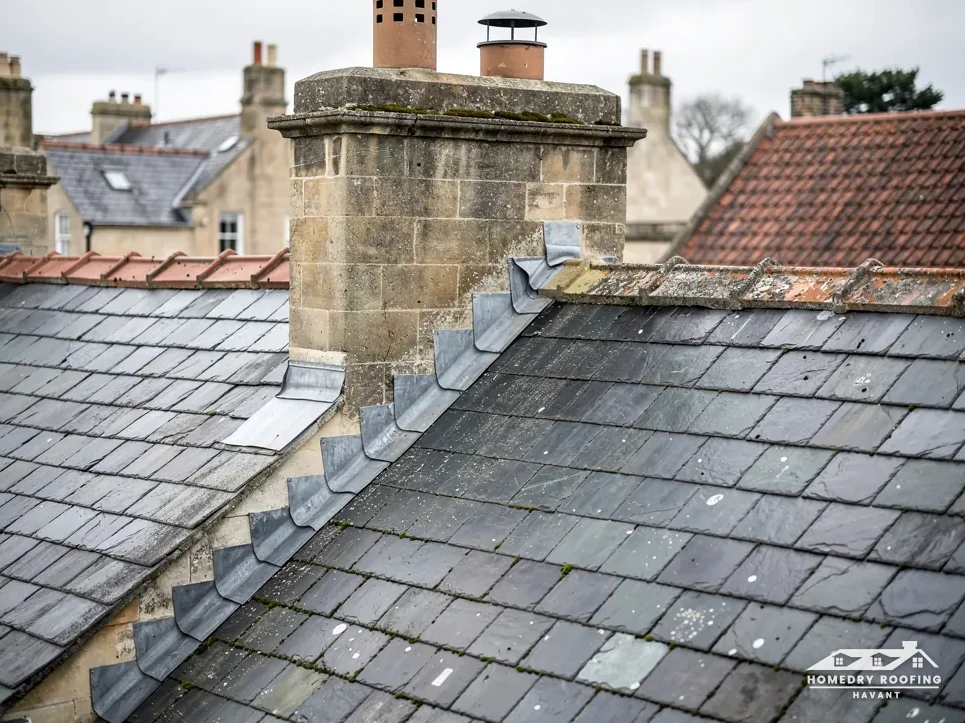
Flashings
Where the tiles stop at a chimney or a wall and one strip of lead bridges the gap.
One lifted edge in that strip lets rain run behind it and into the masonry.

Bishop's Waltham is 17.5 road miles north-west of Havant; lead at chimneys and walls, and the gutters and downpipes below, are each followed to their source and then priced as one written total.
10-year workmanship guarantee, in writing
Where the tiles stop at a chimney or a wall and one strip of lead bridges the gap.
One lifted edge in that strip lets rain run behind it and into the masonry.

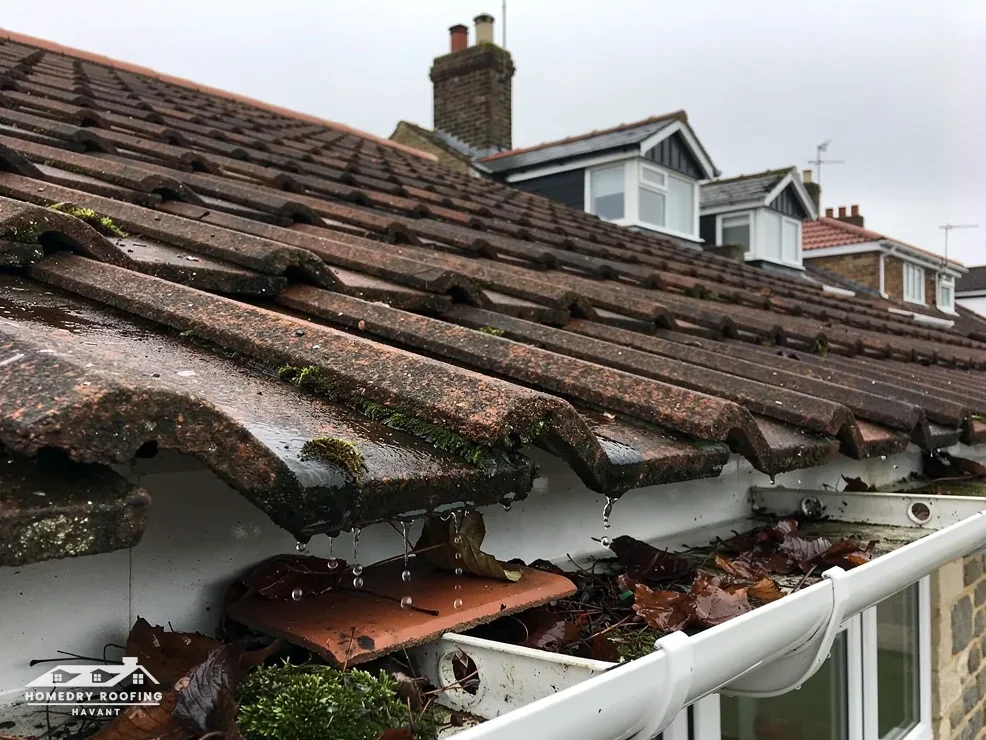
Where a gutter hands its load to the downpipe through a small box at the corner.
Leaves packed into the box send the overflow down the wall, not down the pipe.
Where a downpipe ends at the foot of the wall and the drain takes over.
A gully choked with silt makes the last metre the place the water backs up.

A join holds only as long as its lead, its fixings and its pointing do.
A roof that stops against a wall, or climbs round a chimney, depends on a strip of metal, so the survey starts at those joins. In Bishop's Waltham we read the lead for splits and lifted edges, press the fixings that hold it down, and examine the pointing above it for the gaps where rain can slip behind. A stain on a ceiling can turn up far from the join that causes it, so the loft timbers get a torch as well. Our lead roofing and leadwork page explains the metal, and chimney repairs covers the stack that the lead is wrapped around.
The National Heritage List holds Grade II* entries in Bishop's Waltham for the Church of St Peter, for Bank and Offices and for Palace House, and Bishop's Waltham Palace and Associated Fishponds is a scheduled monument near the centre of the town. The Church of England uses St Peter's for worship, so roof work on the church is a faculty matter, not a listed building consent one. A private house listed in its own right takes the council route instead: listed building consent applies to any work that affects its character, and the entry for your address settles which case you are in. Scheduled monument consent concerns works to the monument itself.
The Bishops Waltham conservation area is designated here, and Winchester City Council can say whether your address falls inside it. The Building Regulations side of a re-roof is handled by Winchester City Council's building control team, on 01962 848 176. Whether an Article 4 direction reaches your road is a question for the same council, before work is booked. The planning guide for roof work holds the roof rules, and we leave them there.
Rain runs along the lead, down a rafter and out at the first low point it reaches, so a mark inside the house need not sit under the join that let it in. We work uphill from the stain and outward from the loft, and photographs of each stage go with the findings. The repair then goes where the rain gets in, and a new strip is never laid over a worn one to bury the fault.
A brown ring spreading across a ceiling beside a chimney breast, darker after each wet spell and fading between.
A lifted edge of lead, or a gap in the pointing above it, where rain runs behind the metal and down the wall.
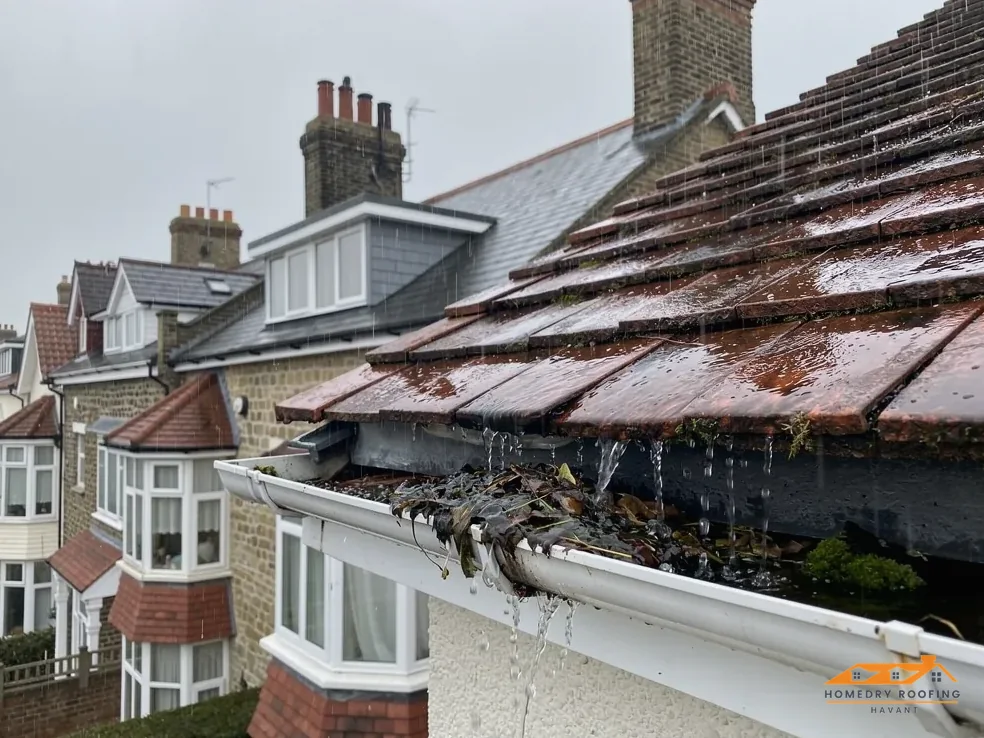
The roof's work is finished only when its water reaches a drain. A pipe that ends short, a gully choked with leaves or a path falling towards the wall can undo sound work above, so each point is checked and recorded.
Rain leaves the slope through the gutter, so the second half of the survey follows the run from the first bracket to the outlet. We check the fall towards the outlet, the joints, the brackets and any length that has sagged enough to hold a pool. A corner that overflows in a downpour may have a hopper packed with leaves behind it, or a joint that has opened, and neither needs a bigger gutter. Soft timber behind the run tells its own story, and a screwdriver tip pressed into the fascia board shows it. Where a board has softened, we trace the cause to the joint or bracket above before a new one is offered. Our gutters, soffits and fascias page sets out the choices, from refixing one bracket to renewing the whole length.
The last metre matters as much as the first. A downpipe that stops short of its gully, or empties on to a path sloping towards the house, hands the roof's water back to the wall. The Environment Agency's flood map puts the centre of Bishop's Waltham in Flood Zone 3. That speaks of the ground and gives a roof no rule, but it is a fair reason to walk each downpipe down to its outfall and write down what is there.
The gutters and boards have been read, and you now learn whether the roof wants mending or covering again, with the reasons in plain words and photographs taken from the ladder and the loft. A sound repair comes first where the battens and covering allow it. The price arrives as one written total, and the lawn and drive are cleared of tile ends and dust at the finish. A fault confined to the gutter run stays a gutter job, and the quote says so. If the covering above is sound, the findings say so.
The survey ends at the drain, not at the gutter.
A fascia that gives under a fingertip, or a soffit stained brown along one edge, shows that rain has been reaching the timber for some time. The source may be a dripping joint, a bracket that lets the gutter tilt, or tiles that stop short of the gutter edge. We note which, so that new boards are not hung beneath the same fault, and the note goes into the findings with a picture.
From the roof first, then from the loft. On the roof we look at the lead where it climbs the stack, press the fixings, and examine the pointing along the top edge for gaps that would let rain run behind the metal. A mark on the bedroom wall beside the breast is followed back along the timbers, because the damp patch may appear well away from the join that let the rain in. A lifted edge means a small repair, while a split along the length points to renewing that stretch. The findings come in writing, with pictures of the lead, so you can see the fault before a price is put to you.
Two questions sit here, and either may arise. In the Planning Portal's guide, a re-roof stays outside building regulations applications where less than 25 per cent of the building envelope and less than 50 per cent of the roof is involved, but approval is also required once a new covering is 15 per cent or more heavier. For Bishop's Waltham addresses the person to ask is Winchester City Council's building control team on 01962 848 176, and we raise it before work starts. Planning is a separate subject, and our planning guide for roof work covers what to ask about a listed or conservation area address.
Hampshire County Council licenses scaffolding on the highway under section 169 of the Highways Act 1980. Hampshire County Council charges £211.90 on application for the first 2 weeks and £72 for each additional 2-week period, and wants ten clear working days to pass between applying and starting. Hampshire County Council's page states: "Scaffolding companies must apply on behalf of their customers." We arrange the licence with our scaffolder, and you agree the dates with us first, so the poles stand only as long as the work needs them.
The Church of St Peter is listed Grade II* (National Heritage List entry 1179141), and Church of England worship continues there. That sends roof work on the church through the faculty system, not through the council's listed building consent. Each list entry protects the building it names, so Bank and Offices and Palace House are separate Grade II* entries, one building apiece. A house holding an entry of its own follows listed building consent instead. Search the National Heritage List by address before materials are bought, because each entry names what it covers.
Winchester City Council can. The Bishops Waltham conservation area is designated, and the council's boundary decides whether your road is in or out. Ordinary re-roofing is normally permitted development even inside a conservation area, but an Article 4 direction can remove further rights, so we check with the council first. Ask Winchester City Council before work is booked, and read our planning guide for the roof rules in full. Give the full postcode and describe the job, and keep what the council says with your papers, so nobody has to ask twice.
It changes nothing about how a slope is laid or fixed. The Environment Agency's flood map puts the centre of Bishop's Waltham in Flood Zone 3, and the zone describes the ground, not the roof. It does shape the survey below the eaves: where each downpipe discharges, the state of the gully, and where the roof's rain ends up. Those points join the roof findings, each with a photograph. For one particular address, the Environment Agency's map gives the answer, and it is worth a look before any work at ground level is planned.
Yes, where the lead is sound apart from a lifted edge or a few loose fixings. Correctly installed lead flashing can last for over 80 years, according to MyJobQuote, so a sound length is worth keeping and a local mend is the better job. A split or a thin patch along the run is another matter, and the photograph shows it plainly. Renewal then covers that stretch of the join, with new fixings and fresh pointing above it, in place of a smear of sealant that hides the symptom and leaves the cause where it was.
The findings arrive with it, in plain words, along with photographs of the faults taken on the roof and from the loft. The price is one written total for the job, given once the survey is done, with a clear line on whether VAT and scaffold count, so another quote can be set beside it on equal terms. A sound repair is put first, and replacement follows only if the roof demands it. Prices are kept good and fair. When the work is finished the site is left swept clean, with the drive and garden checked for stray tile and debris.
You'll get one written total price.
Fill in what you like. It opens WhatsApp with your message ready to send.