
Frames
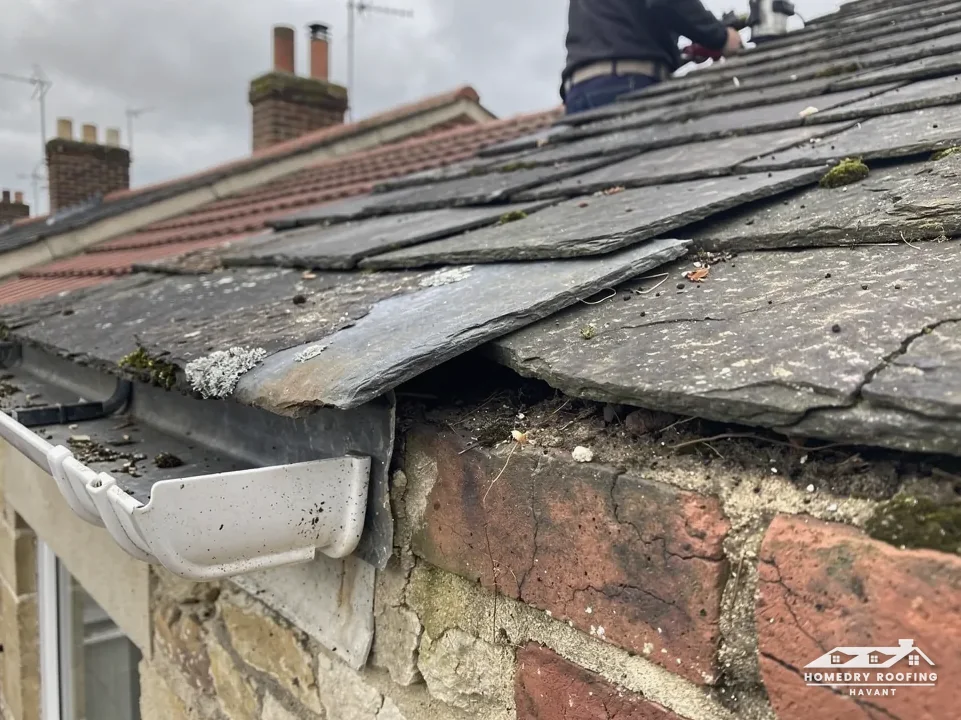
Where a glazed sash hangs in a frame between two rafters, with metal pieces lapping the tiles.
When one metal piece lifts or a seal hardens, a drip appears in the lining indoors.
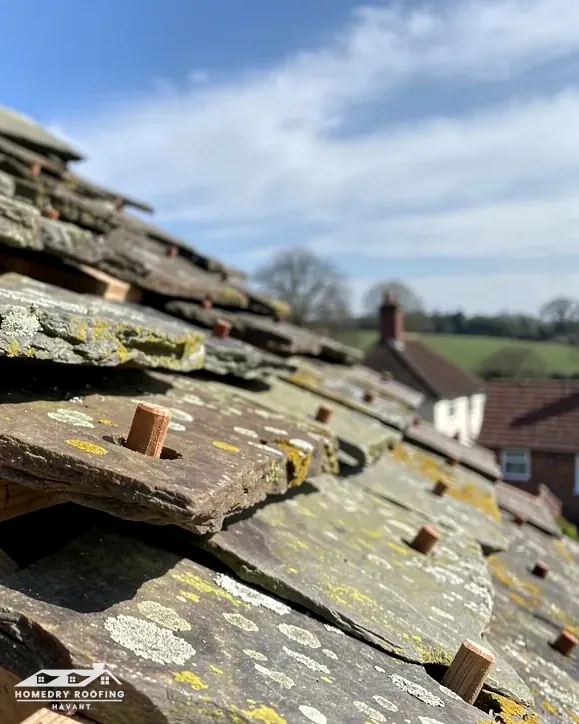
Whiteley is 14.5 road miles west of Havant; roof window frames, flat extension roofs and their outlets are traced there before anything else, and the total price arrives in writing.
10-year workmanship guarantee, in writing
Where a glazed sash hangs in a frame between two rafters, with metal pieces lapping the tiles.
When one metal piece lifts or a seal hardens, a drip appears in the lining indoors.
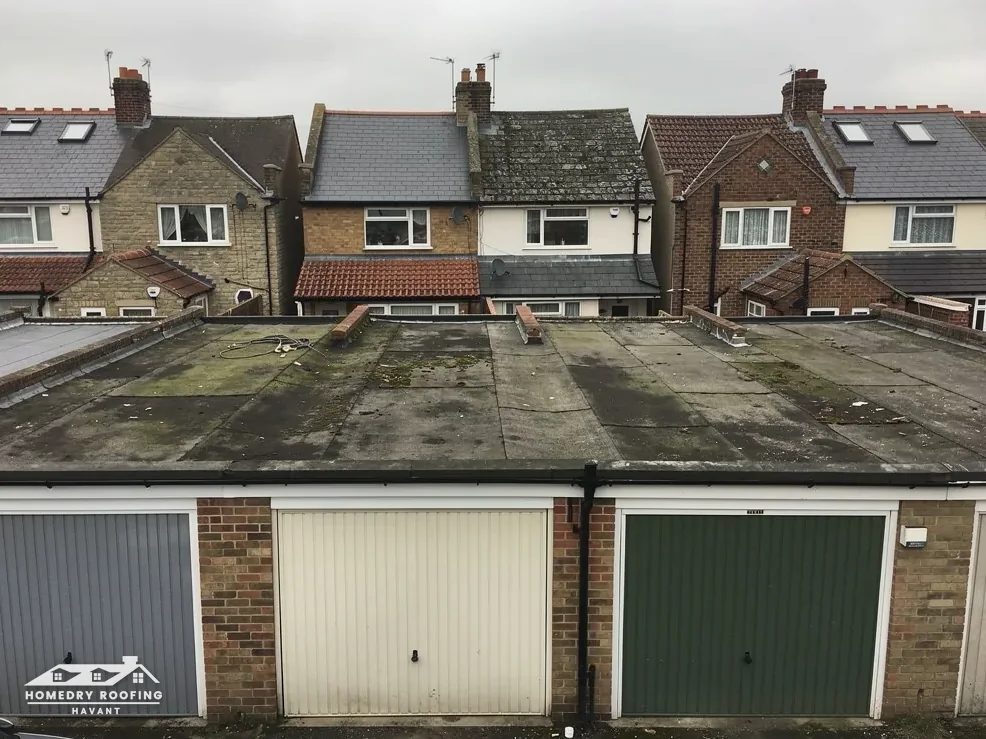
Where a flat roof's covering turns upward and ends against the wall of the house.
Rain slips behind the covering wherever that turn has split or lifted.
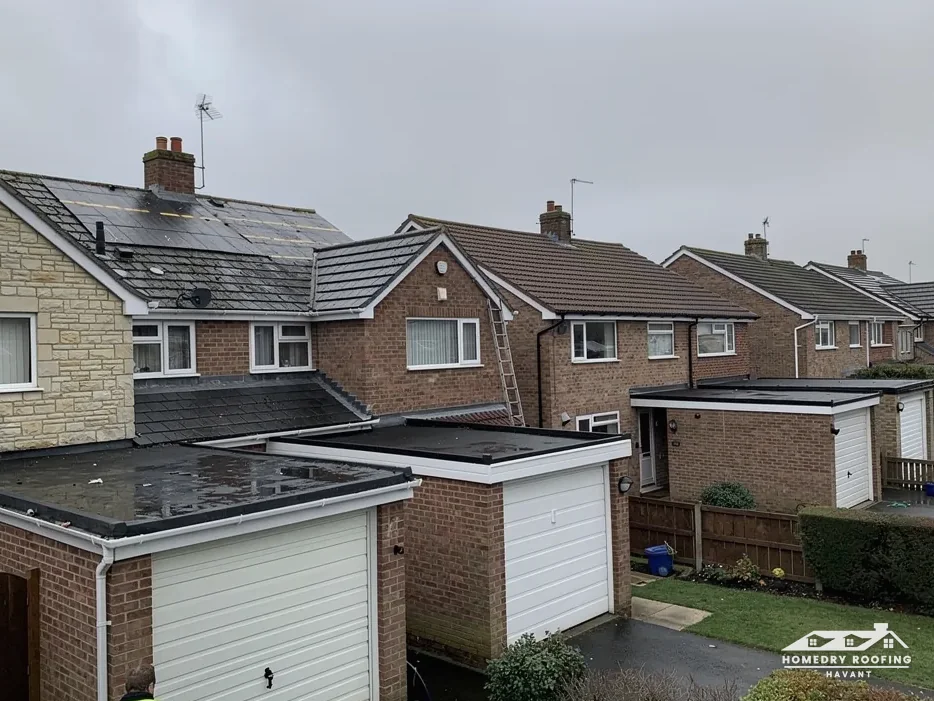
Where the low spot of a flat roof passes its water to a pipe or a gutter.
Leaves packed in that opening leave a puddle sitting there across the days that follow.
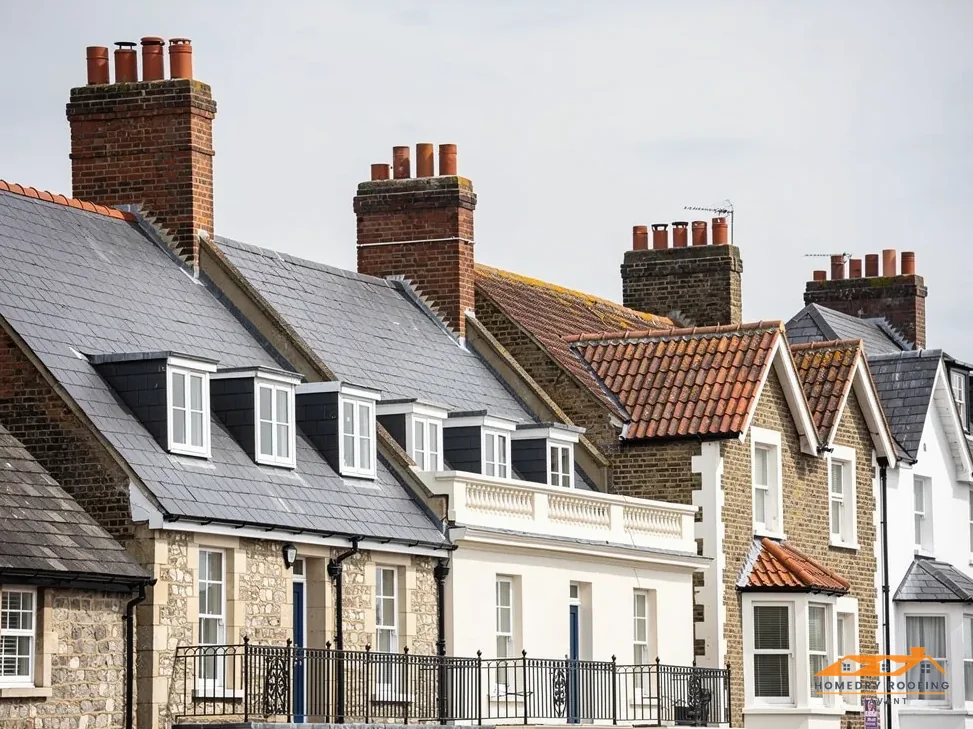
The drip in the room can start a long way from the frame.
Take a roof window apart on paper and you get five parts: the glazed sash, the frame it hangs in, a kit of metal flashings that lap the tiles, the seals between them and the lining inside. Water reaches the room when any one of the five lets go, and the drip you can see says little about which. Our check runs from the top: the tile courses above, the head of the frame, the sides, the cill, then the lining and the glazing. Mist between the two panes tells us a sealed unit has failed, and a tide mark on the lining tells us where water has been standing. The roof windows and skylights page explains what a replacement involves.
A new unit also has to satisfy the energy rules. AD L 2021 Table 4.2 gives 1.4 W/m²K as the roof-window limit for new fabric in an existing home, with Window Energy Rating (WER) Band B as the alternative, and it stays in force until 24 March 2027; the 2.2 W/m²K figure applies to rooflights, not roof windows. Ask to see the label on the new unit. Winchester City Council's building control team (01962 848 176) covers Whiteley, and we put any new opening to the team before ordering.
Botley and Sarisbury Green are conservation areas mapped around Whiteley, on the lists of neighbouring councils as well as Winchester's, and for a Whiteley address, Winchester City Council can confirm whether it lies inside any boundary. On flooding, the Environment Agency's map puts Whiteley's mapped centre in Zone 3, a note about flooding at ground level at a single spot that says nothing about how a roof window was fitted. The rules for roof work are laid out in our planning guide, so this page leaves them out. Where a window sits among tiles of several ages, each side of the frame is photographed.
The lining around a roof window records its own history. A brown tide mark along the top shows water arriving from above, a patch at the bottom corners suggests a leak at the cill, and a bloom of black mould can point to condensation instead of rain. Reading these before touching the window can save a replacement where a re-lapped flashing would do, with a photograph of each mark for you to keep.
A damp patch at the top corner of the lining, or mist trapped between the two panes of glass.
A metal piece that has lifted, a seal gone hard, or slipped tiles feeding water onto the frame.
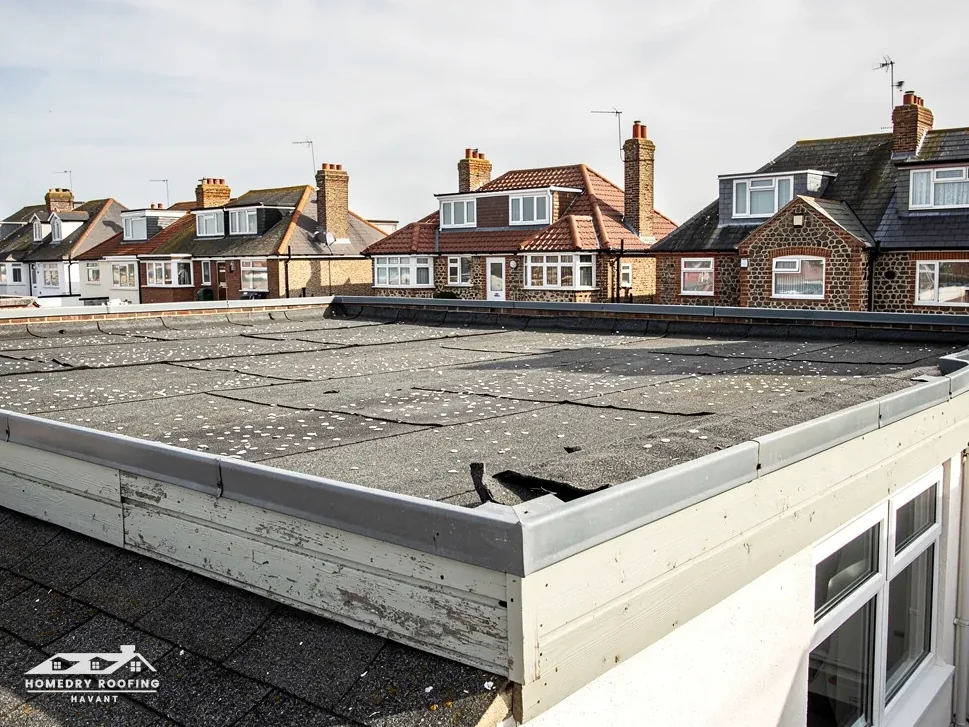
Water that lingers has either nowhere to go or no slope to go down. We unblock the outlet first, then compare the surface level with it, and the findings say whether a clean-out is enough or the covering needs relaying.
On a flat roof the rain has nowhere to run except along the surface, so the whole survey is a tracing of that short journey. It ends at an outlet, and it begins at the covering's upturned edge where it meets the house wall, the upstand. NFRC says BS 6229:2025 sets a minimum finished fall of 1:80. If water is still lying there the morning after a shower, either the slope has gone or something is clogging the outlet. We walk the surface, press the joints, look at the upstand edge and lift whatever has gathered at the opening. Our flat roofing page lists the coverings.
A first-floor extension roof may need scaffold on the street, and the street falls to Hampshire County Council as highway authority. For a licence, Hampshire County Council charges £211.90 on application for the first 2 weeks and £72 for each additional 2-week period, wants 10 clear working days before the scaffold can go up, and states: "Scaffolding companies must apply on behalf of their customers." We arrange it with our scaffolder, and you are shown the dates ahead of the application.
Whether relaying the whole covering counts as a re-roof is worth settling early. The Planning Portal's two measures are under 25 per cent of the building envelope and under 50 per cent of the roof, inside which a building regulations application is not normally expected; a covering whose weight is up by 15 per cent or more is judged on its own. For Whiteley, Winchester City Council's building control team is the body to ask, so we call it before ordering. Once the new covering is down, the outlet is tested with a bucket of water, and the gutters and drive are cleared.
A flat roof's whole story ends at one small opening.
Whatever the cause of ponding, the first thing we do is clear the outlet and see what the roof does with the next rainfall, because a choked opening is the simplest fault to cure and the easiest to mistake for a failed covering. If the puddle stays, the fall has gone, and the findings explain how far the surface sits from level and what a relay would involve. A photograph of the cleared outlet goes in too.
Map of Whiteley and the places around it, with the dashed line of our 30-mile service area from Havant. The same places are listed below the map.
At the slope above it. A drip in the lining is only the end of the water's journey, and the start can be a slipped tile, a lifted flashing piece or a seal that has hardened. We climb to the tile courses above the frame, then work down the sides and across the cill, before looking at the glass for mist and the lining for staining. Each stage is photographed, and the pictures come with the findings. By the time the unit itself is examined we know whether it is the cause, a victim of something higher, or both, and the written findings give you that answer.
It does not. The Environment Agency has the mapped centre of Whiteley in Flood Zone 3, a classification of ground flooding at a single point. A roof leaks when a covering, a seal or an outlet fails, in any zone. Where the flood map does earn a mention is drainage: we note where each downpipe or outlet discharges, and if one empties onto ground that cannot take it, the findings suggest a different route. That is a comment on the pipes, kept apart from the roof repair itself, and it never changes the price of the roof work.
The Planning Portal gives it as two limits. Work that touches under 25 per cent of the building envelope and under 50 per cent of the roof is not expected to need an application, and a new covering whose weight rises by 15 per cent or more is treated separately and needs approval. Winchester City Council's building control team (01962 848 176) is the contact for a Whiteley address. We put the plan to it before ordering anything, then explain its reply in plain language, and the decision is left to you. Keep the note of its reply with your survey.
Hampshire County Council issues scaffold licences for Whiteley under section 169 of the Highways Act 1980, and it states: "Scaffolding companies must apply on behalf of their customers." The Hampshire County Council charge is £211.90 on application for the first 2 weeks, plus £72 for each additional 2-week period, and a new application is needed for more time, because it offers no extensions. Allow 10 clear working days before the scaffold can go up. We arrange it with our scaffolder; you hear the licence dates and the start date together, before any pole is delivered.
Botley is mapped on both Eastleigh Borough Council's and Winchester City Council's lists, and Sarisbury Green on Fareham Borough Council's. Winchester City Council can say whether a Whiteley address lies inside any boundary, being the council for the area, and it can answer in a short call. Ask it about Article 4 as well for your own road. An Article 4 direction can take away rights an ordinary house would otherwise have. Our planning guide carries the roof rules, while the council hears about your address before a quote reaches you.
Where the frame is sound and a matching unit fits the opening, yes. Before saying so we check the rafters around the frame, the tiles beside it and the lining, because a new unit set in a damaged surround repeats the old fault. A replacement has its own energy rules to meet. Under AD L 2021 Table 4.2, a roof window in an existing home is held to 1.4 W/m²K, or Window Energy Rating (WER) Band B, until 24 March 2027. The label is read with you before the unit is ordered, and the quote names the unit.
It means the slope the roof actually has once it is built, measured on the finished surface instead of the drawing. NFRC says BS 6229:2025 sets a minimum finished fall of 1:80, which is 1 part of drop in every 80 of run. A roof built to that line should not hold water for long after rain. If yours does, either the outlet is clogged or the fall has gone, and the survey sorts out which, then reports whether the covering needs a repair or a relay, with a photograph of the surface taken after the outlet is cleared.
That the figure is a single total, that it makes plain whether scaffold and VAT are included, and that someone climbed up before writing it. Our quote is one written total arriving once the survey is done, and if a repair would hold we offer that first, with the findings alongside. Our prices are good and fair. A quote that is vague on those points can be sent back for answers in writing, and the replies make two totals comparable, which a bare figure never does. We are glad to read a rival quote beside ours and say what each one covers.
You'll get one written total price.
Fill in what you like. It opens WhatsApp with your message ready to send.