
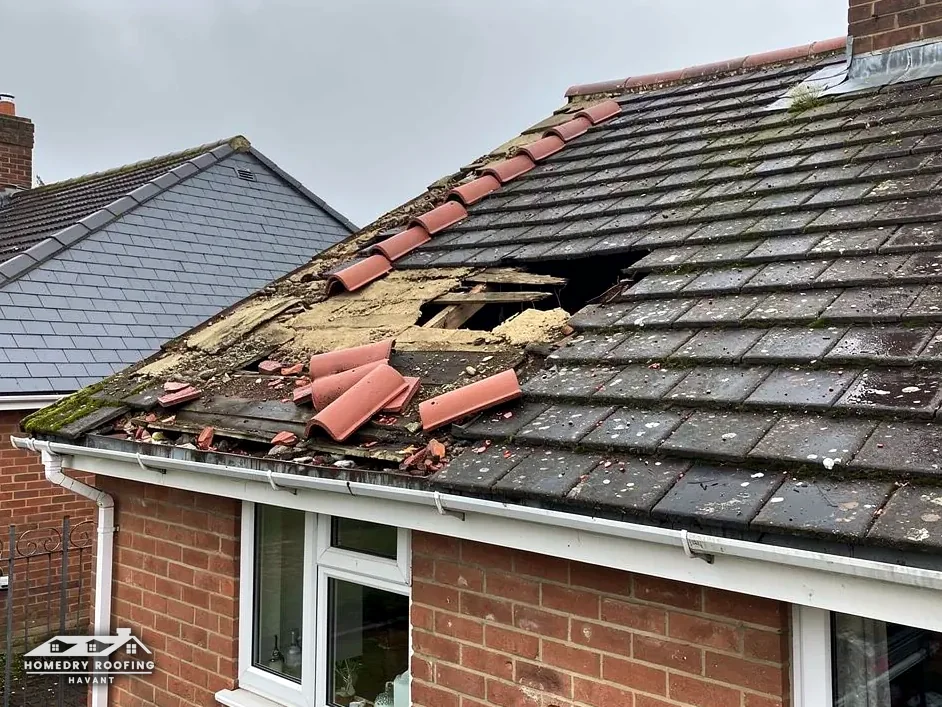
Hips
Where a roof slope turns an outward corner and capping tiles are laid down the angle.
A shifted capping tile there opens a path for rain beside the rafters.
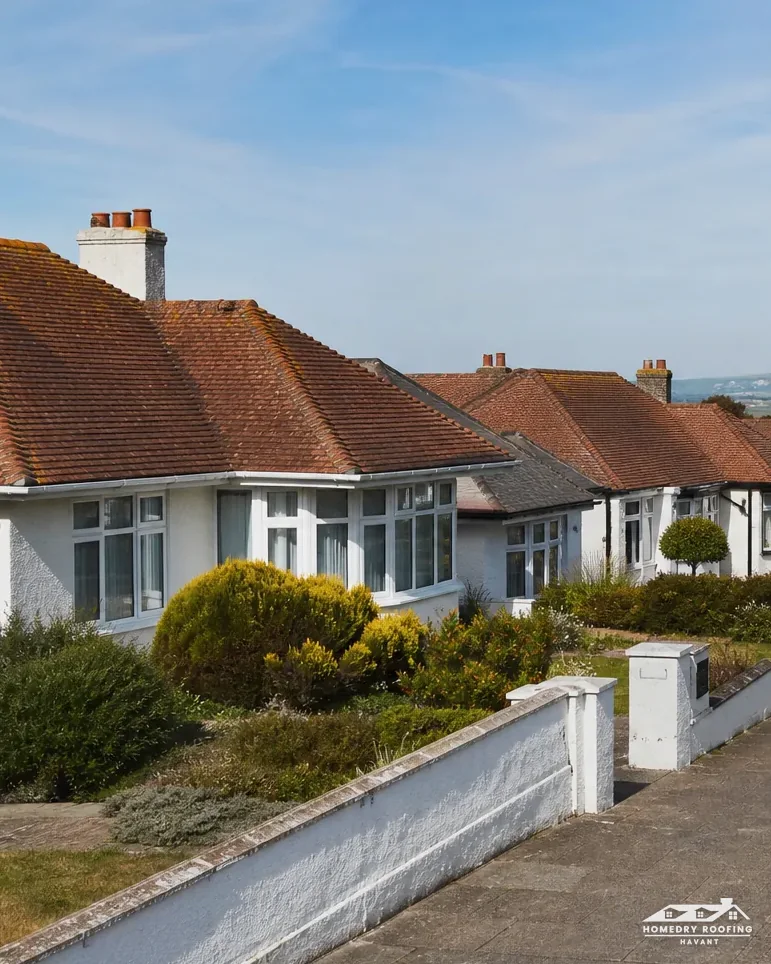
Portchester, a district of Fareham: ridge and hip capping, gutters and fascias are surveyed first, and the written total price comes only after that.
10-year workmanship guarantee, in writing
Where a roof slope turns an outward corner and capping tiles are laid down the angle.
A shifted capping tile there opens a path for rain beside the rafters.
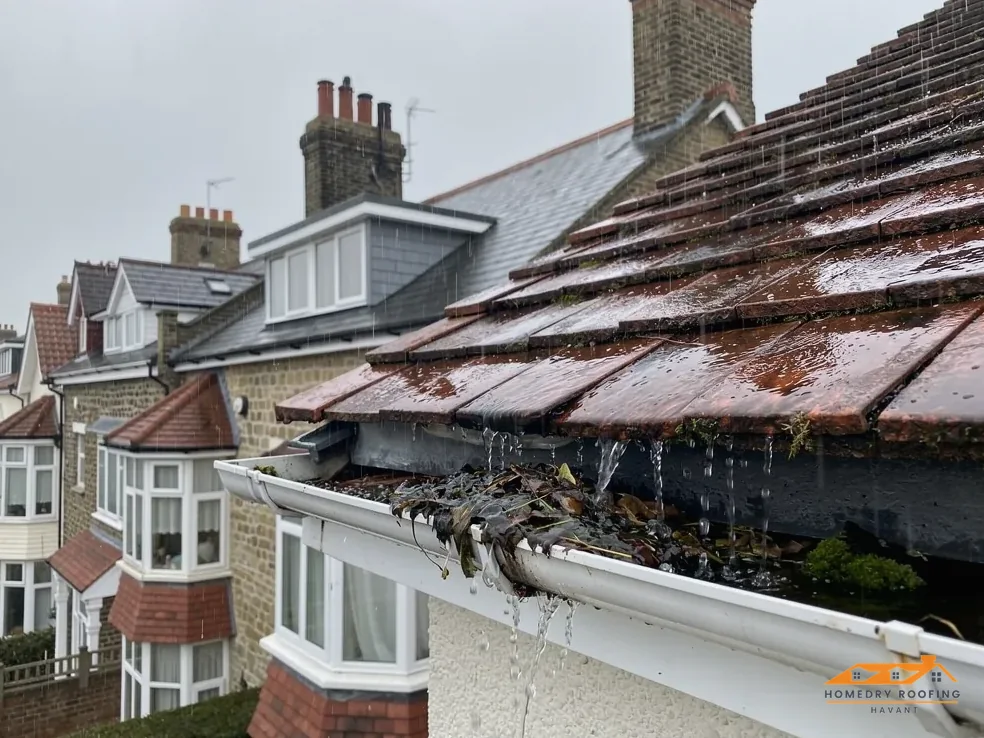
Where the long timber at the eaves takes the weight of the gutter.
When that timber goes soft, the gutter drops and the wall below gets wet.
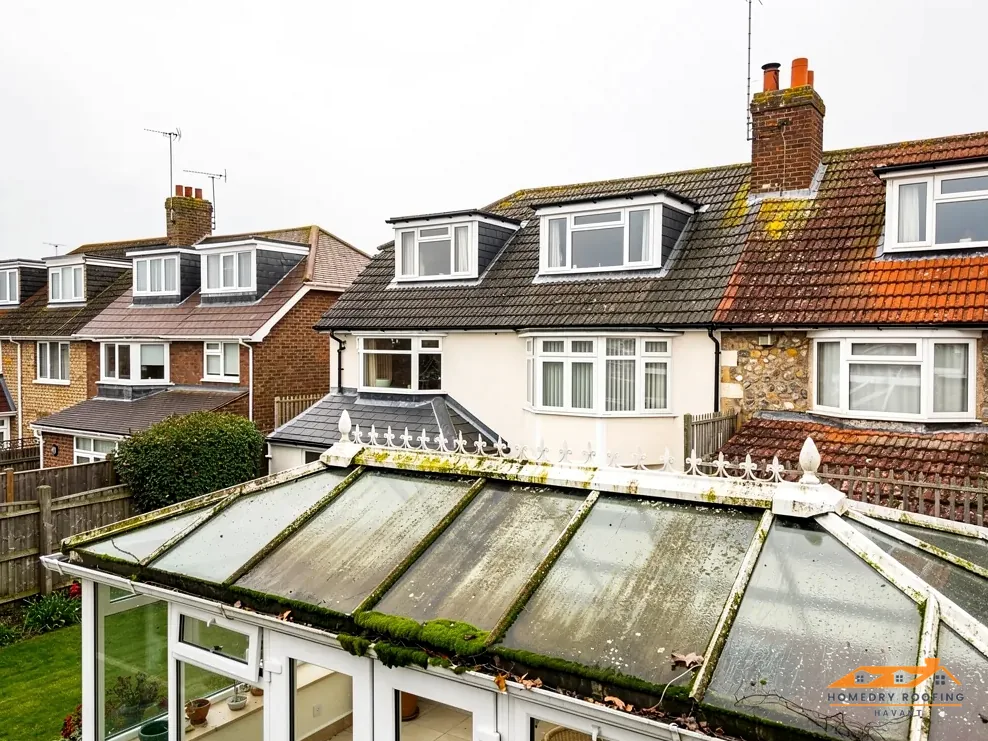
Where the gutter stops and a pipe takes over the long drop to the ground.
A split joint or a clogged shoe lets the brickwork stay damp for days.
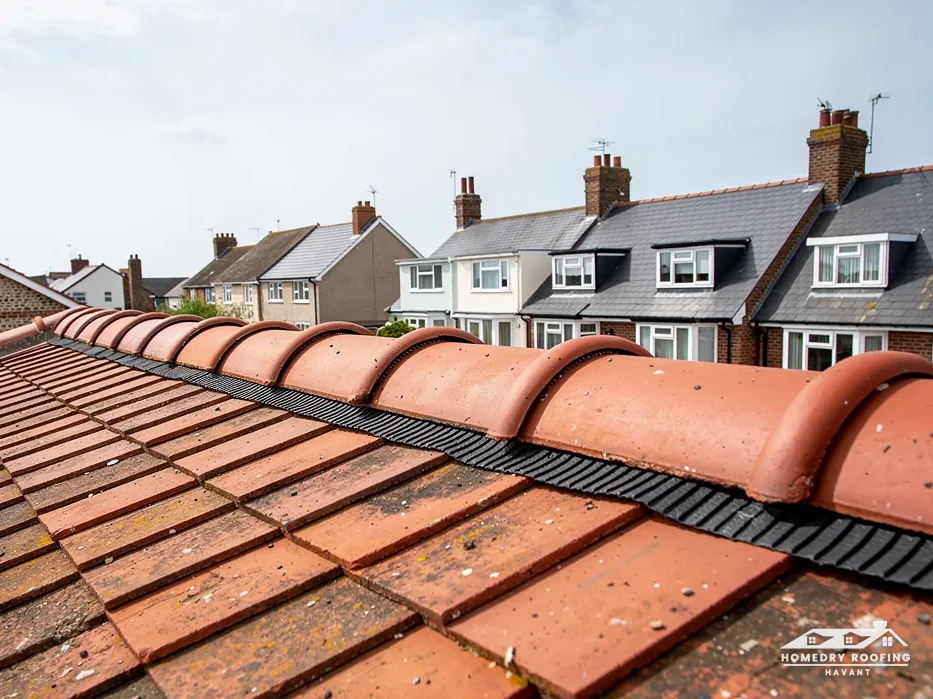
Every capping tile on the ridge is a joint the rain can reach.
A survey of a Portchester roof begins with the ridge line itself. Capping tiles run along it and down each hip, and every tile either sits on a bed of mortar or is fixed down with clips or screws. We look for tiles that have split, for mortar that has turned to powder, for a hip whose lowest tile has slid out of line, and for open ends where the run meets a gable or a stack. Marley says installing to BS 5534 isn't required by law, yet it also says mortar "could no longer be relied upon as the only means of securing the roof covering", so the notes record which method holds each run. Where a dry-fixed system would suit the roof, our dry ridge and verge page explains how it works, and our roof repairs page deals with the smaller fixes.
Portchester sits close to the coast. As Cupa puts it, tall buildings, hills and coastal areas "will be graded with higher exposure". On a ridge repair or a complete re-cover, that puts the fixings under BS 5534 for this particular site, with the batten gauge, nail length and capping clips chosen on that basis and never borrowed from another job.
Portchester Castle Street is a conservation area, and Fareham Borough Council can tell you if your house stands inside its boundary. The council also publishes an Article 4 direction for the Portchester (Castle Street) conservation area. An Article 4 direction withdraws specified permitted development rights, so Fareham Borough Council is the first call to make before any work is planned. Historic England lists Noel Cottage, White Lodge and Murrills at Grade II, and a listed house needs consent for any change that touches its character. The planning guide for roof work covers what the national rules allow for house roofs, so read it before you decide anything.
From the road a ridge can look perfectly sound while its bedding is cracked or one capping tile has crept sideways. Each fault we find is photographed where it sits, so the survey notes show you the exact tile. If the capping is whole and only the mortar beneath it has failed, the tiles are lifted and laid again. If the fixings are the weak point, the notes say so and describe what the repair needs.
A brown mark on a bedroom ceiling below the ridge line, or damp plaster where a hip comes down to the wall.
Cracked bedding under a capping tile, or a gap at the far end of the ridge line, where capping stops short of the gable.
The run may have lost its fall, so water stands in the middle instead of travelling to the outlet, or the outlet may not be big enough for the roof area that drains into it. We check the fall first, then the outlet, and tell you which one it is.
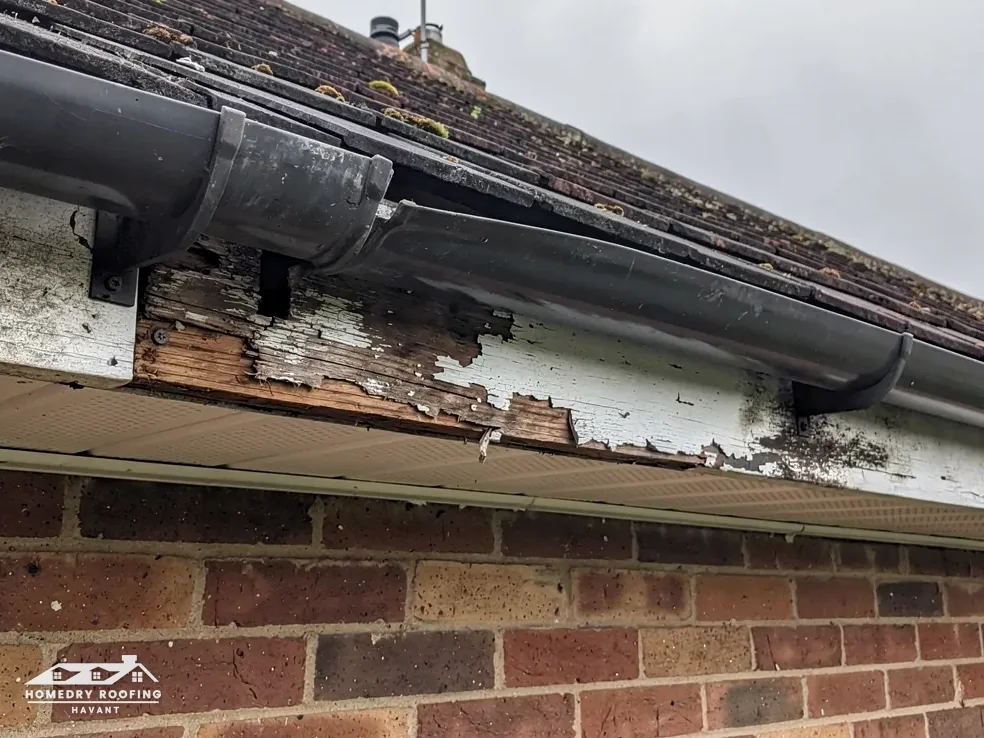
All the rain that reaches the roof is collected by the gutter, which makes the last stage of the route a survey item in its own right. From a ladder we check each joint for a drip or a stain, sight along the run, and look for sag between the brackets. Brett Martin, the gutter maker, advises 1 mm of fall for every 600 mm towards the outlet, and water standing in the middle of a run means the line has dropped. All the gutter's weight hangs on the fascia board, and we press it for soft timber in a number of spots before checking the soffit under the eaves for staining, for gaps and for daylight where a board has pulled away from the wall. Our gutters, soffits and fascias page lists the repairs and replacements.
Downpipes come next. A pipe that is cracked at a joint or loose at its clips lets water run down the brickwork when it should reach the drain, and a blocked shoe or gully leaves a patch at the foot of the wall that never dries out. We trace the discharge from each pipe, because the water has to go somewhere once it has left the roof, and a clear route away is part of the job.
The Environment Agency's flood map has the mapped centre of Portchester in Flood Zone 3. That describes flood risk across the ground, nothing more, and the way we read a roof is the same whatever zone a house sits in. If the repair means a scaffold standing over the pavement, the licence is arranged by us, and its details are in the questions below. Each fault we find is photographed and described in everyday language.
The roof only works if the water has somewhere to go.
Overflow at a single corner is not proof of a blockage. Sometimes the run has sunk below its fall, and sometimes the outlet cannot cope with the area of roof draining into it. Where it is safe we run water along the gutter and watch where it stands, then name the fault. A blocked outlet is cleared, a dropped run is reset on its brackets, and a split joint is renewed in full.
The survey starts at the top and works down. With a ladder against the eaves and then a torch in the loft, we study the ridge for capping tiles that have cracked or shifted, bedding that has crumbled and gaps where it meets a gable. Hips get the same treatment, including the tiles at their feet where the corner turns toward the gutter. Inside, daylight along the timber or a damp patch under the ridge tells the same story from below. The notes record how each run is held, by mortar or by fixings, and a ridge whose only fault is its bedding is repaired as that, never renewed for the sake of it.
Scale decides it. Two Planning Portal tests apply. A re-cover affecting under 25 per cent of the building envelope and under 50 per cent of the roof normally sits outside the need for a building regulations application. Approval is needed anyway if the new covering is 15 per cent or more heavier. In Portchester, building control is handled by the Building Control Partnership, on 01329 824823. Our habit is to ring the Partnership ahead of any work, write down what it says, and file that note with the survey, so the decision is yours and the reply stays on record.
A scaffold that obstructs the pavement needs a licence under section 169 of the Highways Act 1980, and in Portchester that licence comes from Hampshire County Council. Hampshire County Council charges £211.90 on application for the first 2 weeks and £72 for each additional 2-week period, and requires ten clear working days of notice, counted from application to start. The rule from Hampshire County Council is that "Scaffolding companies must apply on behalf of their customers." We arrange it with our scaffolder. Dates are settled between us first, so the start we quote can hold, and a wet fortnight does not leave the pavement blocked longer than planned.
Yes, where the job would change the character of the building. Historic England lists Noel Cottage, White Lodge and Murrills at Grade II, and section 7 of the Planning (Listed Buildings and Conservation Areas) Act 1990 requires listed building consent for work of that kind. Listing leaves the right to re-roof untouched under permitted development, yet consent is still required where the work would affect the building's architectural or historic interest. Noel Cottage, White Lodge and Murrills are examples from the list, not the whole of it. Find your own address, read the whole entry, and raise any doubt with Fareham Borough Council early, ahead of buying materials.
Fareham Borough Council holds the boundary and can answer for your address. Within such an area, re-covering a house roof normally stays permitted development, yet the council publishes an Article 4 direction for this one, which withdraws specified permitted development rights. What it covers is for the council to confirm for your property, so check with Fareham Borough Council before work starts, and do so before a quote is accepted rather than after. Our planning guide explains where national law stands, and we file a note of what the council replies with the survey.
Press the board gently in a few places from a ladder, only where it is safe, and watch for paint that bubbles or timber that gives. A board soft in one stretch can be cut back and replaced in that stretch, along with the gutter brackets it carried. A board soft along its whole length suggests water has been reaching it for a long while, possibly from a failed joint above. We trace that cause first, because new timber under the same joint would only rot the same way.
Coastal homes are graded for higher exposure, so the fixing specification is calculated for the site under BS 5534. Batten gauge, nail length and the clips on capping tiles are then decided for the building and its position instead of copied from a previous job. Marley says installing to BS 5534 isn't required by law, but it is the code of practice the work follows, and Marley notes that mortar "could no longer be relied upon as the only means of securing the roof covering". The same point applies to every ridge and hip we touch, so the notes record the method for each run.
One total price, written once the roof has been walked, with the findings next to it. The wording covers the work and the covering, and says if VAT and scaffold sit inside the figure, so another quote can be read on the same footing. Where the roof is sound enough to repair, repair leads the quote. Should a rival quote skip scaffold or VAT, have the gap written down before the two totals are weighed. The price should be good and fair, and the number on the page belongs to the job described.
You'll get one written total price.
Fill in what you like. It opens WhatsApp with your message ready to send.