
Ridges
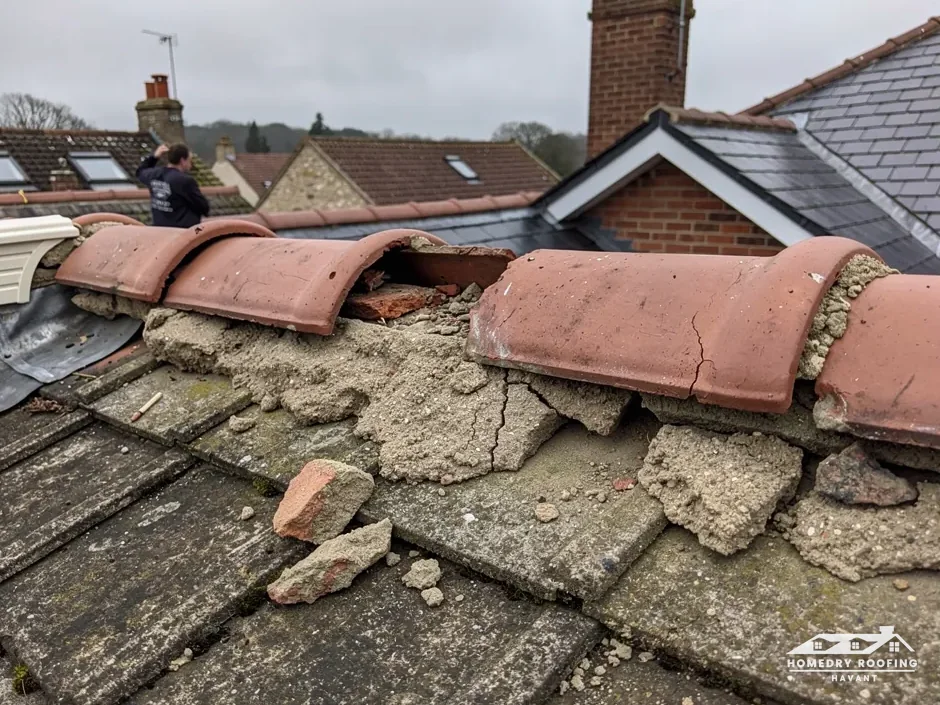
Where the ridge tiles sit on their bedding along the top of a Paulsgrove house.
Cracks in that bedding give rain an easy way past the highest course and onto the battens below, unseen from the street.

Roof repairs and re-roofs in Paulsgrove, a district of Portsmouth, checked point by point, ridge to drain, and finished with one written total price.
10-year workmanship guarantee, in writing
Where the ridge tiles sit on their bedding along the top of a Paulsgrove house.
Cracks in that bedding give rain an easy way past the highest course and onto the battens below, unseen from the street.
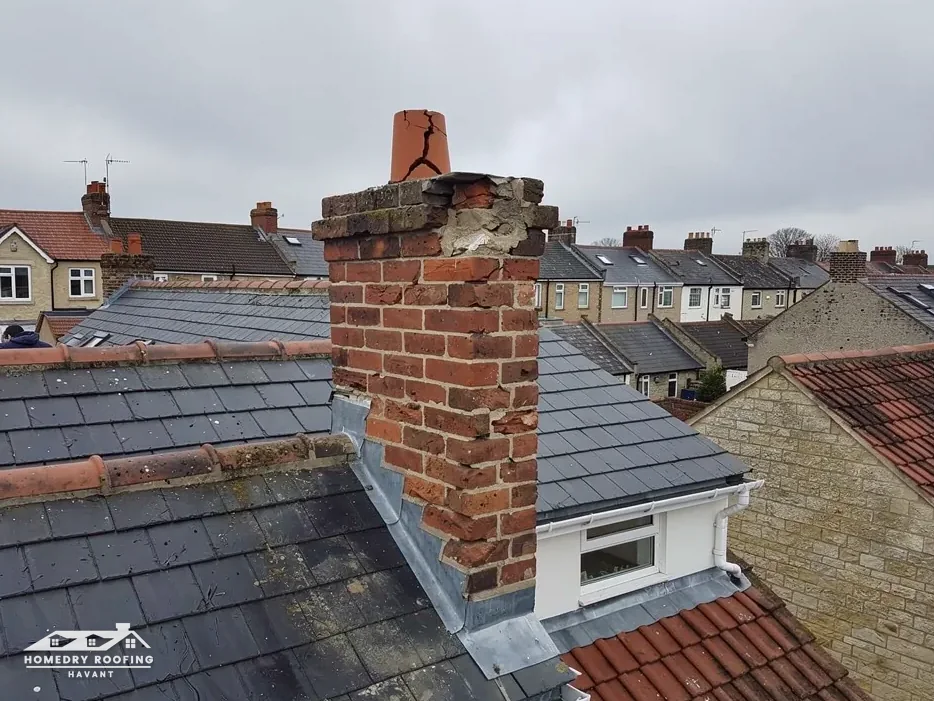
Where two slopes meet in a channel that carries the water of both.
Moss or a split lining there turns the channel into a leak above a bedroom ceiling.
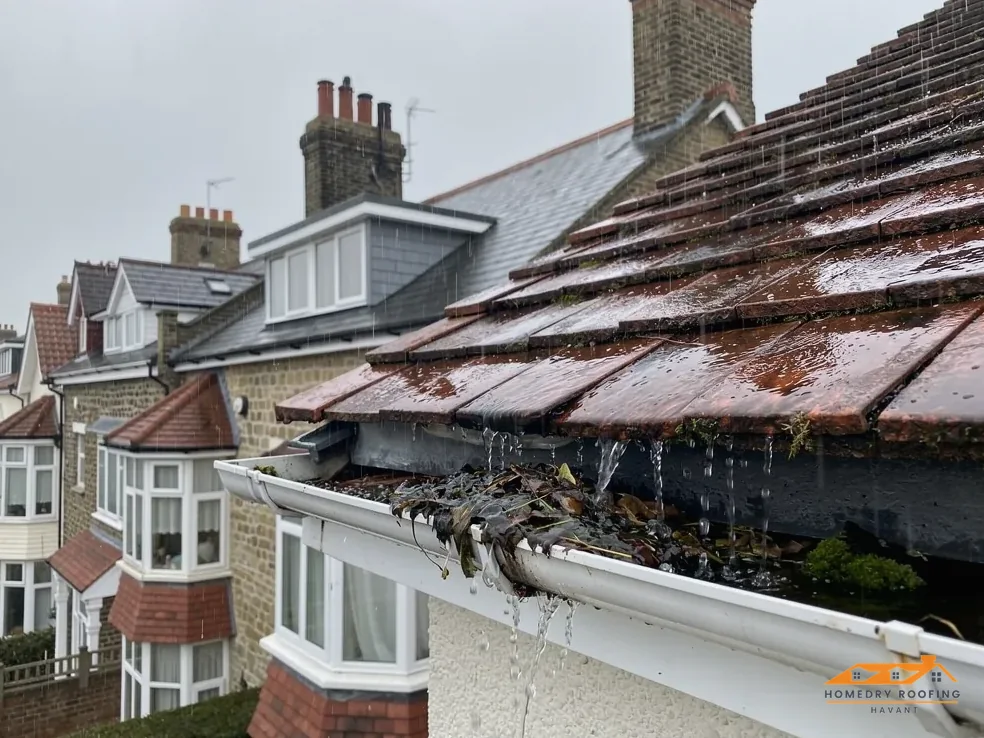
Where a first-floor gutter hands its water to a downpipe through a hopper head.
When silt blocks it, the overflow runs down the wall and darkens the render or brick below.
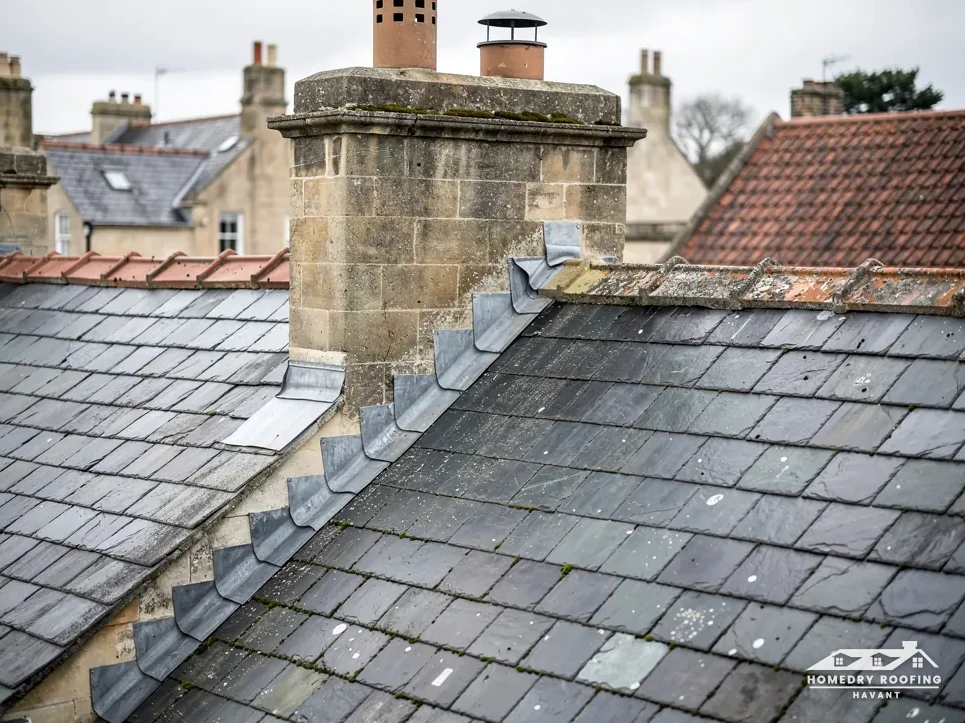
A fault is local: one cracked tile, one lifted flashing, one open joint. A tired roof shows the same wear everywhere, with many tiles crumbling and the battens or underlay giving way as well. The survey records which of the two we are looking at, and you see the evidence.
A Paulsgrove survey runs through the roof as a short list, so that nothing is skipped:
The aim, from the first rung to the last, is to separate a single fault from a roof that is wearing out all over, because the first is repaired and the second is replaced, and the two jobs are priced very differently. We write down which it is, with the reasons, before giving you a total. Each finding is tied to a place on the roof, such as the north slope, third course from the ridge, so a second roofer could find it too, and anything that needs explaining is photographed so you see what we saw, with the picture and the finding together. Ordinary faults are covered under roof repairs.
Listed status is decided building by building. Work that affects a listed home's character needs listed building consent (Listed Buildings Act 1990, section 7), though such a home keeps its permitted development rights for roof work. Among the conservation areas closest to Paulsgrove are Old Wymering and Hilsea Lines, both Portsmouth's, with Portchester Castle Street under Fareham Borough Council and Southwick under Winchester City Council. Portsmouth City Council can say if your road falls inside one. Taking a house's old covering off and laying a new one is normally permitted development, while an Article 4 direction can withdraw rights. The council's pages for Old Wymering and Hilsea Lines show none, but ask it about your address. The planning guide for roof work holds the wider rules.
Replace a roof when the whole of it has run out, not when one spot has failed.
The National Heritage List is searchable by address, and each entry page names the grade, the entry number and what is protected. Check yours before you ask anyone to price roof work, because consent for a listed house must be settled first. If your house has no entry, nothing in this section applies to it, and the ordinary planning position set out above is the one that counts, whatever the neighbours' houses say.
A roof drains well only if the pipe at its edge does too.
Where the slopes end, the work moves to the water's exit. Gutters get a run-through for sag, open joints, loose brackets and growth, and the downpipes are traced from hopper to gully. A gutter that is level but packed with silt gives the same symptoms as one that has sagged, so the first job is to clear it and watch it run. A fascia board that gives under a thumb, or a soffit with peeling paint and dark staining, points to water spilling past the gutter over time. Sometimes the repair is a clear-out, a rebedded joint or a new bracket, and that is the job we recommend, and the page on gutters, soffits and fascias describes the larger jobs.
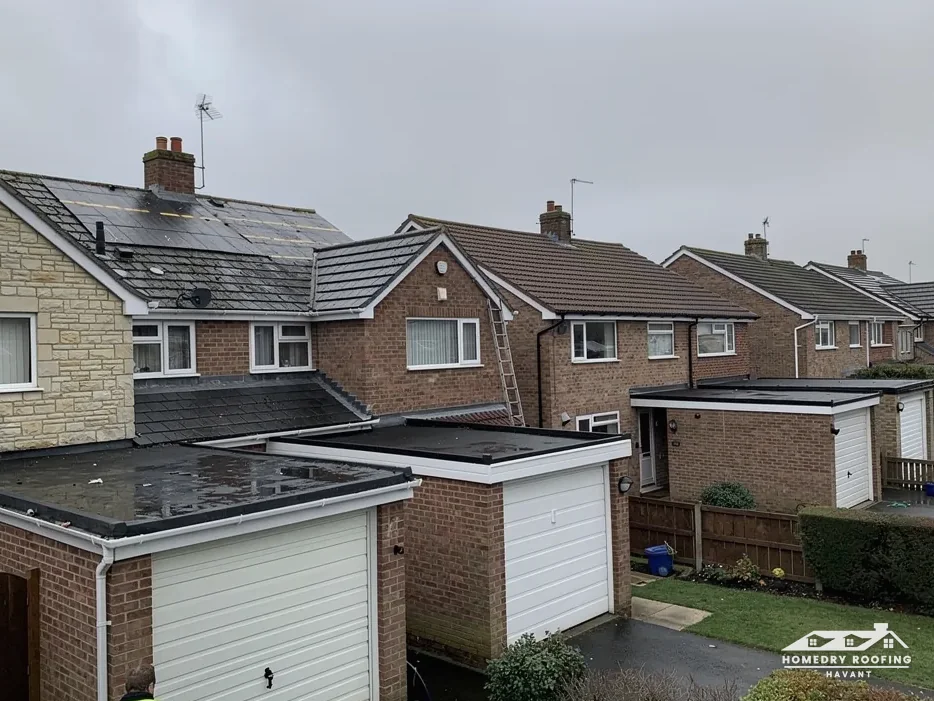
Flat roofs at the back of a house or on a garage are examined separately. The upstand where covering and masonry meet, the seams, any blistering and the outlet are checked in turn, and we look at whether the surface drains or holds a pool. A bubble under the covering, a hairline split at a corner or a patch that feels spongy underfoot each says something different about the deck below. Flat roofing explains the coverings we fit, and you get a straight view on whether the one you have can be repaired or has finished its working life.
Paulsgrove counts as coastal, so exposure comes into how a covering is fixed on every roof here. Cupa, the slate maker, says sites in coastal areas are graded as more exposed, and the fixings are therefore worked out for the roof in question instead of copied from the last job. That calculation sits in the written quote beside the covering, so you can read how the roof will be held down before you agree to anything at all. We tidy the site on completion, and one written total price follows the survey.
We arrange the licence with our scaffolder. Portsmouth City Council is the highway authority behind the permit, and Colas deals with its hoarding and scaffolding permit, which costs £100.00 + VAT per month on its form. When we survey, we mention any narrow pavement, shared access or parked vehicles, since they decide how the scaffold can be set out and for how long.
A damp stripe down a rear wall below the gutter, or algae streaks fanning out from one joint.
An open gutter joint or a blocked hopper, so water spills over the edge and runs down the brickwork.
Four things, always in the same order. The ridge and hips come first, then every slope, then the verges, valleys and flashings around chimneys, and last the loft, where the underlay and rafters show what the outside hides. Gutters and downpipes follow at the eaves, where the roof hands its water on. The checklist exists so that a stain in one room leads to the real cause and not just the nearest tile, and so the same steps are taken on every roof. The findings come to you in writing, saying plainly which the roof needs, repair or replacement, and the reasoning, and the price arrives only at the end of that.
The Planning Portal puts it this way: a Paulsgrove re-roof normally goes ahead with no building regulations application if it affects less than 25 per cent of the building envelope and less than 50 per cent of the roof, yet approval must be sought for a covering 15 per cent or more heavier. The Building Control Partnership runs building control in Portsmouth (01329 824823). If a job sits close to either limit, we raise it with them first, so the route is confirmed before anyone orders tiles and you are not caught out afterwards by a stop on the work, a delay or an unexpected bill for rework.
A scaffold on the public road or pavement is licensed, and Colas handles the hoarding and scaffolding permit on Portsmouth roads at £100.00 + VAT per month on its form. You will not be sent a form, because we arrange the licence with our scaffolder. Do tell us about parked cars, a narrow pavement, a shared drive or a gate that cannot be moved when we survey, because those shape where the scaffold goes and how long the permit has to run, and they are simpler to sort out at the very start of the job, before the scaffolder has a date in the diary and the neighbours have been told.
Only a house that is itself listed. Work that affects a listed home's character needs listed building consent, although the home keeps its permitted development rights. A minute on the National Heritage List, typed with your address, settles whether yours is listed, and the page for the entry gives the grade. If it does, we go through the consent question with you, plainly and in writing, before any quote is written, and if it does not, the ordinary planning position applies, which the planning guide on this site describes in full, so there is no need to wait for us.
Among those closest are Old Wymering and Hilsea Lines in Portsmouth, Portchester Castle Street in Fareham and Southwick in the Winchester district, though that tells you nothing on its own about whether a given road is inside one. The boundaries sit with Portsmouth City Council, which can answer for your address. Replacing an old covering with a new one is normally permitted development for a house, even in a conservation area, but an Article 4 direction can withdraw further rights, so check with Portsmouth City Council ahead of booking any work or ordering tiles, which takes a short call and spares you a longer exchange later.
It changes the calculation and nothing else about the care we take. Paulsgrove counts as coastal, and Cupa, the slate maker, says exposure grades rise for a coastal site, so the fixings are specified for the roof under BS 5534. Marley points out that following BS 5534 is not a legal requirement, which is exactly why we state our method in the quote and do not leave it to be assumed, as it may be elsewhere. Ask to see where each tile, ridge and verge is fixed, and keep that page with the paperwork for the next owner of the house, who will be glad of it.
A repair makes sense when the sheet is sound and the fault is local and clearly bounded, such as a split along an upstand, an open seam or a blocked outlet. Replacement makes sense when the covering is worn across its whole surface, perhaps with brittle edges, the deck beneath has gone soft, or water keeps pooling because the falls are wrong. We press the surface, check the edges and the outlet, and tell you which applies, giving the evidence so you can judge it yourself rather than take our word for it, and photographs where they help.
A single written total covers the whole job, and the findings sit behind it. The document sets out the job and the roofing used, and asks you to make sure the total states what it does and does not include, VAT and scaffold above all, because firms handle those differently. A sound repair beats a replacement, and we tell you which one your roof needs, with the evidence. We clear up when the job ends, and we keep that figure good and fair for the scope.
You'll get one written total price.
Fill in what you like. It opens WhatsApp with your message ready to send.