
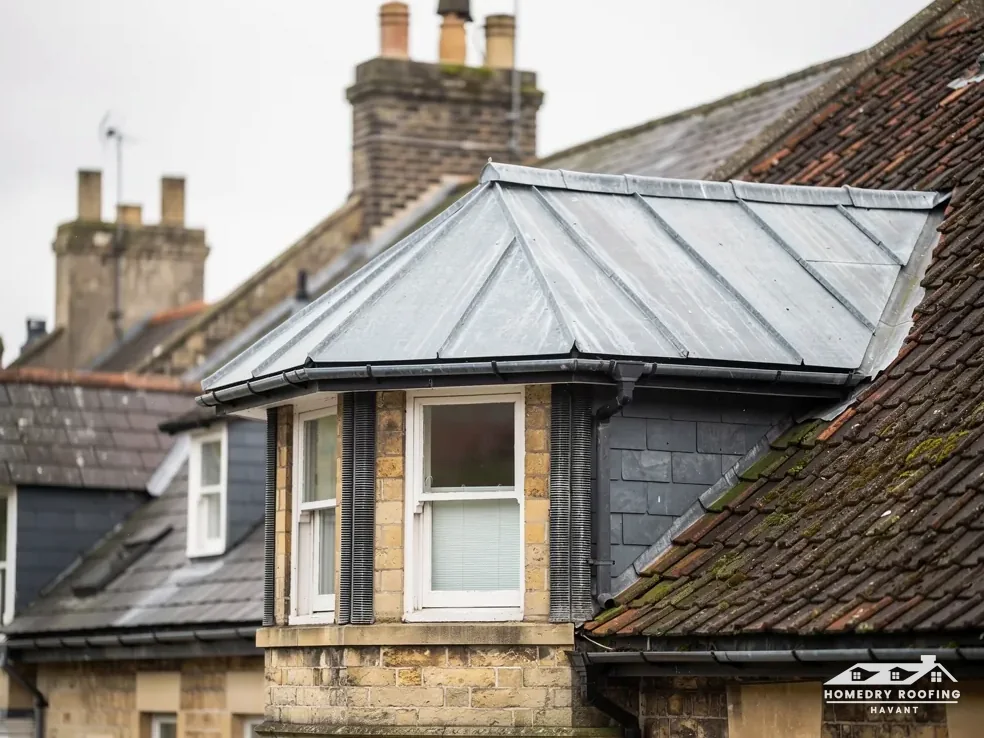
Valleys
Where two slopes run down into a shared channel, lined with lead or laid with cut tiles.
A worn lining or a clogged channel sends the rain over the edge into the roof.

Valley, gutter and downpipe work for Drayton homes, 3.4 road miles west of Havant; every leak is followed to its cause before a price is written.
10-year workmanship guarantee, in writing
Where two slopes run down into a shared channel, lined with lead or laid with cut tiles.
A worn lining or a clogged channel sends the rain over the edge into the roof.

At the head of a downpipe sits a funnel that takes the gutter's water.
A hopper full of silt spills sideways down the wall and shows as a dark streak.
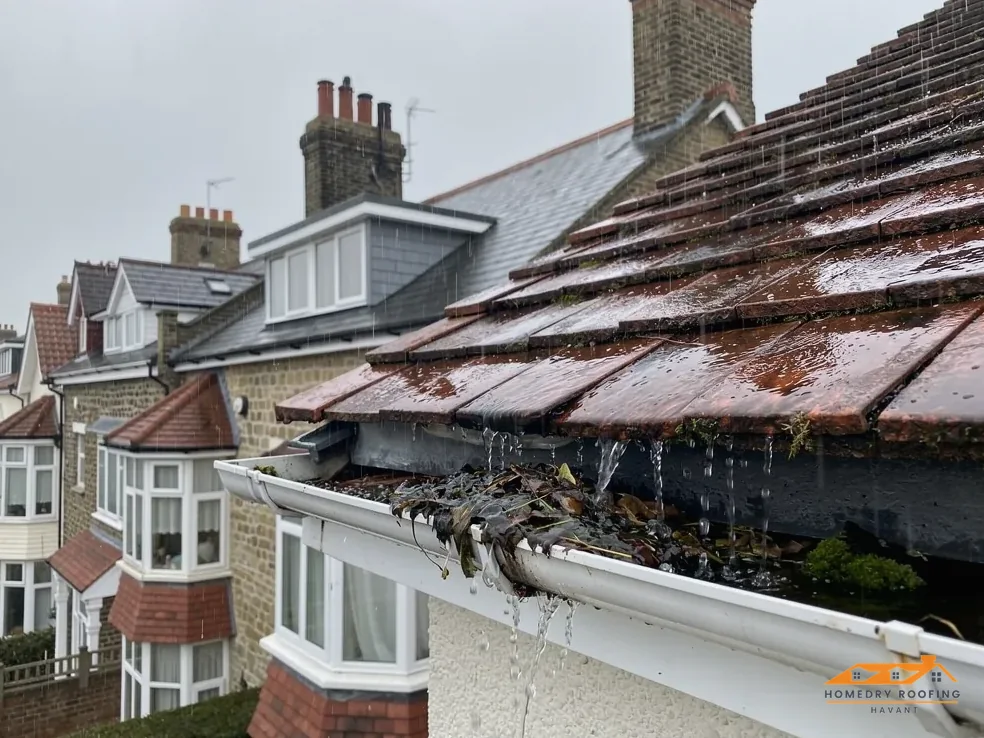
Where a gutter hangs from the fascia on small metal supports along the eaves.
A loose bracket lets the run dip, so the water stops short of the outlet.
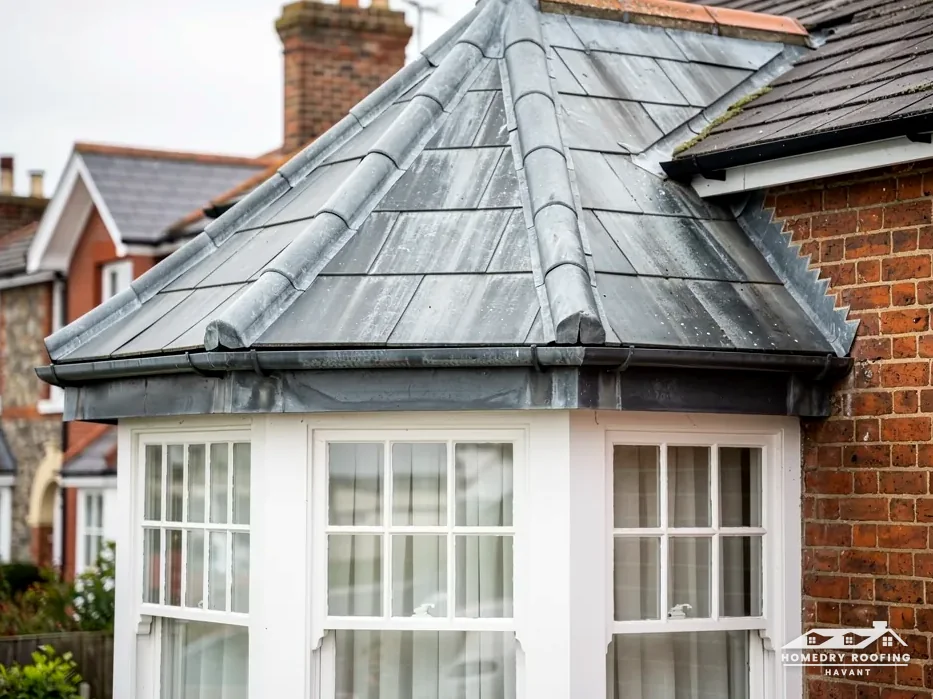
A split in an exposed lining can sometimes be dealt with from the surface. If the lining is worn along its length, the tiles beside it are lifted so that the new one can be laid beneath them, and we tell you before pricing which case yours is.
A valley is the gully formed where two slopes of a roof meet in an inward corner, taking the rain from each side. That makes it the busiest channel on the roof, and it is read before any other part of a pitched roof that is leaking. Some valleys are lined with sheet lead and some are formed with cut tiles laid over a liner. On a Drayton survey we look at the lining along its length, at the edges of the tiles that run beside it, and at the channel for leaves, moss and silt. Royston Lead's cast-lead brochure lists codes 4 to 8 for a pitched valley gutter, so we note which sheet is already on the roof and what has to match it. Cut-tile valleys are also read for the liner beneath. Our roof repairs page covers the repairs that follow, and the lead roofing page explains the metalwork.
In the loft, a valley shows as a line along the rafters beneath it. We look for tide marks, damp timber and daylight at the joint where the valley meets the ridge. A valley gathers the water of two slopes into one channel, so a small fault there can wet a large area of ceiling below, and the stain may be metres from the cause. We trace the route upward, find the fault and tell you whether a new lining or a wider repair is needed.
The National Heritage List records New Inn and Milestone 70.5 Metres East of New Inn in Drayton, both listed Grade II (entries 1333210 and 1333211). The closest conservation areas are Hilsea Lines and Old Wymering, both Portsmouth City Council's, and St John's under Havant Borough Council, so ask Portsmouth City Council whether your address falls in one, and whether an Article 4 direction touches it. Our planning guide for roof work sets out the rules.
Two slopes drain into every valley, so its faults are never small.
Rain in a valley runs along the channel before it finds a way in, and then it follows timber before it drips. By the time a ceiling shows a mark, the water has travelled from its entry point along the lining and a rafter. We read that path in reverse, from the stain back to the first damaged joint, and a patch is only put where the survey proves the water enters.
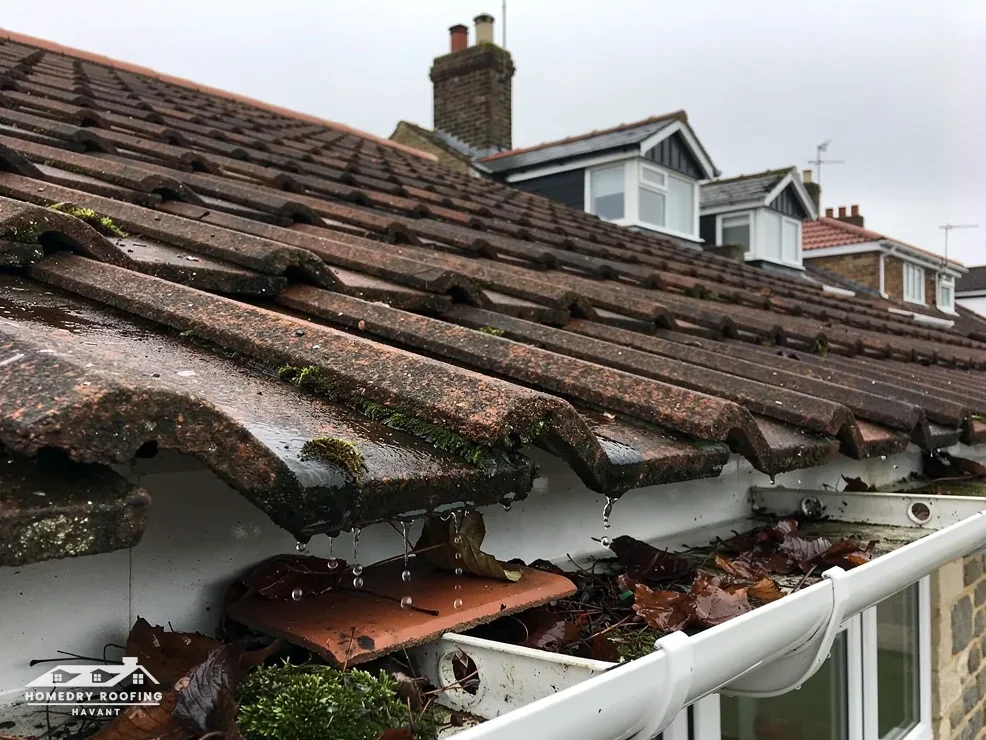
A stain below the gutter tells you where the rain left the route.
Gutters and downpipes take what the roof sheds and carry it to the drain. Brett Martin advises 1 mm of fall for every 600 mm of run towards the outlet, so a gutter that has dipped between brackets holds a pool and spills at the low point. On a Drayton survey we sight along each run, look at every joint for drips and at every bracket for a firm fixing, and check the hopper where a gutter hands its water to the pipe. Moss in a hopper is cleared by hand so the joint underneath can be seen. A downpipe that stands off the wall, or a joint that has parted, sends rain down the brickwork, and a dark streak on the wall is where we start. Our gutters, soffits and fascias page covers the work.
The fascia board behind the gutter has to hold the brackets, and the soffit under the overhang closes the roof edge. If the timber has softened, new brackets will not hold in it, so we press the board at the survey and show you what we find. A board that has rotted is renewed before the gutter goes back, since a new run screwed into soft timber will not stay up. The last metre matters too: where each downpipe ends, at a gully or a soakaway or against the wall, decides whether the water leaves the building.
Drayton is a coastal district, less than a mile from the coastline. In Cupa's wording a coastal site is graded with higher exposure, so the fixing specification is calculated for the roof under BS 5534, and the same attention goes to the fascia and the edge fixings. We look at these on the day and record them, and the written price follows only once we have seen the whole roof from the ridge down to the gutter.
A gutter that sheds its water against a wall footing has not finished its job. We follow each downpipe to its discharge and note whether the water reaches a drain or lands beside the house. Where it lands beside the house, the repair is as much about the pipe and its shoe as the roof, and you should know that before the work is priced.
A dark streak running down the wall below a hopper, or green staining that follows a joint in the pipe.
A joint that has parted, a hopper full of silt, or a run that dips and spills at its lowest bracket.
Map of Drayton and the places around it, with the dashed line of our 30-mile service area from Havant. The same places are listed below the map.
We start outside at the valley, then follow the stain's route in reverse. The lining is checked along its length for splits, and the tile edges beside it for cracks. The channel is checked for leaves, moss and silt that hold the water back. In the loft we look along the rafters under the valley for dark timber and daylight. Because the water can travel along the lining and a rafter before it drips, the entry point may be metres from the mark. We then tell you whether a repair or a new lining is the answer, with photographs.
The Building Control Partnership carries out building control for Portsmouth and can be reached on 01329 824823. Re-roofing is judged against two measures in the Planning Portal's guide: less than 25 per cent of the building envelope and less than 50 per cent of the roof, with approval required where a new covering is 15 per cent or more heavier. Before the work starts, we ask the Partnership which route applies to your house and tell you in plain terms, including any structural check. Where the new covering is heavier than the old one, the rafters are checked structurally first.
Any scaffold erected over a footway or road requires a licence under section 169 of the Highways Act 1980. Portsmouth's hoarding and scaffolding permit is handled by Colas, whose form gives £100.00 + VAT per month, and we arrange the licence with our scaffolder. That is Portsmouth's own monthly unit, so it is never set beside a fee from another council. The permit is sorted before the scaffold is booked, so you are not left waiting for poles to arrive while the paperwork catches up. The start date you are given already allows for that wait.
New Inn is listed Grade II (entry 1333210), as is Milestone 70.5 Metres East of New Inn (entry 1333211). The listing covers only the building it names, so your own house is not included unless it has its own entry, which Historic England's list will show. If it does, any work that would affect its character calls for listed building consent, while a listed home keeps its permitted development rights for roof work. Portsmouth City Council decides on consent, and we write up the findings for the application.
Portsmouth City Council decides for a Drayton address. The closest are Hilsea Lines and Old Wymering, which are its own, and St John's, which Havant Borough Council lists, and your road may or may not be inside one. Portsmouth lists its Article 4 directions conservation area by conservation area, so the council's own list holds the answer. A house roof that is re-covered is normally permitted development, though an Article 4 direction can remove further rights, and we confirm the position first. Where a direction does apply, our survey notes name it, so the council can see it was considered.
It changes the calculation, not the look of the roof. Cupa writes of coastal areas being graded with higher exposure, so the fixing specification for a roof within a mile of the coastline is worked out for the site under BS 5534. Marley says BS 5534 isn't required by law, which is why the survey is where the fixing is decided and written down. We record the clips, nails and edge fixings for each slope, so a later repair can match them and the specification is not a guess. Nothing in the written price is left to assumption about fixings.
Yes, where the run is sound apart from a few faults. A parted joint can be refitted and resealed, a loose bracket moved to firm timber and a blocked hopper cleared, and each of those leaves the rest of the run in place. A run that has dipped along its length, or a gutter that has cracked in many places, is better replaced, and we tell you which it is. Brett Martin's fall of 1 mm for every 600 mm is the test we use for the line of a new run. Cleaning out a hopper comes first, before anything is replaced.
The survey lists every fault with its photograph, and the quote gives one total for the whole job rather than a pile of small figures to haggle over. It says whether VAT and scaffold are in that total, which is worth testing on any quote you compare. If a repair is sound, the price is for the repair. If two faults share a cause, such as a valley feeding a failing gutter, the price treats them as one piece of work and the findings explain the link. Ask us to show you that link on the photographs.
You'll get one written total price.
Fill in what you like. It opens WhatsApp with your message ready to send.