

Chimneys
Where a Purbrook stack breaks through the tiled plane and lead turns in beside it.
A lifted flashing edge sends the rain behind it and into the roof.
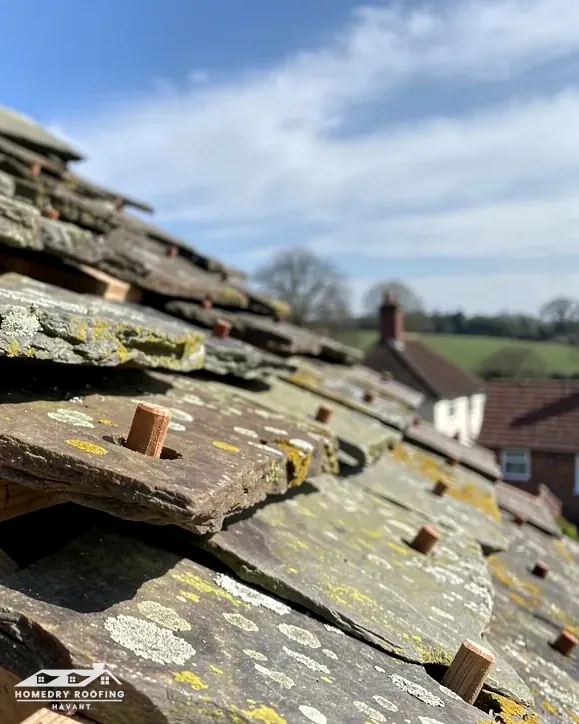
Chimney, valley, slope and gutter work in Purbrook, north-west of Havant by 3.5 road miles, every leak followed to its source before any work is priced as a written total.
10-year workmanship guarantee, in writing
Where a Purbrook stack breaks through the tiled plane and lead turns in beside it.
A lifted flashing edge sends the rain behind it and into the roof.
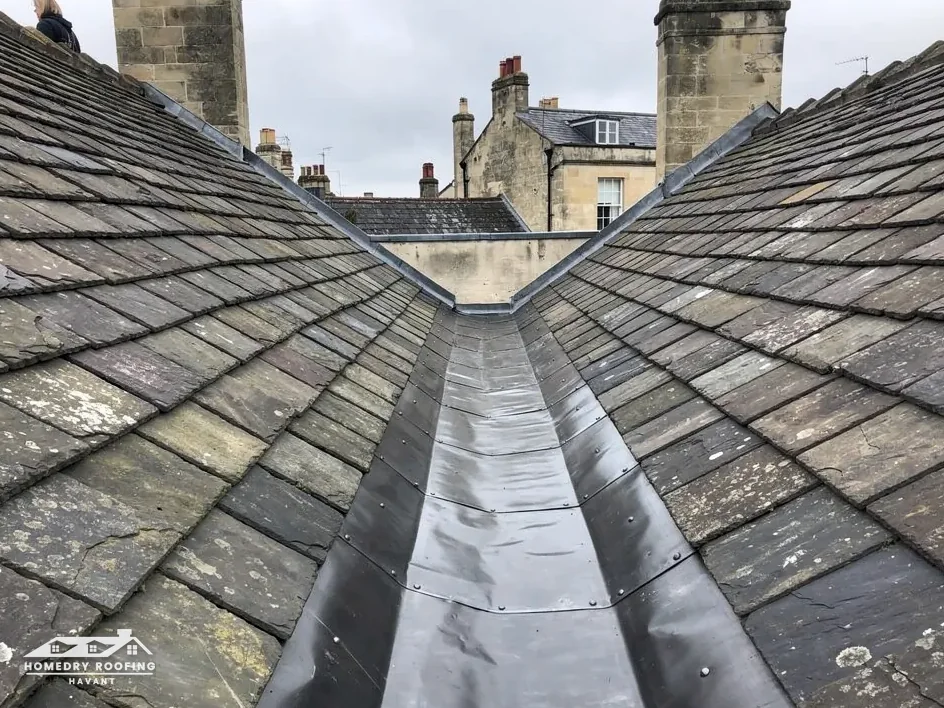
Where two slopes of one roof run together and share a single channel.
A worn lining or a leaf-packed channel pushes water over the edge.
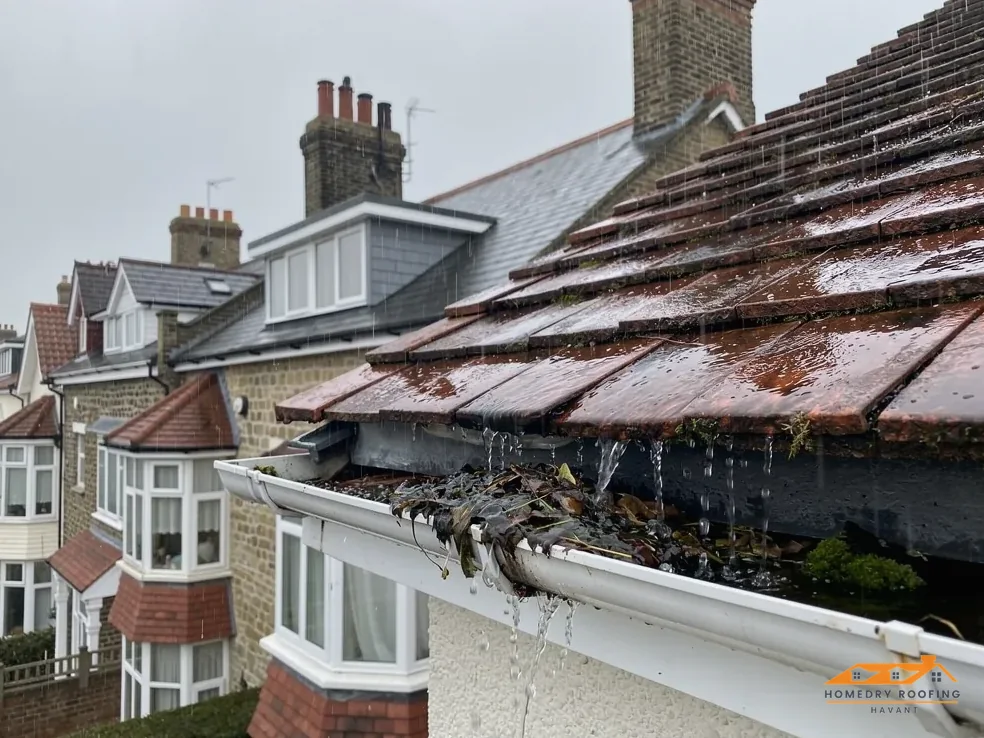
Where the lowest tiles overhang the gutter above the fascia board.
A short tile or a sagging run lets the water drip behind the gutter.
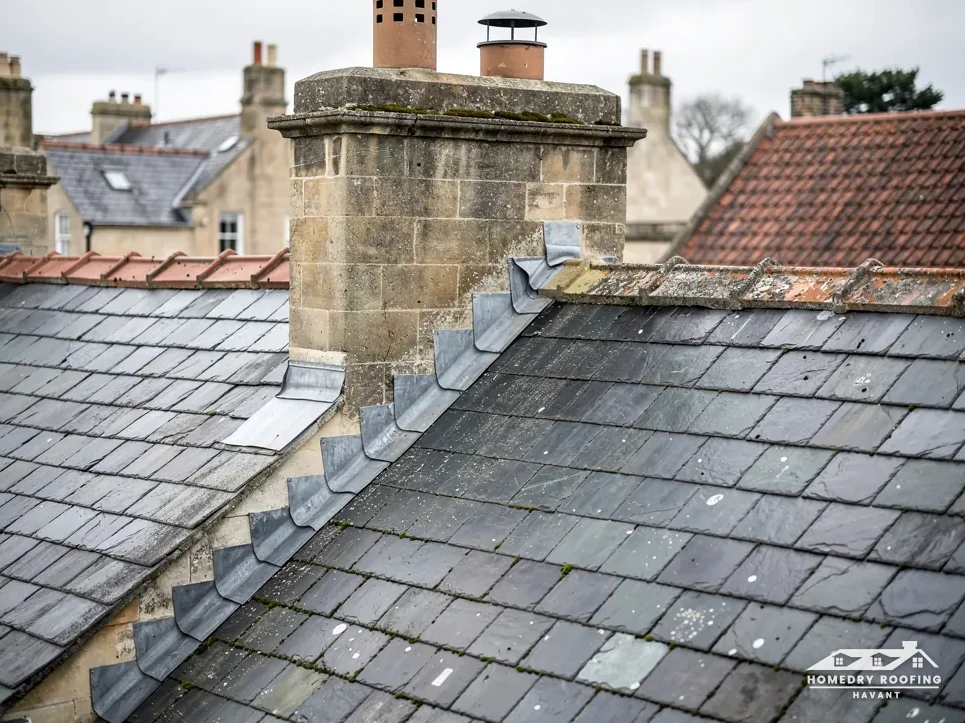
Flashing is sheet lead or another metal dressed over the joint between a slope and a chimney or a wall. Once an edge lifts, rain runs behind it and into the roof timbers, so we check the fixing, the laps and the mortar fillet.
On a pitched roof the water meets its first awkward joints at the chimney and in the valleys, so a Purbrook survey looks hard at both. A flashing is the strip of metal that turns a chimney stack or a wall into the tiles, and a valley is the gully where two slopes of the roof run together. We look for lifted or split lead at the stack, mortar fillets that have cracked, valley linings that have worn thin and channels packed with leaves, then check the ridge and verge above them. Our chimney repairs page and our leadwork page explain the work if a flashing needs renewing. MyJobQuote says correctly installed lead flashing can last for over 80 years, which is why we look at the fixing and the laps before calling anything worn out.
The National Heritage List carries three Grade II entries in Purbrook: Church of St John, Purbrook First School and Purbrook House. If your own home is listed, any work touching its character needs listed building consent, although a listed house keeps its permitted development rights for roof work. Church of St John is a working Church of England church, so the Church of England's faculty system, not the council's listed building consent, is the route for works to it.
Purbrook also has the St John's conservation area, and questions about it go to Havant Borough Council. Re-covering a house is normally within permitted development there too, though Article 4 directions can take away further rights. Havant Borough Council's Article 4 page names none for Purbrook, though that alone does not settle your street, so check with the council before you book work. Our planning guide for roof work covers the rules in full.
A wet patch beside the chimney breast can start at the flashing outside.
A listed address or a conservation area changes who has to agree to the work, not what the roof needs. We survey from the ridge to the drain in every case, write down the cause, and give you the findings to take to whoever must consent. Where consent is required, the route depends on the building, and we tell you which one applies before any tile is lifted.
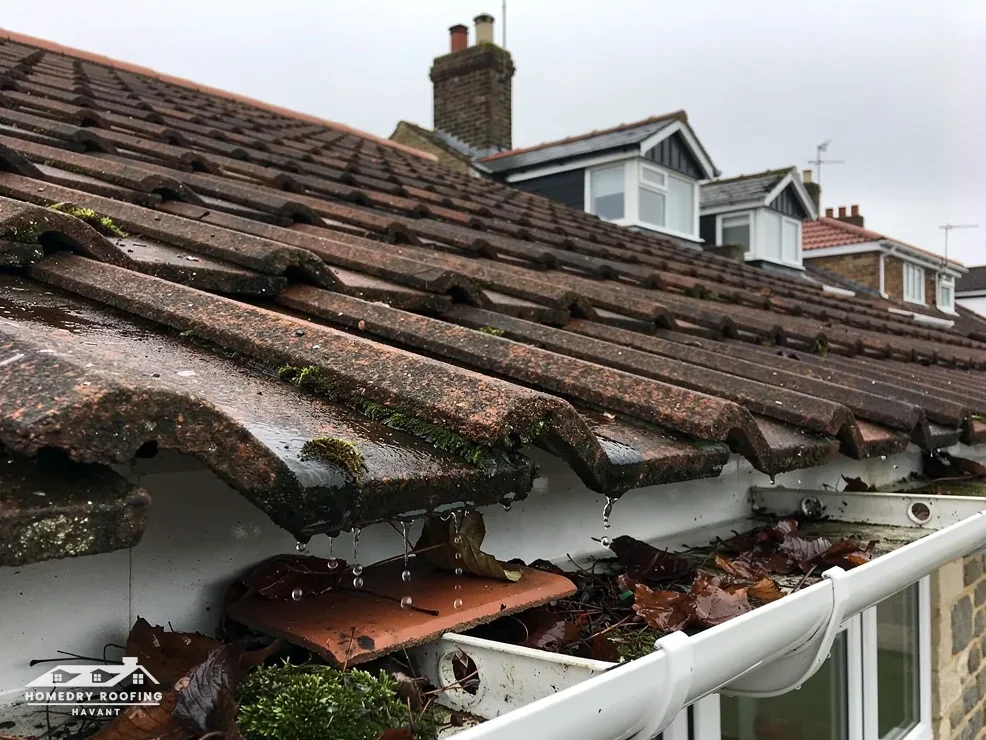
A gutter that holds water is working against the roof above it.
The eaves come last on the route, where the lowest tiles overhang the gutter, so that is where a Purbrook survey ends. We look for tiles ending short of the gutter edge, since a tile that falls short drips behind the board, so water drops behind it, and for runs that sag between brackets and hold water where it should flow. Dripping joints, a downpipe working loose from the wall and a hopper clogged with moss all show up from a ladder, and each is photographed for you. The board behind the gutter and the soffit under the overhang tell us how long a leak has been running. If a blocked run is the only fault, a clean-out fixes it, not a new system, and the quote reflects that.
Flat roofs on extensions and garages have their own survey checks. Where its membrane laps up the house wall, the upstand, the joints and the outlet are the three places rain can enter. We look for standing water on the falls, splits and blisters in the membrane, and an outlet with a clear throat. Our flat roofing page lists the coverings we fit; after the survey you hear if a mend is enough or a new roof is due, and the reason for either.
Environment Agency flood mapping shows land near Purbrook in Flood Zone 3. The map speaks of the ground, so the zone sets no requirement for the roof and the specification is unchanged by it. What the survey does do is follow the water from the roof edge to the place each downpipe discharges, and note where it ends up against a wall or a drain. The written total reaches you after we have inspected the roof from above, and we leave the site clean.
The lowest course of tiles has one job, which is to throw water clear of the fascia and into the gutter. If the overhang is too short, or the gutter has dropped away from it, rain runs back along the underside and soaks the timber behind. We measure the overhang against the gutter at the survey and show you the gap, so the work is aimed at the real fault.
Green staining down the brickwork under the gutter, or a patch of damp plaster on the ceiling by the outside wall.
A joint that drips onto the wall, or a tile that stops short of the gutter edge and lets water run behind.
Map of Purbrook and the places around it, with the dashed line of our 30-mile service area from Havant. The same places are listed below the map.
We begin outside, at the flashing around the foot of the stack, and look for lifted lead, cracked mortar fillets and open joints in the pointing. Then we check the tiles and valley above, because water can travel down a slope before it enters at the stack. Inside, the loft shows rings of staining around the chimney breast if water has been coming in. With the entry point found, we explain if a repair can last or the flashing needs renewing, with the reason, and you receive one written total price afterwards. If the entry point is somewhere else entirely, we tell you that and trace it there instead of guessing.
Everything hangs on the share of the building being touched. The Planning Portal sets out two limits: no application is normally required while the work touches less than 25 per cent of the building envelope and less than 50 per cent of the roof. Beyond that, Building Regulations approval comes into play for a Purbrook covering 15 per cent or more heavier. For a Purbrook address your building control body hears the question from us before work begins, and you get its answer, in everyday words, ahead of any commitment from you. A structural check on the rafters is sensible whenever the new covering is heavier.
Poles and boards set on the pavement or road need a licence under the Highways Act. Hampshire County Council charges £211.90 on application for the first 2 weeks and £72 for each additional 2-week period, while the licence needs ten clear working days' notice before it can start. Hampshire County Council also says scaffolding companies must apply on behalf of their customers. We arrange it with our scaffolder. Scaffold wholly on private ground is a separate case, and the start date you are given allows for any notice. Your neighbours get warning of the scaffold from us too, so nobody is surprised by the poles on the pavement.
A listed house keeps its permitted development rights for roof work, yet it still needs listed building consent for work that changes the character of a building of special interest. Look your address up on Historic England's National Heritage List to see whether you have an entry, and read the entry before anyone orders materials. A church in use is a separate case: the Church of England's faculty system covers works to Church of St John, not the council's listed building consent. If the building is a private house, the council is the body that grants consent, and we talk through the likely steps before any tile is lifted.
Ask Havant Borough Council, which looks after the conservation area and the planning rules for Purbrook. Ordinarily, re-covering a house counts as permitted development even there, but dormers are different and Article 4 directions can remove further rights, so the council is the place to confirm what applies to your street. The council's Article 4 page names none for Purbrook, but we would not treat that as the final answer. Our planning guide explains the rules for roof changes and links to the sources, so you can read them for yourself and decide how much to ask the council.
The answer is no. Land near Purbrook lies in Flood Zone 3 on the Environment Agency's flood map, which describes flooding at ground level. Rain coming through a roof has other causes, and the zone adds no roofing requirement. We use the flood map for one purpose only, which is to take care over where downpipes discharge, since roof water ought to run clear of a wall. All the rest of the survey is about the roof, taken in the order the rain runs: ridge, slopes, eaves, gutter. Nothing is added to the price on account of the zone.
It is, where the battens and tiles are sound and the fault sits in one place, such as a flashing, a valley lining or a cracked run of ridge bedding. The better course, mend or replacement, is named with the reason, and we put the mend first where it is sound. When a whole slope has failed, patching it only moves the leak, so we say that plainly and show you the evidence from the survey before the written price is given. A repair that is sound is quicker for you and leaves the rest of the roof untouched.
The price you get is a single written total, prepared once we have looked over the roof. It describes the job, names the covering to be laid, and should tell you if the figure takes in scaffold and VAT, a point to test against any rival quote. The job is judged as a whole, so there are no separate sums to haggle over. Expect a good and fair price, and a cleared site when we leave. Findings can come in writing with the price, showing what was found, where, and what each part of the job is meant to cure.
You'll get one written total price.
Fill in what you like. It opens WhatsApp with your message ready to send.