
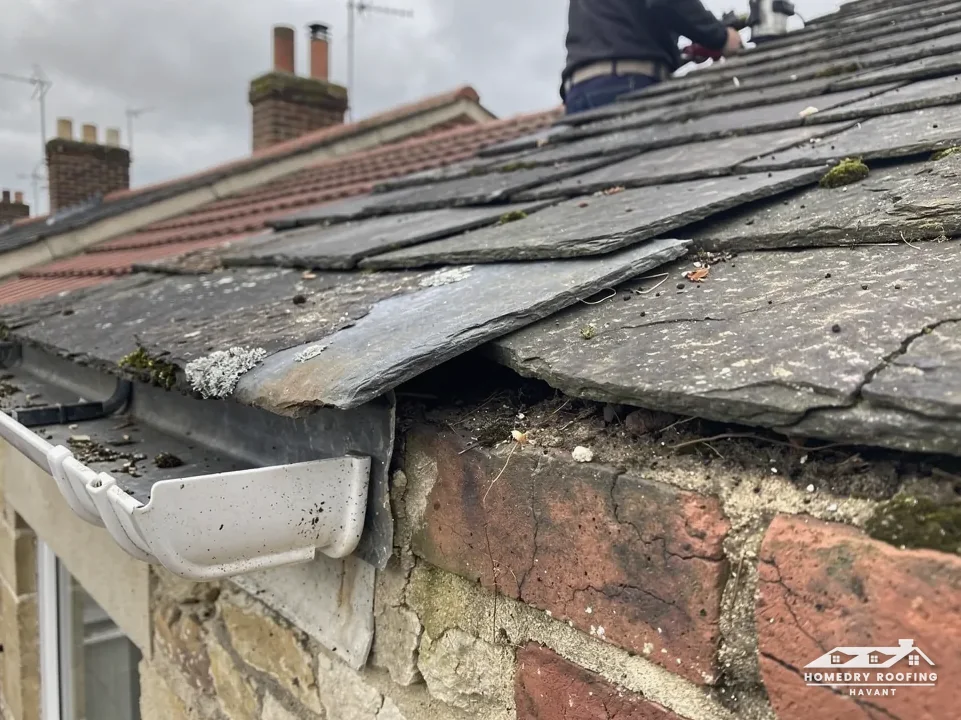
Valleys
Where two slopes of a roof tip into one shared channel running down to the gutter.
A thinned lining or a channel packed with debris pushes the flow sideways under the tiles.

Valley, gutter and slope repairs and re-roofs in Bedhampton, a district of Havant, with the leak traced to its source and the price given as one written total.
10-year workmanship guarantee, in writing
Where two slopes of a roof tip into one shared channel running down to the gutter.
A thinned lining or a channel packed with debris pushes the flow sideways under the tiles.
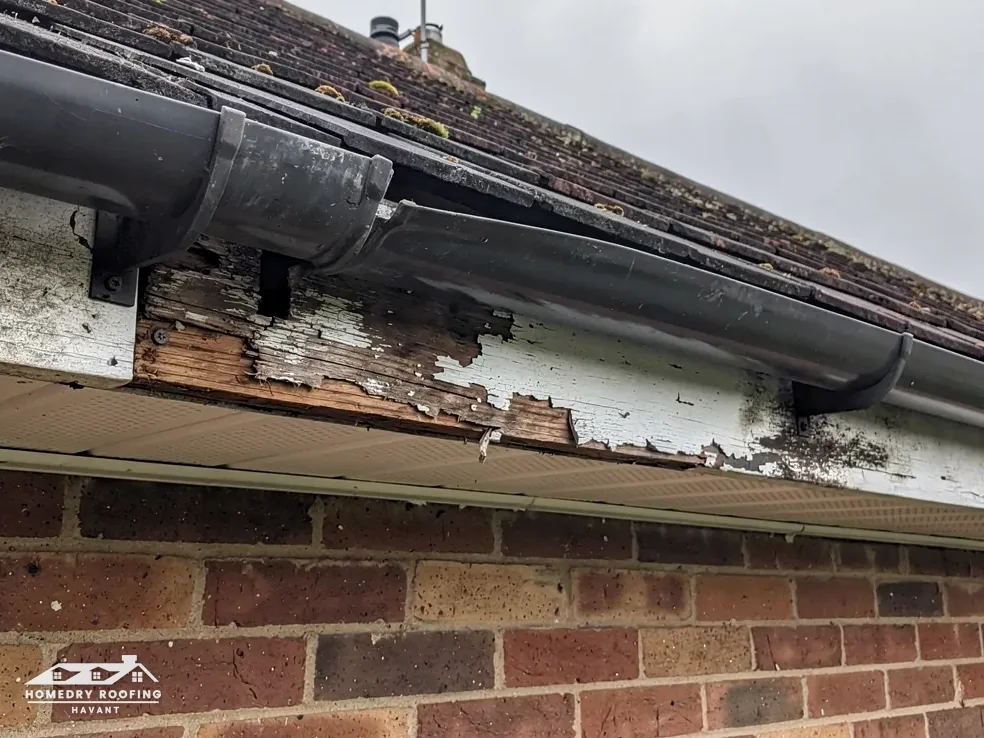
Where a gutter ends in a small box and hands the water to the downpipe.
A cracked hopper or a loose bracket sends the flow down the face of the wall.
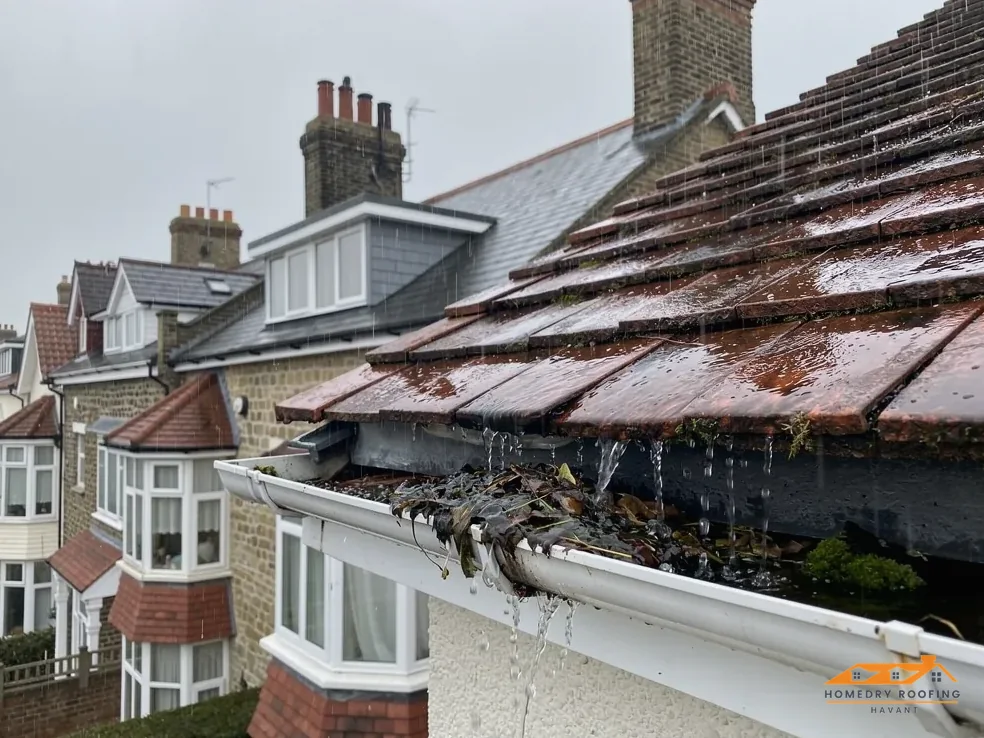
Where the board beneath the lowest tiles carries the gutter along the roof edge.
A soft board lets the brackets drop, and the gutter tilts away from the tiles.
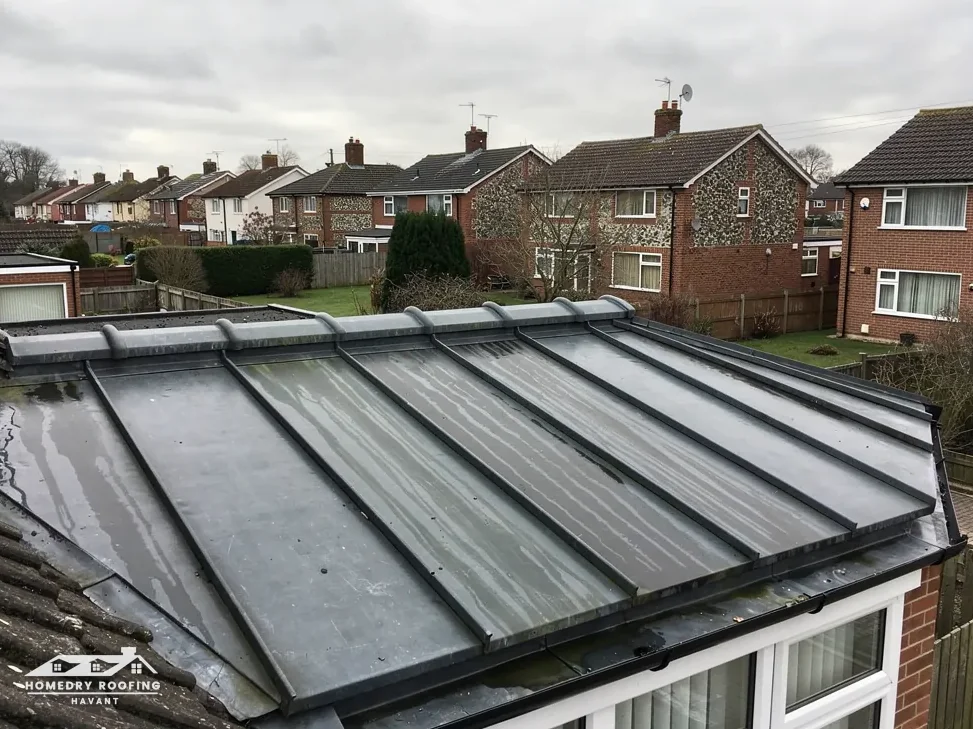
The channel is the only path for the water of two slopes. When leaves or moss narrow it, the flow rises over the lining's edge and runs under the tiles on either side, then down to the first timber it reaches.
A valley is the channel formed by two roof slopes that meet at an internal angle, and it carries the run-off of both. A Bedhampton survey therefore follows it from the ridge downward, with photographs at each stage so the findings show how the lining sits beneath the tile edges. We look at the lining under the tiles, at the tile cuts along both sides, and at whether leaves or moss have narrowed the gap the water travels through. A blocked channel throws its flow over the side and under the tiles, and that is where a ceiling stain in the next room begins. Our roof repairs page explains how a failed lining is handled, and the leadwork page covers valleys that are lined in lead.
Two conservation areas sit close to the centre of Bedhampton, Brockhampton and Old Bedhampton, and Havant Borough Council is the authority for both. Havant Borough Council's Article 4 page does not list Bedhampton among its directions, but ask the council about your own street before you commit to work. The National Heritage List holds several entries here. Church of St Thomas is listed Grade II, The Elms with its front garden wall, gate piers and gates is Grade II*, and Manor House is Grade II.
Church of St Thomas serves as a Church of England place of worship, so works to it go through the Church of England's faculty system and not through the council's listed building consent. A building with a list entry of its own needs the council's consent for work that alters its character, which is why you should look up your address first. Our planning guide for roof work sets out the wider rules for an unlisted house.
A damp patch two rooms away from the valley can start in the valley.
The consent route depends on what the building is. For Church of St Thomas it is the faculty system. For a house with a list entry of its own it is listed building consent from the council. For a house with no entry the roof follows the ordinary rules. We write down which of the three applies to your address before the findings are priced, so nothing is assumed and no one is asked to chase the wrong office.
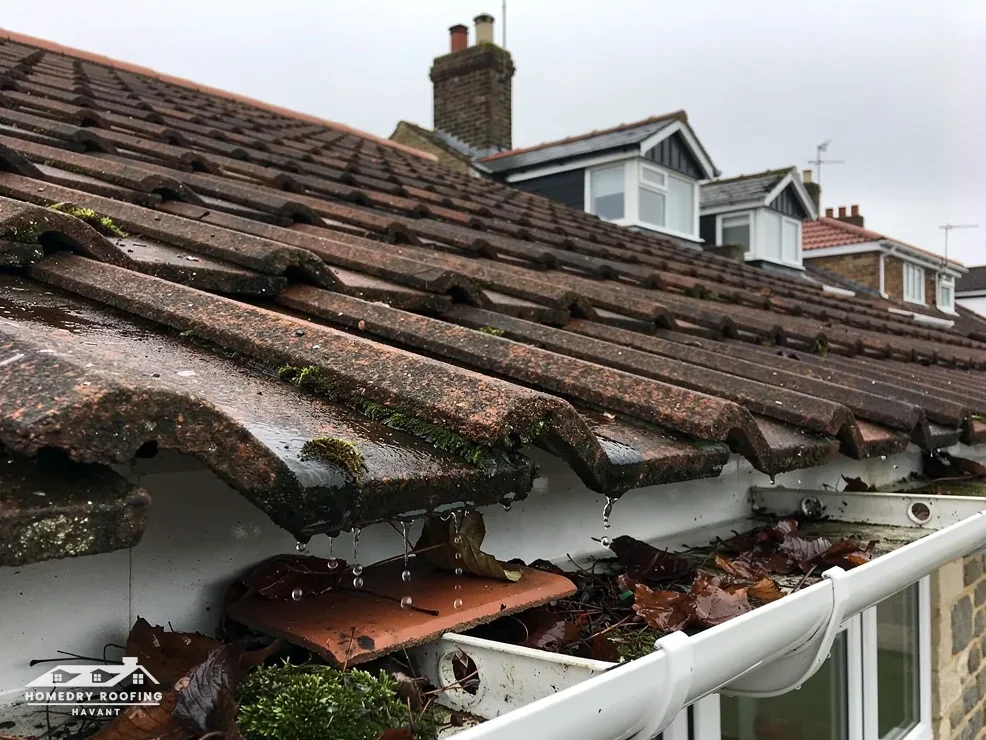
The wall below the gutter shows the fault long before the gutter does.
The last stage of the route is the gutter, and a fault there may go unnoticed until a wall stays damp. A gutter has to fall gently toward its outlet, and Brett Martin advises a fall of 1 mm for every 600 mm. A run that holds water after rain has lost that fall somewhere along its length. On a Bedhampton survey we run a hand along the joints, look for standing water in the channel, count the brackets and check that each one is still held by sound fascia timber. Then we follow the water to the hopper, the small box at the head of the downpipe, and down to the drain. Our gutters, soffits and fascias page covers renewals and the boards behind them.
Land near Bedhampton lies in Flood Zone 3 on the Environment Agency's map, and Bedhampton itself sits within a mile of the shoreline. Coastal homes are graded for higher exposure, so the fixing specification is calculated for the site under BS 5534. The flood zone describes flooding at ground level and is not a roofing rule, but it does make us careful about where a downpipe discharges, so that roof water is not left standing against a wall.
Behind the gutter sits the fascia board, and behind that the eaves. If the board is soft, a new gutter hung on it will drop again, so we probe the timber before recommending a gutter job on its own. Where the board is sound, the repair comes first and the findings explain why a replacement is not needed. The findings list every joint, bracket and outlet that was checked, in the order the water meets them, so the final price matches work you can see.
Land near Bedhampton lying in a flood zone says nothing about the tiles overhead. What it does change is the ground below: we choose where the downpipe discharges with that in mind, and the findings note whether a gully or a wall footing is close to the outlet, so the water leaving the roof is not handed straight to the house. If the outlet is awkward, the findings say what would change it.
Green staining or a damp patch on the wall under a gutter joint.
A leaking joint, a channel that holds water, or a bracket that has let the run sag.
Map of Bedhampton and the places around it, with the dashed line of our 30-mile service area from Havant. The same places are listed below the map.
From the ground a valley looks like a line of tiles. On the roof it has a lining, cut edges on both sides and a channel whose width matters. We check the lining for thin patches and splits, the cut tiles for cracks, and the channel for moss and leaves. In the loft we trace the stain back along the timber, toward the valley or away from it. That second step matters, because the damp mark can sit a long way from the source. The written findings then say whether the valley needs clearing, relining or a wider repair, with photographs of each defect beside the description.
That depends on how much is being replaced. The Planning Portal says a re-roof does not normally need a building regulations application when it affects less than 25 per cent of the building envelope and less than 50 per cent of the roof, and a covering that weighs 15 per cent or more above the old one brings approval back in. For a Bedhampton house, your building control body is asked about the route before work begins, and we pass on the reply in everyday language. A heavier covering is the case where the rafters deserve a second look, so we raise it early, before any covering is ordered.
The highway authority here is Hampshire County Council, and its licence page states that scaffolding companies must apply on behalf of their customers; we arrange it with our scaffolder. Hampshire County Council charges £211.90 on application for the first 2 weeks, with £72 for each additional 2-week period, and it wants a minimum of ten clear working days between application and the intended start. Asking for more time on the highway later means a new application and new fees, so the full period is requested at the beginning and your start date allows for the notice.
Church of St Thomas is a Grade II listed Church of England church in use, so works go through the Church of England's faculty system and not through listed building consent. The Elms, with its front garden wall, gate piers and gates, is listed Grade II*, and Manor House is listed Grade II; where a building has a list entry and is not an exempt place of worship, the council's listed building consent applies to work that affects its character. We read the entry for your address with you before any roof work is planned, and we note on the findings which route applies, so the right office gets a clear description.
Havant Borough Council is the authority for both conservation areas. Ordinary re-roofing is normally permitted development even in a conservation area. An Article 4 direction can remove further rights; the council's Article 4 page names none for Bedhampton, but it is still the body to check with about your own street. Our planning guide lays out the wider rules and links to the sources, and we describe the roof in writing so the council can see exactly what is proposed, which saves a round of questions once the application is in.
No. The Environment Agency's map puts land near Bedhampton in Flood Zone 3, which concerns water at ground level and says nothing about tiles, battens or flashings. The zone matters to us in one respect only, which is where a downpipe discharges, since roof water should not be left to stand against a wall. Everything else on the survey is judged on the roof as it is, from the crest of the ridge to the gutter outlet, in the order the water travels. The same inspection applies on high ground and low, and the price reflects the roof, not the map. No part of it is added because of the zone.
BS 5534 is the British Standard behind the fixing of slates and tiles. Marley says it is not required by law, and that mortar alone "could no longer be relied upon". Coastal homes are graded for higher exposure, so the specification is calculated for the site, covering batten selection, methods of fixing and wind uplift formulas. For a re-roof near the shore, that means the fixings are chosen for the roof in front of us, with the ridge, hips and verges included in the calculation and not left to habit. We would rather show you the basis of the calculation than ask you to trust a general promise, and the written findings carry it.
Yes, where the repair is sound. When the battens, tiles and lining around a fault are in good order, the repair comes first, and the choice between mending and replacing is explained with reasons you can check. A single slope that has failed is a different case: patching it only moves the leak, and the survey evidence shows why. The quote is one written total price after the survey, and it states whether VAT and scaffolding are counted inside that total, so you can compare it with any other quote properly, including how each one treats scaffolding.
You'll get one written total price.
Fill in what you like. It opens WhatsApp with your message ready to send.