
Courses
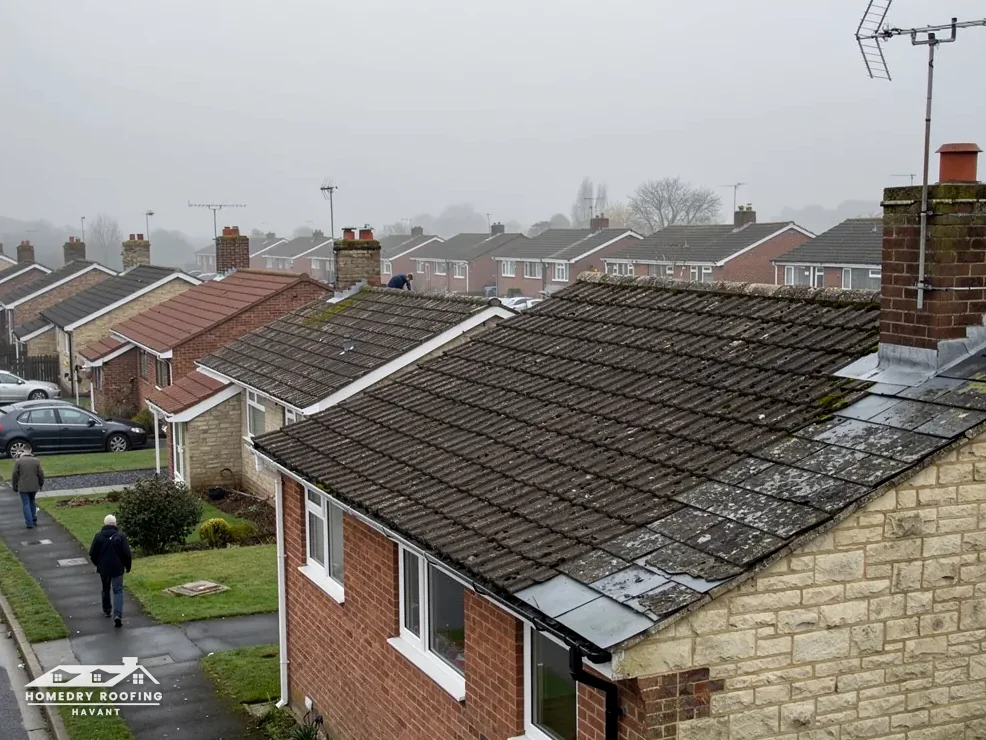
Where rows of tiles overlap down the slope, each row passing water on to the next.
A slipped or cracked tile breaks the row and lets water reach the batten beneath.

Tiled slope repairs, flat roof work and re-roofs across Leigh Park, a district of Havant, with each fault followed back to its source before any price is set.
10-year workmanship guarantee, in writing
Where rows of tiles overlap down the slope, each row passing water on to the next.
A slipped or cracked tile breaks the row and lets water reach the batten beneath.
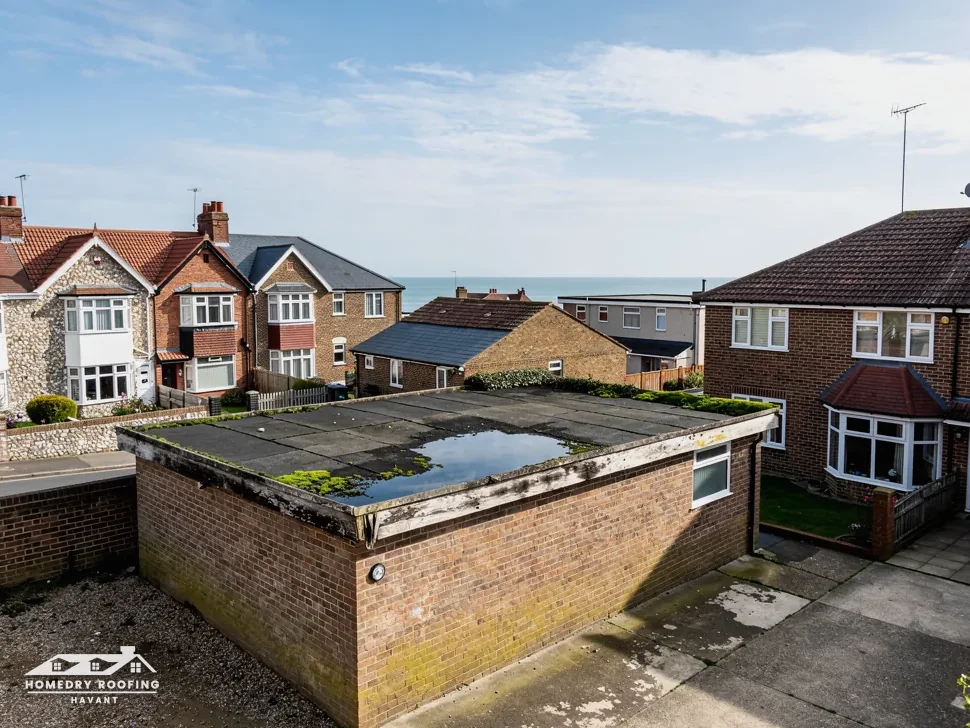
Where a flat roof gathers its water into a single opening at the lowest point.
A blocked or badly sealed outlet leaves a pool standing on the surface.
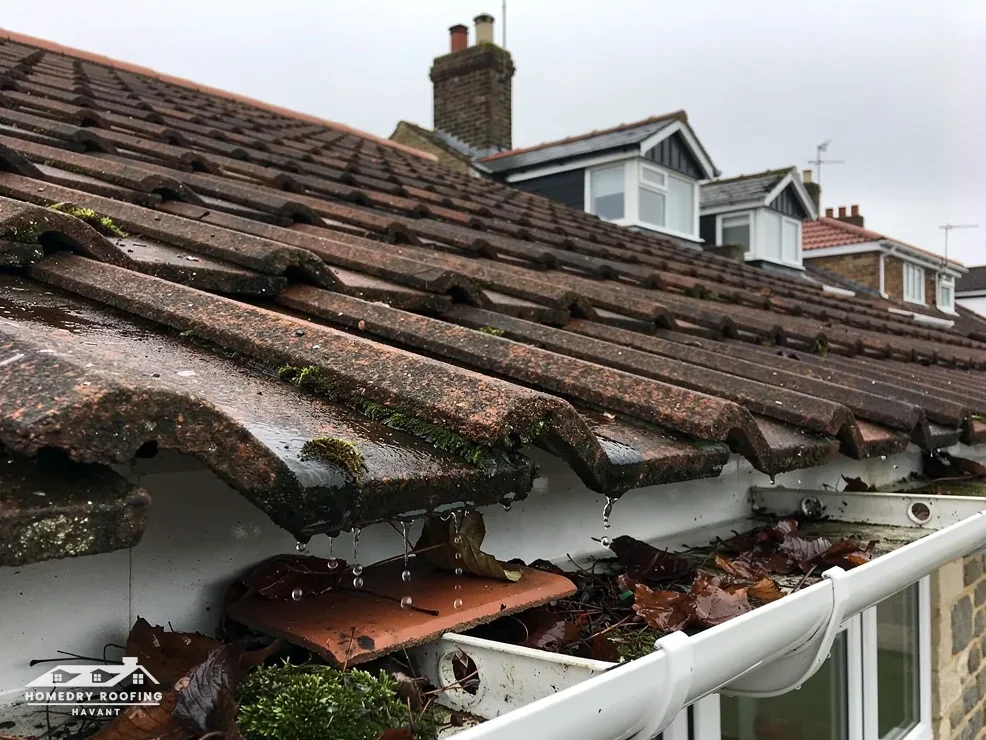
Where the last row of tiles hangs over the gutter, above a gap left for air.
The gap is checked here, together with the board that carries the gutter.
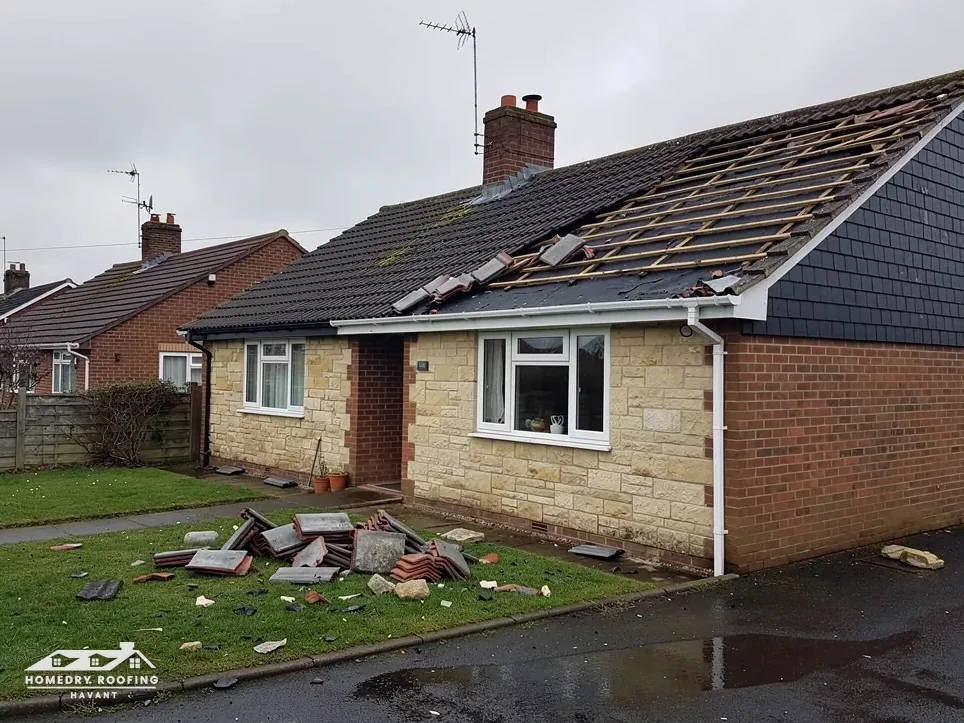
Count the tiles that failed before deciding what the roof needs.
Think of a course as a single row of tiles: each row overlaps the one beneath it, so water is handed down the slope like a relay. A Leigh Park survey reads those courses in turn, noting tiles that have slipped, cracked or lifted, and the gaps they leave. Where a tile has failed we record its row and its distance from the ridge, so the repair can be found again. Under the tiles lie the battens, thin strips of timber that carry them, and under those the underlay, a membrane that catches whatever gets past. If the battens are sound and only a few tiles have failed, replacing those tiles is a repair. Our pitched roofing page covers the way a slope is built and mended.
HomeBuilding gives approximate lifespans of 100+ years for Welsh slate, 60-80 years for clay tiles and 40-50 years for plain concrete tiles. Those figures guide what a covering can be expected to do. They say nothing about any particular roof in Leigh Park, so the survey judges the roof in front of us: the state of the battens, the number of tiles that have failed, and whether the fault is local or spread across the slope. When a whole slope has gone, patching only moves the leak, and a new covering is the right recommendation; our new roofs page describes that work.
At the eaves, a cold roof needs air to move; that term means a roof insulated along the ceiling, which leaves the loft space cold. With a high-resistance underlay, Marley gives 25 mm of eaves ventilation at 15° or less, and 10 mm above 15°. We check that the gap has not been closed by insulation, and we record what we find in the loft alongside what we find on the slope.
The loft tells us what the slope cannot. Daylight showing at a joint, a wet batten, a dark patch beside a rafter and a drip mark on the underlay are all recorded and photographed, and each one is matched to the place on the slope where the water arrived. That match is what turns a ceiling stain into a specific repair, with a place and a reason attached.
A stain on the bedroom ceiling that appears after rain and fades over the next dry days.
A cracked or slipped tile, or a torn joint in the underlay, several courses higher than the stain.
An upstand is the part of the membrane turned up a wall where the flat roof meets it. Its top edge is covered by a flashing or a strip, and a gap there lets rain run behind the membrane.
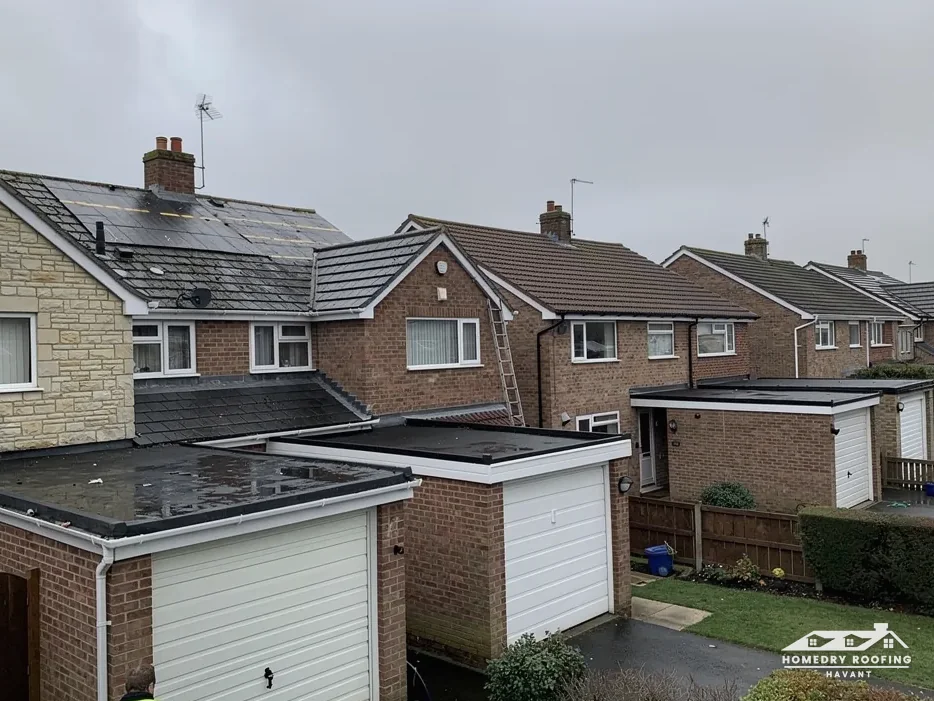
A flat roof sheds its water slowly, so the shape of its surface matters. BS 6229:2025 sets a minimum finished fall of 1:80 for membrane flat roofs, so a designer aims for a steeper fall, which leaves room for building tolerances. A Leigh Park survey of a flat roof looks for ponding, the pool that stands for days after rain. A pool that clears within a day or two is a lesser worry than one still there at the next visit, and the notes record which of the two we found. We trace it to the outlet, the opening where water leaves the surface and enters a pipe or a gutter. Our flat roofing page describes the membranes and the repairs that suit them.
Where the flat surface meets a wall there is an upstand, the short vertical return of the membrane up the brickwork, finished with a flashing or a cover strip. We look at the top edge of the upstand and at the corners, because a membrane can fail at its details, and they are read closely, not glanced at from the ladder. The outlet is cleared and checked for the seal around it, and the nearest length of pipe is followed to the point where it discharges.
The Environment Agency's map places the mapped centre of Leigh Park in Flood Zone 2, which describes ground-level flooding and is not a roofing rule. It does make us follow the downpipe to its end, to keep roof water away from the footing of the wall. The conservation areas closest to the centre are Sir George Staunton, Old Bedhampton and Brockhampton, all in Havant Borough Council's area; for any particular address, check with Havant Borough Council. Our planning guide for roof work explains when permission matters.
Standing water up there marks the place where the fall has gone.
A pool left lying the morning after rain is information. Its position says where the surface has lost its fall, and its edge says whether the membrane is stained, split or simply holding water. We photograph it, measure nothing we cannot defend, and report whether the answer is a local repair or a new surface laid to a proper fall.
Map of Leigh Park and the places around it, with the dashed line of our 30-mile service area from Havant. The same places are listed below the map.
By counting and by locating. A single slipped tile with sound battens around it is a local fault, and replacing it is a repair. Several failures in one area, battens that are soft when pressed, or an underlay that has torn along its laps point to the slope as a whole. We read the courses upward, eaves first, then compare the outside with what the loft shows. The findings give the number and position of failed tiles, with photographs, so the choice between mending and re-covering rests on evidence you have seen for yourself, and nobody has to take the verdict on trust.
The Planning Portal draws the line in two places. If the work affects less than 25 per cent of the building envelope and less than 50 per cent of the roof, no building regulations application is normally needed. If the new covering is 15 per cent or more heavier, approval is needed, and the Portal suggests having a structural engineer or surveyor look at it beforehand. For a Leigh Park address your building control body is the one to ask, and we raise the point at the survey, before a covering is ordered, because a heavier covering is the case that most needs the rafters looked at.
A licence under the Highways Act, issued by Hampshire County Council as the highway authority. On Hampshire County Council's scaffolding page the line reads "Scaffolding companies must apply on behalf of their customers", and we arrange it with our scaffolder. Hampshire County Council charges £211.90 on application for the first 2 weeks, then £72 for each additional 2-week period, and needs the application lodged ten clear working days ahead of erection. With extensions not on offer, a longer stay needs a fresh application. We ask for the whole period at the start and tell you the date that results, so the scaffold is not a surprise on the pavement outside.
The closest to the centre are Sir George Staunton, Old Bedhampton and Brockhampton, and all three are on Havant Borough Council's own list. For a particular address, check with the council, which holds the boundaries. Havant Borough Council's Article 4 page names no direction for Leigh Park, but a direction can remove further rights, so use it as a prompt for a question, not a clearance. If your house has a list entry of its own, consult the National Heritage List under that address before work is planned, since listed building consent then applies to work affecting its character.
Not to the roof covering. On the Environment Agency's map, the mapped centre of Leigh Park sits in Flood Zone 2, and the zone concerns flooding of the ground. It does not alter the tiles, the battens or the flashings. What we do with the information is practical: the downpipe is followed to its end, and if it empties beside a wall footing we point that out and suggest where it could go instead. The roof itself is judged on its own condition, from the ridge to the lowest course, whichever zone the street lies in, and the quote does not change because of it.
It depends on the roof type. With a high-resistance underlay in a cold roof, Marley's figure is a 25 mm air gap along the eaves when the pitch is 15° or less, and 10 mm above 15°. A cold roof is insulated along the ceiling, so the loft stays cold. On a survey we check the gap behind the soffit and the fascia, find out whether it has been blocked, and record the pitch, so any re-roof specification matches the figure that applies to your roof and not to a stock drawing, and the loft stays ventilated once the new covering is on.
Yes, where the membrane around it is sound. A blocked outlet is cleared, the seal around it is inspected, and the surface is checked for the splits and soft patches that ponding leaves behind. If the surface is holding water because the fall has been lost, clearing the outlet will not cure it, and the findings say so with the evidence, including a photograph of the ponding and of the outlet beside it. A repair comes first when a repair will hold, and when the whole surface is worn out, the findings are plain about that.
Start with the total, which should be one figure on paper, and then see what it covers. It ought to say what the covering is, what is being repaired or replaced, and whether VAT and scaffold hire are counted in the figure. Quotes that leave those points open cannot be compared fairly with one that settles them. Ours follows a survey, comes with the written findings if you ask, and is pitched at a good and fair price, with the site left clean when the work is done. If two quotes differ, ask each what it assumes, since that shows what is really being compared.
You'll get one written total price.
Fill in what you like. It opens WhatsApp with your message ready to send.