

Stacks
Where a chimney stack climbs through the front slope and a strip of lead turns into the tiles.
A lifted lead edge lets rain slip behind it, down the brickwork and into the loft.

Roof repairs, chimney work and re-roofs in Langstone, 0.9 road miles south of Havant, with the route of the rain traced first and one written total price at the end.
10-year workmanship guarantee, in writing
Where a chimney stack climbs through the front slope and a strip of lead turns into the tiles.
A lifted lead edge lets rain slip behind it, down the brickwork and into the loft.
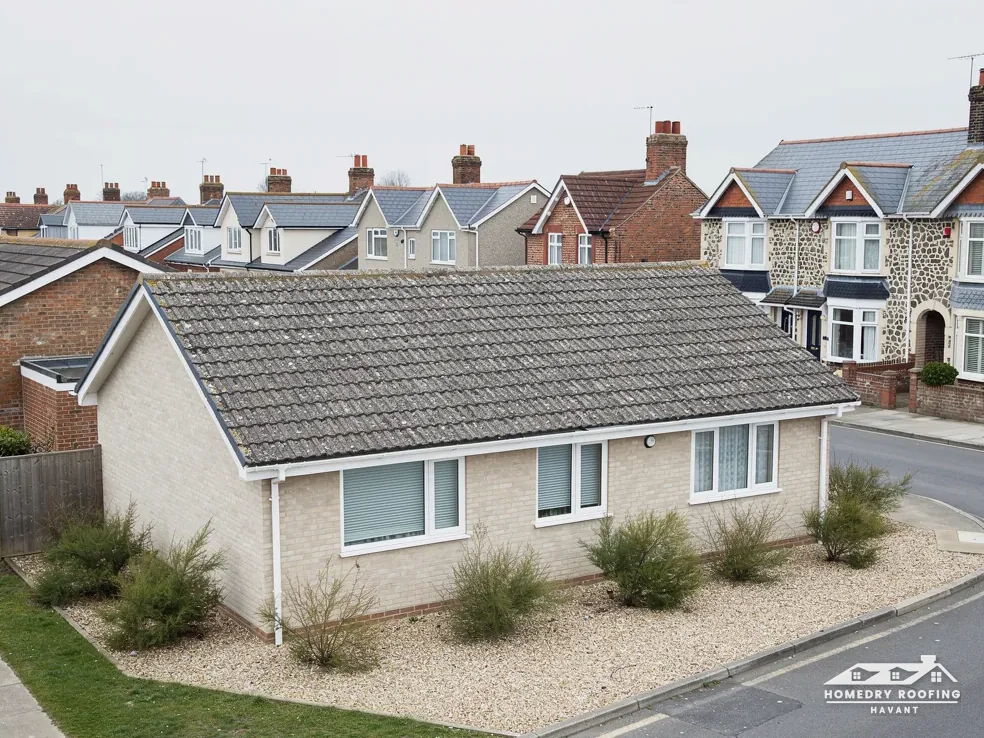
Where the uppermost tiles of two slopes butt together along the crest.
A loose ridge tile or a failed bed opens a gap that runs the length of the roof.
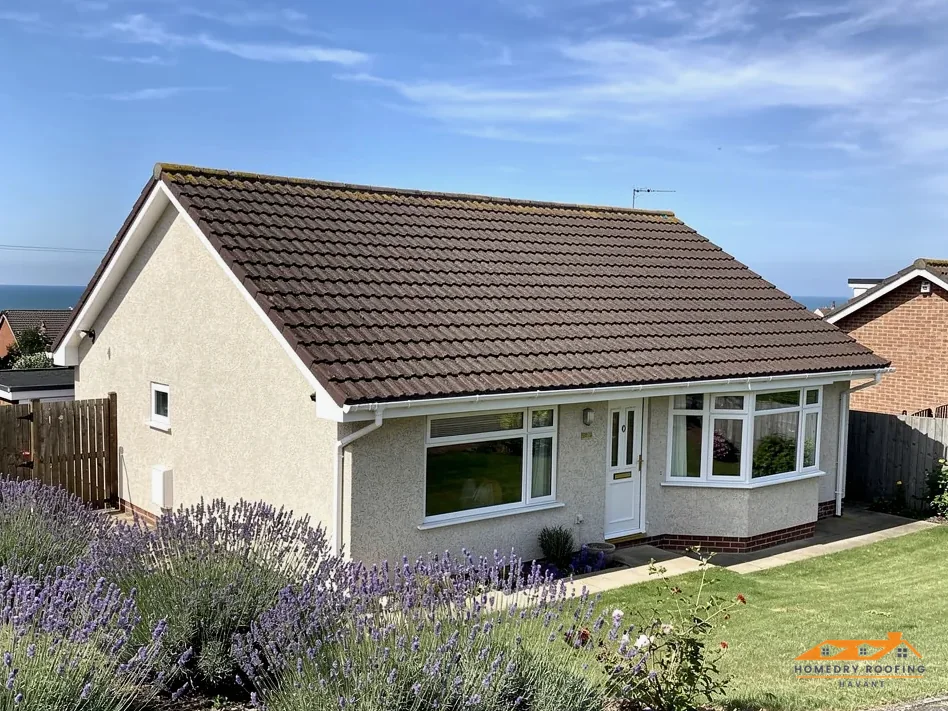
Where a slope finishes against a gable wall, the end tiles overhanging the brick.
A cracked verge bed or a lifted end tile gives driven rain a way underneath.
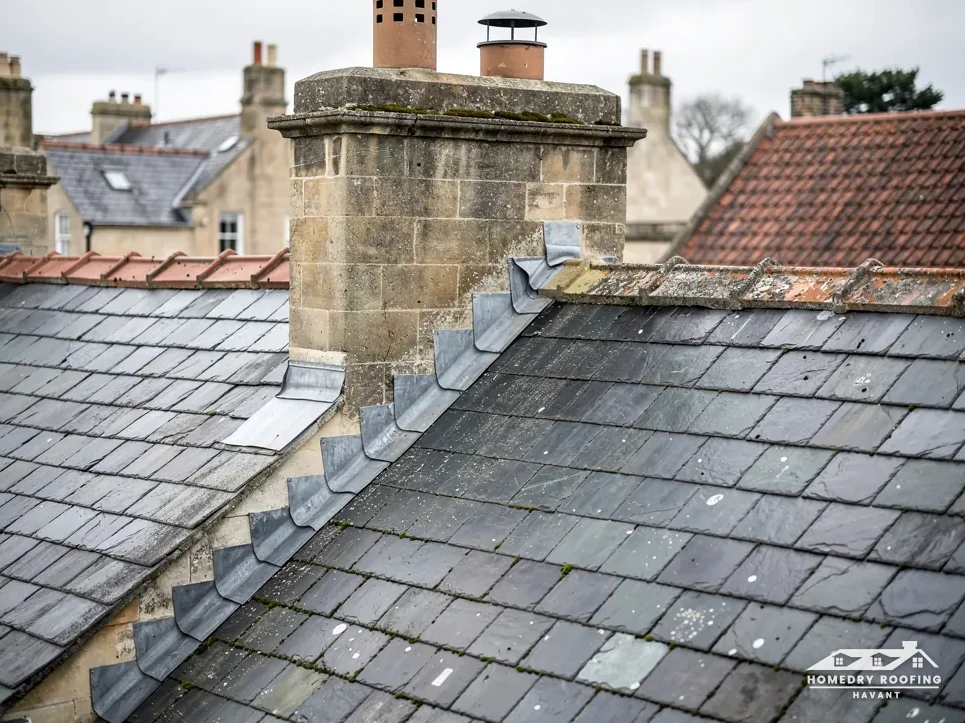
The stain is beside the chimney breast, but the way in may be higher up the stack.
A chimney stack is the place where a roof is cut open and closed up again, so a Langstone survey begins there. The flashing is the strip of lead dressed from the stack onto the slope, and the fillet is the bead of mortar that closes the gap above it. We check that the lead lies flat and is held along its edge, that the fillet has stayed whole, and that the pointing in the brickwork is closed. Then we go up through the hatch and read the timbers around the chimney breast for old stains and for fresh ones. Our chimney repairs and leadwork pages describe each repair, and a stack that is sound is left alone.
Four conservation areas surround the centre of Langstone: Mill Lane, Langstone, Wade Court and Warblington. Havant Borough Council is the authority for them, so a question about one particular street goes to the council, not to us. The Langstone conservation area also carries an Article 4 direction, made on 6 June 2012. Per the council's Article 4 page it reaches properties in the conservation area, though only the elevations that face a public area; rear and side elevations that look onto no highway, footpath or public space are left out. The leaflet from the council includes alteration to the roof of the house, and any chimney, flue or waste pipe work, in its list of controlled changes. We photograph each flashing edge and attach the pictures to the written findings.
Further rights can be withdrawn by an Article 4 direction, which is why Havant Borough Council is the first call before anyone touches a slope or a stack that faces the road. Our planning guide for roof work sets out the wider rules, and our survey describes the stack and the slope in writing so the council has facts to work from.
Which faces of a house look onto a public area matters under the direction, so the survey notes which slopes and stacks are seen from the road and which are not. That note goes in the written findings beside what we found in the roof, so you can take it to Havant Borough Council with the facts to hand and decide on the work without guessing.
A brown mark on a ceiling next to the chimney breast, or damp paper on the stack wall in the loft.
A lifted lead edge, a cracked fillet or open pointing higher up, where rain runs behind the flashing.
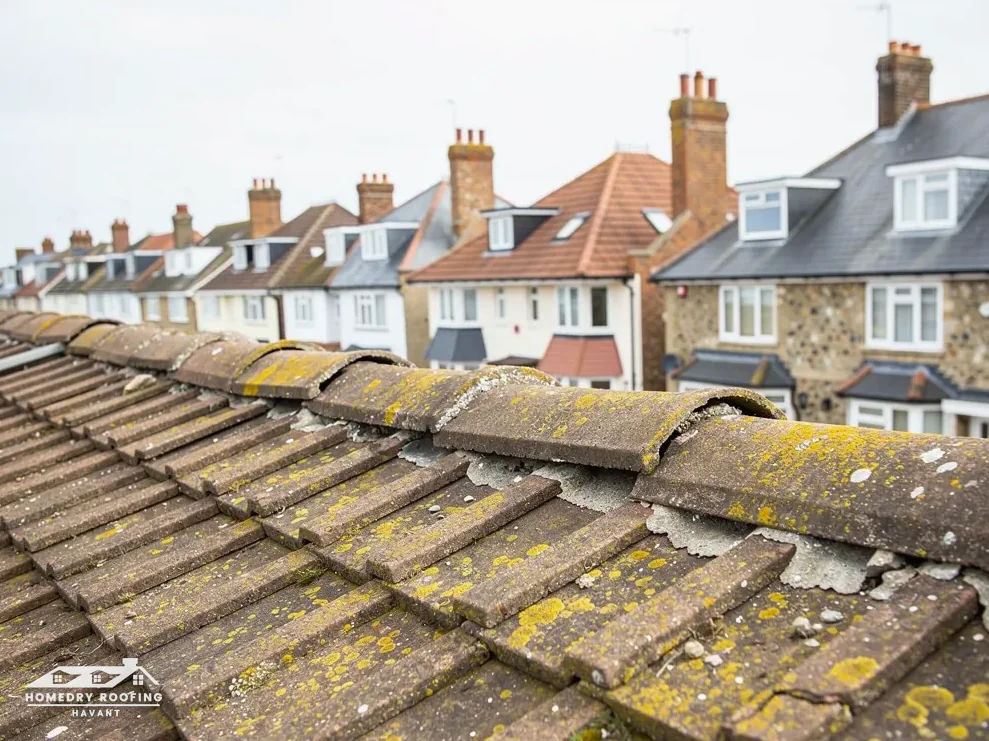
It changes how the fixings are specified. BS 5534 deals with choosing battens, fixing methods and the wind uplift sums, so a roof in an exposed position gets a calculation made for that site, using its position and its height.
Langstone sits close to the water, and a roof in that position is graded for higher exposure when its fixings are specified. The slate maker Cupa says coastal sites, hillsides and tall buildings go in a higher exposure grade. The specification for the site is then calculated under BS 5534, the British Standard that sets out how slate and tile roofs are fixed. Marley describes it as a standard that is not required by law, and adds that mortar bedding alone is no longer enough to hold the covering down. So on the survey we study how the ridge and the hips are held, and not only how they look from the pavement.
A ridge is the crest of a pitched roof, the line where its two slopes join. A hip is the sloping seam at an outside corner, where the roof wraps round the corner of the house. We look for tiles that have crept along the run, bedding mortar that has cracked or dropped away, and gaps at the end of the ridge where it meets a gable. Marley says BS 5534 requires that ridge tiles and hip tiles are mechanically fixed, so we check for fixings as well as mortar. Where a ridge needs work, we explain whether it should be re-fixed the existing way or changed to a dry system, and our dry ridge and verge page explains the second option.
Langstone lies within the Chichester Harbour National Landscape, formerly known as an Area of Outstanding Natural Beauty. The National Landscape name marks protected scenery and does not create a planning authority: Havant Borough Council decides, and ordinary re-roofing stays under the normal rules. To learn whether your own address falls inside the line, look at the designation map or ask the council. Dormers are a separate question, and the planning guide covers where they stand.
A roof near the water is judged for exposure before any fixing is chosen.
Open slopes, tall neighbours and exposed gable ends all go into the survey notes. The fixing specification is then drawn up for your roof and not copied from the last one, and the total price reflects it. Where a repair is sound, we quote for the repair, because a full set of new fixings is only worth buying when the old ones have failed.
Map of Langstone and the places around it, with the dashed line of our 30-mile service area from Havant. The same places are listed below the map.
We start outside, beside the stack. A flashing fault shows as lead lifted at its edge, a fillet that has cracked or fallen away, or a gap where the lead no longer lies against the brick. A pointing fault shows as open mortar joints in the brickwork itself, which let rain into the stack wall rather than the roof. We photograph what we find, check the loft timbers around the breast, and report which fault caused the stain. Sometimes both are present. The repair follows the cause, and the quote covers only the work the survey shows is needed.
It depends on the proportion of the roof being replaced, and on what goes back. The Planning Portal says no application is normally needed for work affecting less than 25 per cent of the building envelope and less than 50 per cent of the roof. A separate rule requires approval for a Langstone covering 15 per cent or more heavier, while the Portal suggests asking a structural engineer or surveyor first. With a Langstone address, the building regulations question goes to your building control body ahead of any work, and you hear the result from us before you commit.
A scaffold standing in the road or on the pavement needs a licence under the Highways Act, and Hampshire County Council issues it. In Hampshire County Council's words, "Scaffolding companies must apply on behalf of their customers", so we arrange the licence with our scaffolder. Hampshire County Council charges £211.90 on application for the first 2 weeks and £72 for each additional 2-week period. Between application and start date the licence needs ten clear working days. A longer stay means a fresh application, so the whole period goes on the first one, and the start date we quote has the notice built in.
A list entry applies to the building it names. Historic England's National Heritage List includes The Royal Oak Public House, The Green Cottage and The Ship Inn, each listed Grade II. If your own home has an entry, the council's consent is needed under the listed building rules for work affecting its character, and that applies even when the roof work would otherwise be permitted development. Before anyone orders materials, check your address against the National Heritage List, and tell us what it says. We can then describe the roof work in terms the council can assess, and you are not asked to guess which rules apply.
The direction, made on 6 June 2012, reaches properties in the conservation area, though only the elevations that face a public area. The leaflet from Havant Borough Council includes alteration to the roof of the house, and any chimney, flue or waste pipe work, in its list of controlled changes. Rear and side elevations that look onto no highway, footpath or public space are not included. Because an Article 4 direction can take further rights away, put your address to Havant Borough Council before work starts. Our survey notes say which slopes face the road, and the planning guide covers the rest.
No. On the Environment Agency's map for planning, the mapped centre of Langstone is shown in Flood Zone 3, which is about water at ground level, not a rule for roofs. The one place it touches our work is the foot of the downpipe, where we make sure roof water is carried away from the wall and not left to collect against it. The rest of the survey stays with the roof, ridge to lowest tile, and the gutter under it. If the ground floods, the roof still needs the same survey, in the same order, and the zone changes nothing about the covering that goes on.
Houses by the coast fall in a higher exposure grade, so the fixing specification is calculated for the site under BS 5534. That standard deals with choosing battens, fixing methods and wind uplift calculations. We look at what holds the ridge, the hips, the verges and the tile courses, not just at the tiles themselves. If the survey shows a covering needs re-fixing, the quote says what is being fixed and how. That keeps the specification tied to your roof and its position, instead of to a stock recipe for every house on the road, and it gives you a reason for each fixing that is listed.
Once the survey is done, one total price arrives in writing. The wording describes the work, names the covering that goes on and says if VAT and scaffolding are counted in that total, a point worth checking whenever you set quotes side by side. Pricing is good and fair by design, and we clear the site as we finish. The findings can be sent in writing too, photographs included, which shows what was found and where, tile by tile if you want that detail. When a repair is sound, the quote is for a repair, and we give the reason a full replacement is unnecessary.
You'll get one written total price.
Fill in what you like. It opens WhatsApp with your message ready to send.