
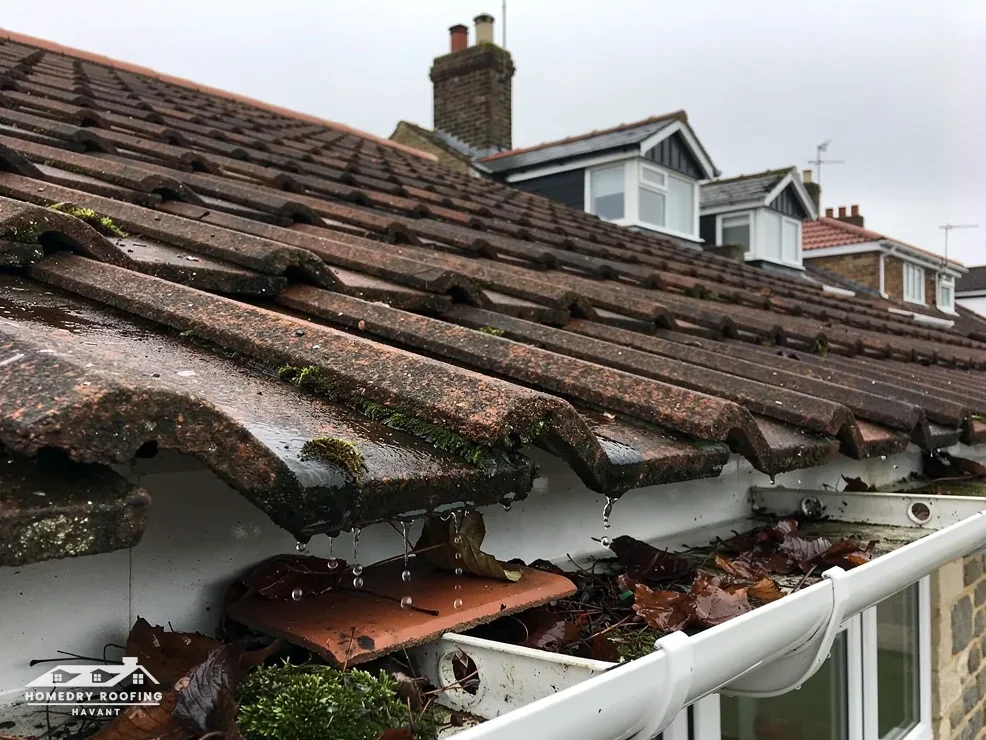
Tile edges
Where each course overlaps the one beneath and every tile depends on its fixing.
A tile that has slipped or lost its nail leaves a gap for the next squall.

Slope, fixing and flat roof work for Farlington homes, 2.6 road miles west of Havant; slopes and flat roofs are surveyed before any price is set.
10-year workmanship guarantee, in writing
Where each course overlaps the one beneath and every tile depends on its fixing.
A tile that has slipped or lost its nail leaves a gap for the next squall.
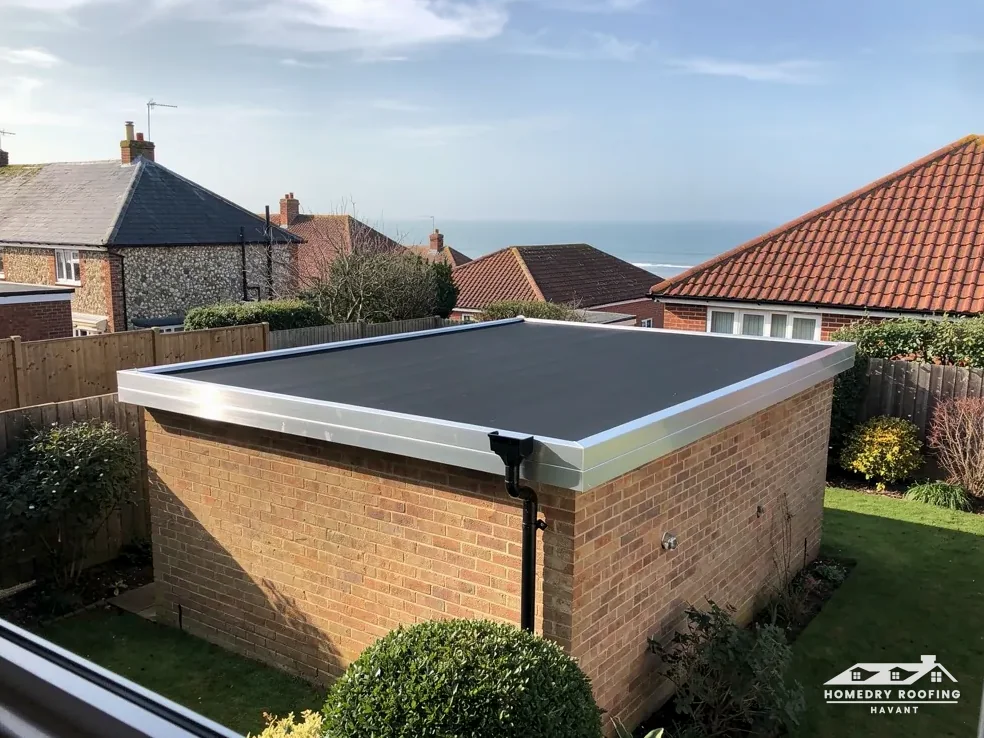
Where rain on a flat roof is meant to leave through an opening and a pipe.
Leaves or silt across the opening leave the roof holding a pool.
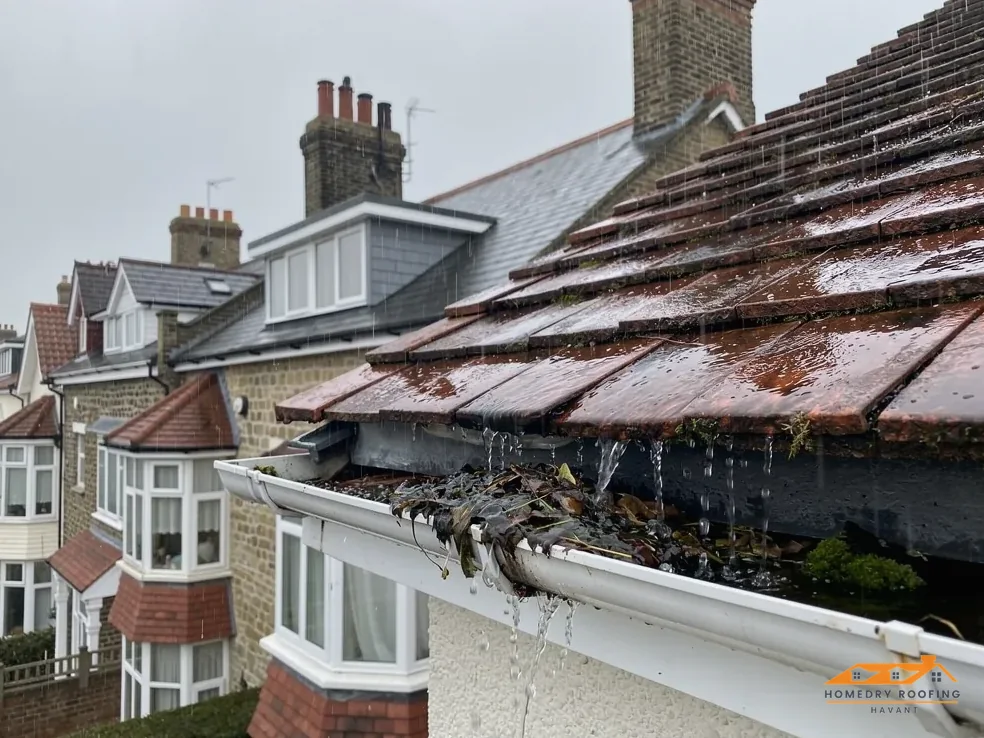
Where the board running along the eaves holds the gutter and meets the lowest course.
A board that has softened lets the gutter drop and the rain run behind it.
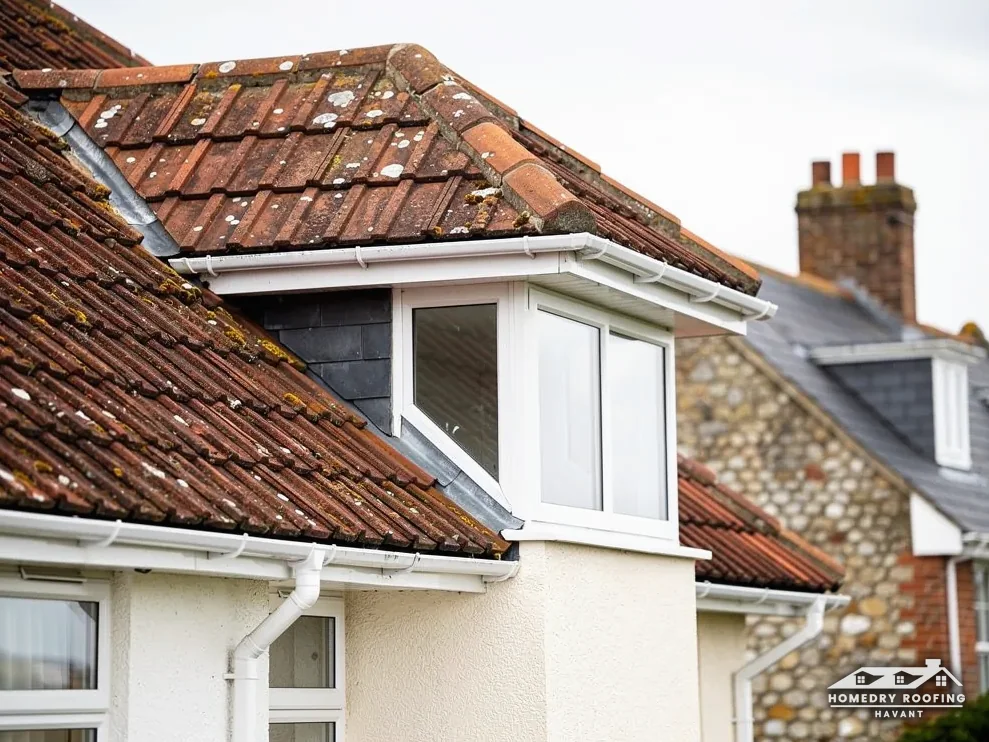
A tile is only as secure as the one small fixing holding it down.
On a pitched roof every tile overlaps the one below it, and each tile is secured with a nail, a clip or both. Farlington is within a mile of the coastline. Cupa's guidance for slating says that in coastal areas a building is graded up for exposure, so the number and type of fixings on a roof here are calculated for the site under BS 5534, and Marley points out that installing to BS 5534 isn't required by law, which makes the survey the place where the fixing is judged. We look for tiles that have slipped, nails that have worked out and clips that are missing, and we look at the ridge and the verges because those edges meet the weather first. Beneath the tiles, battens carry the courses and an underlay catches what blows past them, and from the loft we check both for damp. A slope is read in strips from the eaves upward, so that no course is passed over, and a repair is matched to the fixing method already on the roof. Our pitched roofing page lists the coverings we work with.
Church of St Andrew is listed Grade II (list entry 1333214). The Church of England runs its own faculty system for churches in use, and that system, not listed building consent, governs works to it. The Old Rectory and Milestone, East of Junction With Rectory Avenue, are also listed Grade II (entries 1333212 and 1333219), and for those the council's listed building consent route applies to work that would affect their character.
Old Bedhampton, Hilsea Lines, St John's and Brockhampton lie closest to Farlington. Hilsea Lines is Portsmouth City Council's, and the other three are Havant Borough Council's. Check your address with Portsmouth City Council, and ask it about Article 4 directions too. Our planning guide for roof work sets out the rules.
Exposure does not change what a good roof looks like. It changes how firmly the covering has to be held down. Where the site is graded for higher exposure, the number of fixings, the type of clip and the way the edges are secured are all worked out for that roof, and we record them in the written specification so that the nails and clips are known and not assumed.
A tile lying on the ground after a gale, or a row that no longer sits in line when you look along the slope.
A nail that has worked loose, a clip that is missing, or a cracked tile with the course above holding it open.
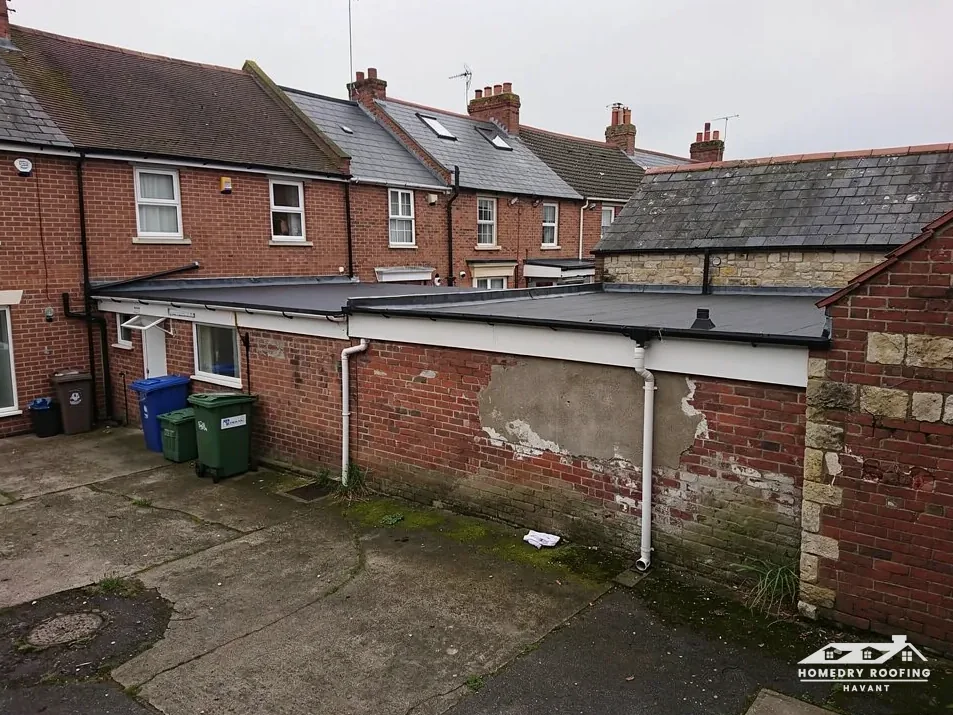
Standing water a day after rain shows where the fall has failed. It points to a dip in the deck or a blocked outlet, and each needs a different repair, so we want to see which it is.
A flat roof is never quite flat. It is laid to a fall so that rain runs to an outlet, the opening where the covering drains into a pipe or a gutter. BS 6229:2025 asks for a minimum finished fall of 1:80 on membrane flat roofs, and designing to a steeper fall leaves room for tolerances. On a Farlington flat roof we look first for standing water a day after rain, then for splits, blisters and lifted laps in the covering, and then for the outlet itself, which should be clear to the pipe. Where the roof meets a wall, the covering turns up into an upstand, so we check its top edge and its junction. A leak at an upstand shows on the ceiling just inside the wall, which is why a stain there is followed outward. Our flat roofing page lists the coverings we fit.
HomeBuilding gives approximate lifespans of 10-15 years for torch-on felt, 25-30 years for EPDM and 25-30 years for GRP, and Less gives different ranges, so the sources disagree and no covering is promised a number. What the survey can tell you is the condition of the roof as we find it, and whether a repair will hold or the covering needs replacing. A covering at the end of its life is replaced, while one with a local fault is repaired, and the survey says which of the two applies and why.
The Environment Agency flood map puts land near Farlington in Flood Zone 2. That describes ground-level flooding and does not alter the roof specification. We take one thing from it: a note of where each downpipe discharges, so that water leaving the roof is not left to collect against a wall. The price comes in writing after the survey, and we leave the site clean.
A roof that drains badly cannot be mended by covering it again.
An outlet that is half blocked turns a flat roof into a shallow tray. We lift the grate or the leaf guard, clear what has collected and see whether the pipe below takes the water away freely. If it does not, the fault is below the roof and the answer is drainage work, not a new covering. That difference is worth knowing before any quote is accepted, because the two jobs are very different in size.
Map of Farlington and the places around it, with the dashed line of our 30-mile service area from Havant. The same places are listed below the map.
We begin at the ridge and the verges, since those edges meet the weather first, then work down each slope looking for tiles that have slipped, nails that have worked out and clips that are missing. Cupa's guidance says coastal areas are graded for higher exposure, and Farlington is close to the coast, so the fixings are specified roof by roof under BS 5534. After the slopes comes the loft, where daylight or damp timber shows what the outside does not. The findings reach you with a photograph of each fault, so nothing rests on our say-so.
The Building Control Partnership, reachable on 01329 824823, runs Portsmouth's building control service. Under the Planning Portal's guide, re-roofing work affecting less than 25 per cent of the building envelope and less than 50 per cent of the roof can normally proceed with no application, though any new covering weighing 15 per cent or more over the old one has to have approval. We put the question to the Partnership before work begins and pass on its reply in everyday language, leaving you clear on the route before you commit to anything, and any structural check on the rafters is raised at the same time.
Section 169 of the Highways Act 1980 is the basis of the licence a scaffold overhanging the highway needs. In Portsmouth the hoarding and scaffolding permit goes through Colas, at £100.00 + VAT per month on its form, and we arrange the licence with our scaffolder. That monthly figure is Portsmouth's own unit, so it cannot be set beside another council's fee. Your start date allows for the permit to be issued before any pole goes up, and we tell you the date once it is confirmed. The Colas form is where the request goes, and not a district office.
Church of St Andrew is listed Grade II (list entry 1333214) and is used as a Church of England church, so works to it follow the faculty system and not listed building consent. A listed private house works the other way: its owner needs listed building consent for work that would affect its character, although a listed home keeps its permitted development rights for roof work. Before we price anything, we explain which of the two routes applies to your own building, and what the consent body will want to see, so the paperwork is ready when the application goes in.
Portsmouth City Council holds the answer. Old Bedhampton, Hilsea Lines, St John's and Brockhampton lie closest to Farlington, and your road could sit inside one or outside all of them. Portsmouth lists Article 4 directions conservation area by conservation area, so the council is the place to confirm your address. We write the survey so that it can go to the council as it stands, with nothing to redraft or retype, and the nearby conservation areas are named in it so the council can see what was considered.
No. The Environment Agency flood map puts land near Farlington in Flood Zone 2, which describes ground-level flooding, not rain coming through a roof. It does not change the covering, the fixings or the survey. The one thing we take from it is care about where each downpipe discharges, since water leaving the roof should not be left to collect at a wall or a footing. Everything else is judged on the roof itself, from ridge to gutter, in the order the rain runs, and the flood zone plays no part in the quote, which is built from what the roof itself shows.
That depends on what the survey shows. If water is still lying a day after rain, the fall has failed somewhere, and a new covering laid over the same dip will pond in the same place. BS 6229:2025 asks for a minimum finished fall of 1:80 on membrane flat roofs, so the roof is designed to a steeper fall to allow for tolerances. If the deck is sound and the outlet was simply blocked, a repair may be enough, and we tell you which it is, with the photographs that led us to say so.
Farlington quotes are a single sum, put in writing after the survey has been done. Look in the quote for the type of covering being laid and for a plain statement of whether the total covers VAT and scaffold, a point to test on any other quote in your hand. If a sound repair turns out to be enough, you are quoted for the repair alone. Findings arrive in writing too, so every item of work can be tied back to something found on the roof, and the site is cleared away when the job is finished. Ask for anything unclear to be explained before you agree, and we will go through it.
You'll get one written total price.
Fill in what you like. It opens WhatsApp with your message ready to send.