
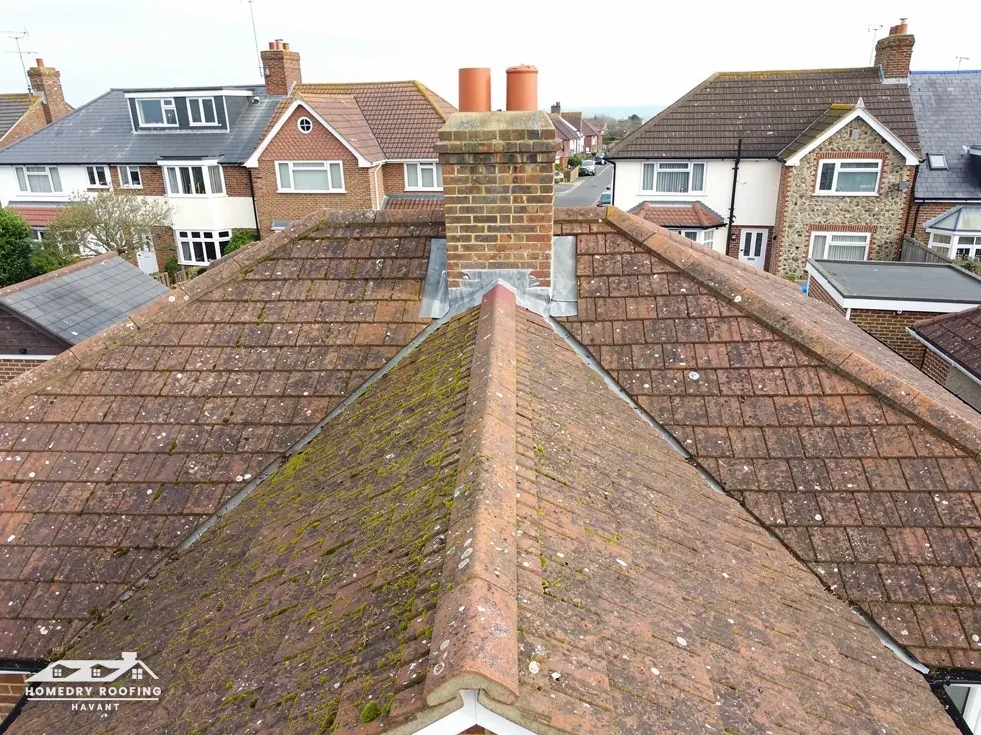
Hips
Where a sloping hip tile meets the ridge bedding above a Hilsea bay window or porch.
A loose end tile there lets rain run beneath the course below it and into the batten space.

Roof repairs and re-roofs in Hilsea, a district of Portsmouth, with the cause traced patiently from the ridge downwards and one written total price.
10-year workmanship guarantee, in writing
Where a sloping hip tile meets the ridge bedding above a Hilsea bay window or porch.
A loose end tile there lets rain run beneath the course below it and into the batten space.

Where a gutter empties into the hopper head at the top of a downpipe on a side wall.
A blocked hopper sends the overflow down the brickwork and past the drain.
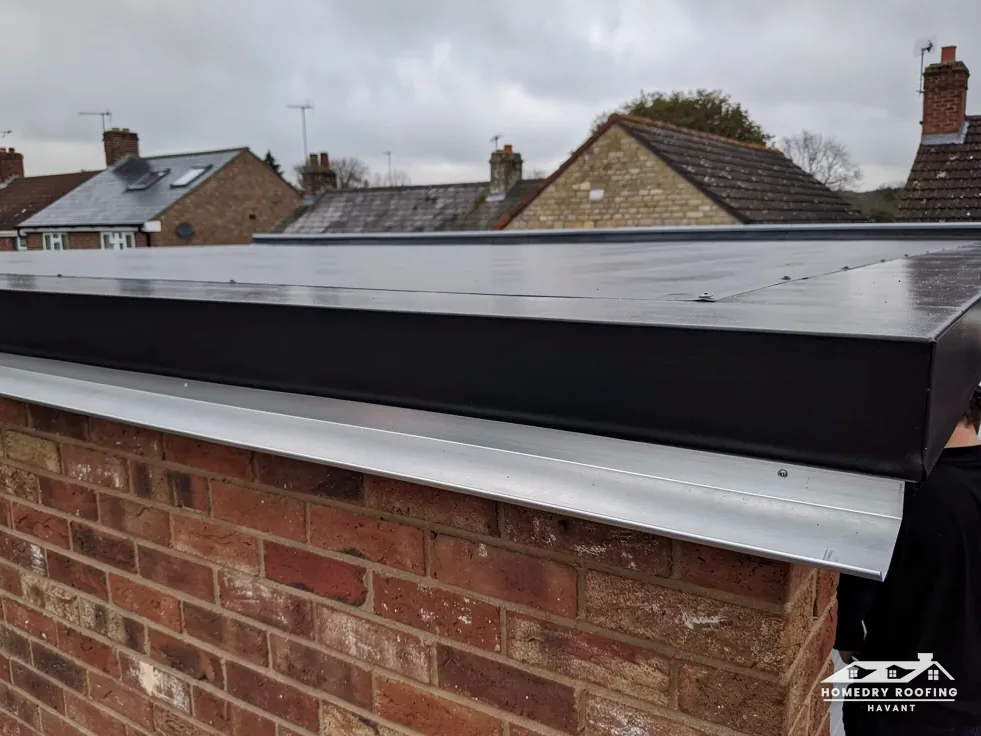
Where the covering on a flat porch or garage turns up the house wall behind the gutter.
If that edge lifts, rain tracks behind the finish and stains the wall indoors.
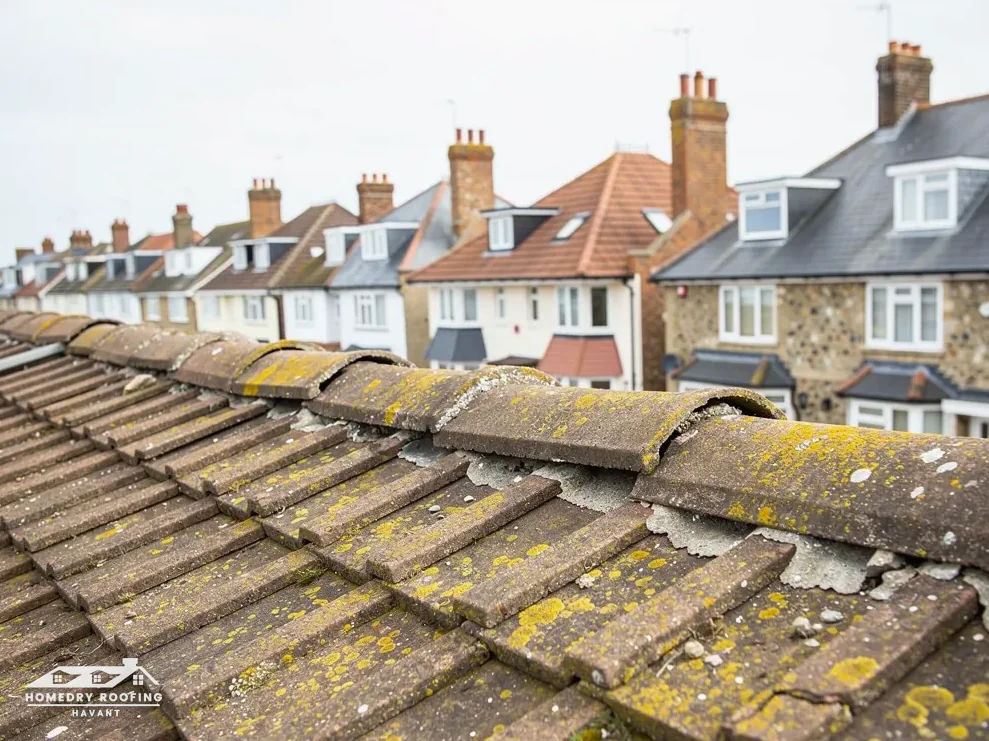
The stain on the ceiling shows where the rain ended, not where it began.
Start at the highest point, because that is where the rain arrives first. On a Hilsea roof we sight along the ridge from the ladder, checking the mortar bedding for hairline cracks and each hip tile for movement, then take the slopes one at a time, looking for tiles that have slid, snapped or lifted. The gable verge comes next, and after it the loft, where torchlight on the underlay and the rafters shows whether damp has been arriving for a week or for years. The damp showing indoors may be some distance from the break that let it in, so a roof repair begins with finding the cause.
Protected ground sits close by. Portsmouth City Council has designated the Hilsea Lines conservation area, and Hilsea Lines also appears on the National Heritage List as a scheduled monument (entry 1001861); works to a scheduled monument need consent under the Ancient Monuments and Archaeological Areas Act 1979, section 2. Its Grade II entries include Former Barn to North of Green Farmhouse (entry 1387038) and Green Farmhouse (entry 1387036). A listed Hilsea house still has permitted development rights for its roof, with listed building consent needed as well for anything that affects the building's character (Listed Buildings Act 1990, section 7).
Portsmouth City Council decides under the usual planning rules for a house with no entry. Re-tiling a house falls under permitted development in the normal way, conservation areas included, though an Article 4 direction can take extra rights away. Portsmouth City Council's conservation area pages show no Article 4 direction for Hilsea Lines, but only the council can answer for your particular road, so ask it directly before you order anything. We keep the full rules in the planning guide for roof work and do not restate them here.
Each listing applies to a single building, so the house across the road may have no entry while yours does. Searching the National Heritage List by address takes a minute, and the entry page shows the grade. If yours appears, tell us at the survey and we will go through the consent route together before any tile is lifted. If it does not, the ordinary rules apply, and you can carry on.
A pale brown ring spreading on a landing ceiling, or a musty smell in the loft after a wet week of weather.
A hairline crack along the ridge bedding, or a hip tile out of place, so blown rain gets past the top course.
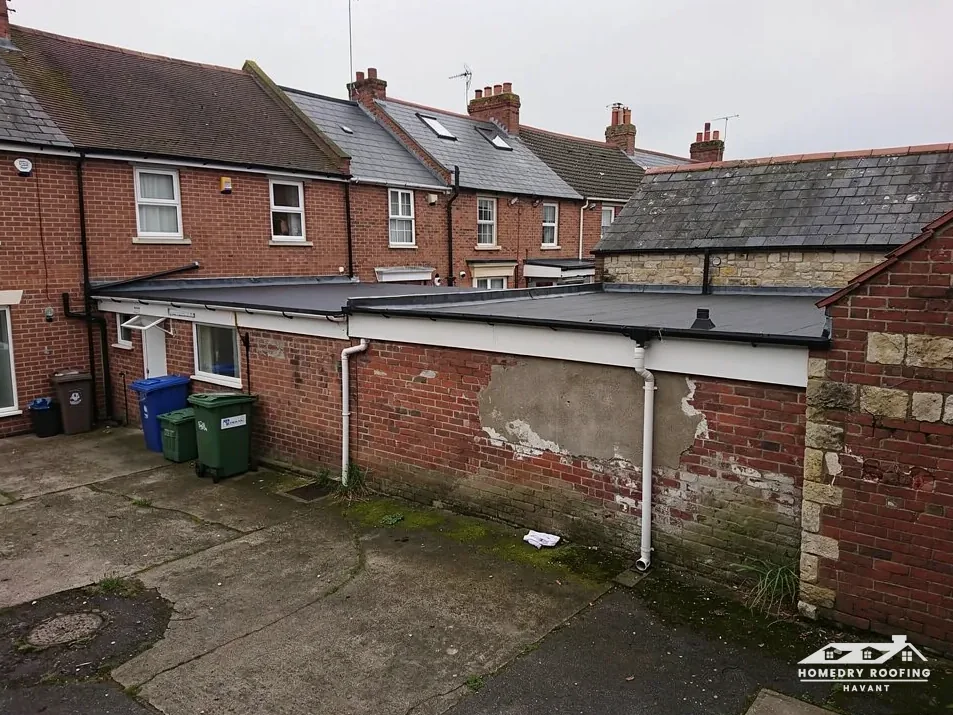
Water that stays after the rain has stopped means the surface falls the wrong way or the outlet is partly blocked. Both strain the upstand and the seams, so we identify which applies before suggesting a patch or a new covering, and we show you the evidence.
Water leaving the slope drops into the gutter, so the survey follows it there. We sight along each run for a sag, test the joints for drips and check the brackets, because a gutter that has dropped by a few millimetres holds a pool instead of passing it on. The downpipe is traced from hopper to shoe, offsets and joints included, and we note where it discharges. Behind and beneath, the fascia and soffit give the game away when a gutter has overflowed for a long time: soft timber, flaking paint, a stain on the underside of the eaves. Sometimes the answer is a clear-out and a refix, and then that is all we will price; see our gutter, fascia and soffit work.
A flat garage or porch roof fails in its own places. The covering is carried up the brickwork as an upstand, the joints run across the sheet, and the outlet takes everything the surface collects. Standing water after rain points to falls that run the wrong way or an outlet that is partly blocked, and a split along the wall points to movement or age. We examine each in turn and tell you whether a patch gives a sound result or the covering is spent. The coverings we fit are described on the flat roofing page.
The Environment Agency's flood map places the mapped centre of Hilsea in Flood Zone 3. That is a statement about flooding from rivers and the sea, not a roofing rule, and it changes nothing about how a roof is surveyed. It does serve as a reminder to look at the foot of each downpipe, since a pipe that empties against masonry or into a silted drain is worth reporting while we are there. The site is left tidy, and one written total price follows the survey.
A roof has done its job only once the rain is safely in the drain.
Hilsea counts as a coastal district, and Cupa, the slate maker, says coastal buildings are given a higher exposure grading. That is why a fixing specification for a roof here is calculated for the site under BS 5534. Marley points out that BS 5534 isn't required by law, but it says mortar by itself "could no longer be relied upon" as the fixing, so we write the method of fixing into your quote, where you can read it before agreeing.
Map of Hilsea and the places around it, with the dashed line of our 30-mile service area from Havant. The same places are listed below the map.
We climb to the ridge and work down: hips, each slope, the verge, the valleys and the flashings round any chimney, before turning to the gutters and downpipes. Inside, the loft hatch lets us study the underlay and timbers wherever we can reach them. By the close of the visit we aim to name the single place the rain gets in, and to say plainly whether mending that spot is enough or the roof is due for replacement, with the reasons behind it. You receive all of this in writing alongside the price, with photographs where they help, so you can check it against the roof yourself. A sound roof gets told it is sound.
Under the Planning Portal's guide, re-roofing does not normally need a building regulations application if it affects less than 25 per cent of the building envelope and less than 50 per cent of the roof. Approval is required where the new covering is 15 per cent or more heavier, so get the load checked before you choose one. In Portsmouth, the building control service is run by the Building Control Partnership (01329 824823). We confirm the route with them before any work begins, which spares you from guessing which side of those limits your roof lands, and from finding out afterwards.
The highway here belongs to Portsmouth City Council, and Colas takes the application for its hoarding and scaffolding permit at £100.00 + VAT per month on the form. There is nothing for you to fill in, because we arrange the licence with our scaffolder. Scaffolding that stands over a pavement is a matter separate from the roof itself, so we raise it during the survey and note the pavement width. Neighbours on a narrow street then hear about it early, which avoids awkward surprises, and the start date you are quoted reflects the time the permit can take to come through.
Hilsea Lines is a scheduled monument (National Heritage List entry 1001861), and works to the monument itself need consent under the Ancient Monuments and Archaeological Areas Act 1979, section 2. A house standing elsewhere is not the monument, so the entry does not turn an ordinary re-roof into a consent matter. The dependable way to settle your own address is to search the National Heritage List or ask Portsmouth City Council. If the answer is unclear, we hold the job until it is clear, and you hear from us first, with the reasons set out in writing.
Portsmouth City Council has designated the Hilsea Lines conservation area, and it can tell you if your road falls within the boundary. New tiles on a house roof are normally permitted development, whether or not a conservation area applies, but an Article 4 direction can remove further rights. The council's entry for Hilsea Lines shows no such direction, yet one street is still the council's call, so check with Portsmouth City Council before booking work. Our planning guide covers dormers and other changes, so those rules are left out here, and a short call to the council settles the question for your road.
No. The flood map from the Environment Agency shows the mapped centre of Hilsea in Flood Zone 3, which concerns water arriving at ground level from rivers or tidal water. A leaking roof has different causes, and we never treat a flood zone as a roofing rule. During a visit we note where the gutters and downpipes empty, since rainfall delivered clear of a wall's base is one less thing for the ground beside the house to absorb. It is a drainage remark made in passing, and nothing grander than that.
Cupa, the slate maker, says a site on the coast is graded for higher exposure, so the fixing specification is calculated for the site under BS 5534. Marley notes that following BS 5534 isn't required by law, and it says mortar on its own "could no longer be relied upon" to secure the covering. The way tiles, ridges and verges are held is therefore written into the specification instead of being left to habit. Ask us to point out each fixing position before work starts, and keep that specification with your quote, so anyone who works on the roof later can see exactly what was done and how it was fixed.
One written total price, given once the survey is done rather than before it. The quote lists the job and the roof covering chosen, and should be clear on whether VAT and scaffolding sit inside the total, a point to test on each quote you hold. Our advice is straightforward: a sound repair is chosen ahead of a replacement, and if the roof has run its course we explain what points to replacing it. Tidying up is part of the job, and the price aims to be good and fair for all of it.
You'll get one written total price.
Fill in what you like. It opens WhatsApp with your message ready to send.