

Valleys
Where two Copnor slopes run together and carry their rain down a narrow lined channel.
Moss or a worn lining there sends the flow sideways under the neighbouring tiles and into the battens.

Roof repairs and re-roofs in Copnor, a district of Portsmouth, found by starting in the loft and ending at the drain, with one written total price.
10-year workmanship guarantee, in writing
Where two Copnor slopes run together and carry their rain down a narrow lined channel.
Moss or a worn lining there sends the flow sideways under the neighbouring tiles and into the battens.
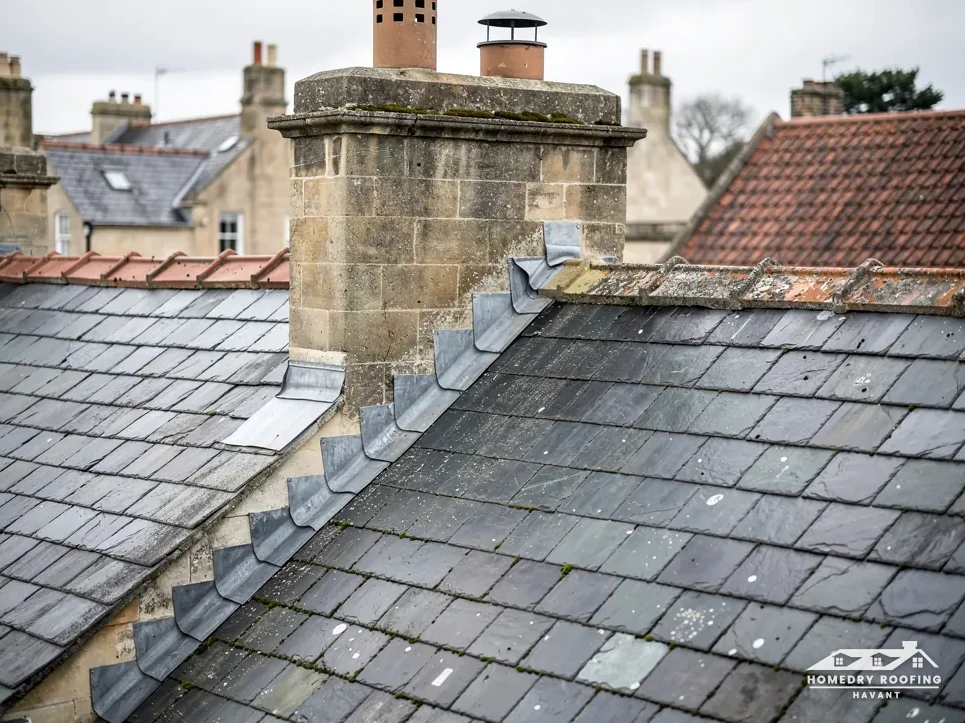
Where a chimney stack or party wall rises through the tiles of a Copnor roof.
A lifted edge on the flashing there gives rain a way behind the brickwork.
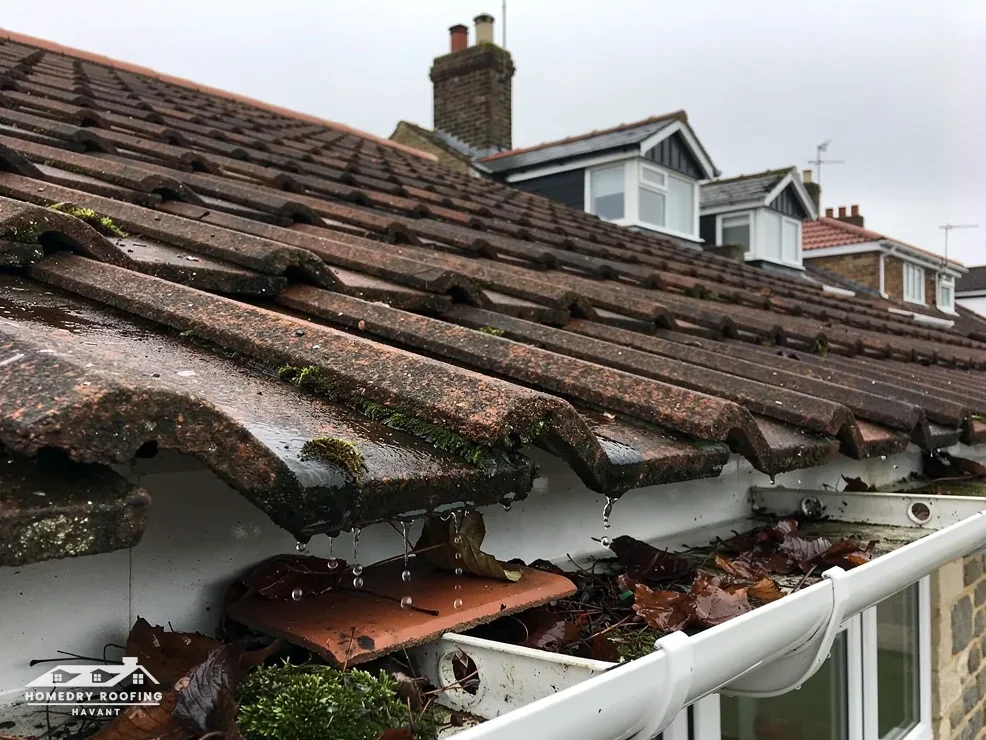
Where boards under the eaves shut off the void where the wall meets the roof.
A soft or peeling board there shows that gutter water has been spilling past for some time, unseen.
Yes. Rain can run along a rafter or the underlay before it drips, so the mark may sit some distance from the entry point. Tracing it from the loft upwards finds the real source, which is why a Copnor survey starts indoors.
Rain does not care where the stain turns up, so a Copnor survey starts indoors and ends on the ridge. In the loft we look at the underside of each slope for dark timber, daylight through the covering and damp insulation, then trace any mark upwards towards the valley, chimney or hip that is feeding it. Outside we confirm what the loft suggested: valleys and the gutters beneath them, flashings round stacks and walls, tiles that have slid or cracked, and the ridge line. The order matters, because a patch laid where the stain shows can miss the entry point altogether, while a roof repair made at the real source deals with it.
Church of St Alban is listed Grade II (National Heritage List entry 1387029). The church is currently used for Church of England worship, which places works to it under the Church of England's faculty system, not listed building consent. A listed house is another matter: it keeps its permitted development rights for roof work, but listed building consent is needed for whatever alters the building's character, under section 7 of the Listed Buildings Act 1990. The National Heritage List records one listed building near the centre of Copnor, so search the list by address before assuming either way.
Portsmouth City Council decides planning in Copnor, and the conservation areas closest to it include St Mary's Churchyard, Fratton; Mile End, Landport; and Hilsea Lines; the council's own list is the place to test your address. Changing the tiles on a house is normally permitted development even inside a conservation area, though an Article 4 direction can remove further rights. Portsmouth City Council publishes its directions for named addresses, conservation area by conservation area, so check with it for your street. The planning guide for roof work holds the detail, and this page leaves it there.
Mend the point of entry, and the stain has nothing more to feed on.
A church in use by the Church of England follows the faculty system instead of listed building consent, which catches out people who assume every listing takes the same route. A homeowner's roof is a different case, governed by the council and not by the church. If you are responsible for a Church of England church building, raise the roof question through the Church of England process before any quote is accepted.

A gutter has to empty, so we check its outlet as well.
Water leaving the slope is carried by the gutter and the downpipe, and from the ground it is easy to miss that either has failed. We look for a run that has dropped from its brackets, a joint that stains the wall beneath it, and a hopper packed with silt and moss. Fascia boards and soffits come next: a board that gives under thumb pressure, or a soffit that has peeled and darkened, tells us rain has been spilling past the gutter for a while. Plastic or timber, the repairs are described on our gutters, fascias and soffits page, and a cleaned and refixed run is sometimes all a gutter needs.
Flat roofs over extensions and garages call for their own checks. Where the covering meets the wall, the edge should stand tall enough to throw rain off, and the junction must be intact. On the sheet we press for soft spots, look along the seams for splits and blisters, and judge whether the surface falls towards the outlet. The coverings we fit are set out under flat roofing, and the survey closes with a clear recommendation: patch it or replace it, and the reasons for either, written down so you can weigh them against any other opinion you collect.
Land near Copnor lies in Flood Zone 3 on the Environment Agency's flood map. That concerns ground and rivers, not roofs, and we do not treat it as a roofing rule. It is still worth a glance at where each downpipe ends up at the bottom, since a pipe discharging against a wall or into a silted gully is a fault we would flag on our visit, separately from the roof. Before leaving we tidy the site, and one written total price follows the survey.
Copnor is a coastal district, and Cupa, the slate maker, notes that coastal areas are graded with higher exposure. In practice a fixing specification gets worked out for the site under BS 5534, not copied from a stock detail. Marley says BS 5534 isn't required by law, yet tile fixing no longer rests on mortar alone, so the written specification states how tiles and ridges are fixed.
Green streaks down the wall below a gutter joint, or a damp patch on the soffit at the eaves.
A joint that has opened or a run that no longer falls to the outlet, so the flow spills over the front.
Because the ceiling stain is the end of the story, and the loft shows the middle of it. Looking up at the underside of the slope, we can see dark timber, daylight, damp insulation and the line a leak has taken, and that sends us to the right valley, hip or chimney outside. The ladder work follows, down every slope, with the valleys, flashings and ridge, then the gutters and downpipes at the eaves. You receive our findings in writing with the price, and where the roof is sound we say that plainly, so nothing is replaced without a reason.
Under the Planning Portal's guide, re-roofing does not normally need a building regulations application if it affects less than 25 per cent of the building envelope and less than 50 per cent of the roof. A covering 15 per cent or more heavier needs approval, so the load should be assessed by someone qualified before you commit to a heavier tile. For Portsmouth, the Building Control Partnership carries out building control, and its number is 01329 824823. We confirm which side of the limits a job falls on before it begins, so there is no uncertainty halfway through the work.
Portsmouth City Council is the highway authority, and its hoarding and scaffolding permit goes through Colas at £100.00 + VAT per month. We arrange the licence with our scaffolder, so you do not chase a form or wait on the council yourself. A scaffold that overhangs a pavement or narrows a road is worth discussing early, because it affects neighbours, parked cars and deliveries to the house. At the survey we look at the frontage and the width of the pavement, tell you what the job will need, and give you a start date that allows for the permit to come through.
Nothing changes by proximity alone, because a listing belongs to one building and not to a street. Church of St Alban is listed Grade II (National Heritage List entry 1387029) and, as a Church of England church in use, its own works go through the faculty system, not listed building consent. A neighbouring house is affected only if the house itself is listed, and then work touching its character calls for listed building consent. Searching the National Heritage List by your address answers that in a minute, and the entry page names the grade. If your home does appear, ask us before any quote is signed.
St Mary's Churchyard, Fratton; Mile End, Landport; and Hilsea Lines are among the closest, so those names are the place to start. Portsmouth City Council holds the authoritative list and the maps, and it is who to ask about your address. Changing the tiles on a house is normally permitted development even in a conservation area, but an Article 4 direction can remove further rights, so a call to the council before booking is sensible, and takes only a few minutes. Our planning guide handles dormers and the other changes, which this page does not repeat.
Land near Copnor sits in Flood Zone 3 on the Environment Agency's flood map, and that describes the ground, rivers and tidal water. No roofing rule follows from it, and a roof leaks for different reasons. Where it helps is as a prompt to check what happens to the water after it leaves the gutter, so we look at where each downpipe discharges and whether the gully beneath it is clear. If something is wrong at ground level, we tell you what we saw, and it stays separate from the roof quote so the two are never muddled together.
Copnor is a coastal district, and Cupa, the slate maker, says coastal sites get a higher exposure grading. So the fixing specification is calculated for the site under BS 5534, rather than taken from a stock detail. Marley points out that BS 5534 isn't required by law, yet tile fixing no longer rests on mortar alone where ridge and hip tiles are concerned. We set the method out in writing, including how the ridge is fixed and what holds each verge tile, and you can then compare it against any other quote you hold.
It comes after the survey and never before it, and it is one written total price for the whole job, from the first tile to the last bucket of rubbish. It states the job and the roofing material, and you should check it makes clear if VAT and scaffolding sit in the total, as quotes differ on that. If a repair is sound, we recommend the repair, and if a roof is spent we explain the evidence for replacing it, with photographs of what we found. We leave the site clean, and we price the work to be good and fair.
You'll get one written total price.
Fill in what you like. It opens WhatsApp with your message ready to send.