
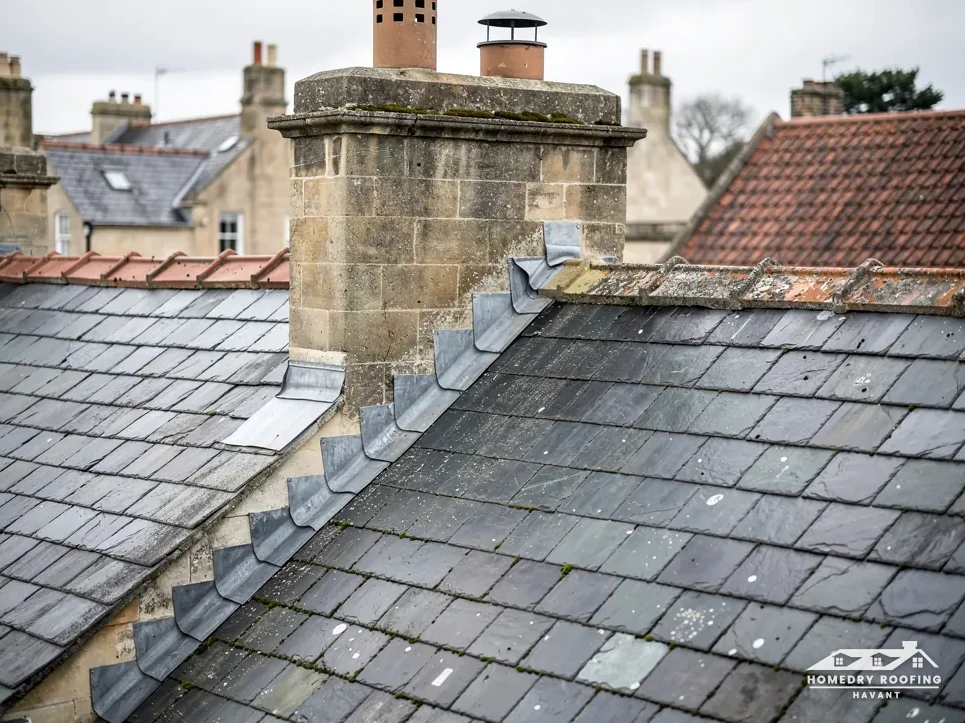
Flashings
Where a chimney stack meets the slope and a strip of metal closes the gap.
Once an edge lifts, rain gets behind the strip and into the brickwork.

Roofing for Eastney homes and buildings near the shoreline, from a lifted flashing to a full re-roof, with one written total price following on from the survey.
10-year workmanship guarantee, in writing
Where a chimney stack meets the slope and a strip of metal closes the gap.
Once an edge lifts, rain gets behind the strip and into the brickwork.
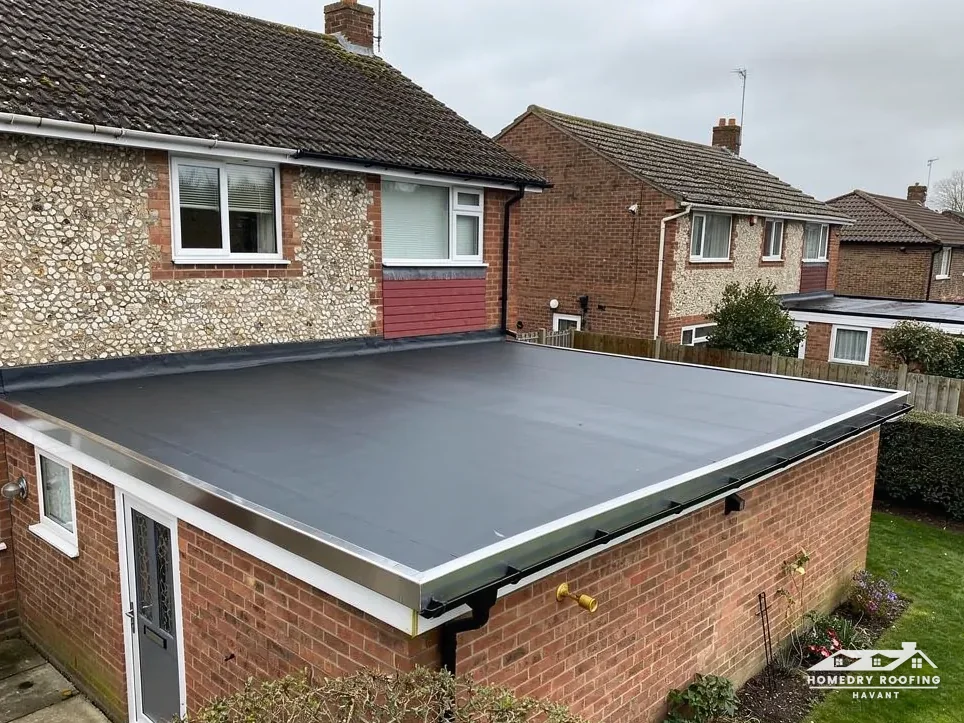
The single opening at the lowest point of a flat roof, where all its water leaves.
A clogged outlet keeps the water on the roof, working away at the seams.

Where the lowest course of tiles overhangs the wall above the gutter.
A dropped tile at the eaves sends water behind the gutter and down the wall face.

A stack stands up through the slope, so every side of it is a joint, and the rain running down the tiles meets all of them. A gap in the metal or its pointing lets water into the brickwork, and from there into the house.
The awkward parts of a pitched roof are the places where it meets something taller: a chimney stack, a party wall, the side of a bay window. Metal is dressed into each of those joints to carry the rain past them, and that metal is the flashing. The survey spends time there, because one gap lets water into the brickwork. We check how the metal is tucked into the masonry, whether the mortar holding it has crumbled, and whether any edge has lifted or split. Where a stack looks cracked at the top, we look at its pots and cement bed as well. After that come the tiles beside it, the ridge above, the verge and, from the loft hatch, the timbers beneath. A roof repair starts by following that route.
Eastney carries more protection than one list. Two conservation areas lie close to the centre, St Andrew's Church, Eastney and Eastney Barracks, and Portsmouth City Council decides planning for both. Historic England's National Heritage List holds Eastney Depot: Engine House, Eastney Depot: Gas Engine House and Eastney Beam Engine Museum, each at Grade II, and it also names Eastney Sewage Pumping Station as a scheduled monument. Changes that alter a listed building's character call for listed building consent, whereas works to a scheduled monument need scheduled monument consent under section 2 of the 1979 Act, which is a separate route.
For a house, a new covering is normally permitted development even within a conservation area, though an Article 4 direction can take further rights away. Portsmouth City Council's pages for those two areas show no such direction, but that does not settle your own street, so ask the council before any covering is ordered. Our planning guide for roof work covers what else changes, and we go through it with you when a house falls inside one.
Flashing holds only while the brickwork it is tucked into holds.
A scheduled monument and a listed building are protected under different Acts, and the route to consent differs. Eastney Sewage Pumping Station is scheduled, while its neighbours in the depot are listed. If your property is close to either, the first job is to find out whether any entry covers your own roof at all, because the entry page on the National Heritage List names the kind of protection it gives.
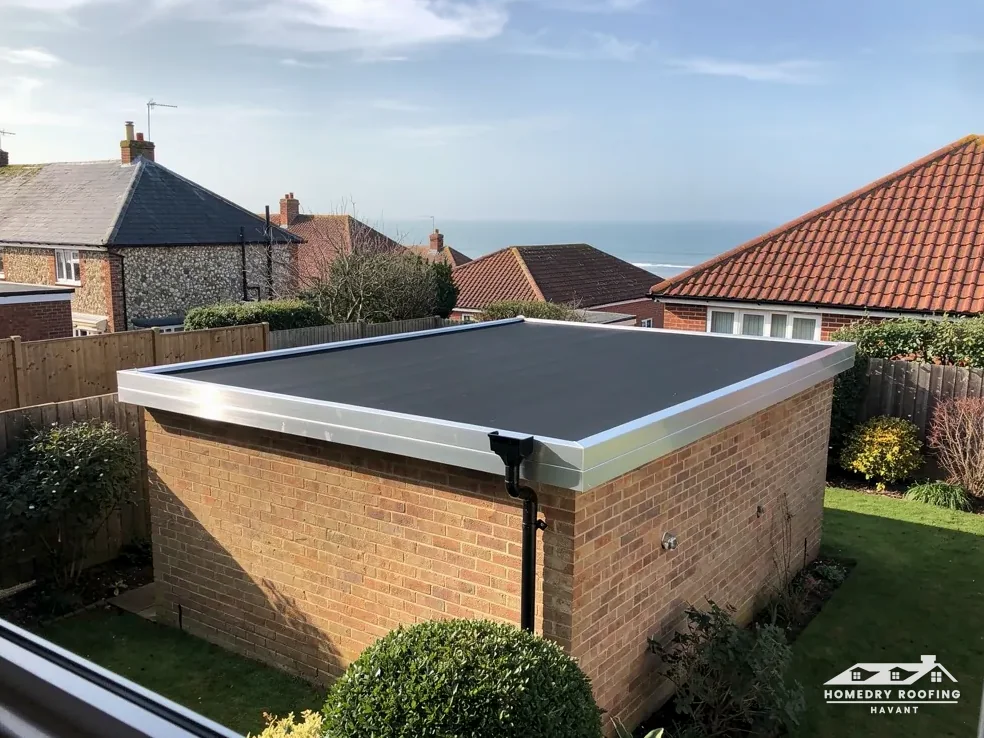
The longest wait on a flat roof is for the water it cannot shed.
Flat roofs come last on the route, whether over an extension or a garage. A flat roof drains to one low point, so everything depends on the covering falling towards it. We look for puddles still standing a day after rain, for blisters and splits, and for the upstand, the short turn-up of covering against the wall, which deserves close attention. Where the flat roof meets the house wall, we look at that junction from both sides, since a stain inside a back room may start at the joint rather than in the middle of the roof. The outlet is checked for debris and for how firmly it is fixed. Our flat roofing page lists the coverings we fit, and the survey tells you whether yours needs repair or a new covering, with the reason.
Eastney sits close to the shoreline, and that bears on fixings. Cupa, the slate maker, names coastal areas among the positions that "will be graded with higher exposure". The fixing method for a roof here is therefore worked out for the site under BS 5534, rather than carried over from the last job. Marley adds that the standard isn't required by law, and says mortar alone "could no longer be relied upon" to hold a covering, so a ridge, a hip and a verge each get a named fixing in the specification, which you can read before any work begins.
The Environment Agency's map shows Flood Zone 3 across land near Eastney. That is a ground-level matter, separate from how a roof is built, so the survey stays with the roof, the gutters and the place where each downpipe discharges. A downpipe ending against masonry is written up for you plainly, as its own item.
The fixing method is part of what you are buying, so ask to see it written down. A specification that states how the tiles, ridge and verge are held shows the job was planned for an exposed site and not left to habit. We keep a copy with your quote and go through it at the survey, so that every fixing is accounted for before any tile is lifted from the roof, and so you know what was agreed.
A bubble in the covering, or a stain that darkens on the ceiling below after every spell of rain.
A split at the upstand or a seam that has opened, where the covering meets the wall or another sheet.
Map of Eastney and the places around it, with the dashed line of our 30-mile service area from Havant. The same places are listed below the map.
A stack stands up through the slope, so rain running down the tiles meets every side of it. The metal flashing that closes each joint, the mortar holding it in the brickwork and the tiles around the base all get a close look, as does the top of the stack. Where a strip has lifted or split, we show you the fault, explain whether a repair closes it, and give the cost in writing once the survey is complete. If the flashing is sound, the leak is traced to another part of the route and we carry on down.
According to the Planning Portal, a re-roof needs no building regulations application as a rule when less than 25 per cent of the building envelope and less than 50 per cent of the roof is changed, and a covering 15 per cent or more heavier needs approval. Portsmouth's building control is carried out by the Building Control Partnership, with a Business Support team on 01329 824823. For an Eastney address the building regulations route is settled before any tile is lifted, and where the weight changes we suggest a structural check first, so the rafters are known to carry it.
Scaffolding on the highway needs one. We arrange the licence with our scaffolder, so no form comes your way at all, while in Portsmouth the hoarding and scaffolding permit goes through Colas, and its form gives £100.00 + VAT per month. At the survey we tell you whether the frame will stand over a pavement, since that shapes the order of jobs and the start date we can offer. If you would like to see the permit before work begins, ask us and we will show you it once it is issued.
Only where your own roof belongs to a protected building. Eastney Depot: Engine House, Eastney Depot: Gas Engine House and Eastney Beam Engine Museum are listed at Grade II, and Eastney Sewage Pumping Station is a scheduled monument. Altering the character of a listed building calls for listed building consent, whereas scheduled monument consent is a separate route under the 1979 Act. A house without an entry keeps ordinary permitted development for a re-roof, so look up your address on Historic England's National Heritage List first, then talk to us before the survey, and bring the entry if there is one.
St Andrew's Church, Eastney and Eastney Barracks are the conservation areas close to the centre, so put the question to Portsmouth City Council. Inside a conservation area a house keeps its permitted development rights for a new covering as a rule, but Article 4 directions can remove further rights. The council's pages for these two areas show none. Treat that as a prompt to phone Portsmouth City Council with your address, not as an answer, because the council knows its own streets better than any map does. Our planning guide covers dormers and the other changes, and we read it through with you when it matters.
With coastal areas in the higher exposure grading used by Cupa, the slate maker, a roof near the Eastney shoreline has its fixings specified for the site under BS 5534. Marley's point is that installing to BS 5534 isn't required by law, yet bedding mortar cannot be the only fixing any more. So the method for the tiles, ridge, hips and verge goes into the written specification. Compare that paper with any other quote, and ask us to talk through each fixing before you agree, so that the choice stays yours and the paper tells you exactly what holds the covering down.
No. Land near Eastney is shown in Flood Zone 3 by the Environment Agency's flood map, a zone about water reaching the ground from rivers or the sea. A roof leak is rain getting in from above, so the zone is not a roofing rule and changes nothing on the job. What we do check is where the gutters and downpipes discharge, because clear drainage at the roof edge helps keep rainwater away from the foot of the wall. Any pipe that ends in the wrong place gets noted for you.
The survey. We climb up, follow the water from ridge to drain, and write down the one place it gets in. Only then do you receive a price, as one written total that states the work covered and the covering used. Look for VAT and the scaffold on any quote you compare, as one may include them and another leave them out. Where a repair is sound, it comes before a replacement. The job ends with the gutters running clear and the ground swept, and photographs of what we found stay with your paperwork, so the roof has a record after we leave.
You'll get one written total price.
Fill in what you like. It opens WhatsApp with your message ready to send.