
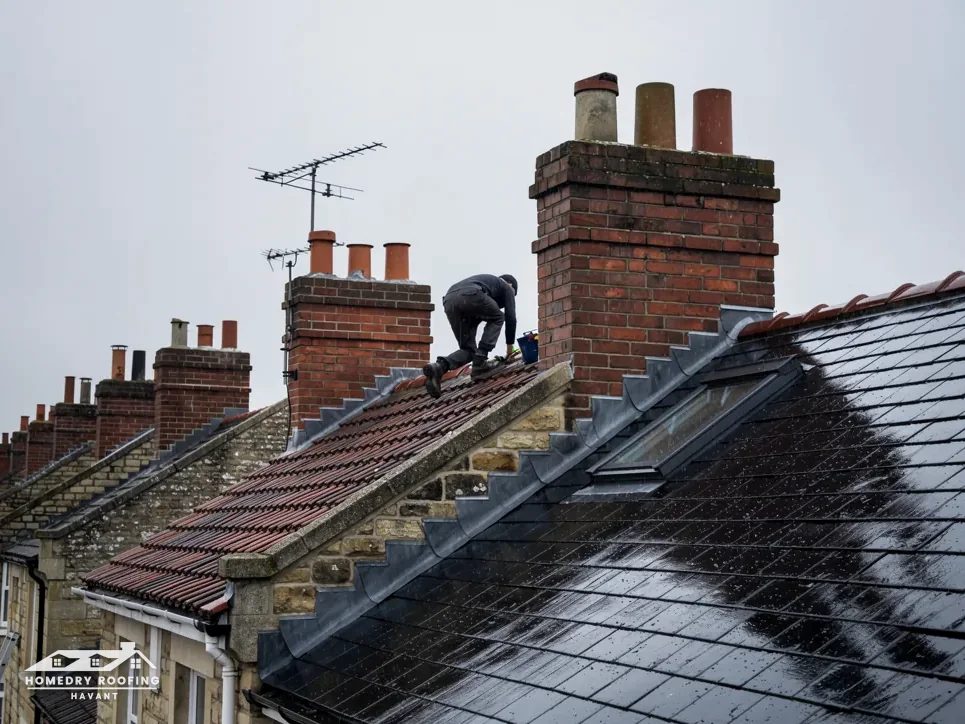
Chimneys
Where a brick stack stands up out of the slope with tiles meeting it all round.
Crumbled pointing in the stack passes rain through the joints and into the brick.

Chimneys, lead details and roof repairs in Old Portsmouth, checked from ridge to drain, and one written total price to follow the visit, whatever the work turns out to be.
10-year workmanship guarantee, in writing
Where a brick stack stands up out of the slope with tiles meeting it all round.
Crumbled pointing in the stack passes rain through the joints and into the brick.
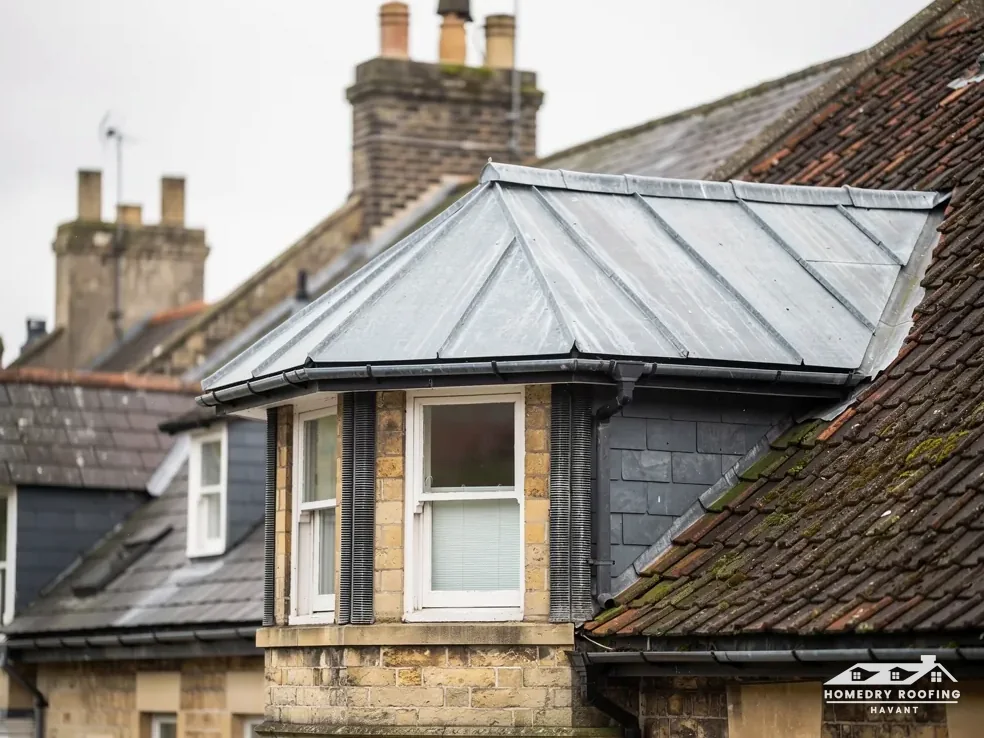
Where the side walls of a dormer window meet the main slope of the roof.
Lead or tile worn at that join lets water in beside the window frame.

Where the water leaves the gutter and drops towards the ground.
A cracked joint in the pipe lets it out against the wall instead.
At the addresses each one names, both list the removal or alteration of chimney stacks and the replacement of the roof cladding on the main elevation fronting a highway. Other addresses are not covered by them.
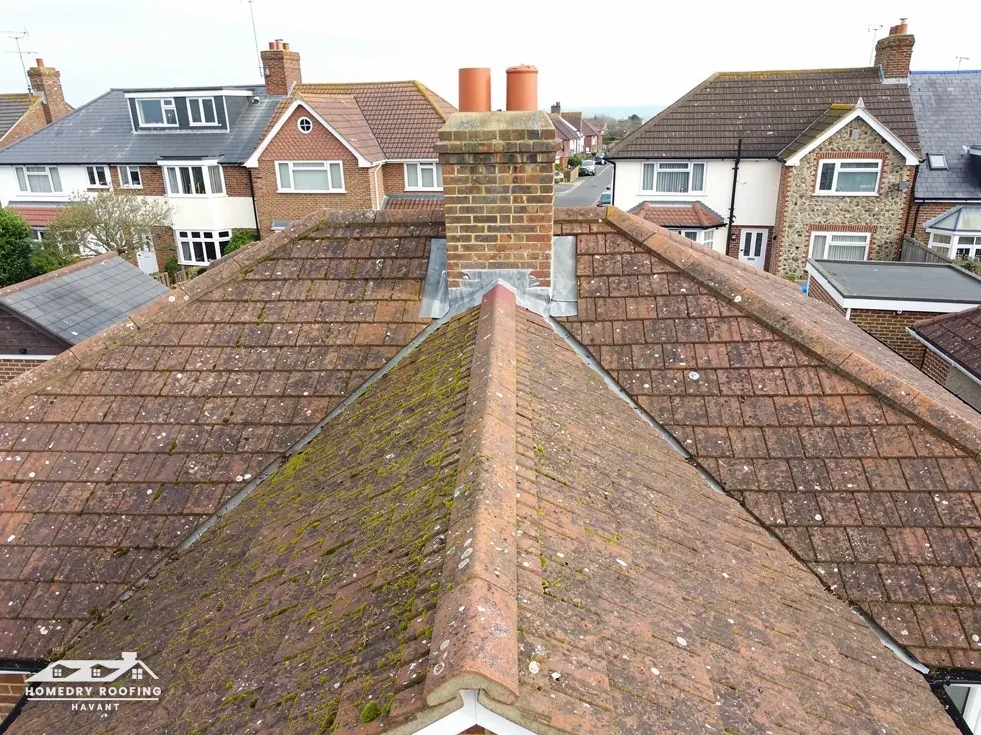
A chimney stack is a column of brickwork standing up through the roof, and the survey treats it as a separate structure with its own weak points. We look at the pointing between the bricks, the cement bed that holds the pots, the flashing around the base and the tiles that meet it on every side. Cracks, leaning and loose brick are noted from the ladder, never guessed at from the ground. Then the ridge, slopes and verge are checked, and, from the hatch into the loft, the timbers near the stack, where a leak shows as a mark on the breast or on the ceiling beside it. A chimney repair is planned from what the stack itself shows.
Old Portsmouth is among the conservation areas close to its centre, with King Street; Gunwharf; Castle Road; Guildhall and Victoria Park; The Terraces; and Owen's Southsea, and Portsmouth City Council decides planning for them. Haslar Peninsula, across the water, is Gosport Borough Council's. Here, an Article 4(2) direction sealed on 26 June 2008 names addresses in Bath Square, Broad Street, Tower Street and West Street, and one confirmed on 2 October 2006 names addresses in Battery Row, High Street, Highbury Street, Lombard Street, Peacock Lane, Pembroke Road, Penny Street, St Nicholas Street and St Thomas's Street. Both reach chimney stacks and roof cladding there only, so ask Portsmouth City Council before ordering.
The list for Old Portsmouth reaches the highest grade. Cathedral Church of St Thomas, The Square Tower and Landport Gate are all Grade I, and Long Curtain, King's Bastion and Spur Redoubt is a scheduled monument. A Church of England cathedral comes under the Care of Cathedrals Measure, not the faculty system. Listed building consent under section 7 of the 1990 Act governs a listed house, and scheduled monument consent is a separate route. Our planning guide for roof work covers the rest.
A stack that looks sound from the street can be loose at the top.
The two directions name numbered addresses, not whole streets, and houses beyond them are not covered by either, though they may sit in another conservation area with different controls. Two neighbours can therefore receive different answers. Photographs of the roof's main elevation taken from the street help the council check the position quickly, and we can supply those from the survey for your file when you write to Portsmouth City Council, with a note of the covering.
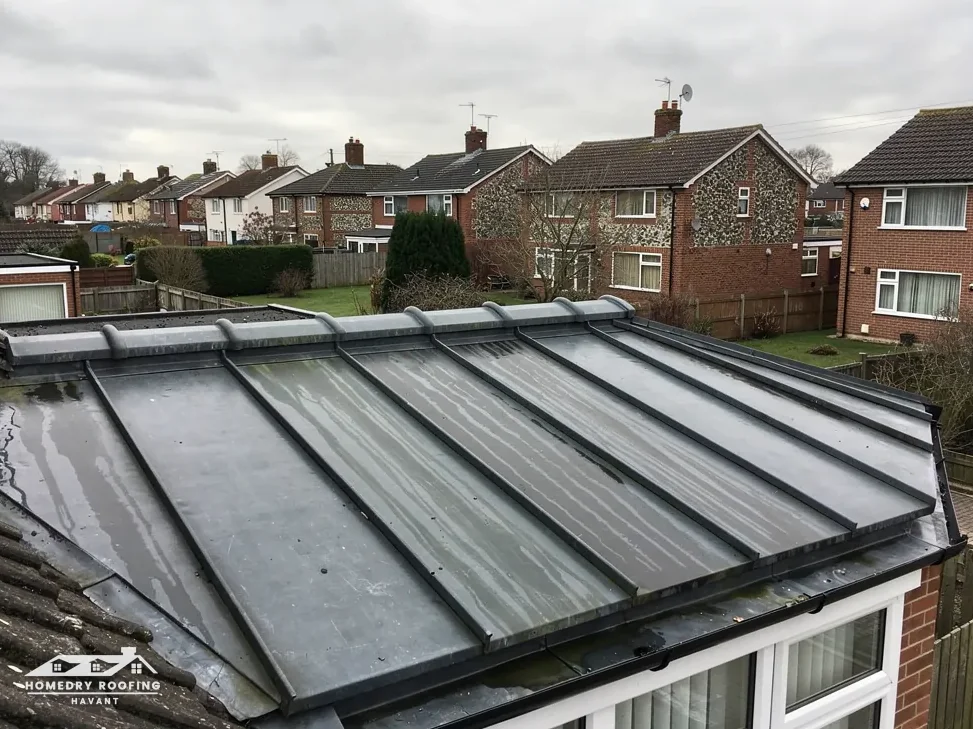
Where a roof changes direction, the lead has to follow the turn.
Lead sheet turns up in the parts of a roof that tiles cannot cover: valleys, flashings, the cheeks of a dormer, a gutter set behind a parapet. We check each lead detail for splits, for lifting at the edges, and for gaps in the pointing that holds it in the wall. MyJobQuote says correctly installed lead flashing can last for over 80 years, which is a reminder that a sound flashing needs no replacing for its own sake. Where lead has been patched with a smear of sealant instead of being re-dressed, we record it as a stopgap and describe the full repair. Our lead roofing page describes the work, and the survey tells you which details are sound and which are not.
Below the lead, the gutter line takes the flow. Joints, brackets and falls are inspected, downpipes are followed from the hopper to the shoe, and the fascia and soffit are pressed for soft timber. A gutter, fascia and soffit repair is proposed only for faults we have photographed, and a clean-out is recommended when a clean-out is all that is wanted. The photographs are taken from the position we worked in, so you can find each fault yourself.
Old Portsmouth is close to the shoreline, and Cupa lists coastal areas among the positions "graded with higher exposure", so the fixing specification is calculated for the site under BS 5534 instead of being copied from another job. Flood Zone 3 covers land near Old Portsmouth, according to the Environment Agency. That is a matter of water at the ground, not a roofing rule, so the work stays with the roof, the lead, the gutters and the drainage at the foot of each pipe.
Lead is dressed into the places where a roof changes direction or meets a wall, so a failure there lets water into the structure rather than onto the tiles. For that reason each detail is treated separately: the edge is lifted gently, the metal and its pointing are examined, and a photograph is taken. A detail that is sound is left alone, and the report says it was sound. Nothing sound is replaced for the sake of it.
Damp on the plaster next to a chimney, or tide-lines on the ceiling below a valley.
A split or a lifted edge in a lead flashing or valley lining, where water slips in behind the sheet.
Map of Old Portsmouth and the places around it, with the dashed line of our 30-mile service area from Havant. The same places are listed below the map.
A stack takes the rain on every side, and much of it cannot be seen from the ground. We check the pointing, the cement bed under the pots, the flashing at the base and the tiles that meet it, and we note any lean or loose brick from the ladder, since a pot that is bedded badly can tilt without anyone noticing. Inside, any staining on the breast or the nearby ceiling is noted. Where the stack needs work, the report gives what and why, with one written total price to follow.
Two Article 4(2) directions apply in the Old Portsmouth conservation area. One, sealed on 26 June 2008, names numbers in Bath Square, Broad Street, Tower Street and West Street. The other, confirmed on 2 October 2006, names numbers in Battery Row, High Street, Highbury Street, Lombard Street, Peacock Lane, Pembroke Road, Penny Street, St Nicholas Street and St Thomas's Street. Both list the removal or alteration of chimney stacks and the replacement of the roof cladding on the main elevation fronting a highway, at those addresses only. Ask Portsmouth City Council about yours before work is booked, and survey photographs can go with your letter.
For the Cathedral Church of St Thomas, which is Grade I, the route is the Care of Cathedrals Measure, since a Church of England cathedral does not use the faculty system. The Square Tower and Landport Gate are Grade I as well, and Long Curtain, King's Bastion and Spur Redoubt is a scheduled monument, where scheduled monument consent is needed. A listed house needs listed building consent for changes to its character under section 7 of the 1990 Act, and the National Heritage List shows whether yours has an entry. We confirm which category applies before any tile is lifted.
Portsmouth City Council decides planning in Old Portsmouth and in the Portsmouth conservation areas close to its centre. House re-covering inside a conservation area is normally permitted development, yet the directions for the named addresses above show Article 4 taking rights away in practice. Dormers and the like are explained in our planning guide, which is better read in full than summarised here. Bring your full address when you contact the council, and mention the roof covering you have in mind, because that is a conversation to have before a covering is chosen, not after it is delivered.
Planning Portal guidance asks for no application as a rule where a re-roof affects under 25 per cent of the building envelope and under 50 per cent of the roof; a new covering 15 per cent or more heavier needs approval whether or not those two tests are met. The Building Control Partnership carries out building control for Portsmouth, and its Business Support team takes calls on 01329 824823. Before the job begins we work out which side of the test the roof falls, and we recommend a structural check for any heavier covering, so the timbers underneath are known to carry it.
Where scaffolding stands on the highway there is. We arrange the licence with our scaffolder, so nothing reaches your doormat, while the permit for hoarding and scaffolding in Portsmouth runs through Colas and costs £100.00 + VAT per month on its form. At the survey we say where the frame will stand and for how long, because a frame in a footway is a matter for the highway authority as well as for the house, and the start date has to allow for both. Neighbours are told what to expect before the poles arrive, and the dates are given to you in writing so that nothing is a surprise.
The shoreline changes fixings, and the flood zone changes nothing. Cupa counts coastal areas among the positions graded with higher exposure, so the fixing specification is calculated for the site under BS 5534, and the paper you receive names the fixings for the covering, ridge, hips and verge. Land near Old Portsmouth is in Flood Zone 3 on the Environment Agency's flood map, which concerns water reaching the ground, not rain getting in above. Where each downpipe ends is noted on the visit, and any that finishes against a wall is pointed out to you, because water that ends at a wall can be mistaken later for a roof leak.
Only the metal itself can answer that, and the survey looks at it closely, edge by edge. MyJobQuote says correctly installed lead flashing can last for over 80 years, and the words correctly installed carry weight, because a flashing that is poorly dressed or badly pointed can fail much sooner. A sound detail is left alone, and a failing one is repaired or renewed with the reason written down beside a photograph. Where lead work is needed, the price follows as one written total, and the ground is swept before we leave, and the lead you have kept is photographed as a record of what remains.
You'll get one written total price.
Fill in what you like. It opens WhatsApp with your message ready to send.