
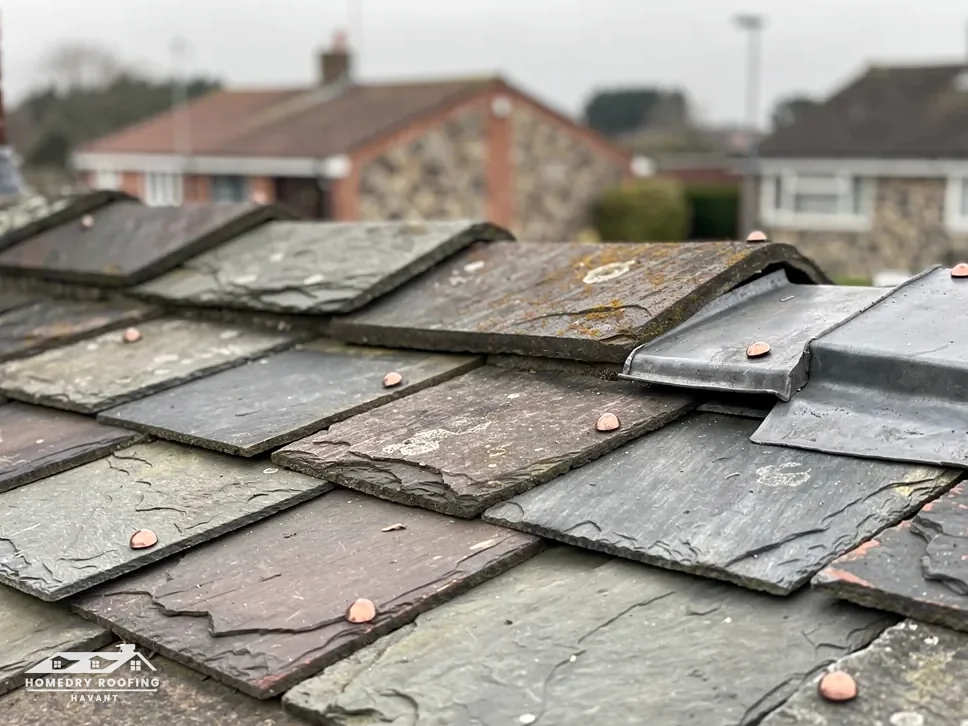
Abutments
Where a pitched slope ends against a house wall and a stepped lead strip fills the gap.
When that strip lifts, rain tracks behind it and darkens the plaster inside.

Hardway, a district of Gosport, has each point where a slope meets a wall, and each flat-roof outlet, traced one by one before a written total price is given.
10-year workmanship guarantee, in writing
Where a pitched slope ends against a house wall and a stepped lead strip fills the gap.
When that strip lifts, rain tracks behind it and darkens the plaster inside.
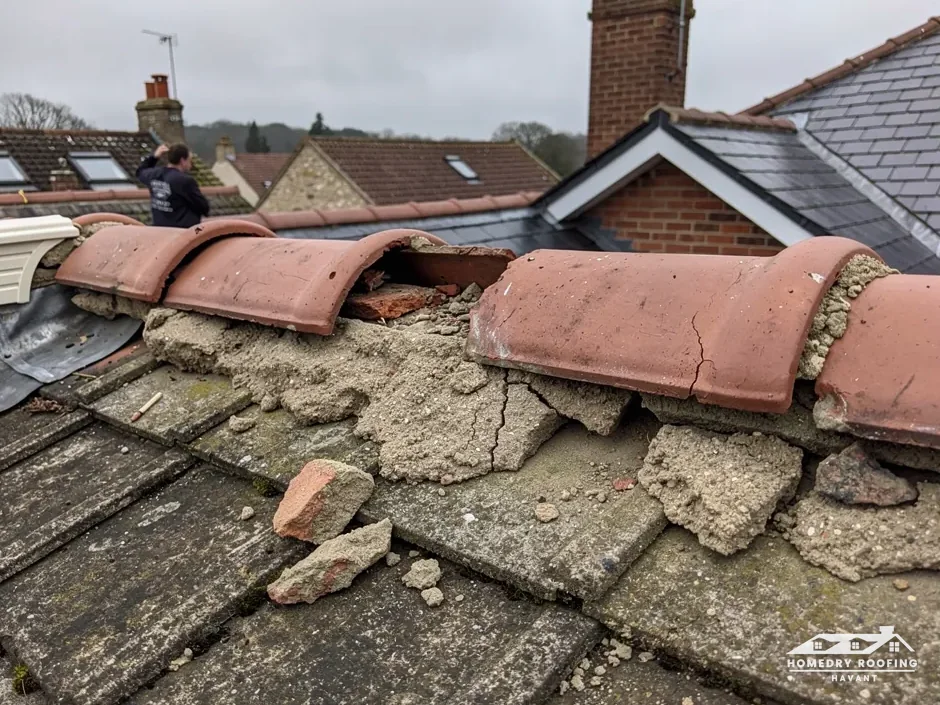
Where a flat roof covering turns up the wall along its back edge.
A split along that fold lets a wet patch spread across the ceiling below.
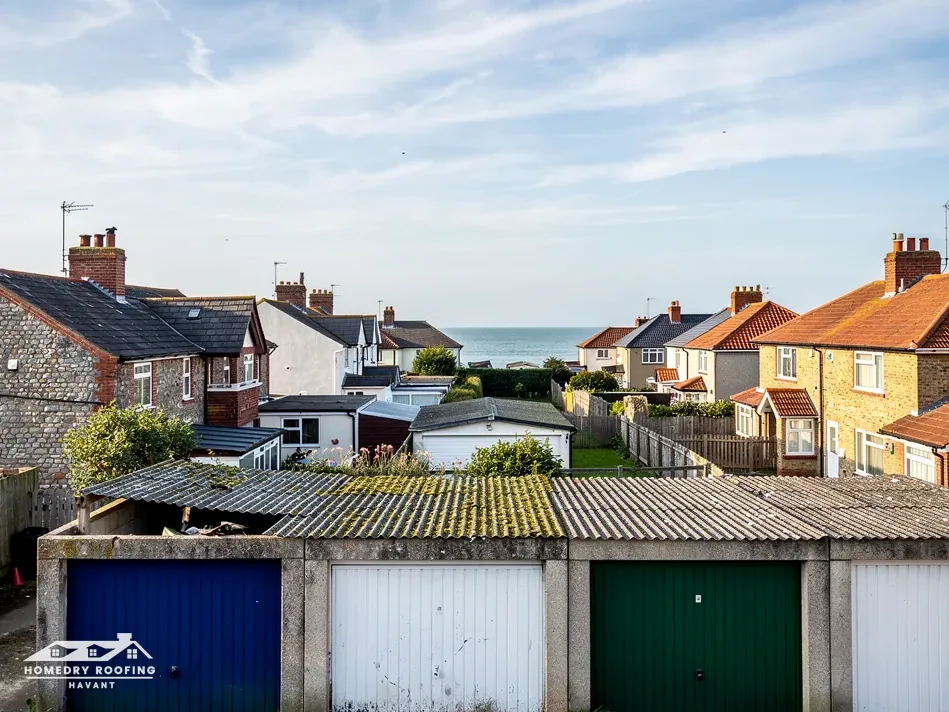
Where a gutter empties into a box head and the downpipe starts its drop to the drain.
Leaves and grit packed into that box turn it into an overflow point.
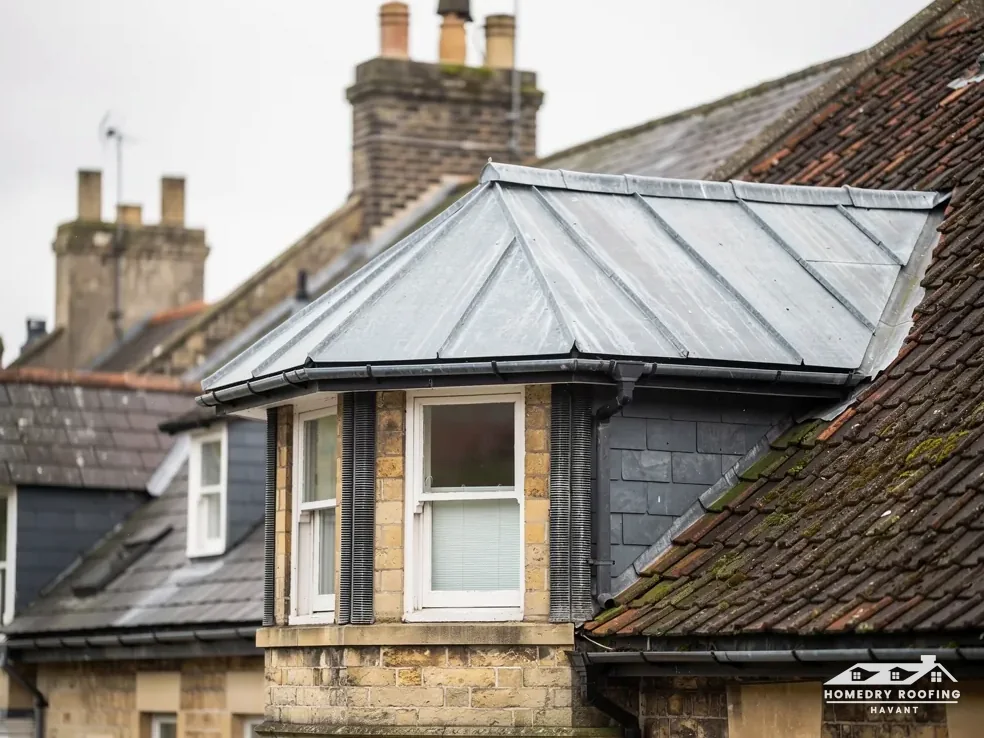
Where a slope meets a wall, the lead has to carry the join.
A slope that runs into a wall, yours or the neighbour's, has to be joined to it so that rain is turned away from the gap, and that join is called the abutment. Lead does the work. It is cut into the mortar course by course in short steps, each step lapping the one below, and a cover strip is fixed above the highest of them. On our visits we study each step for an end that has lifted, search the bends for fine cracks and press the mortar overhead to see whether it crumbles. Away from the wall we look along the nearest row of tiles for any that have slid out of line. Our leadwork page describes how these flashings are cut and dressed, while our roof repairs page explains how a smaller fault gets mended.
From inside, a failed abutment gives itself away as a tide mark running down the wall beside the roof line, or as a loft corner that dries out and darkens again as the weeks change. So the loft gets its turn, with a torch trained along the wall plate and the timber beneath the flashing. A stain on its own never proves where the water entered, because the path from slope to stain can be long, and the survey follows it back uphill until the entry point is found and shown to you.
Priddy's Hard, St George Barracks North and Hardway are the three conservation areas near the centre of Hardway, and Gosport Borough Council will tell you if your own address lies inside one. Where an Article 4 direction exists it can withdraw a share of the rights a house holds by default, which makes Gosport Borough Council the first call, ahead of any plan for the roof. Our planning guide for roof work sets out the national rules in full.
A lead step can lift at one end without any sign from the ground. We trace the whole run, from the lowest step beside the gutter to the highest under the ridge, and note each point where the metal has curled away or split. Where only the mortar line has gone, the lead is dressed back and the joint refilled. Where the lead itself has failed, the findings name the stretch that needs renewing.
A tide mark running down the wall beside the roof line, or a corner of the loft that dries and darkens in turn.
A step of lead curling away from the mortar, or a crack in the cover strip above where rain runs in behind it.
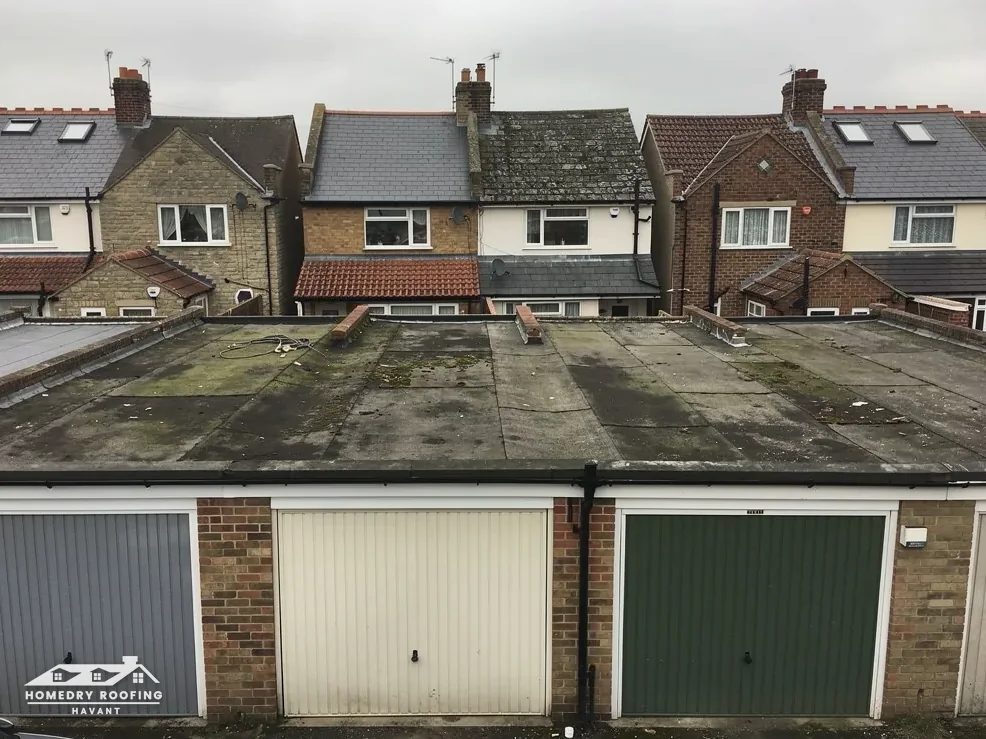
A puddle that lingers for a day means the water is not reaching the outlet. The fall may have been lost, or the outlet may be blocked, and each needs a different repair. We check the outlet first and then read the surface for dips.
No flat roof lies truly level. A slight fall carries water over the covering to an outlet or a gutter, and the faults we look for are breaks in that journey. The first sign is a pool still sitting there the next day; after that we read the covering for blisters, open seams and cracks at a joint. Where a roof light or a vent pipe passes through the surface, its collar is checked as well, because each opening is a join that can part from the covering around it. At the wall, the upstand where the covering climbs is followed for its full length, since a split there sends a damp patch across the ceiling below. Our flat roofing page describes the repairs and the re-covering options.
The standard for membrane flat roofs, BS 6229:2025, puts the minimum finished fall at 1:80, and designers aim steeper to leave room for building tolerances. Water that stays on the surface long after rain therefore raises a plain question: has the fall gone, or has the outlet clogged? The two call for different repairs. A clogged outlet is cleared and tested with water, while a lost fall calls for lifting the covering and relaying it to a better line. The findings tell you which of the two you are dealing with, and why we think so.
Beyond the outlet comes a hopper or a gutter and then a downpipe. Brett Martin advises a fall of 1 mm for every 600 mm toward the outlet, so each run is sighted for sag, and any stretch that stands full is noted. If the job needs scaffold standing on the pavement, the licence is dealt with in the scaffold question below. When the visit is over, the findings reach you in plain words, with a photograph of each fault, then a single written total price.
A flat roof has to drain, so we follow the way it does.
Two quite different faults can leave water standing on a flat roof. A choked outlet is a quick job once it has been found, whereas a lost fall asks for the covering to be relaid. We find out which by clearing the outlet first and then watching where the surface drains afterwards. The notes put the result in writing, so the price matches the fault and not a guess about it.
Map of Hardway and the places around it, with the dashed line of our 30-mile service area from Havant. The same places are listed below the map.
The stepped lead is followed from its lowest point beside the gutter up to its highest, with an eye out for ends that have lifted, bends that have cracked and a cover strip that has pulled away. The mortar above gets pressed for crumbling and the tiles at the join are checked for movement. Inside, the loft is searched along the wall plate for damp or daylight. Each fault is photographed on the spot and the price in writing comes out of those findings, so a lifted step is priced as a lifted step, not as a new roof.
Under the Planning Portal's guide, re-roofing does not normally need a building regulations application if it affects less than 25 per cent of the building envelope and less than 50 per cent of the roof; a new covering 15 per cent or more heavier does need approval. Hardway addresses go to the Building Control Partnership, on 01329 824823. Our part is to put the question to them early and relay what they say in ordinary words, leaving the decision with you. The notes keep the reply, so it travels with the quote.
Yes, whenever the poles or boards would obstruct the highway; that is the effect of section 169 of the Highways Act 1980, and Hampshire County Council is the body that licenses it here. Hampshire County Council charges £211.90 on application for the first 2 weeks, then £72 for each additional 2-week period, and its page says: "Scaffolding companies must apply on behalf of their customers." Hampshire County Council wants its application made ten clear working days before any scaffold goes up, which is why dates are fixed early. We arrange it with our scaffolder.
Those are the three conservation areas near the centre of Hardway, and Gosport Borough Council holds the boundaries, so it can say whether your road falls within one. In a conservation area, swapping the covering on a house stays permitted development as a rule, yet an Article 4 direction can take rights away, and what a direction here covers is for the council to confirm: check with Gosport Borough Council. Its reply can be written into the survey notes, the planning guide lays out the national position, and nothing is booked until you have heard back.
The National Heritage List for England, kept by Historic England, can be searched by address, and each entry gives the grade and a description. Listed building consent is required where work would change a listed building's character (section 7 of the Planning (Listed Buildings and Conservation Areas) Act 1990). If an entry leaves you unsure whether your work would alter the building's character, put the question to Gosport Borough Council before a tile is bought or a date is booked. Its reply then goes in the notes.
A puddle still there on the day after rain is the plainest clue, along with a dark ring on the surface marking where water settles. Leaves and grit at the outlet and a stain on the ceiling underneath add to the picture. If you can see the roof safely from a window or the ground, a photograph helps. The survey decides whether a blocked outlet or a lost fall is behind it, and the notes explain why, since a fresh layer laid over a lost fall only repeats the pool.
Hardway lies close to the coastline, and Cupa (a slate maker) ties exposure to the site: coastal areas "will be graded with higher exposure". That is why the specification for fixings is worked out for the plot under BS 5534, with batten sizes, nails and ridge fixings picked to suit the building and where it stands. BS 5534 is advisory, a code of practice rather than a statute. Survey notes lay the fixings out against your own roof, so each choice can be read and questioned, and the notes say why a given nail or batten size was picked for the plot.
One total, written down after the visit, with the findings in everyday language beside it. The total spells out the work and the covering, and VAT and scaffold are each marked as included or as extra. Before you compare it with another quote, make sure both treat scaffold and VAT the same way, since a total that looks low may have left them out. Where a repair would hold, it is offered ahead of a re-cover, and the pricing is good and fair, measured against the faults the survey actually found. If anything in the total is unclear, ask for it to be explained before you accept.
You'll get one written total price.
Fill in what you like. It opens WhatsApp with your message ready to send.