
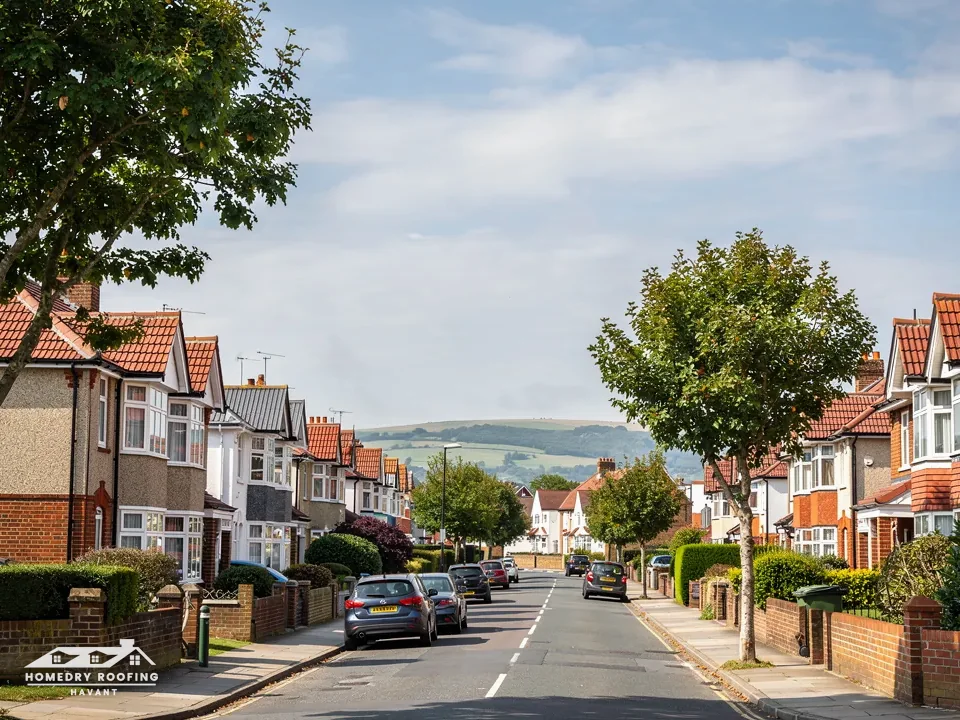
Hips
The sloping corner where two roof planes meet, finished with a row of rounded or angled capping.
Every capping tile hangs on a fixing of its own, so one working loose is easy to see from the garden.

West Wittering is 16.7 road miles south-east of Havant. We start with hips, ridges and flat roofs by the shore, then put one written total price on paper.
10-year workmanship guarantee, in writing
The sloping corner where two roof planes meet, finished with a row of rounded or angled capping.
Every capping tile hangs on a fixing of its own, so one working loose is easy to see from the garden.
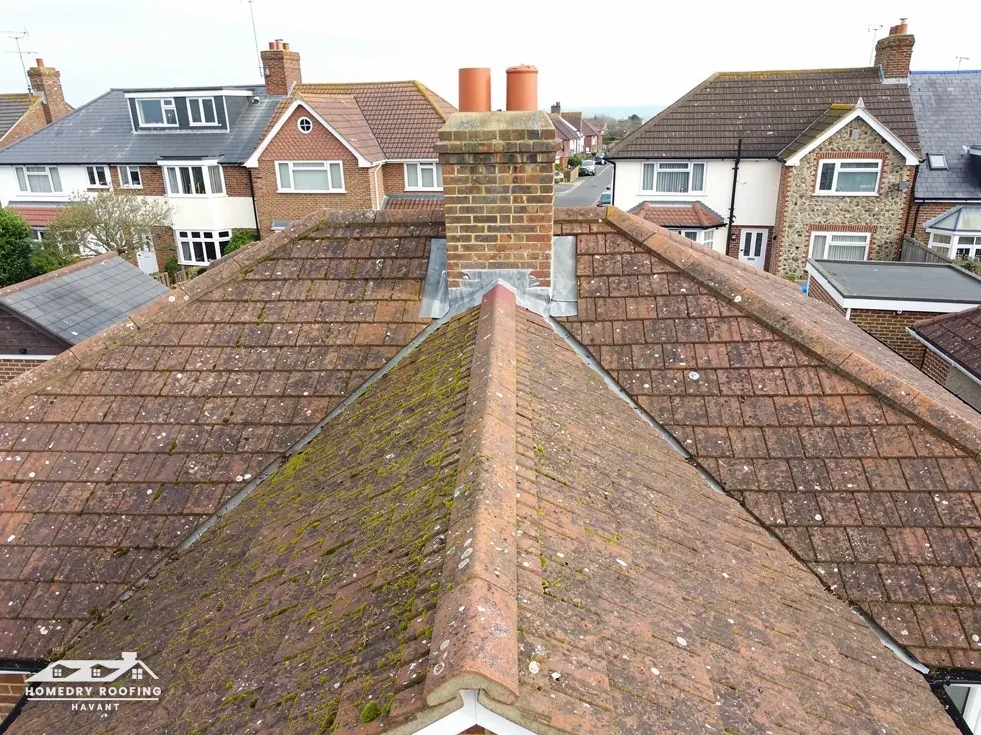
The side rim of a roof, where the final row of tiles hangs out beyond a gable wall.
Wind pushes at that edge from the side, which is why its bedding is read tile by tile.
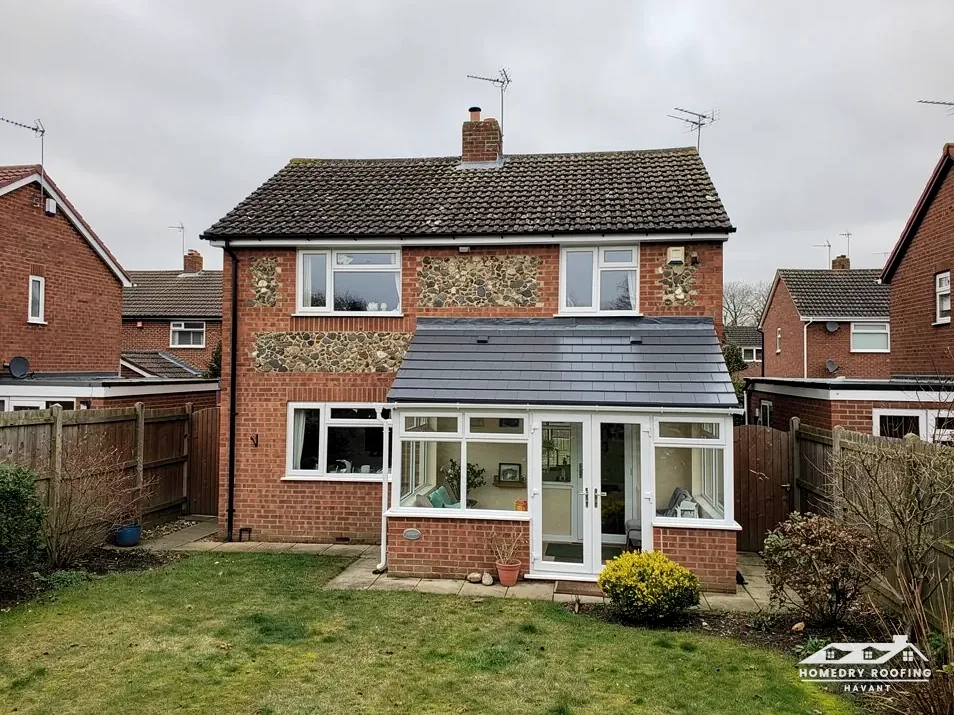
The lowest spot on a flat roof, where a hole in the surface hands the water to a pipe.
A mat of leaves over that hole keeps the surface wet long after the rain has stopped.
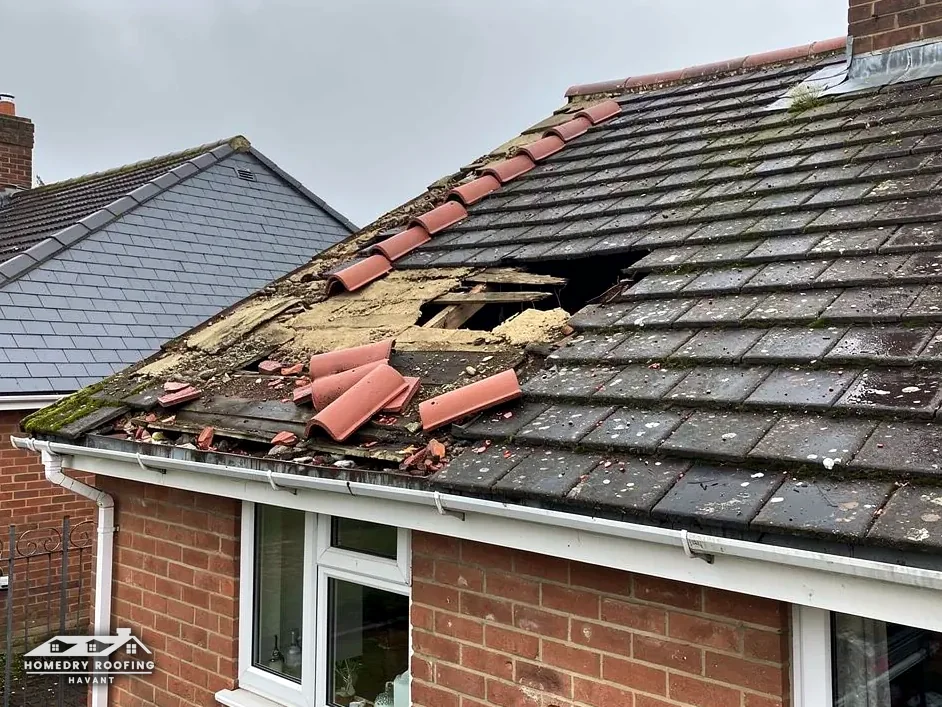
Wind meets a ridge before it meets anything else on the house.
We start at the top. The ridge and the hips take more weather than any other part of a roof, and they are the lines where a small movement shows first. Walking the length of each, we note capping tiles that have slid, joints that have gaped, and bedding that has crumbled or been mended in the past with mortar of another colour. Cupa, the slate maker, says a building's exposure grade follows its surroundings, and coastal areas are graded higher, so a ridge re-fixed in West Wittering follows a specification that is calculated for the site under BS 5534, not to a rule of thumb. A full re-cover of the slopes is described under new roofs.
The Parish Church of St Peter and St Paul carries a Grade I listing (list entry 1354665). It is in current use for Church of England worship, which puts building work on it under that church's faculty system, and the council's listed building consent is not the route. Houses are different. The Studio (list entry 1354631) and Pounces Cottage Rambler Cottage (list entry 1354667) are each listed Grade II, which means listed building consent is required for roof work that would alter what makes them special. Read a list entry in full before anyone prices a job, because it says exactly what is protected.
West Wittering has a designated conservation area of its own, and Chichester District Council can confirm the position for a given postcode. Chichester Harbour National Landscape, which the planning rules still call an area of outstanding natural beauty, lies near West Wittering, while planning decisions here are taken by Chichester District Council. Article 4 directions exist to take more rights away, and the council is where to ask whether one touches your address. Our planning guide for roof work covers the rules themselves.
Three routes can sit behind one West Wittering ridge. A Church of England church in use follows the faculty system, a listed house follows the council's consent route, and an ordinary house follows neither. We ask at the start which of the three applies to your roof, because a wrong guess costs weeks, and the answer decides who must be asked before a single tile is lifted from the ridge, which keeps the programme honest.
Light at the apex of the loft on a bright day, or one capping tile sitting a little out of line with the rest.
Bedding that has dried and dropped away from under a capping tile, leaving it free to rock and let rain into the joint.
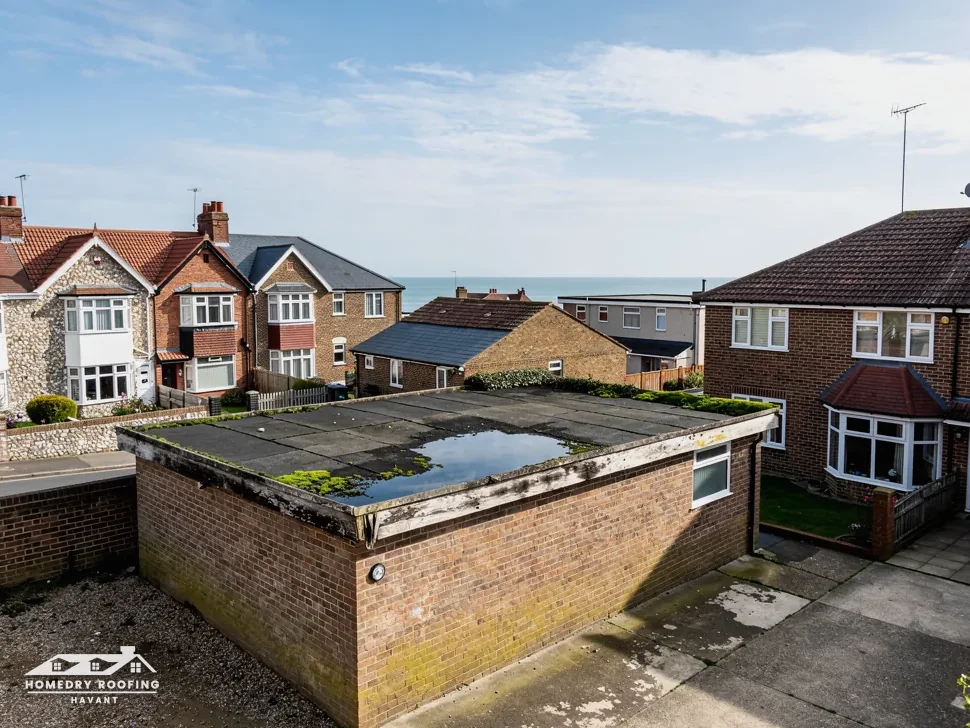
A shallow fall or a blocked outlet. We check both before proposing anything, since clearing an outlet is a small job and relaying a covering is a large one, and the shape of the pool shows which you have.
Flat roofs get their name from how they look, not how they behave. Each is laid with a slight tilt so rainwater drifts to the outlet, and a short upstand carries the covering up the house wall. On a survey we check three things in turn: whether the surface still holds water a day after rain, whether the upstand has split or peeled from the brick, and whether the outlet is clear. A pool means the tilt has failed or the hole is blocked, and each has its own cure. Our flat roofing page goes through the coverings.
Water leaving the roof then enters the gutter, so we follow it there. A leaking joint, a run that dips between brackets, or a pipe whose foot discharges onto the brickwork each show up with a ladder and a torch, and early repair costs little. The fascia boards and soffits hidden behind the gutter get a firm press with a thumb to test for softness. Replacing a failing run is covered under gutters, soffits and fascias.
Paperwork comes last. Two limits for a re-roof come from the Planning Portal: under 25 per cent of the building envelope and under 50 per cent of the roof, which is the usual dividing line for a building regulations application. A new covering 15 per cent or more heavier needs approval before work starts. Chichester District Council's building control team is told of the plan before a tile is lifted. The scaffold licence for a West Wittering road costs £266 for one month from West Sussex County Council, which wants at least 10 working days' notice, and we arrange the licence with our scaffolder. As for flooding, the Environment Agency's flood data places the centre of West Wittering in Flood Zone 3. That concerns land, and the roof survey is a separate matter.
A flat roof drains slowly by design, and the outlet decides whether it drains at all.
A pool that survives a dry night is the clue. Either the fall has gone shallow, so the water never makes it to the outlet, or the hole itself is choked. One needs the covering relaid, the other only a gloved hand and a bucket, and photographs of the pool and the outlet go into your findings before any price is written down, so the evidence stays with you.
Map of West Wittering and the places around it, with the dashed line of our 30-mile service area from Havant. The same places are listed below the map.
Each ridge and hip is walked end to end. We look at every capping tile, the joints between them and the bedding underneath, and from the loft we look for light along the apex. A tile that has moved breaks the line, and failed bedding leaves crumbs on the slope below. Cupa says coastal surroundings are graded higher for exposure, so we also check what fixes each tile, whether old mortar is doing a job a fixing should do, and whether the arrangement matches BS 5534. Our report arrives in writing with photographs, and a sound ridge is left exactly as it is.
Sometimes. The Planning Portal's test for a re-roof has two limbs: no building regulations application is normally needed below 25 per cent of the building envelope and below 50 per cent of the roof. The structure has to carry the extra load, so a covering 15 per cent or more heavier needs approval before the work begins, however small the area touched. We hold your roof up against both measures, then check with Chichester District Council's building control team which route applies, well before a start date is fixed, so the answer is on paper before materials are ordered.
Poles and boards put up over a public pavement or carriageway fall under section 169 of the Highways Act 1980, which is why a licence is needed. West Sussex County Council issues the licence for West Wittering addresses, at £266 for one month, with a notice period of at least 10 working days. Even then, we arrange the licence with our scaffolder, and the poles are booked for a day we settle together, so they go up when the road and the weather suit. You are never left holding the forms, and nobody waits for a licence to arrive after the crew has turned up.
Not by itself. The Parish Church of St Peter and St Paul is listed Grade I (list entry 1354665), and because Church of England worship still takes place there, work to the building goes through that church's faculty system. That route belongs to the church. A house nearby needs listed building consent only if it carries a separate list entry, and then only for changes that touch what makes it special. Search Historic England's list for your address before anyone quotes, and let us have the details, so the survey can be arranged around them and nothing catches anyone out on the day.
Listed building consent, for anything that would alter the building's character, and a different roof covering or a reshaped chimney can do exactly that. The Studio and Pounces Cottage Rambler Cottage are both listed Grade II, which shows that ordinary-looking houses can hold an entry. That consent comes on top of whatever else the planning rules ask. Put the question to Chichester District Council ahead of any price, file the reply, and we will fit the survey and the programme to it. Work waits until it comes.
Ask Chichester District Council, the planning authority for West Wittering. West Wittering has its own conservation area, and Chichester Harbour National Landscape lies near the village, but neither fact tells you about one particular road or one particular front door. A direction under Article 4 can withdraw rights too, which is another reason to ask Chichester District Council about your address before settling on a covering. The general rules live in the planning guide on this site, which is where to read them. Keep the council's answer with your survey papers.
No. The Environment Agency's flood data places the centre of West Wittering in Flood Zone 3, but that is a statement about land and flooding, not about roofs, and a leaking flashing or a slipped tile gets the same mend in any zone. Where flooding bears on a renewal or a purchase, look to the Environment Agency, and your insurer or solicitor can explain the consequences. Our part is the roof: we record what we find in pictures and words, and the file is yours.
One total price, written after a survey, with the findings listed alongside it in ordinary words. The page lists the job and the covering you are getting, and states plainly if VAT and scaffold are counted inside it. It comes only after somebody has been up and looked. Where a repair would hold, we put it forward before any replacement, and any case for replacing is explained on paper, with the reasons set against what we saw. Prices are good and fair. Between rival quotes, ask each firm to state what its sum leaves out, and keep the reply.
You'll get one written total price.
Fill in what you like. It opens WhatsApp with your message ready to send.