
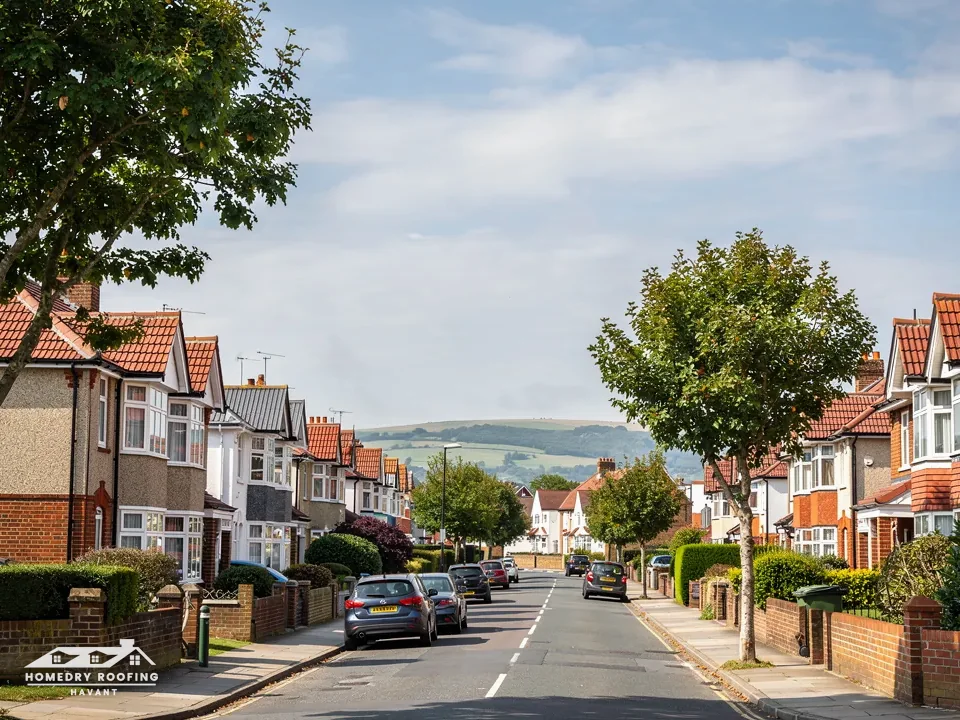
Caps
The pieces that close the top of a ridge or hip, bedded or clipped in a line.
A cap that rocks under a hand has lost its hold and can lift in a blow.

Birdham is 13.6 road miles south-east of Havant; ridges, hips, flashings and chimneys there are inspected for exposure as well as for faults, and the survey ends in one written total.
10-year workmanship guarantee, in writing
The pieces that close the top of a ridge or hip, bedded or clipped in a line.
A cap that rocks under a hand has lost its hold and can lift in a blow.
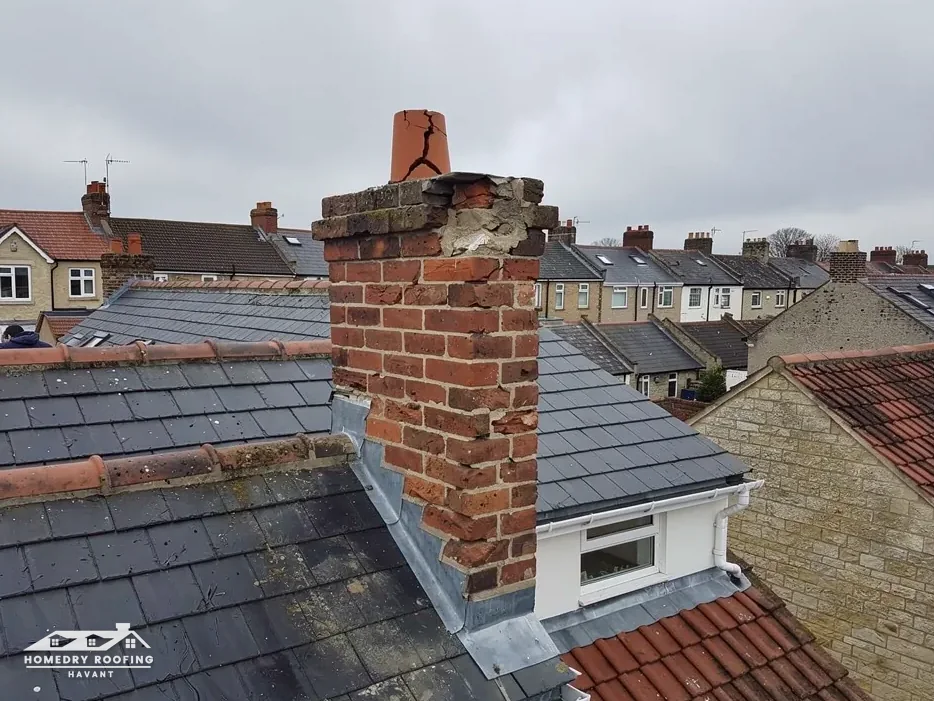
The flat strip of lead that sits below a chimney or a wall and sheds rain forward.
Splits along its folds, or a corner that has lifted, leave the join open.
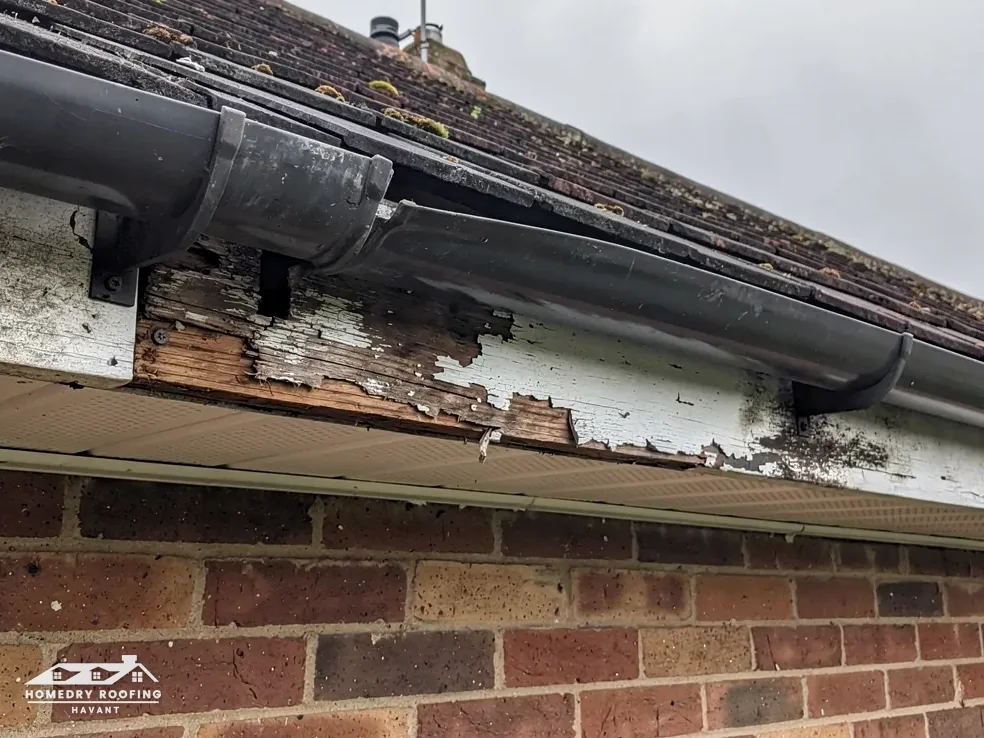
The boards that follow a gable edge and finish the roof against the sky.
Soft timber or open joints in them show where the edge has been taking water.
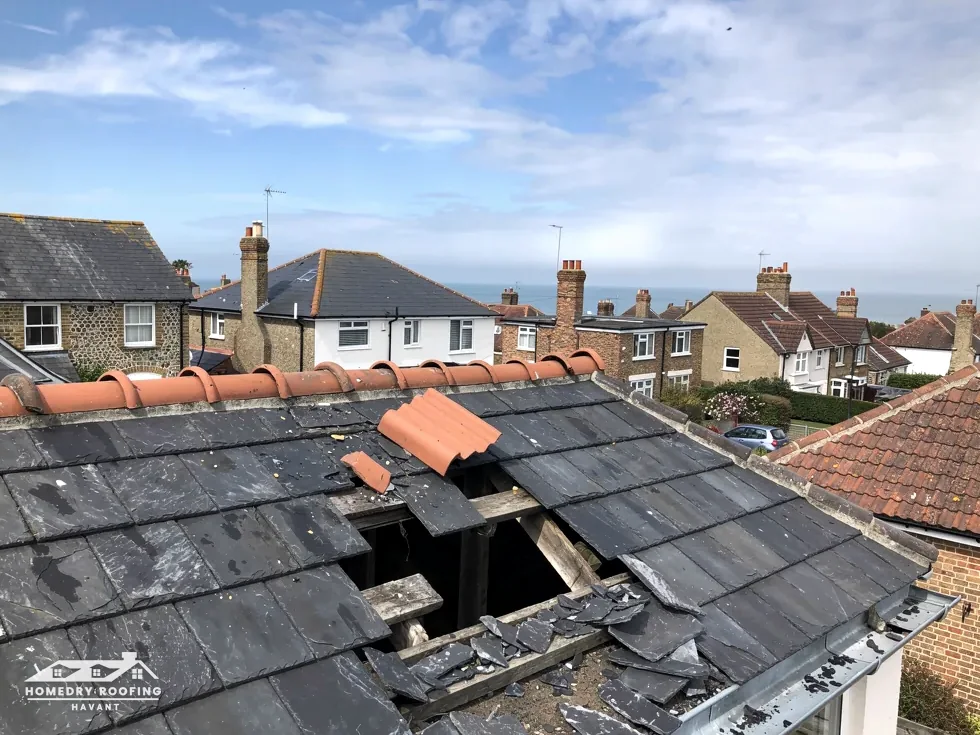
The ridge takes the weather first, so it is read first.
Ridge caps, hip caps and verge edges stand at the highest and outermost lines of a roof, so they are looked at first and most closely, from a ladder and again from the loft. We check how each piece is held: whether by mortar bedding, which can crack, or by a dry-fix system whose clips and screws have to be sound. Every cap is tried by hand for movement. Because Birdham is a coastal place, exposure is part of the question, and the fixing specification for a coastal site is calculated and not assumed. The survey notes what is on the roof now, with photographs, so a repair or a new covering can be specified for the site and the choice explained to you. The dry ridge and verge page describes the systems.
The Parish Church of St James, Grade I, is a Church of England church that remains in use. Its denomination is exempt, so roof work on it is a matter for the faculty system, and the council's listed building consent does not apply. St Mary's Cottage and Broken Stone are each listed Grade II. A house listed in its own right is a different case, because the council route applies there, and any roof change that would alter its character needs consent first, before a covering is ordered.
Birdham lies within the Chichester Harbour National Landscape, formerly an Area of Outstanding Natural Beauty. The landscape team advises, but Chichester District Council decides planning applications, and ordinary re-roofing stays under the normal rules. Whether a particular address is inside the boundary is for the published map to show. Somerley, West Itchenor and Dell Quay are conservation areas around Birdham, and Chichester District Council can confirm whether your address is in one of them. Our planning guide for roof work gives the detail.
A national landscape designation shapes how a place is looked after, but it does not decide planning applications; Chichester District Council does, and it is the body to write to. For roof work the practical result is narrow, and the planning guide explains it. What we add is a record of what is on the roof today, written and photographed, so any application, or any later question about the work, starts from facts.
A cap that rocks when pressed, or a gap along the ridge line that daylight shows from the loft.
Bedding that has cracked away from a cap, or a clip that has loosened so the cap lifts when the weather leans on it.
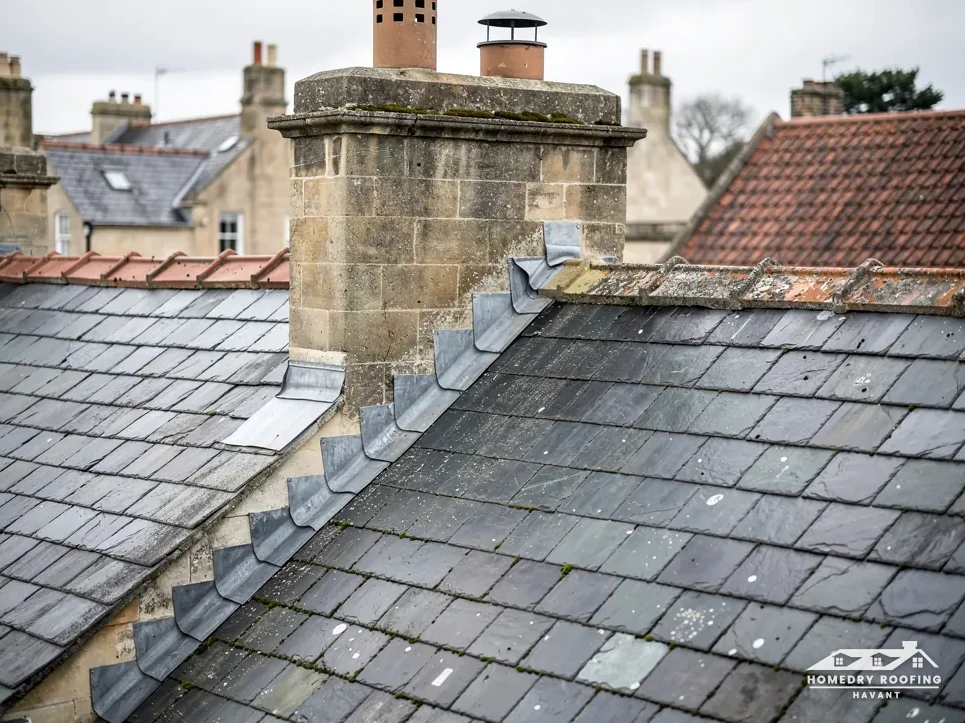
Look for a stain on the wall beside a chimney or on the ceiling beneath a wall join, a lifted corner of lead, or a gap where the top edge meets the wall. From the ground these are hard to judge, so a ladder survey settles it.
Wherever a roof meets something taller, a flashing stands guard: lead at a chimney, a stepped strip along a wall, a flat apron below a stack. We look at the top edge, where it is tucked into the wall and sealed with mortar or sealant, because that edge is the first place for a gap to open. Below it, we run a gloved hand along the lead for splits at the folds, lifted corners and patches where an earlier repair has been laid over the original. The leadwork page explains how lead is dressed and fixed at each kind of join.
A chimney stack carries its own set of joints. The flaunching on top, the pointing down the sides and the collar of lead round the base all get a look, with the pots checked for movement. Damp that shows on a chimney breast inside can begin at any of those joints, so the search runs from the lead at the bottom, to the pointing, and then up to the flaunching, in that order. Our chimney repairs page covers rebuilding and repointing, and the survey tells you which of them a stack actually needs. Where a stack leans or a joint has opened wide, the report says so plainly.
A roof meets many edges between its ridge and its drain, and a flashing is the line of defence at each. Birdham roofs are examined as any others are, with extra thought for how they are fixed in a coastal place. The findings are written in plain words with a photograph for each, a repair that will last is preferred to a replacement, with the site left clean at the end of the visit. If a flashing only needs its edge re-pointed, that is what the report says, and nothing larger is suggested in its place.
A flashing can let water in at its top edge.
Lead is soft and takes the shape of what it covers, which suits it to awkward joins. It also moves with temperature, so a fold that was sound can split along its crease. When we find a split we show it in a photograph, say whether a patch will hold or the whole strip should be replaced, and explain which is the better choice for the wall it sits against.
Map of Birdham and the places around it, with the dashed line of our 30-mile service area from Havant. The same places are listed below the map.
Every cap is tried by hand, because a cap that rocks has lost its hold. We look at the bedding beneath for cracks and gaps, and where a dry-fix system is used, at the clips, screws and fixing strips for looseness. Hips get the same treatment, and so do verge edges. The findings are photographed and set against the exposure of the site, since a coastal place calls for fixings that suit it. You are told whether a loose cap can be refixed on its own or whether the whole run should be taken up and redone, with the reason shown on the photographs.
Cupa, a slate maker, describes coastal areas as ones that "will be graded with higher exposure", and for a coastal site the fixing specification is calculated under BS 5534 rather than assumed. BS 5534 is a code of practice, not law, and Marley says mortar alone can no longer be relied on as the only means of securing the roof covering. For a repair that means looking at how each part is held; for a new covering it means the fixing method is chosen for the site, with the details written down in the quotation, so the specification can be read by anyone who is asked to approve or compare it.
Birdham sits inside the Chichester Harbour National Landscape, which the planning rules still call an area of outstanding natural beauty. The designation is not the planning authority: Chichester District Council decides, and the landscape team advises. Ordinary re-roofing stays under the normal rules. Whether a particular address is inside the boundary is a matter of checking the published map, which takes a minute online, and our planning guide gives the rules for roof work, including what a National Landscape changes, and the source of each one, so you can read them at first hand.
They are two questions. For building regulations the Planning Portal gives a test: when work touches less than 25 per cent of the building envelope and less than 50 per cent of the roof, building regulations approval is not normally required. Approval is needed for a covering 15 per cent or more heavier, however small the area covered, so a change of covering is discussed with Chichester District Council's building control team first, before any order is placed. Planning depends on the house and its setting, such as a National Landscape or a listing, which is why the planning guide is a separate read.
A licence is needed when scaffolding occupies a public highway, under section 169 of the Highways Act 1980, and for Birdham that licence comes from West Sussex County Council. West Sussex County Council licenses scaffolding on the highway at £266 for one month and asks for at least 10 working days' notice, so a start date is chosen well ahead. We arrange the licence with our scaffolder. Whether the tower can stand on your own land instead is looked at during the survey, before any date is promised, because a tower on a drive needs no highway licence at all and saves the notice period.
The Parish Church of St James is listed Grade I, and it remains a Church of England church in use. Its denomination is exempt, so works go through the faculty system and not through the council's listed building consent. That route is for a church in use. A house that is listed in its own right follows the council route instead. St Mary's Cottage and Broken Stone are listed Grade II, and the Historic England list shows whether your own address has an entry of its own, which is worth checking before any roof job is planned.
Somerley, West Itchenor and Dell Quay lie around Birdham. Chichester District Council can answer whether your address lies within one of them, which is quicker than working it out from a plan. Article 4 directions can remove further permitted development rights, so ask Chichester District Council about your road as well, and keep its reply with your papers. Our guide to planning for roof work covers what the rules allow and where each rule is found, and it is the place to start before you write to the council.
The work, the covering, whether scaffold and VAT are counted in, and the findings that led to the figure. It follows the survey and never a guess from the road. Ours is one written total price, with repair put ahead of replacement wherever the existing roof is sound. When you compare it with another firm's quotation, ask both to state in writing what the total covers, because a smaller figure can simply be missing the scaffold or the VAT. A fixing method suited to exposure should be stated too, so that two quotations are comparing the same roof.
You'll get one written total price.
Fill in what you like. It opens WhatsApp with your message ready to send.