
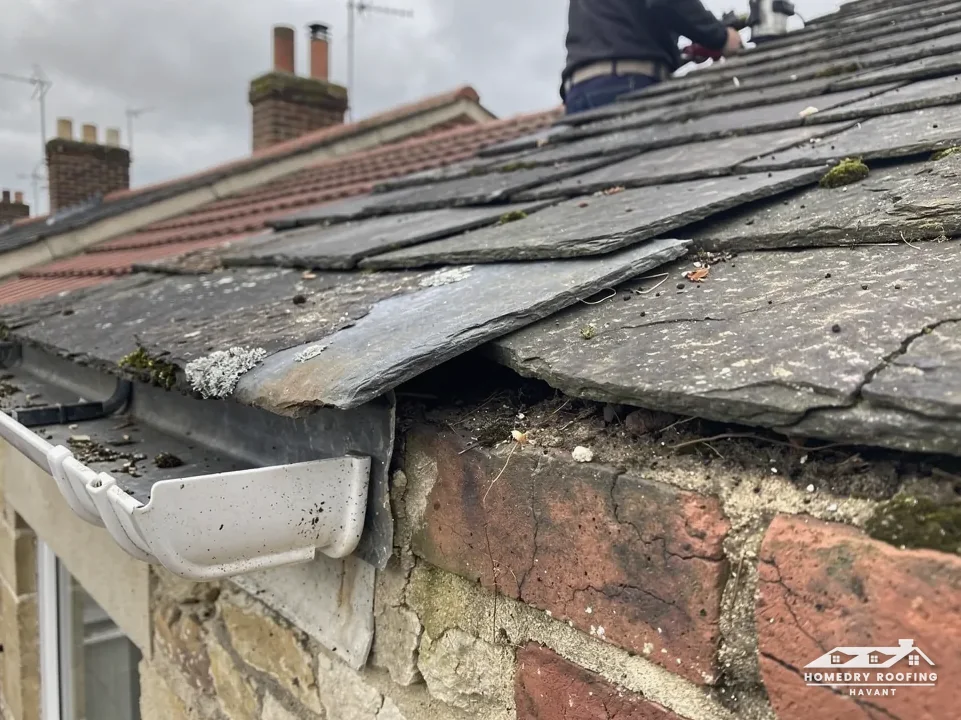
Valleys
The fold where two slopes tilt towards each other and share one lining.
Leaves collect in the fold, and a worn lining beneath them leaks into the loft.

Bosham is 7.2 road miles east of Havant. Here the valleys, flat extensions and listed rooflines get a survey up on the slopes, and a price is written only after that.
10-year workmanship guarantee, in writing
The fold where two slopes tilt towards each other and share one lining.
Leaves collect in the fold, and a worn lining beneath them leaks into the loft.
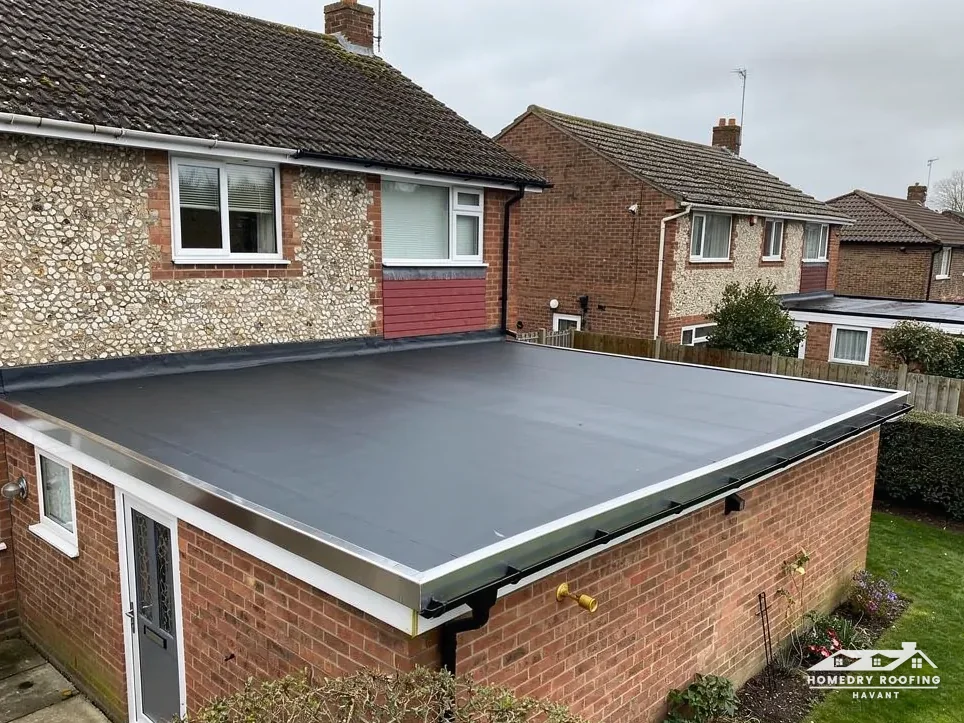
The upturned edge of a flat roof covering where it climbs the house wall.
A split or a lifted edge there lets rain run down behind the membrane.

The boards that close the underside of the eaves beneath the fascia and gutter.
A stained or sagging board is a sign that water has been spilling over the gutter.
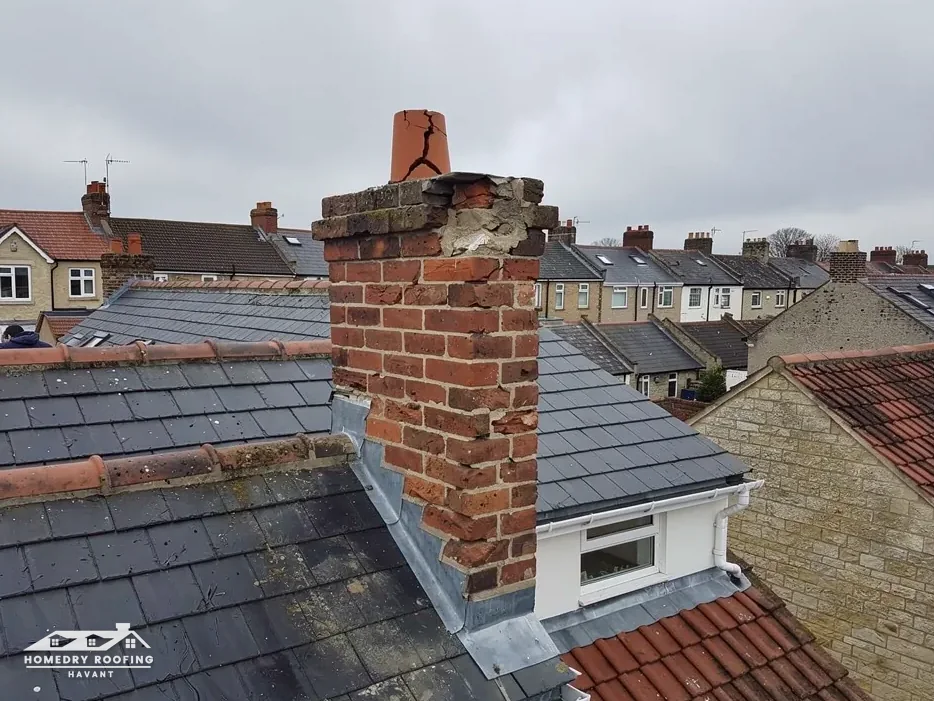
Two roofs pour into one fold, and the fold has to cope.
At an inside corner of the roof, two slopes tilt towards each other and form a valley, and that valley carries the run-off of both down to the gutter. Its lining takes more water than any single stretch of the covering, so it is the first place a survey slows down. We clear the leaves, look for splits and thin patches in the lining, and inspect the edges of the tiles on either side. Hips, the outward corners, get their own pass: the tiles along them, the bedding beneath and the fixings that hold them. Our pitched roofing page covers the wider work, and our roof repairs page explains what a repair involves when the fault is local.
Bosham is on the water's edge, and Cupa, the slate maker, says buildings on coastal areas, slopes and hills will be graded with higher exposure. For a roof that has a practical result: the fixing specification is calculated for the site under BS 5534, which Marley calls a code of practice, not law. We do not apply a standard sheet. Batten size, fixing type and the ridge and valley detail are written for each house, and the survey says why each choice was made, so the thinking can be checked later.
Bosham sits within the Chichester Harbour National Landscape, the new name for what was an Area of Outstanding Natural Beauty, and it has a conservation area of its own. The National Landscape is a designation, not the body that grants planning permission; Chichester District Council decides. Whether your address falls inside either boundary is for the council to confirm. Whether an Article 4 direction covers your plot is for that council too, so check with Chichester District Council. Our planning guide for roof work sets out the rules, which this page does not restate.
A valley lining can fail without one dramatic spot. It thins along the line where the water runs fastest, and a patch in the middle leaves the rest to go next. We look along the whole length, mark where the metal or membrane has worn, and photograph it, so the survey can say whether the lining should be renewed from end to end instead of repaired in one spot.
Damp high on an upstairs side wall, coming back in the same corner whenever the weather turns wet.
A worn patch in the valley lining, or a cracked tile edge where the water runs fastest.
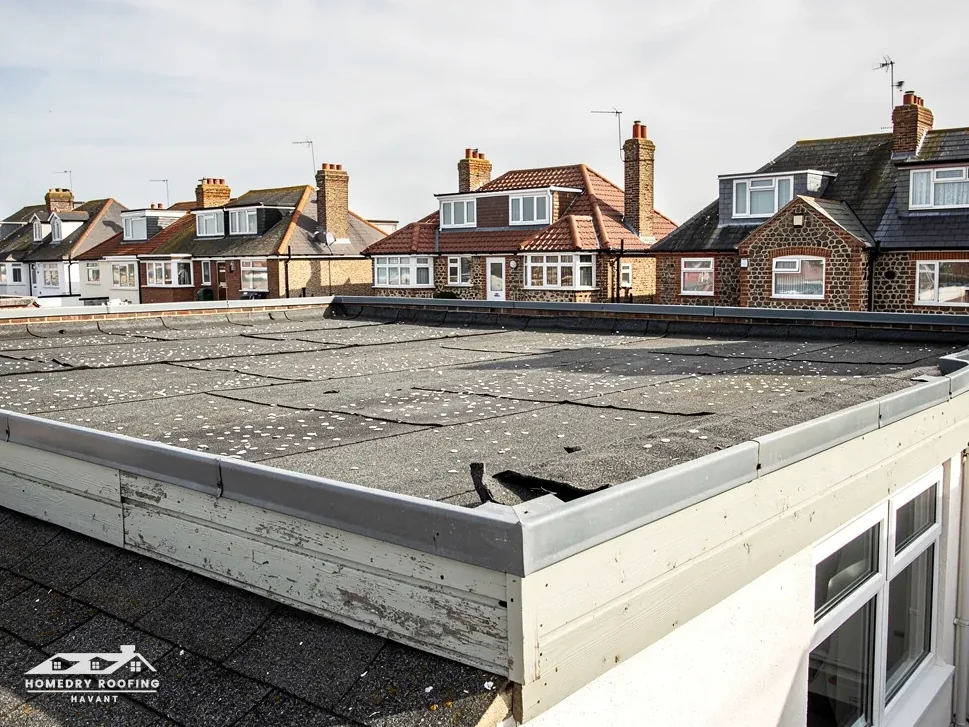
One possibility is that the slope towards the outlet has been lost, so the water has nothing to follow. The other is that the opening is choked and cannot take the flow. The remedies differ, and the survey says which you have before suggesting a repair or a new covering.
A flat roof is only flat to the eye. Its covering is meant to lean gently towards an outlet, and at the house wall it turns upward to form an upstand, a few inches of the same membrane running up the brickwork and finished beneath a flashing. We read three things from the top: the state of the upstand, any pooling on the surface, and the opening where the water leaves. If water sits, the slope towards the outlet may have been lost, or the opening may be choked, and the remedies differ. Our flat roofing page explains the options when a covering has to be relaid.
Bosham has a Grade I church and smaller listed houses. The Parish Church of the Holy Trinity is Grade I (list entry 1354443) and is still used for worship by the Church of England, so works to the church go through the faculty system, not listed building consent. A house is another matter. Loafers is listed Grade II (entry 1279061) and Leat Cottage is Grade II (entry 1026453). A listed house keeps its permitted development rights for roof work, but listed building consent from Chichester District Council is required for any work that would alter its special interest.
Entries belong to single buildings, so a neighbour's listing says nothing about yours. Search the Historic England list for your own address before planning work, and tell us what it shows, because a listing changes the approach before a price is written. Where there is none, a flat extension roof is treated like any other: surveyed, photographed, and described in plain words, with a sound repair put ahead of a replacement wherever a repair will serve. Every finding comes with a picture, so the reasoning can be read at the kitchen table, shown to a neighbour, or handed to a surveyor if you want a second view.
On a flat roof the water has nowhere to hide.
The upstand is a small strip, yet it carries the join between the roof and the wall. We press along it for lift, look at the edge where the membrane ends, and check the flashing that covers it from above. If rain has been getting behind, the damage may not show at the join itself. It can show on the ceiling below, away from the cause, which is why the survey follows the line.
Map of Bosham and the places around it, with the dashed line of our 30-mile service area from Havant. The same places are listed below the map.
A valley takes the run-off of two slopes in one fold, so a split in its lining lets in more water than a single cracked tile would. We clear any debris, run along the lining looking for thin patches, and study the tile edges either side. From the loft we look at the timbers beneath for stains, since damp high on an upstairs side wall may lead to the same fault. The survey says whether the lining should be patched or renewed along its length, with photographs that show you the evidence, so you are not asked to take the verdict on trust.
The church is listed Grade I (National Heritage List entry 1354443) and is still used for worship by the Church of England. A Church of England church in use goes through the faculty system rather than listed building consent. The exemption goes with the church building. Your own house, if it carries a list entry, has no such shelter, and Chichester District Council must be asked before any work that changes its special interest, so look up your address on the Historic England list before work is planned or a date agreed.
Leat Cottage is listed Grade II (entry 1026453) and Loafers is Grade II (entry 1279061), but entries belong to single buildings, so first check whether yours has one. If it does, permitted development rights for roof work remain, while listed building consent from Chichester District Council is required for work that touches what makes the building special. A change of covering, gutter or chimney detail can each count. We raise the proposal with the council before a price is written, because its answer can change what the job is, and it is better to learn that before a scaffold goes up than after.
Bosham has a conservation area, and the Chichester Harbour National Landscape covers the village. Neither is the body that decides: Chichester District Council does, and the National Landscape team advises. Whether a given plot is inside the conservation area is a question for the council, as is any Article 4 direction on your road, and a short written question gets that answer. The planning guide linked on this page sets out which rights apply, and we do not restate them here, but we are glad to talk through how they meet your roof.
Building regulations and planning are separate questions. The Planning Portal's guide says no application is normally needed where the work affects less than 25 per cent of the building envelope and less than 50 per cent of the roof, and a new covering 15 per cent or more heavier must be approved by building control. For Bosham addresses Chichester District Council's building control team is consulted by us before work begins, so the route is settled in advance. Planning is a distinct matter, covered in the guide linked here, and it is worth reading before you commit to a date or a covering, since each depends on the answer.
We arrange the licence with our scaffolder. Section 169 of the Highways Act 1980 covers scaffolding that obstructs the highway, and West Sussex County Council issues the licence at £266 for one month, with at least 10 working days' notice. That notice is why the start date is settled with you beforehand, and the scaffold goes up only once the licence is granted. An early application is worth making, and we tell you if the dates move, with the reason. You do not have to chase the council yourself.
On the Environment Agency's map, land near Bosham is placed in Flood Zone 3. The map concerns the ground, not roofs, and contains no roofing rule, so it does not alter how a roof is surveyed or covered. What the roof contributes is rainwater, which is why we follow each downpipe to its foot and note where it empties and whether the gully is clear. A blocked drain or a pipe aimed at a wall goes into the written findings with a photograph, so the cause is on paper before any repair is agreed with you.
Possibly. Approved Document L (2021 edition) counts replacing the waterproof membrane on a flat roof as renovation. Its Table 4.3 gives a threshold of 0.35 and an improved value of 0.16 W/m²K for roofs, and where more than half of the surface is renovated, the whole roof should reach the improved figure if that is technically and functionally feasible and pays back within 15 years. We check the route with Chichester District Council's building control team, and the written price states what is included, so a requirement is never left to turn up as an extra on the day.
You'll get one written total price.
Fill in what you like. It opens WhatsApp with your message ready to send.