
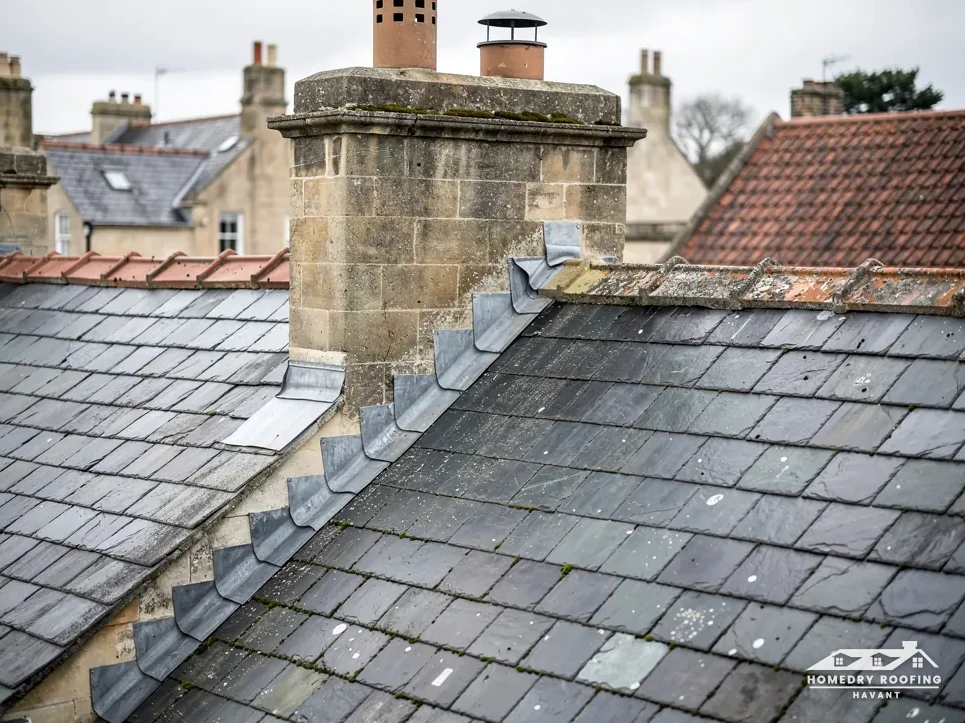
Chimneys
Where a stack rises through the slope with a collar of lead round its foot.
If that collar lifts, or the mortar at the foot crumbles, rain runs in behind it.

Hunston is 12.1 road miles east of Havant; ridges, chimney flashings, lean-to roofs and gutters there are each traced back to where the rain is coming through, then priced as one written total.
10-year workmanship guarantee, in writing
Where a stack rises through the slope with a collar of lead round its foot.
If that collar lifts, or the mortar at the foot crumbles, rain runs in behind it.
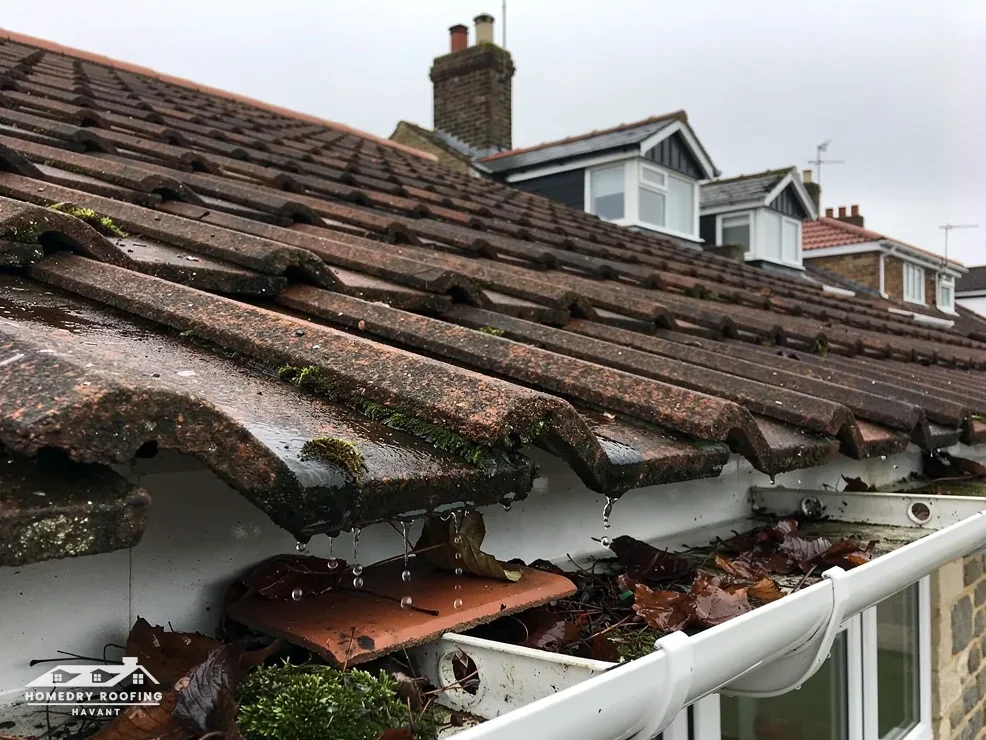
The lower rim of the roof, where a gutter is bracketed to the fascia.
A sagging length or a split joint tips rain down the wall instead of the pipe.
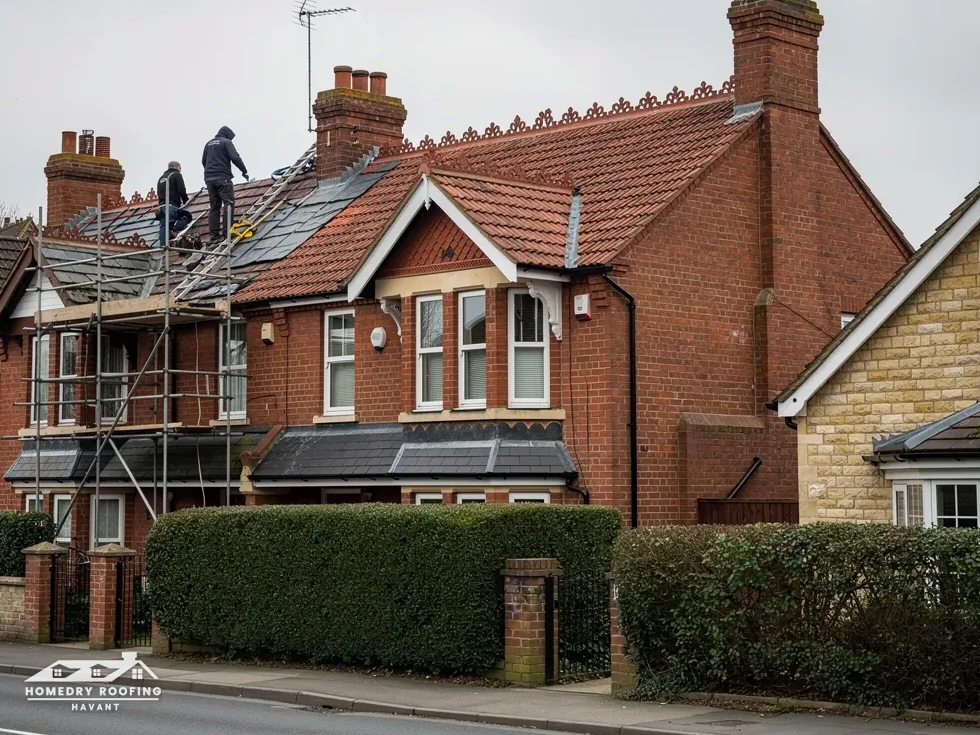
Where a small lean-to roof meets the house wall above a door.
A gap along that join shows up as a damp patch on the wall inside the door once a few days of rain have passed.
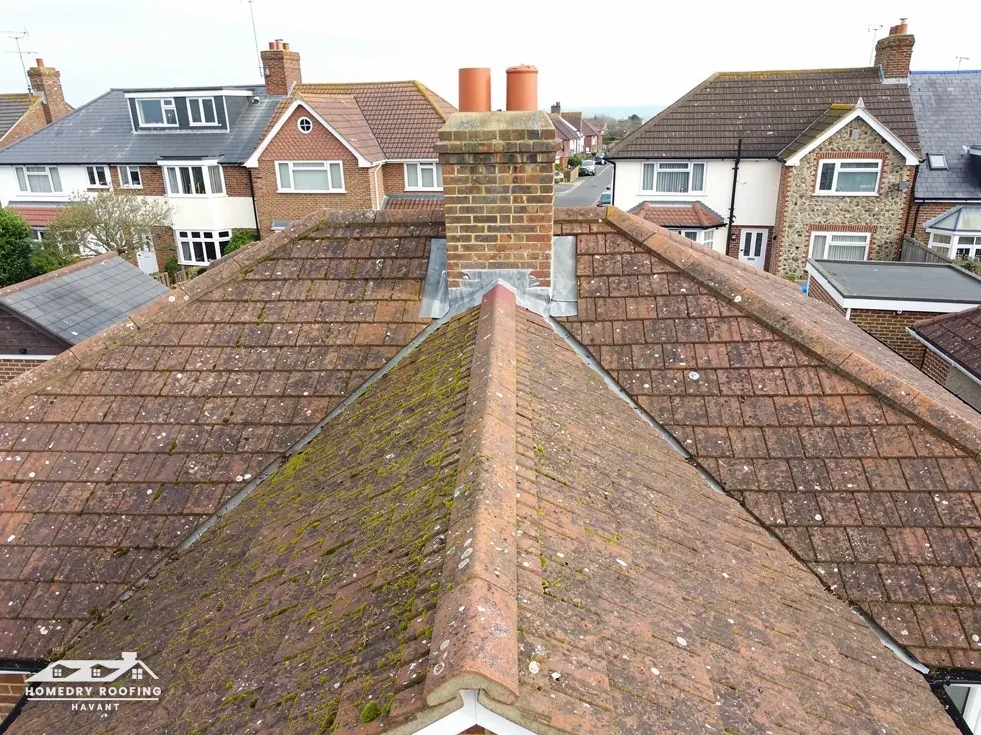
The highest point of the roof is where we start looking.
Rain lands on the highest parts first, so the survey begins there. On the ridge we check each capping piece and the bedding under it for cracks and gaps. A stack gets a longer look: the lead collar at its foot, the mortar fillets, the pointing above and the pots on top. In the loft, a torch shows whether a stain on the timber sits directly below any of those. Valleys and hips are read in the same spirit, and each finding is photographed. The roof repairs page explains how a fault is closed once it has been located, and why a small fault is dealt with before a large one grows from it. At this stage the tools are a ladder and a torch, and nothing is taken apart.
Hunston has several entries on the National Heritage List, The Spotted Cow Public House, Flagstones and Autumn Cottage among them, all Grade II. A roof change that alters a listed building's character needs listed building consent, and a listed house still has its permitted development rights for roof work, so the two questions are put separately. Should your own house have an entry, find it before a date is fixed and let us know; it changes how the roof is recorded before any covering is moved, and who is asked first.
Hunston and Donnington are the conservation areas around the village. Whether your address sits inside either is a question for Chichester District Council, which keeps the boundaries. Article 4 directions can take extra rights away, so ask Chichester District Council about your road before assuming anything, and file that reply beside the survey papers so the answer is easy to find later. The planning guide for roof work lays out the rules so this page need not.
On a listed house the roof is photographed before anything is lifted: the ridge line, the chimney, the edges at the verge and the eaves. Those pictures travel with the written findings, so you and anyone at the council who is asked for consent look at the same record. Where a repair can keep what is already there, the report states it; where it cannot, the reason is given in plain words.
A stain on the ceiling beside the chimney breast that widens through a rainy fortnight.
A lifted collar of lead round the stack, or a ridge cap that has shifted and left its bedding open to the weather.
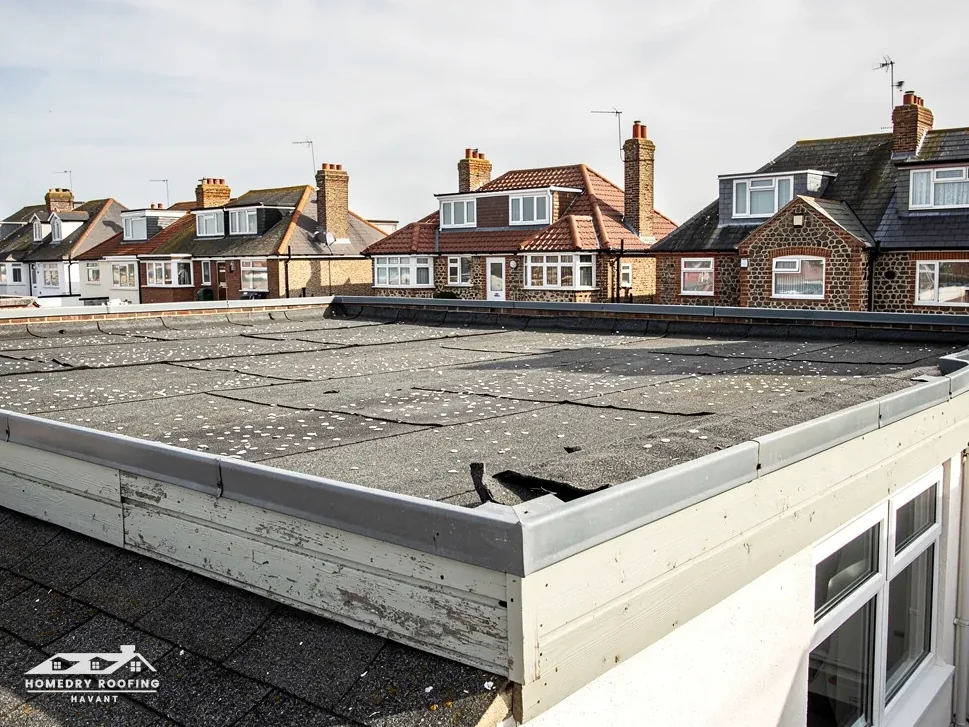
A stain below a flat or lean-to roof points to the upstand, the joints in the covering or a blocked outlet. We check those three from outside and trace the stain's path from inside before saying which one let the rain in.
After the main slopes, rain reaches the lower roofs, and a lean-to or flat extension carries it by its own route. The covering climbs the house wall as a low upturned edge, the upstand, then slopes toward an outlet. We inspect the top of that edge, any water still lying on the surface the day after a shower, and the outlet itself for leaf litter and grit that has washed in. At the point where a lean-to joins the house, a strip of lead is tucked into the wall above the join, and its top edge is checked too. Standing water means a blocked outlet or a wrong fall, which are different jobs, and we name the one you have. Our flat roofing page describes the coverings and how each is laid.
The final stretch runs from gutter to drain. Looking along it from a ladder, we note a drip at a joint, a bracket that has allowed one section to droop, and a downpipe that pours onto brickwork and misses its gully. A thumb is pressed into the fascia timber behind the gutter to test for softness, and the soffit under the eaves is checked for stains. A gutter that keeps its fall moves water without fuss; one that has dipped in the middle overflows when the rain is heaviest. See guttering, soffits and fascias for repair and renewal.
Afterwards you get the findings in plain language, a sound repair put forward before any replacement is considered, and the drive and garden swept clean. Hunston is no special case: the rain is followed from ridge to drain, the point of entry is found and that point is closed. If a fault turns out to be small, the report says it is small, and nothing larger is sold to you. Where the lower roofs need nothing, that goes in writing too.
Water lying on a flat roof is a clue and not yet a verdict.
Standing water on a flat roof the morning after rain has more than one cause. A blocked outlet is cleared in minutes, while a wrong fall means relaying the covering. The survey notes where the water sits, how far it spreads and where the outlet stands, with photographs, so you can compare the roof with the findings later. Both cases are explained before any work is priced.
Map of Hunston and the places around it, with the dashed line of our 30-mile service area from Havant. The same places are listed below the map.
The lead collar round the foot of the stack comes first, since a slope and a wall meet there and the joint takes whatever the weather sends. After that: the mortar fillets, the pointing above, the flaunching on top and whether the pots sit firm. A torch in the loft shows if staining on the timber lines up with the stack. You then learn whether the lead can be dressed again, whether the pointing wants work or whether the stack itself is the problem, each with a photograph, so the fault is in front of you before any figure is written down.
Two separate questions. On the building control side, the Planning Portal sets two tests for a new covering: if the work touches less than 25 per cent of the building envelope and less than 50 per cent of the roof, a building regulations application will not usually be required, and a new covering 15 per cent or more heavier needs approval at any size of job. Before work starts, Chichester District Council's building control team is asked which route applies. Planning is a matter of the house and its setting, for example a listing or a conservation area, and the planning guide sets those rules out with their sources.
Scaffolding that obstructs a public highway has to be licensed under section 169 of the Highways Act 1980, and for Hunston addresses West Sussex County Council is the body that issues the licence. West Sussex County Council licenses scaffolding on the highway at £266 for one month and asks for at least 10 working days' notice. Dates are fixed with you first, since a licence has a start and an end, and we arrange the licence with our scaffolder. Whether a tower must stand on the highway at all is settled at the survey, because a drive or front garden can sometimes take it instead.
Yes, wherever a house or outbuilding carries a list entry itself. The Spotted Cow Public House, Flagstones and Autumn Cottage are each Grade II, and under section 7 of the Planning (Listed Buildings and Conservation Areas) Act 1990 consent is required for works affecting a listed building's character. An entry covers the building it names, so search the Historic England list under your own address before assuming either way. Where a house is listed, the roof is photographed and the findings put in writing first, which gives the council a clear record when you apply and spares you from describing the roof from memory.
Hunston and Donnington are the conservation areas close to the village. Chichester District Council decides planning applications and keeps the boundary maps, so ask it whether your address lies in either. Article 4 directions can withdraw further permitted development rights, and only Chichester District Council can speak for your road, so ask it directly. The planning guide covers what the rules allow for roof work and names where each rule is found, so you can read it first hand and decide what to ask the council.
The Environment Agency flood map for planning places the mapped centre of Hunston in Flood Zone 2. The map describes flood risk to land, so it is a separate subject from the roof survey, and we do not turn it into a roofing rule. The zone is given for the centre of the village, which says nothing certain about a particular plot, so look up your own address on the map before drawing any conclusion. What the roof survey follows is the route that rain takes from the slope to the gutter, the downpipe and the drain.
A gutter should fall gently towards its outlet, and Brett Martin advises a fall of 1 mm for every 600 mm. A run that has dropped in the middle holds water, which then spills over the edge in heavy rain or sits and stains the fascia. The fall is judged by eye and with a level, every joint and bracket is looked at, and we say whether a re-hang will do or whether the run needs replacing. Pressing the fascia behind it for softness happens in the same visit, so one report covers the whole eaves line, with a photograph of each joint that was found open.
The work itself, the covering, whether VAT and the cost of the scaffolding sit within one total, and the findings behind it, all in writing and all from someone who has climbed up and looked. A figure quoted down the phone cannot supply that, and it is not the same as a price on paper. Our quote is one written total price, with a sound repair put forward ahead of a replacement. Comparing quotes is simpler if you ask every firm to write down what its total includes; otherwise a smaller figure may just leave the scaffold or the VAT out.
You'll get one written total price.
Fill in what you like. It opens WhatsApp with your message ready to send.