
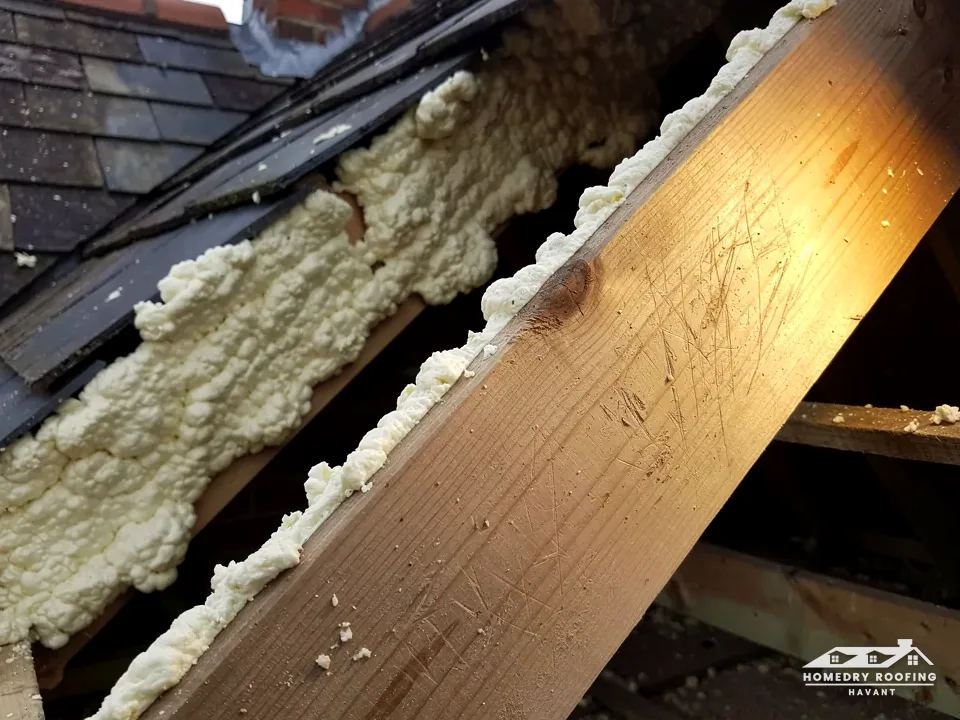
Spray foam is sold under one name, but it is made in two forms. Both are sprayed onto the underside of the roof as a liquid and set into a solid layer. They behave differently once they are there, and that difference is the reason surveyors, lenders and roofers ask which kind you have before they say anything else about your loft.
The Energy Saving Trust, which gives independent advice on home energy, names the two as closed-cell and open-cell and says the rot risk behind the roof should be much lower with the second. That is a careful statement, and this guide keeps it as careful as the source wrote it. Lower is not none, and the roof above the foam still decides most of what happens to the timber.
Below you will find the two types side by side, why the timbers are the real question, how to work out which foam you have, what the type alters when you sell or borrow, and what taking foam out involves. It sits under our spray foam removal page.
Two types of foam under one name
The Energy Saving Trust puts it in one line: "There are two main types of spray foam insulation, closed-cell and open-cell." Everything else in this guide follows from which of the two is on your rafters. If you have never seen the paperwork, you may not know, and nothing wrong has been done by not knowing. The sections below cover how to find out.
The Energy Saving Trust describes the closed-cell type by its drawback: "Its main drawback is that it's not vapour permeable." Vapour permeable means that water vapour in the air and in the timber can pass through the material instead of being held behind it. A foam that is not vapour permeable gives that vapour nowhere to go.
| Type | What the Energy Saving Trust says | What to ask |
|---|---|---|
| Closed-cell | "Its main drawback is that it's not vapour permeable." | What sits behind it, and could the timber be seen? |
| Open-cell | The rot risk "should be much lower with an open-cell foam." | Lower than what, and is the roof above it sound? |
Two features of that table matter. The Energy Saving Trust sets out one drawback for one type and a lowered risk for the other, so neither line says a foam is safe. And the questions in the last column are the ones a survey is built around, because the foam is only half of the picture.
Closed-cell has one stated drawback, and open-cell has a risk that should be much lower, but neither is a clean bill of health.
Why the timber is the question
Rafters, battens and the ends of the joists hold the roof up, and they are made of wood. Wood that stays wet decays. A roof is built so that rain runs off the covering, and any that gets past it is carried away by the underlay. When foam is sprayed onto the underside of the roof, it changes what the timber is exposed to and what can be seen.
The Energy Saving Trust gives the mechanism in plain terms: "Spraying foam directly to the underside of the roof will partially seal the timber." It then says where the type comes in. The risk of rot "should be much lower with an open-cell foam." Read that sentence slowly. It says much lower, and it says should. It does not say the risk is gone.
RICS, the chartered surveyors' body, adds a second point in its consumer guide: "If the timber roof structure is covered with spray foam it cannot be fully seen or inspected". A surveyor or roofer may therefore be unable to say what the timber looks like, whichever type of foam covers it.
- Type of foam: sets the level of risk, in the Energy Saving Trust's words.
- State of the roof above: decides whether water reaches the timber at all.
- Quality of the application: part of whether the foam was installed correctly.
- Visibility: if the timber cannot be seen, it cannot be vouched for.
So the type matters, but it does not replace a look at the roof covering from outside and at the loft from inside.
How to find out which foam you have
The easiest route is paperwork. A foam installation may come with a record of the job from whoever did it: a product name, a date and a description of the work. If you bought the house with foam already in the loft, the seller's papers or the survey from your own purchase may mention it.
- Look for the installer's name, invoice or paperwork pack, and read the product name on it.
- Search for the product's data sheet from the manufacturer, which says whether it is open-cell or closed-cell.
- Photograph the foam from the loft hatch, showing how far it runs and what it is stuck to.
- Ask whoever sold or surveyed the house whether they hold a record.
If none of that turns up, we can look at the foam on a survey and give you our view of the type, with a note of how certain it is. A view from the hatch can be useful. It is a view, though, and it is no substitute for a data sheet.
It also helps to note anything else the loft shows. Is there a separate layer of underlay behind the foam? Are the tiles or slates visible from inside, or covered? The Energy Saving Trust observes that timbers coated in foam are harder to replace, and that the same goes for tiles or slates where there is no felt or other layer between the foam and the tiles. Those facts about what lies behind the foam will shape any repair, whichever type it is.
Photos taken before any work starts are worth keeping with the paperwork. They help a roofer, a surveyor and a lender to see the same thing, and they take two minutes to take.
What the type does and does not change
Open-cell or closed-cell does not decide whether a buyer, a surveyor or a lender will want to know about the foam. RICS reported in March 2023 that there had been concern in some parts of the lending market, such as equity release mortgages, and its guide tells readers to check with their mortgage provider whether the lender's policy allows such products. Neither of those two statements is tied to a foam type, so ask your own lender about yours.
The Energy Saving Trust gives a more settled view of mortgages: "there should be less of an issue with getting a mortgage for homes that have had spray foam insulation installed correctly." The word correctly is carrying weight there, and a record of how the foam went on is one way to show it.
| Matter | Does the type change it? |
|---|---|
| Rot risk behind the roof | Yes: "should be much lower" with open-cell, says the Energy Saving Trust |
| Whether the timber can be seen | No: timber covered with foam cannot be fully seen or inspected |
| A mortgage provider's policy | Ask the provider, for either type |
| Whether the foam is permanent | No: the Energy Saving Trust calls spray foam a permanent installation |
We cannot say what a lender or surveyor will decide, and we do not pretend to. What we can do is open the roof space to view, record the timber and give you something in writing to show them. Our short answers on spray foam and a mortgage and damp take those two points further.
Removal and re-insulating, whichever type it is
The Energy Saving Trust is direct about taking foam out: "spray foam is considered a permanent installation. If you decide to remove it at a later stage then you might also need to replace the structure it was applied to." That applies to both types, and it is the reason nobody should promise that foam simply peels away. Our short answer on whether spray foam can be removed covers the job itself.
On price, MyJobQuote gives two figures, a rate and a worked example: "The average cost of spray foam removal is £40 per m²" and, for its own example, "For a standard 3-bedroom property with roughly 80m² of roof space, total removal costs typically come to around £3,200." These are MyJobQuote's, dated 17/09/26, and neither is our price. We give one written total price after a survey.
Once the foam is out, the loft needs insulating again. If the roof is renovated, Approved Document L (AD L) 2021 expects improved insulation where that is feasible: a renovated roof works to a U-value of 0.16 W/(m²·K), against a threshold of 0.35, where it is feasible and pays back within 15 years. Your building control body can tell you whether the work needs an application, whether that is the council's own team or a registered approver.
The type of the old foam changes none of that. What shapes the job is the area the foam covers, how firmly it has bonded and what the timber looks like once it is bare.
What to do next
Start with the paperwork and the photographs, because those cost nothing and tell the most. Gather them in one place, with the date the foam went in if you know it. Then decide what you are trying to settle: a sale, a mortgage, a worry about the timber or a plan to insulate differently. The right step depends on which of those it is.
- Selling or remortgaging: ask your lender and your surveyor what they want to see, before spending money on any work.
- Worried about the timber: have the roof covering checked from outside first, since a sound covering is the best protection the timber has.
- Planning to remove the foam: agree what happens afterwards, including the felt, the battens and the new insulation.
- Not sure which type you have: send us the photographs and any paperwork and we will give you a view on what is in the loft.
A survey does not commit you to removal. Where the foam is sound and the roof above it is sound, our report tells you to leave it alone, and where a repair will do, that is the route we recommend. Where neither holds, you get the findings in writing with photographs, and the choice of what happens next stays with you.
The loft insulation that goes back afterwards is a separate decision, and it is worth settling before the foam comes out rather than after.