
What the Energy Saving Trust says
The Energy Saving Trust describes two main types of spray foam, closed-cell and open-cell. About closed-cell it says: "Its main drawback is that it's not vapour permeable." That means moisture in the surrounding air or other building materials cannot travel through it and escape.
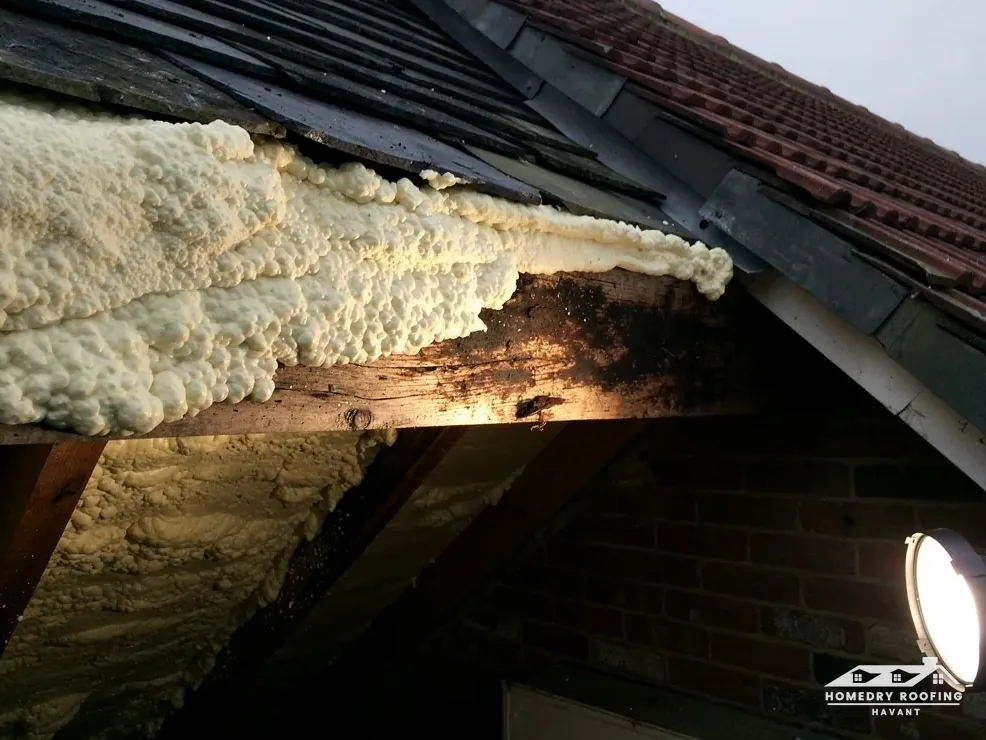
On the roof itself it says: "Spraying foam directly to the underside of the roof will partially seal the timber." It warns of rot if rainwater from a leak collects there, and of a condensation risk even without a leak, then adds that this risk "should be much lower with an open-cell foam."
Take the wording at face value. The risk is described as lower with one type of foam, never as absent, and the advice does not say that every foamed roof will rot. For that reason a survey of the particular roof counts for more than any general rule about foam. What it does show is why the question is a fair one: timber sealed behind foam is not easy to keep an eye on. Our guide to open-cell or closed-cell spray foam explains the two types in more detail.
Two kinds of damp that resemble each other
Damp in a roof has more than one possible cause, and foam can make them hard to tell apart. Rain that gets past a slipped tile or a lifted flashing is a leak. Moisture that forms inside from the air of the house is condensation. Both can leave a stain on a ceiling, a musty smell, or a dark patch on timber.
Which one you have decides what mends it. A leak is closed where the water gets in, which is not always where it shows. Condensation is a question of how air and moisture move through the roof, and a new tile will not fix it.
With foam in the way, the ordinary clues are covered. You cannot see a tide mark running down a rafter, and a damp underlay can be hidden. So the check starts on the outside, because a fault in the covering is a route for rain whatever is fixed under it. Only when the outside is sound does the question turn to what is happening behind the foam.
What a check can and cannot show
A roof check on a foamed house covers the outside in full: the covering, the ridge, the valleys, the flashings, the gutters. It covers the inside as far as it can be seen: the face of the foam, its edges, the ends of the loft and any place where timber shows through. Signs of damp on ceilings and walls below can be recorded as well.
It has nothing to say about the timber under the foam. RICS puts the limit in one sentence in its consumer guide: "If the timber roof structure is covered with spray foam it cannot be fully seen or inspected." A report that says "not visible" is stating a limit, and it is no verdict on the timber either way.
- No sign of damp outside or in the house is a good sign, but it is not proof of sound timber.
- A stain below the roof points to a cause worth finding, whether leak or condensation.
- Only removal, or a gap in the foam, lets the timber be examined.
- A roofer can still say what the covering, flashings and gutters are doing, and that is where a leak starts.
If damp turns up behind the foam
If a stain, a smell or a surveyor's note raises the question, the sequence is simple. Close any fault in the covering first, so that rain is ruled out. Then, if the worry about the timber remains, ask for a view on taking the foam out, at least from the part of the roof that concerns you.
The Energy Saving Trust is plain about what removal involves: spray foam "is considered a permanent installation", and taking it out later might also mean replacing the structure that the foam was sprayed onto. So the decision belongs after the facts are in, with the survey findings and a written price beside them. Ask for the timber to be photographed once it is bare, so that you hold the record yourself.
Once the foam is off, each rafter is examined for staining and soft areas, and you see photographs of what is found. Sound timber stays, and weak timber is dealt with. Our guide to the problems with spray foam insulation keeps to what is actually known, and the spray foam insulation removal page explains the job.