
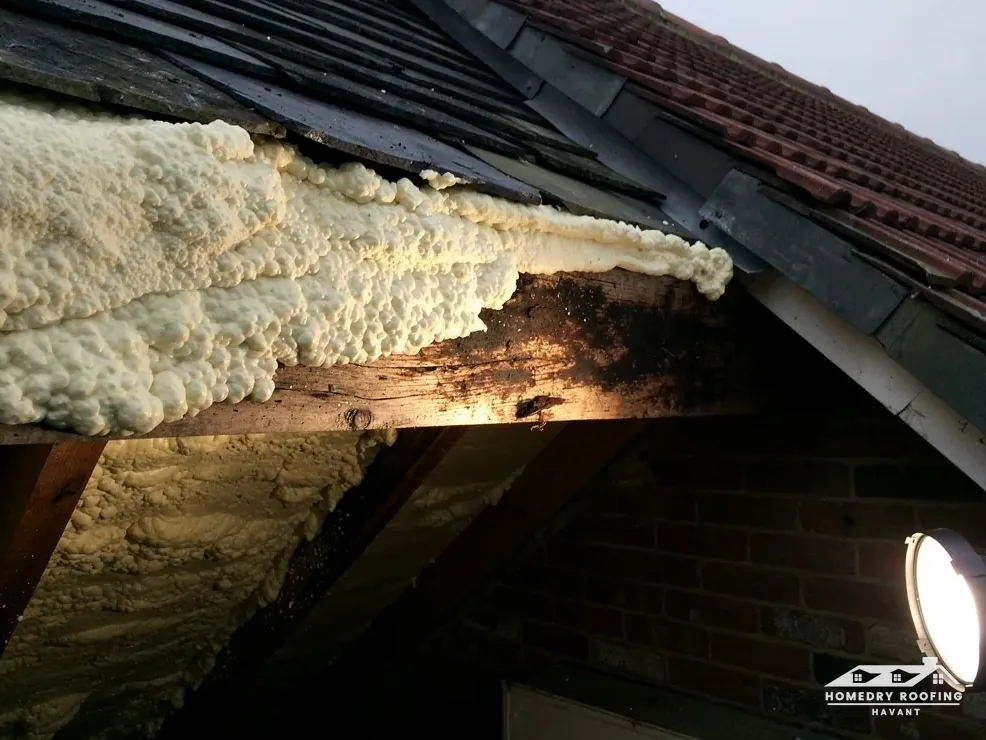
Spray foam insulation has had a rough press. Search for it and you meet stories of rotten rafters, houses that cannot be sold and bills for stripping it out. Some of those stories are true for some houses. None of them is true for every house with foam, and a homeowner trying to decide what to do needs to know which is which.
The sources worth trusting here are measured. The Energy Saving Trust gives independent home energy advice, and RICS is the chartered surveyors' body. Both say what foam can do, and both use careful words, such as should, can and some. We keep those words, because a hedge is part of the fact.
This guide takes the main worries one at a time: the timber, the difficulty of inspecting and repairing the roof, selling and borrowing, and what removal involves. It belongs to our spray foam removal service and finishes with the checks that tell you whether your own foam is a problem at all.
What the foam changes about the roof
Before foam, the underside of a pitched roof is open to the loft. You can look up at the timbers, the back of the underlay and, in some roofs, the backs of the tiles. Spray foam is applied as a liquid on the underside and sets into a solid layer, so after the work that view is covered.
That one change has two effects, and they are worth keeping apart. The first is on the timber, which is now partly sealed. The second is on what can be seen, because a loft that was easy to look into has become a surface of foam. A roof does not fail because it is foamed. A foamed roof is simply harder to judge, and a roof that is harder to judge needs a more careful look when something goes wrong.
| Part of the roof | Effect of foam |
|---|---|
| Roof covering | None: tiles or slates shed rain as before |
| Timber | Partly sealed by the foam |
| View from the loft | Largely lost |
| Loft ventilation | Changed, depending on where the foam stops |
The covering is the first line of defence, and foam does not alter its job. Water that gets past a lifted tile or a cracked slate is the route to the timber, and it is the first place we look. If that route is closed, the foam sits on dry wood and the worries above have little to attach to.
The foam does not make a roof leak. It makes a leak harder to spot.
The rot question, with its hedges
The most repeated claim about spray foam is that it rots the rafters. The Energy Saving Trust takes the claim seriously and answers it in three steps, each of which matters.
- Spraying foam directly to the underside of the roof "will partially seal the timber."
- If rainwater from a leak collects there, it can eventually cause the timbers to rot.
- "But this risk should be much lower with an open-cell foam."
Read those together and the position is plain. The foam does not rot timber by itself. It changes how wood copes with water that reaches it, and the type of foam changes the size of the risk. For the other type, the Energy Saving Trust says closed-cell foam's main drawback is that it is not vapour permeable.
Notice the care in the wording. The trust says should be much lower, which is a lower risk and not a clear one. It says a leak is what starts the trouble, and a roof that keeps its rain out has no leak to start it. Our short answer on spray foam and damp sets out the same position on one page.
It follows that nobody can say from the front of the house whether your timber is sound. A foamed roof with a well-kept covering may be fine. One with an old leak behind the foam may not be. The only way to tell is to look at the covering from outside and, where the foam allows, at the timber.
Inspecting and repairing a foamed roof
RICS's consumer guide is blunt about the difficulty: "If the timber roof structure is covered with spray foam it cannot be fully seen or inspected". In practice that has three consequences for a homeowner.
- A leak can go unnoticed for longer, because the usual signs in the loft are covered.
- A surveyor may be unable to report on timber they cannot see, and say so in writing.
- A repair that would be simple on an open roof, such as replacing one rafter foot, can mean cutting the foam back first.
None of that is a reason to panic, and each has a practical answer. Work from the outside. A roofer can look along the slopes, the ridge, the valleys and the lead at the walls and chimneys without touching the foam, and a stain on a ceiling can be matched to a particular tile or flashing above it. A fault on a foamed roof can be an ordinary roof fault, and it is repaired in the ordinary way.
Where the foam does get in the way, the job is cutting it back from the point of repair and no further. We tell you before we start how far we expect to go, and we say what we find once the timber is exposed. Stripping a whole loft to deal with a single slipped tile is a poor trade, so we do not recommend it.
Our short answer on whether spray foam can be removed covers the bigger job.
Selling, borrowing and the lending question
A worry that comes with foam is whether it will stop a sale. The published answer comes in two parts, and they should be read together.
In March 2023 RICS reported concern in some parts of the lending market, such as equity release mortgages, and its guide says: "Do check with your mortgage provider whether their lender policy allows the installation of such products." That is advice to ask, and it does not report a rule.
The Energy Saving Trust, in a page updated in October 2026, takes a more settled view: "there should be less of an issue with getting a mortgage for homes that have had spray foam insulation installed correctly." Correctly is the key word. A buyer's surveyor wants to know how the foam was applied, what is behind it and whether the roof has been kept dry.
| Who | What they tend to ask |
|---|---|
| Buyer's surveyor | Can the roof timber be seen, and what does the foam cover? |
| Mortgage provider | Does its own policy allow foam under the roof? |
| Seller | Is there a record of the work and of the roof's condition? |
We cannot tell you what a particular lender or surveyor will decide, so please raise it with them before work is agreed. We can give you what helps them: dated photographs of the covering, notes on the loft and, where you choose to open the roof space, a record of the bare timber. Equity release is the one product RICS names, so anyone considering it should ask early.
Leaving foam alone, or taking it out
The Energy Saving Trust is plain about one thing: "spray foam is considered a permanent installation." It continues: "If you decide to remove it at a later stage then you might also need to replace the structure it was applied to." That should make anyone pause before starting removal, and it should make anyone who says it comes away cleanly lose a little credibility.
Leaving foam in place can be right, and removal can be right. The choice rests on the evidence.
- Leave it where the covering above is sound, the loft shows no staining, and no buyer, lender or surveyor needs the timber seen.
- Open it up in part where a leak or a stain points to one area, so the repair and the check are both local.
- Take it out where the timber needs inspecting, a lender or buyer requires it, or the roof needs re-covering and the foam stands in the way.
- Delay a decision where the paperwork is missing, until you know which foam you have.
The sensible order is to find out first, then choose. A survey costs far less than a wrong decision either way. If the answer is removal, the roof then needs its felt, battens and insulation put back, and our guide to re-felting after spray foam removal sets out what that stage involves.
If removal is the answer, the price arrives in writing after we have seen the loft, as a single total for the job.
What a survey of a foamed roof looks at
A survey of a foamed roof starts outside, because the covering decides what the timber has been through. We then go into the loft, and the order is the same each time.
- The covering: lifted, slipped or cracked tiles or slates, the ridge, the valleys and the lead.
- The gutters and the eaves, where rain leaves the roof.
- The ceilings below, for stains that mark where water has arrived.
- The foam itself: how far it runs, how thick it is and what it is stuck to.
- Any paperwork, which names the type and the date.
We photograph what we see and tell you what we cannot see. If the foam covers the timber, the report notes that, and it sets out what opening it up would show. Where staining on a ceiling and a fault in the covering line up, we repair the fault and tell you that is what we did.
Part L of the Building Regulations can come into the work afterwards. AD L 2021 expects a renovated roof to reach improved insulation where that is feasible and pays back within 15 years, so insulation that goes back after removal is not a free choice. Ask your building control body whether the work needs an application.
The written price that follows the survey is one total. It states what is to be done, what happens to the foam and whether scaffold is included, and we leave a clean site.