
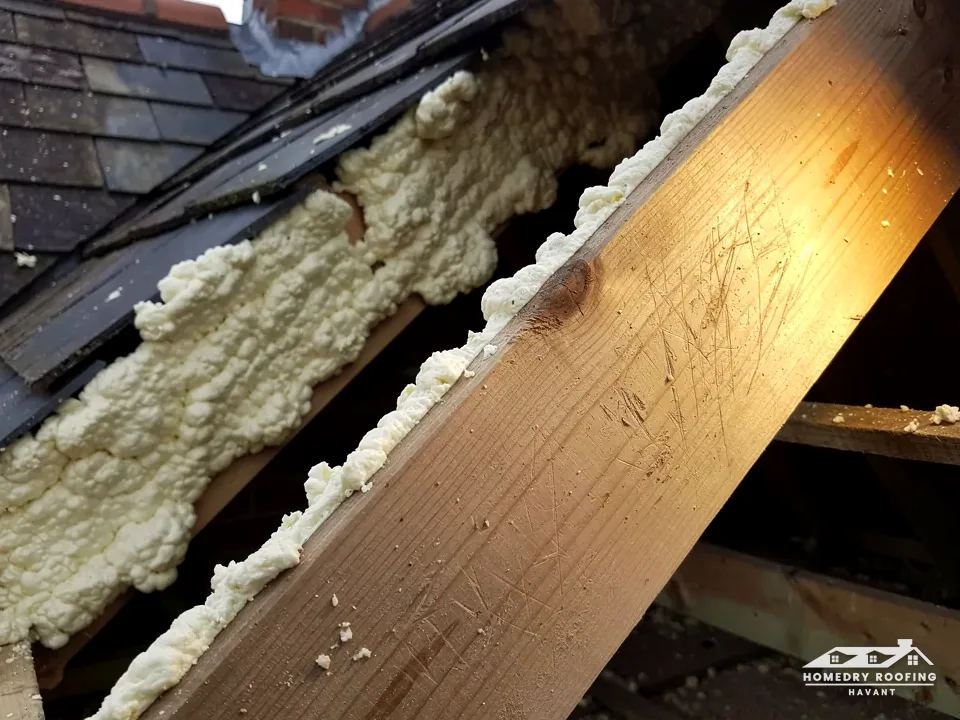
Why age alone does not decide the job
Nobody can say how a house of a given age will turn out, because the date of building tells you little about what is behind the foam. Over the years a roof may have been repaired, re-covered, had felt added, or been altered by an earlier owner, and each of those leaves its mark on the timber and the layers above it.
So an older home is judged from the roof, not from the date. The survey looks at the covering and flashings from outside, then at whatever structure shows in the loft, and records what the foam has been sprayed onto.
- The surface behind the foam: bare timber, an old sheet or the tiles themselves.
- How far the foam runs, and whether it reaches the eaves and gables.
- Any sign of earlier leaks or repairs near the foam's edges.
- How the loft can be reached, and where waste can go.
The Energy Saving Trust describes spray foam as a permanent installation, and that holds for any house, however old it is. A survey that records these four points lets you compare one house with another on facts, and it keeps the quote from resting on guesses about age.
Listed homes and special areas
In England the owner of a listed home still has the roof rights in Classes B and C, yet the owner also has to ask whether the work needs consent under the listed buildings rules, which turn on the building's character. Whether taking foam out of a listed loft counts is a question for the council's listed building team, and it is best asked before the work is priced, not afterwards.
Areas with a special designation work differently. Ordinary re-roofing is normally permitted development under Class C of the General Permitted Development Order 2015, even inside a conservation area. Dormers are different, because they are not covered there, and an Article 4 direction can remove further rights. Which streets such a direction covers is for the council to say, so the safe step is to check with it.
If the house is listed, mention it on the first call. It changes the questions the survey has to answer, and it may affect who must approve the insulation and underlay that go back afterwards. Settle consent first, then commit to the work, because a refusal after the foam is out leaves you with an open roof and no plan.
Checking the timber before anything goes back
RICS puts the difficulty in one sentence: "If the timber roof structure is covered with spray foam it cannot be fully seen or inspected." For an older home, owners often want to know what the roof is built from and in what condition, before putting money into it, and foam stands in the way of that answer.
With the foam gone, every rafter and batten can be checked for dark marks and soft areas, then photographed. Sound timber is left alone. A weak end can be repaired where enough good wood remains, and timber that has lost its strength gets replaced. The result may be a repair job, not a full re-cover, and a sound repair is always preferred to replacement.
The photographs are worth keeping with the house papers. A future buyer, a surveyor or a lender can then see what was found, which tells them far more than a note saying the timber was covered.
Nothing new is fitted over the structure until you have heard the findings and agreed the next step.
Insulating afterwards, and the price
When the foam goes, the loft needs insulating again, and in England that can bring Part L of the Building Regulations into the job. How much of the roof is renovated decides whether it does, so your building control body is asked to confirm the route for the house before any work starts. Listed status can add its own questions, and the council can say how the two fit together. Keep the answers in writing, so the insulation that goes in is the insulation that was agreed, and anyone reading the house file later can follow the decisions.
You receive one written price after the survey, never a list of parts. For scale only, MyJobQuote's September 2026 guide gives its own total of around £3,200 for a standard 3-bedroom property with roughly 80m² of roof space, from an average of £40 per m². An older roof may need more or less than that, depending on what is found once the foam is off.
Our answer on what to insulate with after spray foam covers the choices, and the spray foam insulation removal page shows the job from survey to finish.