
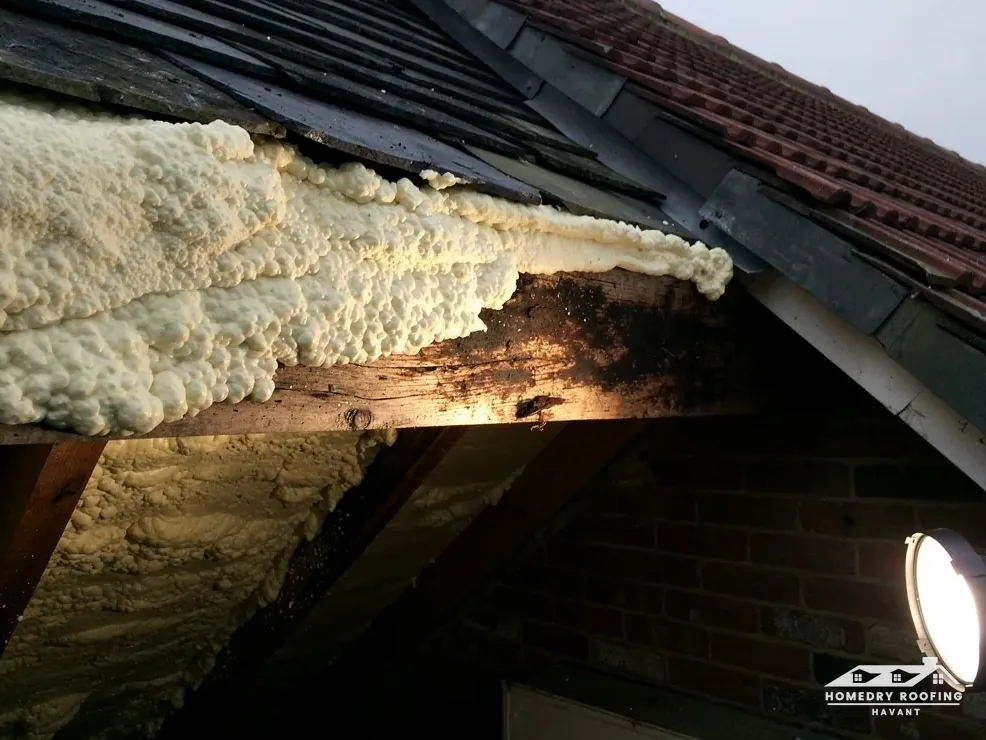
How difficult spray foam is to remove is a fair question, because the foam is not like other insulation. Mineral wool is laid between the joists and can be lifted out. Foam is sprayed on as a liquid and sets in place, which means it has bonded to whatever it was sprayed against. The difficulty is in that bond and in what lies beneath it.
The Energy Saving Trust gives the plain outline. It says spray foam is considered a permanent installation, and that removal at a later stage might also involve replacing whatever the foam was sprayed onto. That second clause is the one that changes the size of the job. It means the foam can come out cleanly, or the roof can need repair work as part of the removal, and the way to know which is to have the roof assessed.
This post walks through the questions that decide how hard a removal is, the checks that come first, what the roof may need once the foam is out, how the roof is brought back up to standard for insulation and the cost figures that others publish. It does not describe removal techniques, and it cannot say how any one roof will turn out.
Why foam is not a simple strip-out
Removing most insulation is a matter of lifting it away from a surface that is not changed by its presence. Spray foam is different because the Energy Saving Trust describes it as spraying directly to the underside of the roof, where it partially seals the timber. The foam is in contact with the roof, not simply resting on it.
The same Trust page warns that taking foam out might call for new structure where it was applied. It is a warning, not a forecast. The Trust does not say that removal always damages the roof. It says the possibility exists, and a sensible owner plans for it.
RICS adds a second difficulty from the inspection side: if the timber roof structure is covered with spray foam, it cannot be fully seen or inspected. So before the foam is taken out, nobody can be sure what condition the timbers are in. That is the heart of the matter, and it is what separates a removal quote from a removal estimate.
- Before removal, the condition of covered timbers is not known.
- During removal, timbers become visible for the first time.
- After removal, the roof is assessed and repaired where it needs it.
A price given before the foam is out therefore rests on an assumption about the roof. A survey that looks at every visible part of the roof from inside and out narrows that assumption without removing it.
What decides how hard the job is
No single figure says how difficult a removal will be. The job depends on a handful of facts about the roof, and a survey is the way to establish them.
| Question | Why it matters |
|---|---|
| Is the foam open-cell or closed-cell? | The Energy Saving Trust treats the rot risk differently for each |
| What was the foam sprayed against? | The structure it was applied to may need replacing |
| Is there any sign of damp or rot? | Timbers in poor order change the repair scope |
| How large is the roof? | Published removal costs are given per square metre |
The foam type deserves a closer look. The Trust names one main drawback for closed-cell foam, that vapour cannot pass through it, and says the rot risk should be much lower with an open-cell foam. Much lower is not none, and the Trust does not say that either type has rotted timber in a particular roof. What it describes is why the timbers behind foam get looked at.
The second question, what the foam was sprayed against, is the one a loft visit alone cannot settle. A surveyor can see the foam surface and perhaps its edges. They cannot see what sits behind it.
You can help the survey by finding any paperwork from the installation, noting when the foam went in and mentioning any roof leaks or damp patches since. Those details are worth more than a general description of the loft.
For the first row, it is worth asking the installer or checking the paperwork before the visit.
Checks before anyone starts work
Some checks belong before any work begins, and they cost little compared with the job itself. They are also the part of the process an owner can see and understand.
- A survey of the roof from inside and out, with the findings written down.
- A view on whether the covering above the foam, tiles or slates, is sound enough to leave in place.
- An answer on what happens if the timbers prove worse than expected, and whether that changes the written total.
- A plan for the waste, since foam removed from a roof is a quantity of material to be taken away.
- A statement of what insulation will go back, and to what standard.
The third item deserves attention because removal quotes can differ on it. A quote that treats the roof as sound and says nothing about the possibility of repair is leaving a gap. A quote that explains what would change if the structure needed work is being straight with you, even though it reads as less definite.
It is also sensible to ask who will be on the roof and how it will be reached, since the HSE says all roofs should be treated as fragile until a competent person has confirmed they are not. Scaffold is one way to work at height on a house, and whether it is in the price is something a quote should state.
These checks are practical advice and not a statement of legal duty. They are the questions that separate a considered job from a rushed one.
What the roof may need once the foam is out
When the foam has gone, the roof's underside is open to proper inspection, probably for the first time since the foam went on. What follows depends on what is found, and it falls into a few broad outcomes.
- Timbers in sound order: the roof is cleaned up and made ready for new insulation.
- Timbers with damp or rot in places: the affected pieces are repaired or replaced.
- A covering or underlay that was disturbed by the work: it is made good so the roof sheds water as before.
The Energy Saving Trust's wording covers the middle outcome, since it says removal might mean replacing the structure that the foam was applied to. The guide on re-felting after spray foam removal covers the underlay side, which is the layer between the covering and the timbers.
It is worth knowing that the roof covering itself is not the first thing at stake. The foam sits beneath it, so tiles and slates may be able to stay, but whether they do depends on how the foam was applied and on what the survey finds. A roofer cannot promise either outcome before looking.
A sound repair is preferred to replacing more than the roof needs, and a quote should name the work and give its reasons. Where the survey finds a section past repair, the quote says that in writing as well. The written total shows you what the bill is for before the work is agreed.
Bringing the roof back up to standard
Removing foam leaves a roof with no insulation, and that has to be put right. In England the rules sit in Approved Document L, Part L of the Building Regulations. Its Table 4.3 gives limiting U-values for existing elements in existing dwellings. For a roof the threshold is 0.35 and the improved value is 0.16 W/m²K.
The document says a renovated roof should reach the improved value, 0.16, where that is technically and functionally feasible. If that cannot be done, or would take longer than 15 years to pay back, the roof should reach the lowest value that is feasible and repays itself within 15 years. Renovation is judged on the whole element: if more than 50% of its surface is renovated, the whole should be improved to the better value.
These are national figures for England, and your building control body confirms how they apply. The 2021 edition of the document applies until 24 March 2027, after which the 2026 edition begins to take effect, so check which one governs your job.
The questions below help when a quote names new insulation.
- Which product is proposed, and at what thickness?
- What U-value does the quote say it will reach?
- How will the roof space be ventilated?
- Will building control be notified, and who handles that?
The answer on what to insulate with after spray foam looks at the choices for re-insulating. Whatever goes in, it needs to meet the rule above, and that is something to see written down before the work, not after.
Cost, and what one written price covers
MyJobQuote says the average cost of spray foam removal is £40 per m². That is a unit rate from one cost guide, last updated in September 2026, and it is not a total. The same guide gives its own worked example, a three-bedroom house with roughly 80m² of roof space, where it says total removal costs typically come to around £3,200.
Both figures are third-party averages. They describe removal, so they do not stand for the repair work, re-insulating or scaffold that a particular roof may need, and the Trust's point about replacing structure shows why the foam alone is not always the full job.
Our own quote is a single total price in writing, given after a survey. You are never asked to add up rates, and the quote ought to state where VAT and scaffold stand. Our spray foam removal service explains how that survey works, and the guide to what spray foam removal costs sets out what third parties publish.
Before you agree to anything, it is worth asking three things.
- Is the roof repair that the survey expects included, and if not, why not?
- What happens to the price if the timbers turn out to be worse?
- Is the insulation afterwards part of the total, or separate?
If the answers are on paper, the job can be compared with any other quote on equal terms, and you can see which parts of the roof each quote assumes are sound before the work is agreed.
Filed under Spray foam removal