
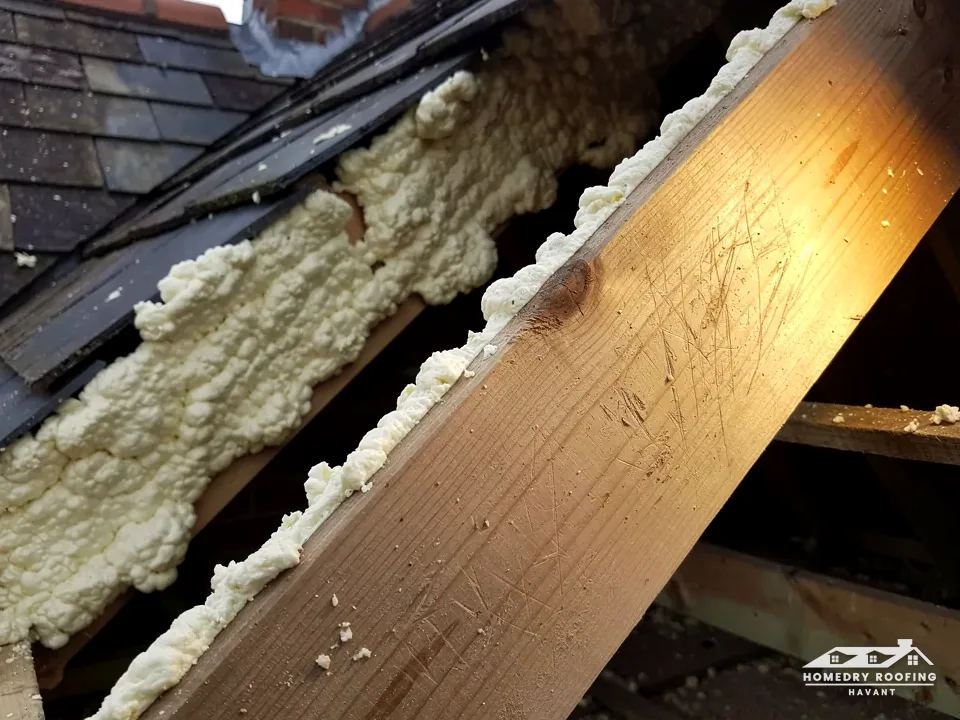
Where the foam sits in the roof
Spray foam insulation is applied from inside the loft, on the underside of the roof. It goes onto the rafters, which are the sloping timbers holding the roof up, and often across the battens and underlay as well, so the loft ends up lined with one continuous layer where bare wood used to show. Anyone who has stood at the hatch with a torch knows how much that torch used to reveal, and how little it reveals now.
That layer is the problem for anyone trying to look. The Energy Saving Trust notes that "spraying foam directly to the underside of the roof will partially seal the timber." A rafter that is sealed under foam cannot be seen along its length, cannot be touched, and cannot be tested for softness with a probe, which is how a roofer would normally judge old timber.
- The faces and edges of the rafters are covered over.
- The underside of the felt, where a leak would leave a mark, is hidden.
- The joints at the ridge and the wall plate are out of sight.
What remains visible is the surface of the foam, together with any spot where it ends or has pulled away.
What a surveyor can still report
Foam inside the loft does not change the roof outside it, so a surveyor can still record the covering, the ridge and hip tiles, the valleys, flashings and gutters. From the loft they can describe the foam, look for cracks, gaps or stains on its surface and note any place where timber shows through. Ceilings and walls below can be checked for signs of damp too, and the whole visit can be photographed so that each finding has a dated picture behind it.
None of that reaches the structure. A competent report will say what was seen and will say, just as plainly, what was not. The wording "not visible" states a limit, and a reader should treat it as exactly that: neither good news nor bad news about the wood.
For a buyer, that creates a decision. The report cannot tell you the timber is sound, and it cannot tell you it is not. Anyone relying on the report has to decide whether to accept the uncertainty or ask for the foam to be opened up at a place that matters. A loose, stained or cracked patch of foam near the ridge or an eaves corner is the sort of place worth asking about, since that is where a leak would run.
Why the limit is hard to get round
You might expect a surveyor to push a probe through the foam, or to cut a small window in it. Whether that is acceptable is for the surveyor and the owner to agree between them, because cutting into foam that the Energy Saving Trust describes as a permanent installation alters the roof, and it should never be treated as routine.
Other routes are less direct. A camera cannot see through foam, and a look from outside shows the tiles, not the face of the timber behind them. An instrument reading taken at a ceiling would not, by itself, tell anyone the state of the rafters above.
This is why the wording in a report matters. A line such as "timber structure not inspected, covered by spray foam" carries real information. It tells a buyer, a lender or the owner exactly what has been left unchecked, and whether that matters is a question for them to answer. It also protects the surveyor, who has recorded the limit instead of guessing past it, and it protects you from relying on a report that claimed more than it could see.
Getting the timber seen
If the timber has to be seen, whether for a sale, a new loan or a stain that keeps returning, the foam has to be lifted off it. That may be one slope or the whole roof. The Energy Saving Trust cautions that removal might also take the structure beneath with it, so the choice is best made after the outside of the roof has been checked and you hold a written total price.
When the wood is bare, each rafter can be looked at for dark staining, softness and old leak marks, and photographed. The photographs are yours. Sound timber stays as it is, and a surveyor or a lender can read the record instead of guessing.
Our spray foam insulation removal page explains the job, and the guide to the problems with spray foam insulation goes through what is known. Our answer on whether spray foam can be removed covers the work itself, and the RICS consumer guide to spray foam sets out the inspection limit in full.