
What RICS actually reported
RICS, the Royal Institution of Chartered Surveyors, published a consumer guide on spray foam insulation, and its press release is dated 3 March 2023. The sentence that matters here is the one quoted above, and it is worth reading slowly: it speaks of concern within specific sectors of the lending market, of which equity release is the named example, and it adds that the concern is now having a wider impact on lenders.
The sentence reports concern. It is not a ruling that equity release is closed to every owner with foam, and it is not a list of lenders. Treat it as a prompt to ask questions, and as nothing more than that, because your own provider's policy is what applies to your application.
The same consumer guide gives the practical advice in one line: "Do check with your mortgage provider whether their lender policy allows the installation of such products." Whether foam is yet to be fitted or has been in the roof for some time, the sensible response is the same question, asked early and put in writing.
Where the roof comes into it
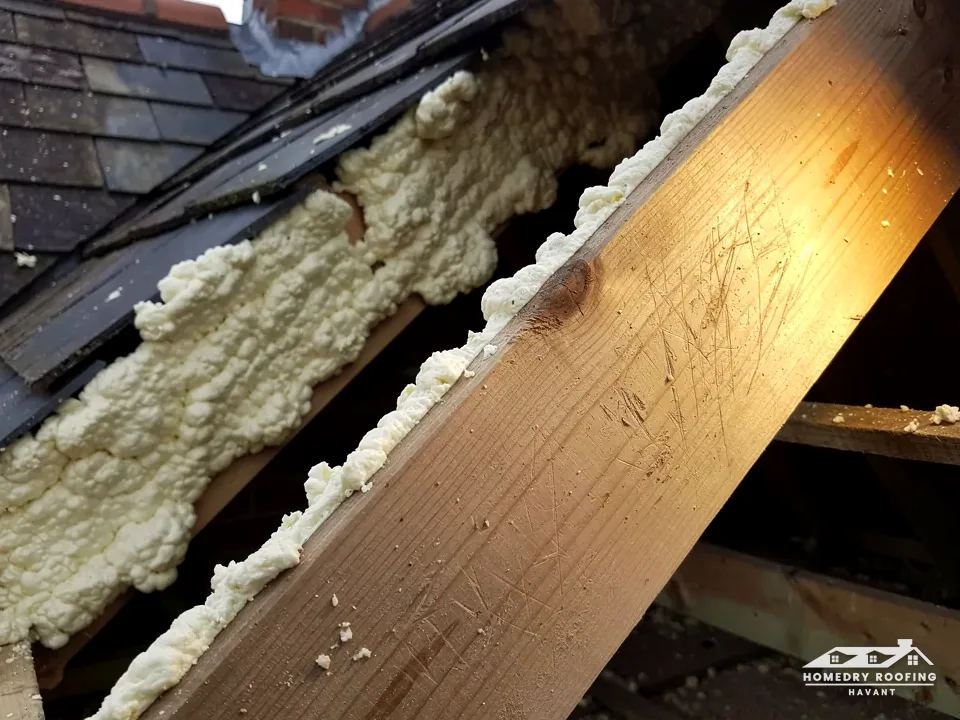
A roof with foam is awkward for a surveyor's report. The consumer guide from RICS gives the reason in a sentence: "If the timber roof structure is covered with spray foam it cannot be fully seen or inspected."
Anyone who relies on that report will want to know the structure is sound, and a note that the timber could not be seen is unable to confirm it, however carefully the surveyor has worded it. That is a limit of the inspection, and it says nothing against the timber itself. The surveyor is not at fault, because the foam stands in the way, but that gap in the report is a likely reason for the question being asked at all.
A roofer's contribution is a record. A check from outside can put the covering, flashings and gutters into a dated report with photographs, and where foam is removed the bare timber can be examined and photographed as well. Neither decides what a lender does, and we cannot speak for one, but a written record gives you something to hand over when the question arrives.
Questions for your provider and adviser
Equity release is a serious decision, and the answers on spray foam should come from the people arranging it, in writing, before anything is signed or any work is commissioned. A conversation on the phone is easy to misremember later. These are worth putting to them:
- Does your policy allow a home with spray foam insulation in the roof?
- Does the type of foam, open-cell or closed-cell, make a difference?
- Do you want installer paperwork, a survey of the roof or a surveyor's note on the timber?
- If the foam were removed, what would you want to see afterwards?
- Is the position the same now as it was when we first spoke?
Write down the answers, noting the date and who gave each one. Where two providers differ, it suggests lenders do not all take the same view, which is a fair reason to ask more than one. We cannot make the call for a lender, and a roofer who tells you what a lender will accept is guessing. Keep any installer paperwork with your notes, since an adviser may ask what was sprayed and when.
If the foam has to come out first
Sometimes the provider's answer is that the foam would need to be removed, or that they would want the timber seen. Removal is possible. The Energy Saving Trust describes it as a permanent installation, though, and warns that removal might mean replacing the structure underneath. A job of that size should follow the lender's answer, and should never come before it. Ask whether partial removal, from the slope that worries the surveyor most, would be of any use to them.
The Energy Saving Trust's wider advice, updated in October 2026, is more reassuring: "there should be less of an issue with getting a mortgage for homes that have had spray foam insulation installed correctly." Set beside the concern reported earlier, that leaves a mixed picture: the position can differ from one provider to another and from one roof to another, which is why your own provider's answer is the one that counts.
If you do go ahead, the quote arrives as one written price after our survey of the roof, and the timber is photographed once it is bare. Our answer on spray foam and mortgages covers the wider lending question, and the spray foam insulation removal page explains the job. The RICS spray foam consumer guide is worth reading in full.