
What is known, and what is not
Two organisations have published views on spray foam that touch on value, and neither gives a figure for it. In March 2023 RICS reported concern within specific sectors of the lending market, such as equity release mortgages, and the Energy Saving Trust says that "there should be less of an issue with getting a mortgage for homes that have had spray foam insulation installed correctly."
Both lines are about borrowing against a house, which is not the same as what it would sell for or what an energy certificate records. A price effect, up or down, would be a claim that neither organisation makes.
That leaves three separate questions, and each has its own answer:
- What the energy certificate shows afterwards is for the assessor who produces it.
- What the home is worth is for a valuer and, in the end, a buyer.
- Whether a lender will lend is for that lender, in writing.
A roofer can say what is wrong with the roof, what the foam covers and what removal involves. We cannot honestly give a number for any of the three.
Insulation after the foam is out
Removal takes away the insulation the foam provided, and new insulation goes in as part of the job. In England, AD L 2021 Table 4.3 sets a threshold of 0.35 W/m²K for an existing roof and an improved figure of 0.16, and looks for the entire roof to reach 0.16 once more than 50% of its surface has been renovated, where that is feasible.
Those are the targets the work is built to, and they are not a prediction about any certificate. How new loft insulation is recorded in an energy rating is a question for the assessor, and it is sensible to ask in advance what evidence they would want: invoices, a description of what was fitted, photographs of the work.
Keep that paperwork together with whatever the original installer left. Foam work that has no record behind it is harder for anyone to assess, and the same goes for new work. A dated list of what went where, with the product names, takes little time to write and saves a good deal of argument later. Our answer on what to insulate with after spray foam explains the choices at the roof.
Value is for a valuer and a buyer
A house with foam in the roof can be sold, and our post on selling a house with spray foam covers how that goes. What a buyer will pay is a market question, and a roofer's opinion of it would carry no weight with them.
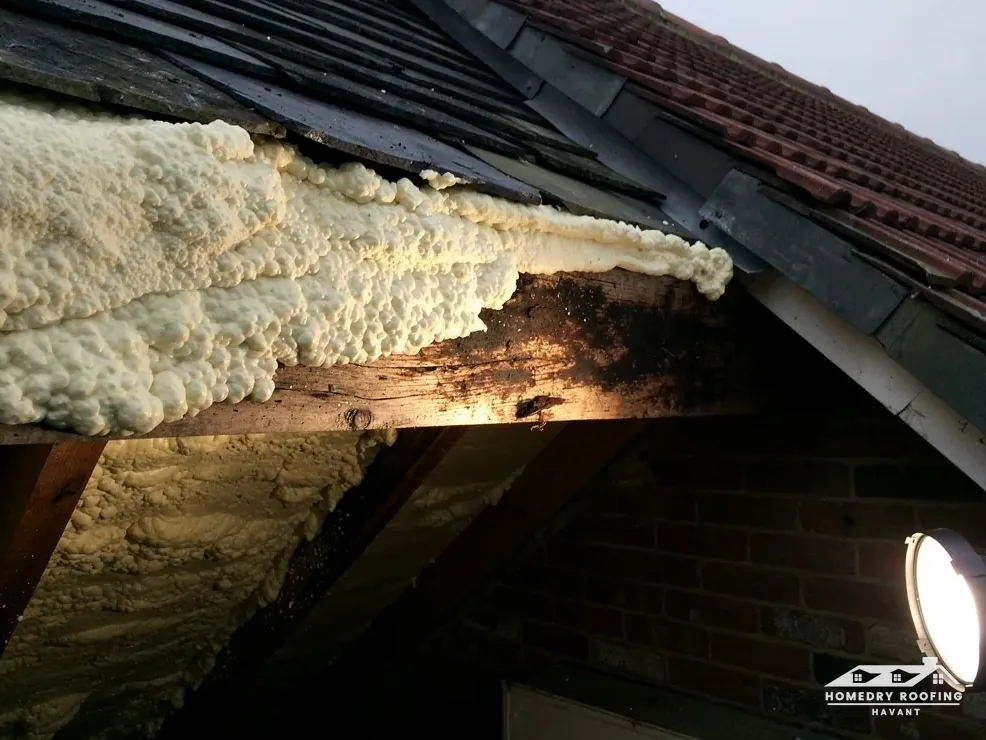
What a roofer can add is evidence about the roof. In its consumer guide, RICS puts the difficulty in a sentence: "If the timber roof structure is covered with spray foam it cannot be fully seen or inspected." A surveyor's report therefore has to record that timber as not visible. A buyer who reads that line may ask questions, and an answer based on photographs of bare, checked timber is a stronger one than a shrug.
That is a case for looking at the roof before deciding anything, and not a case for removal in every house. Where the roof checks out and you are happy with the foam, nothing says it has to go. If a sale or a mortgage is the reason you are asking, find out what the buyer's surveyor or lender would accept before you commit to the cost of removal.
Steps before you spend anything
Because the effect on rating and value is unknown, the sensible order is to collect facts first and spend afterwards.
- Get the outside of the roof checked, so any fault in the covering is found and written down.
- Ask your mortgage provider whether its policy allows spray foam insulation to be installed.
- Ask the energy assessor, or the buyer's surveyor, what they would want to see after the work.
- Request a survey of the foam, so you know what it is stuck to and how much of the roof it covers.
- Compare any quote on the same basis, checking that VAT and scaffold are stated in each.
If removal still makes sense, the price arrives in writing as one total, after we have seen the loft. MyJobQuote's September 2026 guide gives its own average of £40 per m² for spray foam removal, and a total of around £3,200 for a standard 3-bedroom property with roughly 80m² of roof space, though a real roof can sit well away from that example. Our spray foam insulation removal page explains the route from survey to finish.