
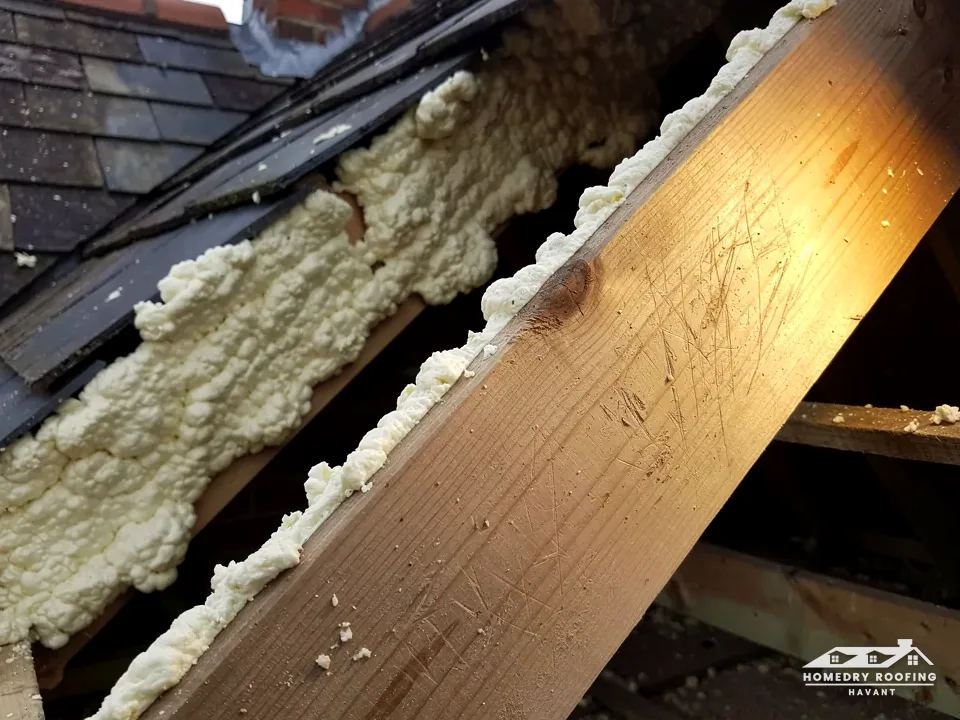
Spray foam insulation is applied as a liquid and sets into a solid layer on the underside of the roof. Once the house goes on the market, the roof becomes a part a buyer's side wants to examine closely, and the foam is the reason.
The answer to the question in the title is not a flat yes or no. Neither RICS nor the Energy Saving Trust says a house with spray foam cannot be sold. What it does say is that foam can hide the roof timbers from inspection, that RICS reported concern in part of the lending market, and that the Energy Saving Trust sees less trouble with mortgages when foam has been installed correctly.
This post sets out those published statements in order, explains the difference between closed-cell and open-cell foam as far as it matters for a sale, and lists the choices open to a seller: leave the foam, have the roof inspected, or take it out. It then covers what removal can involve, what the rules say about re-insulating afterwards and what third parties publish on cost. It cannot say what a particular buyer, surveyor, lender or solicitor will decide, and it does not try to.
What the published guidance says about selling
Two bodies have written about spray foam in a way that bears on a sale. The first is RICS, the surveyors' professional body. In March 2023 it published a consumer guide and a press release. The release says there has been concern within specific sectors of the lending market, such as equity release mortgages, which is now having a wider impact on lenders. That is a statement about concern in some parts of the market. It is not a statement that any lender will turn a house down.
The second is the Energy Saving Trust, which says homes with correctly installed spray foam insulation should meet less of a problem in getting a mortgage. The word that matters there is correctly. The Trust does not go on to say what a lender will do where nobody can show how the foam was installed.
Put together, the two sources give a cautious picture. The foam is not a bar on a sale. It is a feature of the roof that a buyer's surveyor will want to understand, and a mortgage provider may want to look at.
- The surveyors' own guide for owners advises: "Do check with your mortgage provider whether their lender policy allows the installation of such products." That sits beside the concern within specific sectors of the lending market that RICS reported.
- RICS says: "If the timber roof structure is covered with spray foam it cannot be fully seen or inspected."
- The Energy Saving Trust says spray foam is considered a permanent installation.
The mix of these points differs from one buyer to the next. How much each one weighs depends on the buyer, and published guidance cannot tell you how any individual sale will go.
What a buyer's surveyor can and cannot see
A survey is an attempt to understand a house in a few hours. In the loft, the surveyor looks at the roof timbers, the underlay and the insulation, checks for signs of damp and judges whether the roof is in sound order. Spray foam gets in the way of most of that, because RICS says that where a timber roof structure has been sprayed over, it cannot be fully seen or inspected.
The result is a gap in what can be reported. A surveyor who cannot see the timbers can say that foam is present and that the structure is hidden, and may recommend further investigation. Whether that recommendation matters to a particular buyer is for that buyer and their lender to decide.
For a seller, the useful response is to hold information the surveyor would otherwise lack. That might include the following.
- Who installed the foam, when, and whether paperwork survives.
- Whether the foam is closed-cell or open-cell, if you know.
- Whether the roof was inspected before the foam went on.
- Any roof inspection carried out since, with photographs.
We cannot tell you that any of these items is required; that is a question for your solicitor. They are the things an informed buyer's side is likely to ask about, and having them to hand saves time. Equally, a missing piece of paper is not proof of a problem.
Where the lender side is the worry, the answer on spray foam and mortgages goes into it in more detail.
Closed-cell and open-cell foam in a roof
The Energy Saving Trust says there are two main types of spray foam insulation, closed-cell and open-cell. The difference bears on a sale because it affects how the timbers behind the foam are likely to be doing.
| Foam type | What the Trust says |
|---|---|
| Closed-cell | Its main drawback is its lack of vapour permeability |
| Open-cell | The rot risk to timber should be much lower than with closed-cell |
| Either type | Spraying foam directly to the underside of the roof will partially seal the timber |
The rot point deserves care. The Trust does not say that open-cell foam removes the risk, only that the risk should be much lower than with the closed-cell type. Nor does it say that foam of either type has caused rot in any particular house. It describes a risk that arises because the foam partly seals the timber.
For a seller, the relevant fact is that the type of foam is part of the roof's history. A buyer's surveyor who sees open-cell foam may ask different questions from one who sees closed-cell. If you do not know the type, say so plainly, and consider having someone look at it before the house is listed. A roofer's survey can identify which one it is, and a note of the answer, with a photograph, goes in the folder of sale papers. Guessing the type in conversation with a buyer is worse than admitting it is unknown.
Our guide to open-cell or closed-cell spray foam explains how to tell which one you have.
Three options before you put the house on the market
A seller with spray foam in the roof has three broad options. Each carries costs and uncertainties, and the published guidance does not rank them.
| Option | What it involves | What it leaves open |
|---|---|---|
| Leave it | Sell with the foam in place and give the buyer what you know | The buyer's lender may want more |
| Inspect it | Have a roofer inspect the roof and report in writing | Hidden timbers may still be hidden |
| Remove it | Take the foam out and reinstate the roof | Removal can mean further repair work |
Leaving the foam is the simplest, and for a house where it was installed correctly and the roof is sound it may be enough. The risk is a delay late in the sale if the buyer's lender takes a different view.
An inspection costs less than removal and gives a written view of the roof's condition. It cannot show what lies under foam that is still in place, so it narrows the uncertainty without ending it.
Removal ends the question for the foam itself. It is also the largest job. The Energy Saving Trust considers spray foam a permanent installation, and adds that taking it out may also involve replacing the structure it was sprayed onto. That makes the decision one to take on the evidence of a survey, not in a hurry because a sale is moving.
At this stage a roofer's task is to judge the roof: repair, replacement or neither, with the reasons written out.
What removal and re-insulating involve
If the decision is to take the foam out, the work does not stop when the foam is gone. The roof has to be left in a condition where it can be insulated again, and building rules apply to that work.
In England, Approved Document L (Part L) sets limits for the insulation of existing roofs. Its Table 4.3 gives two figures for an existing roof: a threshold of 0.35 and an improved value of 0.16 W/m²K. A renovated roof element should reach the improved value where that is feasible in practice and would pay back within 15 years. Paragraph 11.3 says the whole element should be improved where more than 50% of its surface is renovated.
Those are national figures, so the survey has to show how they apply to your roof, and your building control body is the place to confirm the result.
- Find out if the job counts as renovating over half of the roof surface.
- Ask which insulation product and thickness the quote uses to reach the figure.
- Ask how the roof will be ventilated afterwards, since the Trust says closed-cell foam is not vapour permeable.
- Keep any building control certificate with the sale papers.
The guide to whether spray foam can be removed covers the other side, which is how much of the roof must be opened.
The point for a seller is timing. Taking foam out, repairing and re-insulating is a sequence of jobs, and it is better done before a buyer's survey than started in the middle of one.
What third parties publish on cost
Cost comes next, and the published figures are limited. MyJobQuote gives the average cost of spray foam removal as £40 per m². That is a unit price, and it is not a total for any house. MyJobQuote also gives its own total: for a standard three-bedroom property with roughly 80m² of roof space, it says removal costs typically come to around £3,200.
Treat both as the average of one cost guide, dated September 2026. Neither figure says it covers the repair work that may follow, and the Energy Saving Trust's warning about replacing the structure is a reminder that the foam is not always the whole job.
Our own price is one total, written down after a survey. It is not built up from rates per square metre, so the quote can include the roof repair that the survey turns up. The spray foam removal service shows what the work covers.
For a sale, three things about cost are worth settling early.
- Whether the buyer is likely to ask for removal or only for an inspection.
- Whether the repair work that may follow is in the price you are given.
- Whether VAT and scaffold are stated as in or out of the quote.
Asking these before the house is listed avoids a price negotiation in the final weeks with no figure to anchor it. A written total from a survey gives both sides something firm to discuss, whichever route the sale takes, and it tells a buyer that a person who inspected the roof recorded the findings.
Filed under Spray foam removal