
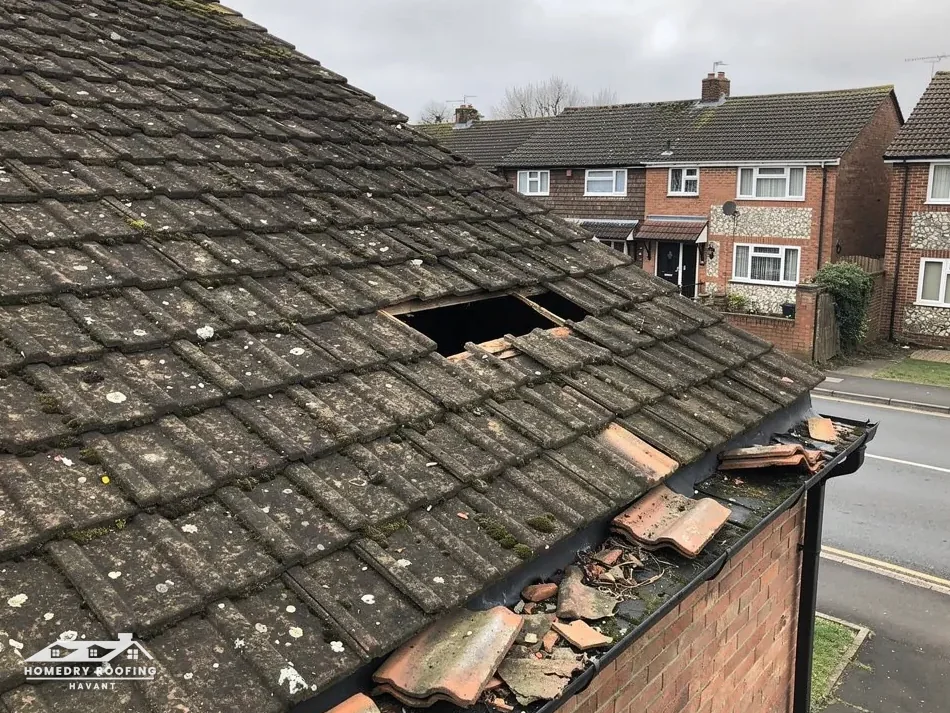
No single figure answers how much to pay for a roof repair, because "a repair" covers anything from three slipped tiles on a bungalow to a chimney flashing three storeys up. What you can do is test a price against sensible published ranges, and against a clear account of what the price contains.
Two outside sources are used below, and they do not agree. That is useful, not awkward. One prices a defined small job and gives a range; the other gives a single average across repairs of every size. Reading them side by side shows why a number quoted without a survey tells you little.
The page starts with what moves a repair price, then sets out the published figures with their dates and their limits, then the cost of getting scaffold onto a house beside a road, then the wording a written total should carry. Charges for urgent attendance sit on a different page, because they answer a different question.
What moves the price of a repair
A repair is cheap or dear for reasons you can see on the roof, once someone has looked at it properly. Five things set it:
- The count. Two broken tiles and twenty are different jobs, even on the same slope.
- The cause. A cracked tile is a tile job. A leak at a chimney or a valley is a flashing job, and the lead, the mortar and the detail around it take more time than a tile swap.
- The reach. A repair that a ladder reaches costs less to set up than one that needs a tower or full scaffold.
- What is underneath. If the battens or the underlay are damaged, the repair has to deal with them or it will not hold.
- The weather. Rain and wind stop work, and a roof left open is covered and made safe before the crew leaves.
None of these can be judged from the ground or from a photograph on a phone. A figure given by phone before the roof has been looked at is an estimate of the job you described, not of the job you have.
Our answer on what a roofer charges per day explains why a day rate, even where one is published, tells you little until you know how many days the fault needs and what it takes to reach it. The count and the reach come first, and the rate comes last. A roofer who starts from a rate and works backwards to a total has priced the day, not the roof.
What Which? and MyJobQuote publish
Both sources below publish repair costs openly. Neither knows your roof, so each figure is a marker for where prices sit, not an offer:
| What was priced | Figure | Source |
|---|---|---|
| A handful of broken or missing tiles (one to six, standard size) | £75 to £400 | Which?, November 2025 |
| One new ridge tile along the top of the roof | £80 to £300 | Which?, November 2025 |
| Roof repair, average | around £650 | MyJobQuote, 2026 |
Which? built its ranges from a survey of 11 tradespeople in November 2025. Its prices cover labour and materials and leave out VAT. Which? expects London and South East prices to land near the top of its ranges, and Hampshire and West Sussex both sit in the South East. The ranges are therefore more useful as a floor for your thinking than as a target for any quote.
MyJobQuote's page gives a single average and shows the date it was last updated. An average means some repairs cost less and some cost more, and it does not say what a repair of your size will cost.
Do not multiply any of these figures. A per-tile or per-metre sum from a cost guide does not turn into a total, because setting up, access and the detail work do not grow in step with the tile count. Only the total written for your own roof matters.
Why the two sources sit so far apart
The Which? figures describe small, defined jobs: one to six tiles, one ridge tile. The MyJobQuote average is a single number for repairs of every size, so a long ridge re-bed, a flashing replacement and three slipped tiles all feed into it. A figure built that way sits somewhere in the middle of a wide spread, and it can be higher than a small job and lower than a large one at the same time.
So when a quote for a small repair lands under £650, nothing is wrong, and when a quote for a larger repair lands above it, nothing is wrong either. The point is that the quote names the job, and that the named job matches what you can see.
Three checks help when a price looks odd:
- Is the job described in words you recognise from your own survey note: which slope, which fault, how much?
- Does the price say whether it includes scaffold, and whether it includes VAT?
- Is a reason given if the roofer recommends more than you asked for?
A price far above the published ranges for a small job invites a question about access or the extent of the damage. A price far below calls for a question on what the price leaves out. Both questions are fair, and a roofer who has been up and looked can answer them in a sentence.
Keep the answers. A reply that explains why the price is high or low, in terms of the roof, is a good sign; a reply that talks about the market in general is not an answer about your roof.
Our page on the cost of replacing a few roof tiles looks at the smallest job in more detail, including what the survey adds.
Scaffold, licences and the extra cost of access
Access is the part of a repair price that people see least, and on a terrace or a semi beside a road it can be the largest part of the work. If a scaffold would stand on the pavement or the carriageway, the authority responsible for that road issues a licence, and the fees differ from one authority to the next. Each fee carries its own unit, so do not set one against another:
- Hampshire County Council: £211.90 on application for the first 2 weeks, and £72 for each additional 2 week period. Ten clear working days are needed between applying and the start date, and Hampshire County Council's page reads: "Scaffolding companies must apply on behalf of their customers."
- Portsmouth: Colas handles the hoarding and scaffolding permit, at £100.00 + VAT per month.
- West Sussex County Council: £266 for one month of scaffolding, with at least 10 working days' notice.
Those notice periods mean a repair that needs a scaffold on the road cannot start on the day you call, so a roof leaking now needs a temporary measure first. Our page on roof repairs sets out how a small job is handled, and where a ladder is enough.
Scaffold is included in the written quote. We arrange the licence with our scaffolder, so it does not arrive as a separate bill. If a roofer says no scaffold is needed, ask how the roof will be reached and how the crew will be protected. The answer is a safety point as well as a cost point.
What a written total should say
The price to aim for is a single written total that follows a survey. The document should let you say, in your own words, what you are paying for. These are the things to find on it:
- The single total, with a note saying whether VAT is in it.
- The fault in plain words, and the part of the roof it is on.
- What will be removed, what will go back and what will be new.
- Whether scaffold, and any licence it needs, are included.
- Where the waste goes, and how tidy the site is left.
- What happens if extra damage is found when the covering comes off, and how you would be asked to approve it in writing first.
That last line is the one that decides whether a total stays a total. A roofer cannot always see what lies under a tile, so a good quote explains how any extra would be raised with you before the figure moves.
On a contract signed after a survey at your own address, the cancellation period is 14 days, and work can begin within that window only if you request it in writing. A repair visit you specifically asked for as urgent carries no cancellation right. Our answers on what a roofing quote should include and cancelling a roofing contract cover both points, and the quote form on every page starts the survey that produces the total.
When a repair price is the wrong question
Sometimes the sound answer to what to pay for a repair is that a repair is the wrong job. A roof whose battens are soft or whose covering has failed across a slope is better served by a different job, and the survey says so with a reason. A survey names the right job, with the reasons set out; a repair that would hold comes first, and a reason is given whenever the answer is different.
The difference between the two is covered on a companion page, repair or replace, a decision guide for Havant roofs. It sets out which jobs sit on which side, and how the planning and Building Regulations tests apply once a repair spreads over more of the roof.
A repair also has a life of its own, and no roofer can promise one. Our page on how long a roof repair lasts explains what the answer depends on, which is the cause of the fault as much as the work done on it.
When you want a written total for your own roof, the survey is the first step. The price that comes back is one total, with the scaffold in it, and it should read clearly enough that you could explain it to a neighbour. If it does not, ask for it to be rewritten before you decide anything, and take your time: a written total is yours to read at home, with the survey note beside it.
Filed under Roof repairs