
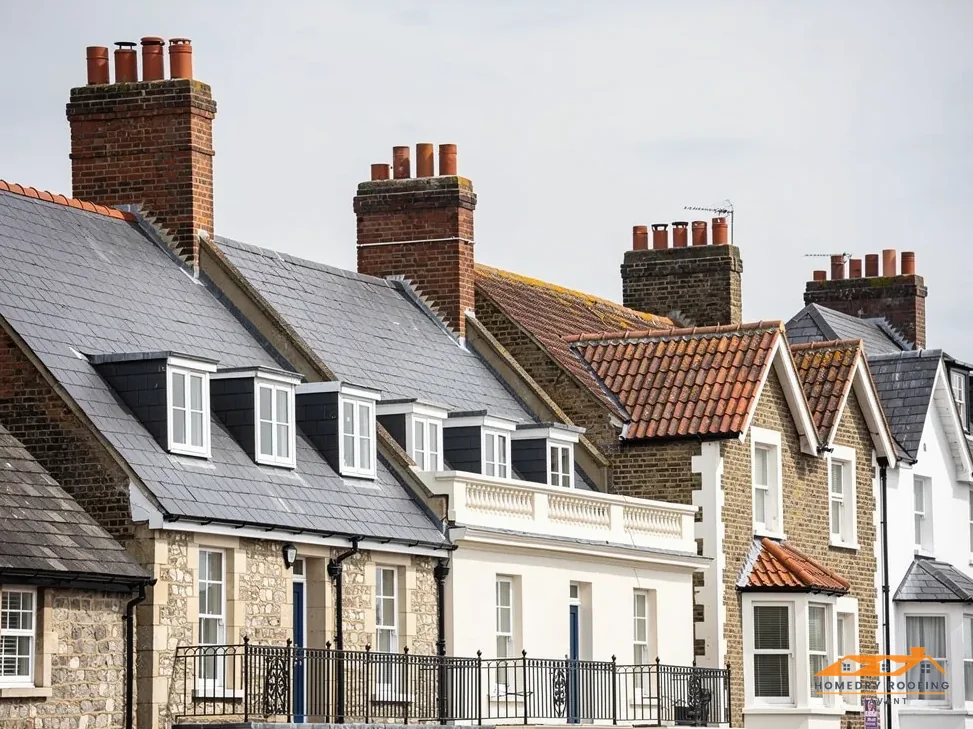
A routine look from the ground
Maintenance on a chimney starts with noticing. No single period suits every stack, because age, exposure and condition vary between houses, so a habit works better than a date in a diary. Pick moments you will remember, such as a change of season or a day when the weather has just cleared, and make a point of looking up.
From the garden or the pavement, with binoculars, check:
- The pot: is it upright, and free of cracks and chips?
- The mortar slope round the pot and the joints in the brickwork: any gaps, crumbling or missing pieces?
- The brick faces: flaking, or a surface that looks worn away?
- The lead flashing where the stack meets the slope: lifted, split or hanging loose?
- The line of the stack: does it look straight, or has it started to lean?
- Anything growing from the top, such as moss or small plants.
Write down what you see, and take photographs from one fixed place every time so that you can compare them with the last set. A change from one look to the next tells a roofer more than a single picture can, and it shows whether a crack is new or old. Share the photographs when you book, and mention the dates you took them.
Signs that call for a check sooner
Some things should not wait for the next routine look. Book a roof check if you notice any of the following:
- A damp patch or stain on the breast in the room, or on the ceiling next to it.
- Fragments of mortar, brick or soot in the fireplace.
- A pot, or part of the stack, that has shifted since you last looked.
- Debris on the ground below the stack after rough weather.
- Birds visiting the pot, or noises from the flue. It is an offence to intentionally take, damage or destroy a wild bird's nest while it is in use or being built, so any work has to allow for that.
If masonry is loose or has come down, keep people away from the ground below it. That is a safety matter before it is a repair, and our answer on a leaning chimney stack says more about it.
The same applies if the stack has been through a storm. A check afterwards is a sensible habit, and it finds a problem while it is still a small one.
What a roofer's check covers
A look from the ground can only go so far. A roofer's check goes up to the stack, and covers what you cannot see from below. The table sets the two side by side, part by part, so you can see what the extra step adds:
| Part of the stack | From the ground | On the roof |
|---|---|---|
| Pot | Outline and obvious cracks | Fixing, cracks and the inside of the flue top |
| Flaunching | Hard to see from below | Splits and gaps |
| Joints and bricks | Obvious gaps | Close inspection of every face |
| Lead | Lifted edges | Dressing, joints and fixings |
We also ask about the flue and the room below, and we record what we find so that any repair can be priced as one written total. A check is a survey of the stack, and you hear what is sound as well as what needs work, which leaves you able to decide what to do next. We also note whether the stack is leaning, and whether the lean looks new. The guide to chimney repointing and flaunching explains what happens when the joints or the mortar slope need work.
Fitting checks around other roof work
The easiest time to check a stack is when someone is already up there. If scaffold is standing for a re-roof or a repair, ask for the stack to be looked at while it does. A chimney is part of the roof, and a repair next to it can disturb the lead or the covering round its base.
It also helps to treat a chimney that is no longer used the same way as one that is. A flue with no fire in it still has a top, joints and lead, and nobody is looking at them from inside the house. A cover on the pot is one way to keep rain out of it, and our answer on a chimney cowl or cap explains the choices.
When you book a check, tell us what you have noticed and where, and mention if the house is a listed building or in a conservation area, since that affects what work needs consent. We survey the stack, then give you one written price for any work it needs. The chimney repairs page gathers our other answers on stacks, from pots to breasts.