
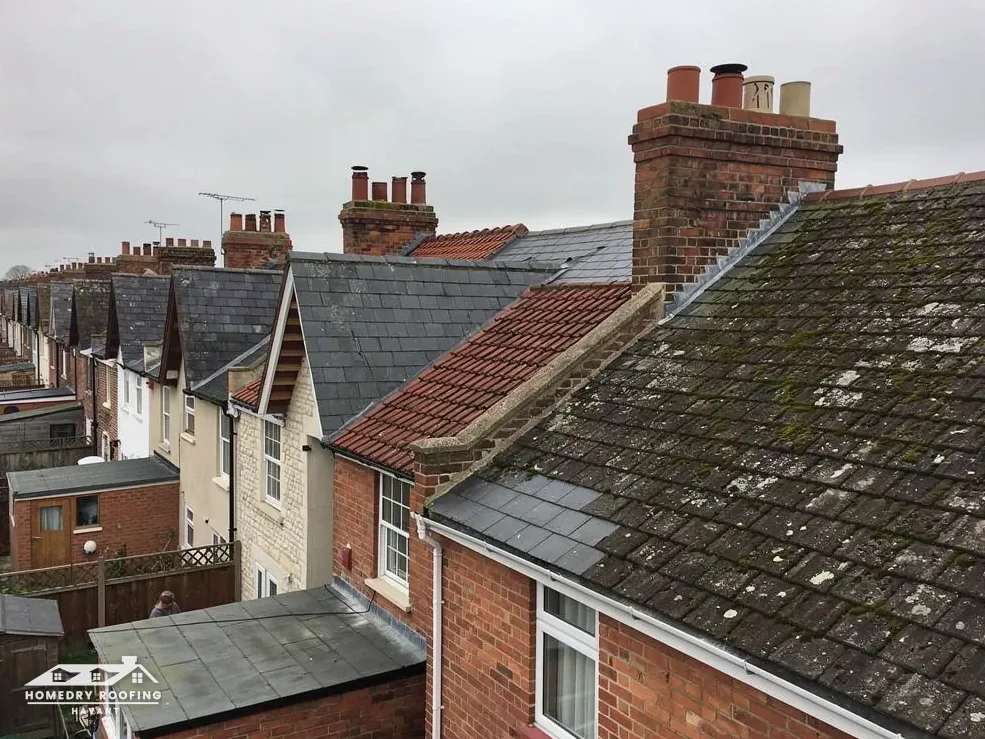
What a cowl does and what a cap does
Both are covers fitted over the top of a chimney pot. In everyday use, a cowl is the one built to let the flue breathe, and a cap is the one that closes the top. Suppliers and roofers do not all use the words the same way, so the safest question is about the job and not the label: does this cover leave the flue open, or does it shut it?
That question matters because an open pot is a route for rain. Anything that runs down an uncovered flue ends up at the bottom, beside the fireplace, and on a breast that is never dried by a fire the water has nowhere to go. A cover over the top answers that, and what separates the two kinds is how much air they let through.
A cover is not a repair. It sits on a pot that still needs to be sound, fixed in sound mortar, so the pot and its base are looked at first. Our answer on why chimney pots crack explains what a survey finds there.
Choosing between them for your chimney
Start with how the flue is used today, and what you want for it tomorrow:
- A working fireplace, stove or boiler flue needs to stay open, so it takes a cover that lets gases through.
- An unused flue that you may want back one day can take a cover that is fitted so it can come off later, with some air still moving through the flue.
- A flue that is finished for good can be closed at the top, and the bottom of the chimney breast dealt with to match.
Before anything is fitted, we ask you whether the flue is in use. If the answer is not certain, a chimney sweep can confirm it, and a sweep can also clear a flue that needs it before the cover is fitted. Nobody can read that from the roof alone.
If the room below has been sealed off, we also look at whether it needs an air brick or vent to go with the new cover, so the capped flue is not left shut in. A decision to remove the breast and stack altogether is a different job, described in our post on removing or capping an unused chimney.
Birds, bats and what may already be in the pot
A pot that has been open for a long time can have things living in it, so we look before a cover goes on. Wild bird law applies: it is an offence to intentionally take, damage or destroy a wild bird's nest while it is in use or being built, so a cover waits until birds have finished with the pot. Our answer on birds nesting in a chimney explains the law.
Bats are covered by separate rules, and harm to a roost counts as an offence without any need to prove it was meant. If there may be bats, we pause and take advice before fitting anything, because closing a pot can also obstruct their way in.
Putting a cover on early is one of the ways to keep a flue free of nests in future. That only works if the flue is empty when the cover goes on, so the looking happens first and the fixing second.
This is also why a cover is something to arrange at a survey and not to order and fix from a ladder at the weekend.
What the survey looks at before a cover goes on
The cover is a small piece of the job. What we check around it matters more:
- The pot: is it sound, level and well fixed, or cracked and loose?
- The mortar slope round the base of the pot, called the flaunching, and the joints beneath it.
- The lead collar at the foot of the stack, where the stack passes through the roof slope and the rain is carried over it.
- Whether the flue is in use, and what it is attached to.
- Whether the house has listed status or sits in a conservation area, since a cover changes how the top of the stack looks.
A listed house is covered by listed building consent, which is required for work that reaches its special character. A conservation area may carry an Article 4 direction, and where it does, the council is the one to ask before the cover goes on.
After the survey, the price reaches you as a single written total, with nothing split out. The chimney repairs page lists the other questions we answer on stacks. Anything that would move the price is explained at the survey, ahead of the written total.