
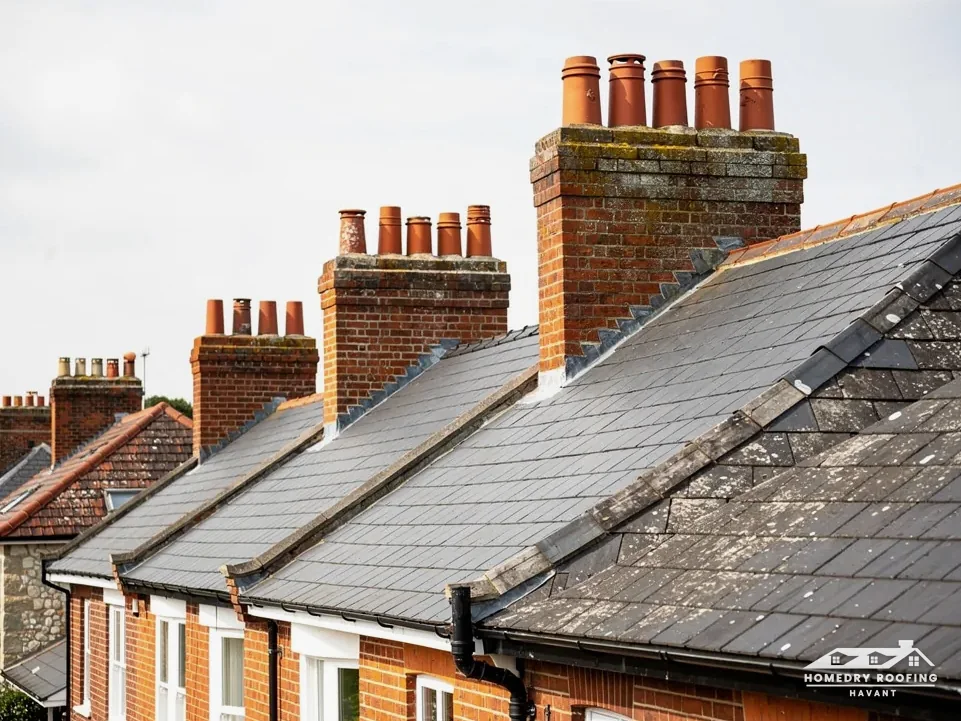
A chimney can stand on a house long after it stopped doing a job. The fire was closed off years ago, the boiler moved to the wall, or the previous owner opened up the room and never touched the stack. It still stands on the roof, though, and it still has to keep the weather out.
That leaves a choice. You can leave the stack and look after it, cap the pot so that nothing runs down the flue, or take part of the chimney out. Taking out the breast inside the house is one decision, and taking down the stack above the roof is another. The two are often confused, and they bring different rules.
This post follows the options from the top of the roof down into the room. It covers what each one involves, which approvals and notices come into play, what published sources say removal costs, and how to choose between them. The written price for any of them follows a survey.
Four options for a chimney nobody uses
Before talking about cost or rules, it helps to name what is possible. A chimney has an outside part, the stack and pots above the roofline, and an inside part, the breast that rises through the rooms. Work on one does not have to mean work on the other.
- Leave it and look after it. The stack carries on as it is, with its pointing, flaunching and flashings kept in sound order.
- Cap it. A cap or cowl goes on the pot so that rain does not run straight down the unused flue.
- Take the stack down to below the roof, and make good the slope.
- Take out the breast inside the house, with or without removing the stack above it.
Each option changes where the rain can get in. A stack left in place needs its joints, lead and top kept in order. A capped stack still has a top that can weather. A stack taken down leaves a hole in the roof covering that has to be closed, while a breast removed from a room leaves whatever is above it needing support.
The people involved change as well. Work above the roof is roofing work, while taking out a breast brings in building control and, on a shared wall, the neighbour. Those steps are covered further down.
Choosing well starts with a survey from the roof. The survey tells you what condition the stack is in, which in turn tells you whether keeping it is cheap, awkward or a poor idea.
Capping the top: what a cap does, what to ask
A cap is the simplest response to a flue that no longer carries smoke. A cowl or cap sits over the pot and shuts out the rain, so that nothing runs down the passage and onto the old fireplace. It is a small piece of work compared with taking the stack down.
A cap does not make a stack maintenance-free. The pot still sits in its flaunching, the brickwork still has joints, and the lead at the base still has to hold. If any of those fails, rain still gets into the stack and down the breast, so a damp patch in the room below may come from a joint further down, not from the open pot.
Before a cap goes on, ask the roofer three things:
- Whether the flue is to be left open to the air at some point, and how.
- What the cap is made of and how it is fixed to the pot.
- Whether anything is living in the stack that has to be dealt with first.
The last question is a legal one. Under the Wildlife and Countryside Act 1981 the offence is to intentionally take, damage or destroy a wild bird's nest while it is in use or being built, and harm to a bat roost is an offence even when it was not intended. A stack that has been open for years could hold either, so look first.
Our short answer on a chimney cowl or cap explains the difference between the two and what each is for.
Taking the stack down to the roof
Removing a stack above the roof is a different job from capping it. The brickwork comes down in courses, usually from a scaffold, to a point below the slope. The roof covering is then rebuilt over the gap, with new battens, tiles or slates matched to the rest.
The lead that sealed the stack to the roof goes with it. That removes a joint that could have leaked, which is a real gain, but the new area of roof has to be closed properly, and the survey should say how.
Several things need checking before the work starts.
- Whether the home is listed. A listed home needs listed building consent where work changes its character, and a stack can be part of that character.
- Whether an Article 4 direction applies. In Portsmouth, the Article 4 directions published for Old Portsmouth, and for the Castle Road and Campbell Road areas among others, name taking out or altering stacks, and they apply to the addresses they name alone.
- Whether the house is in Langstone. Havant Borough Council's leaflet for the Langstone direction brings chimney, flue and waste pipe work under its control where the elevation faces a public area.
None of this applies to every house, and several places have no direction at all. For several other councils in the area, what a direction covers is not something we can state, so the plain advice is to ask the council before you commit. Ordinary re-roofing is normally permitted development, but a stack removal is not the same thing, and the council can tell you which rules reach your address.
Taking out the breast inside the house
The breast is the chimney's structure inside the room. Taking it out frees floor space, and it is a bigger decision than it looks, because the breast carries load. The Planning Portal states that building regulations approval will always apply when removing chimney breasts, as they are part of the building's structure.
In practice, that means talking to your building control body before anything is cut. In Havant, we confirm the building regulations route with your building control body before work starts, and wherever you live the same first step applies. The body decides what calculations or drawings it wants to see, particularly where the stack above is to stay and has to be held up by something new.
The Planning Portal page is worth reading before you plan: permission to remove chimney breasts.
A shared wall
If the breast is part of a party wall, there is more to do. The building owner serves the party wall notice, and the Party Wall etc. Act 1996 lists among the owner's rights the right to cut away a projecting chimney breast from a party wall, so the work is allowed, subject to the notice. Notice for that kind of work has to reach the neighbour two months or more before it begins. A neighbour who is content can say so in writing and allow an earlier start. Only if they dissent, or stay silent for 14 days, does a surveyor come in.
Two of our short answers go through these steps one at a time: chimney breast removal and building regulations and the party wall and a chimney breast.
What removal costs: published figures and what they leave out
For removal there are dated published averages. On the MyJobQuote page about taking out a breast (page date 03/11/26), the average for the breast alone is around £2,500, and the average for the whole chimney stack together with the breast is around £3,000 to £3,500. No VAT basis is given there, and the figures are UK averages.
An average cannot show several things that move a real price:
- How high the stack stands, and how long the scaffold has to stay up.
- How the roof is made good once the stack is gone, which differs between slate and tile.
- The approvals and notices that have to come first.
- The state of what lies behind the breast once it is opened up.
Capping, and keeping the stack in sound order, are cheaper routes with a different shape: the work is on the roof and leaves the breast alone, though a listed house or an Article 4 direction still means asking the council first. Published prices for them are not reliable, so the price comes after a survey.
At HomeDry the written quote is a single total price, issued once we have been on the roof. It names the work, says that scaffold is included and says what is left out, so that it can be set beside another roofer's. If the stack is to come down, the quote states how the slope will be made good and who deals with the waste.
Ask us to price capping and removal, and you receive each as its own total. That way you can weigh the two choices on what each leaves behind.
Choosing between leaving, capping and removing
There is no single right answer for every house. A stack that is sound, on a house where the chimney is part of the look of the street, may be best left and kept in order. A stack with failing brickwork, on a roof due for new covering, may be the one to take down. The decision rests on three questions.
- What condition is the stack in? A survey from the roof answers this.
- Does anything about the address change the rules? Listed status, a conservation area, an Article 4 direction or a shared wall each adds a step.
- What do you want the room and the roof to look like afterwards?
Where the stack is sound, a cap and sensible maintenance may be all that is needed. Where it is leaning, shedding brick or letting in rain, removal can end a recurring bill, but the approvals and the neighbour come first.
One caution: if the stack is in use for a boiler flue or a fire elsewhere in the house, do not remove or cap anything until you have been told what each flue serves. A flue can look unused from the roof and still carry something from another room.
Whichever way you lean, the next step is the same: a survey, then a written price. Our chimney repairs page explains what the service covers, and you can reach us by phone or the quote form from any page.
Filed under Chimney repairs