
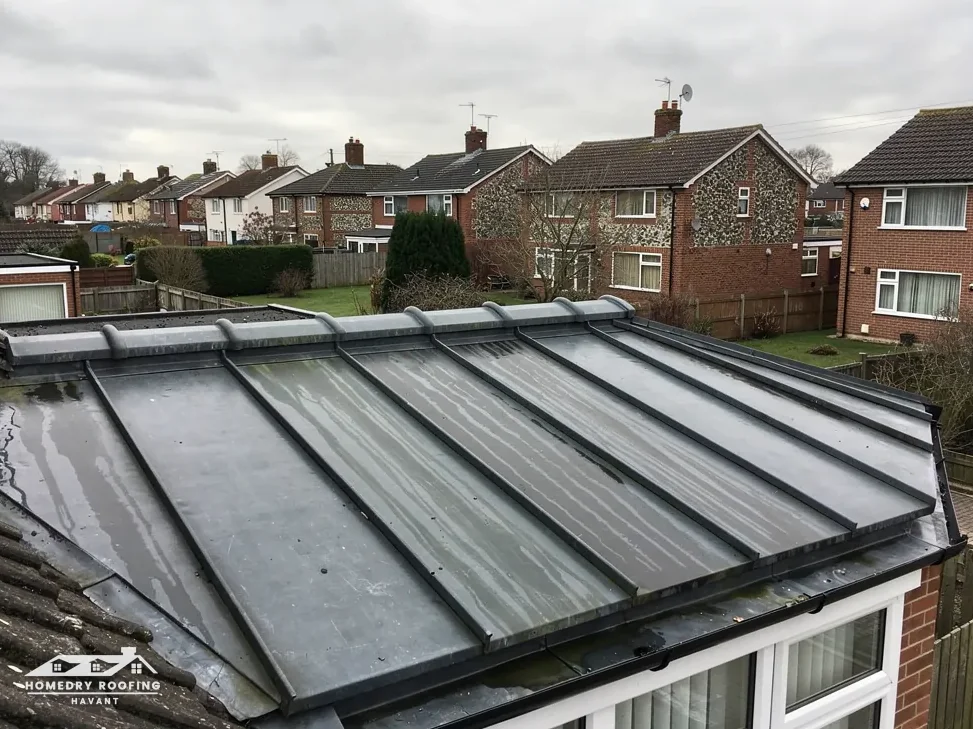
Lead is the metal at the joints of a roof. It lines valleys, turns up the face of a chimney and caps the edges of bays and porches. When lead is taken, the tiles around it stay where they were, which makes a theft easy to miss from the ground until rain starts running in through the gap, and by then the damage indoors has begun.
That gap is the real problem. A roof is a route for water, and the joints are the places on that route to close. Remove the lead from a chimney junction and the rain that ran harmlessly past the stack now runs behind it and into the loft.
This post follows what happens next. It covers what to do in the first hours, how an insurer is likely to approach the loss, how a like-for-like replacement is specified and which other materials are used for the same details. It names the alternatives without making claims for them.
What lead does at the joints of a roof
Lead is used wherever a roof covering meets something that is not a roof covering. A flashing seals the line between slope and chimney or wall. A soaker steps up beside a junction. A valley lining carries water from two slopes into the gutter, and a lead cover caps a bay window or a porch roof.
In each of those places the tiles or slates cannot do the work alone. They overlap each other to shed water down the slope, but they cannot turn a corner or close a joint against a wall. The metal does that, which is why a stolen strip matters far more than its size suggests.
The signs of a theft often appear indoors before anyone looks up:
- A damp patch or brown stain on a ceiling below a chimney or valley
- Tide marks on the wall around the stack, seen from indoors
- Drips in the loft after rain, close to the stack
- A flapping tarpaulin, or loose tiles, where the lead has been peeled back
From the garden, the missing metal may be visible as a clean band where a grey flashing used to sit. Binoculars from the ground are a safer way to check than a ladder, and they are enough to tell you whether to call a roofer.
A roofer tracing the cause follows the route upwards: from the stain to the loft, from the loft to the stack, from the stack to the junction. If the lead is gone, the trail ends at an open joint, and that is easy to confirm once the roof has been reached safely. A guide to the detail itself is in our answer on lead stolen from a roof.
The first steps once lead has been taken
The priority is to stop more water getting in, and to do it without anyone going onto the roof. HSE puts it plainly: nobody should assume a roof will bear a person until someone competent has checked it, and a roof where metal has just been torn away is not one to test. The plain steps are these:
- Photograph the damage from the ground, and the damp indoors, before anything is moved.
- Report the theft, and let your insurer know what has happened.
- Ask a roofer for a temporary cover over the gap while the loss is considered.
- Keep every receipt for the temporary work.
- Leave the permanent repair until the specification is agreed.
The temporary cover is a stopgap, not a repair. It keeps the loft dry while the insurer reviews the loss and the permanent work is planned. Anything fixed over a gap in lead should be described in writing, so that you can show later what was put on, when and why.
It is worth taking time over the permanent repair. A written description of the work and a single total price are the two things to ask for before anyone starts, and a roofer who has surveyed the roof can give both.
If the loft insulation or ceiling has been soaked, tell the roofer and the insurer both, since the water damage is part of the same loss. Leave any lead that remains in place until the roofer has seen it, because what is left is part of the evidence of what was taken.
What the insurer will look at
Whether a policy pays for stolen lead depends on the policy, and that is between you and your insurer. What can be said is how the Financial Ombudsman Service describes the evidence in its guidance on storm damage claims. Expert reports and photos are what it says it will usually look at, and an insurer which relies on an exclusion has to prove it applies, for example with an inspection report. The same kind of evidence helps with any loss to a roof.
The practical lesson is that the evidence is gathered at the start. Photographs taken before any temporary cover goes on show the roof as it was left. A written note from a roofer, describing what was missing and what was fitted as a stopgap, gives the insurer something specific to read. Receipts for the temporary work show what was spent and when.
A theft is different from storm damage, and the two should not be mixed up in a claim. The Ombudsman's wording on storms is about wind, rain, hail and snow, and it has nothing to say about theft. If an insurer treats the loss in a way you think is wrong, the Ombudsman expects you to complain to the firm first, and the firm normally has up to eight weeks to consider a complaint for most cases.
Nothing here suggests a claim is certain. A roofer can supply a survey and a plain written description of the damage, which is the kind of document an insurer asks to see, and a copy of it belongs in your file beside the photographs.
Replacing like for like with lead
When the old lead is replaced with new lead, the question is which code goes where. Each code is a thickness, and the thicker ones are listed for channels while the thinner ones suit soakers and flashings. Our post on lead codes explained sets out the supplier's table, and the specification for your roof decides the final choice.
Lead has one clear argument in its favour, which is how long it can last. MyJobQuote says correctly installed lead flashing can last for over 80 years. The word correctly carries the weight in that sentence: dressing, fixing and the wall behind it count as much as the metal.
The same argument cuts the other way. Lead on an accessible roof can be taken, and replacing it with new lead leaves the same target in place. That is a worry a roofer should talk through with you, not skate past. The choice between lead and something else is a real one, and it rests on the roof, the access and what you want from the detail.
Cost figures from third parties give a sense of scale. MyJobQuote (September 2026) puts a chimney lead flashing patch repair at around £200 and a full replacement at around £570. It also gives a spread of £350 to £920 for a full leadwork replacement, depending largely on whether scaffolding is required. Those are one guide's averages and not a price for your roof. Our answer on what leadwork costs gives the context.
Alternatives to lead, named without claims
Several other materials are used for the same jobs. This section names them and says what each is. It makes no claim about how well any of them performs. No comparison with lead is quoted here, and the lifespans that are published relate to whole flat roof coverings and not to flashings.
| Material | What it is | Where it appears |
|---|---|---|
| Zinc | Metal sheet | Roof coverings, flashings, trims |
| EPDM | Rubber membrane | Flat roofs, upstands |
| GRP | Fibreglass laminate | Flat roofs, edges, trims |
| Felt | Bitumen membrane | Flat roofs, flashing strips |
Zinc is a sheet metal. It is used as a roof covering in its own right and also for flashings and trims, so it is the alternative a roofer is most likely to raise for a metal detail.
EPDM, GRP and felt are membrane and laminate materials, so they suit flat roofs and upstands better than the pitched junctions where lead is usual. Some roofers also use proprietary strips sold as lead substitutes. A roofer who proposes one should name the product and say why it suits the detail.
Alternatives can come up after a theft, or where the lead has simply worn out. Both are fair reasons. The survey is what decides whether a given detail suits another material, and a change of material is a decision about that detail, which is why it should be written into the quote and not left as a verbal aside.
Fixings and laps matter in the same way. Whatever the material, it is the detail where wall and slope meet that has to close, so ask how each edge is finished and what holds it. A neat sample on the van says little about the corner of your own chimney.
Choosing, and what to ask in writing
The decision comes down to the detail in front of you. A chimney flashing, a valley and a porch roof are three different jobs, and the right material for one is not automatically the right material for another. A survey looks at each detail, the access to it and the house it sits on before a material is named.
Where the house is listed, any work touching its special character needs listed building consent, and swapping the metal at a junction can count. Where it sits in a conservation area, an Article 4 direction can remove permitted development rights, so ask the council before changing a visible material. We check with the council first.
When a quote arrives, put these questions to it:
- Is the proposal lead for lead, or a different material?
- Which detail does each material go on, and why?
- Is the roof being protected in the meantime?
- Does the quote make clear what happens with VAT and scaffold?
- Is the whole job covered by a single written figure?
Ask for photographs of the finished detail as well, so that you hold a record of what was put on the roof and where. A later owner, and your insurer, may both want to see it. A written price comes after the survey, and it covers the work you have agreed. The fuller picture of leadwork, from flashings to valleys, sits under lead roofing and leadwork, and that page is the place to start when the roof needs more than a patch.
Filed under Lead roofing