
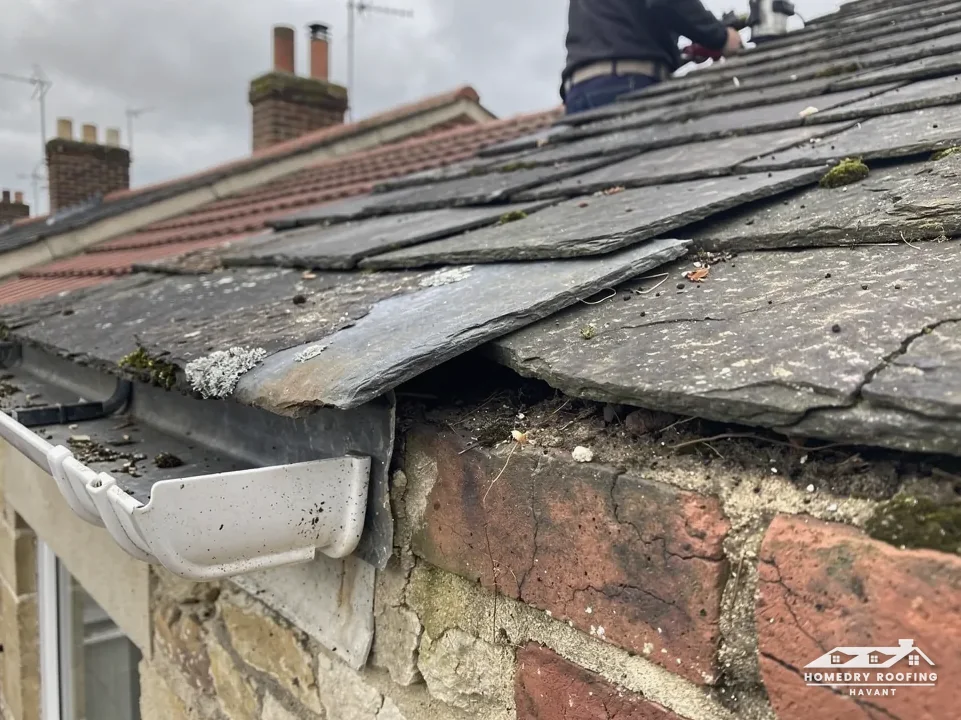
Where two slopes of tiled or slated roof come together in an internal angle, the rain from both has to leave along a single narrow line. That line is a valley, and it gathers the water from a large area into something this small. Valleys are built in more than one way, and this guide is about the lead-lined channel, laid in the angle between the slopes with the covering lapped over its edges.
It explains how a lead valley gutter is put together, the ways one fails, how a leak is traced to it, what separates a repair from a replacement, which lead codes the brochure lists for the job, what published guides report for cost and lifespan, and the checks that can apply before work begins.
The wider subject of lead on a roof is on our lead roofing and leadwork page. The lead at walls and stacks has its own guide to lead flashing repairs.
How a lead valley is put together
A valley has one job: to gather the rain running off two slopes and deliver it to the gutter at the eaves. Lead suits that job because it can be dressed into the angle in long lengths and turned up at each side.
| Part | Where it is | What it does |
|---|---|---|
| Base | In the angle, beneath the lead | Gives the metal a continuous bed to lie on |
| Lead sheet | Along the angle, in lapped lengths | Forms the channel the rain runs down |
| Turned-up edges | On each side, under the covering | Keep the rain in the channel |
| Covering edge | Tiles or slates cut to the channel's line | Leaves the channel open while lapping over its edges |
The lengths of lead are lapped so that the upper one passes over the lower one, so the water crosses each lap in the direction the lap faces. The channel ends over the gutter, so the valley and the gutter work as one route. A gutter that has silted up at that point can slow the discharge from the channel above it, which is why the survey takes in the gutter at the foot of every valley as well as the lead.
Royston Lead's brochure treats this as its own detail. Its key separates a pitched valley gutter, which lies between two slopes, from parapet, box and tapered valley gutters, which lie behind walls or between roofs. This guide stays with the pitched kind.
Two slopes drain into one line, so a small fault is tested every time it rains.
Why lead valleys fail
A valley can fail in more than one way at the same time. A survey looks for each of these faults, working down the channel from the ridge.
- Debris: leaves, moss and silt collect in the channel until it narrows, and rain from a heavy shower rises over the edge of the lead.
- Cracks: the metal splits along a fold or at a lap where it has moved.
- Laps: a lap that is too short, or has lifted, lets water run under the lead rather than over it.
- Holes: a nail or screw driven through the channel during an earlier repair has opened a path to the base.
- Edges: a tile or slate beside the channel has slipped, either closing the channel or leaving a gap beside it.
- Thickness: the code of lead is too light for the detail, and the metal has worn through.
- Falls: a channel that no longer drains freely holds water on the lead.
Several of these can sit in one valley at once. A channel full of moss also hides the cracks beneath it, and a slipped tile at the edge may be the reason the moss collected there. Treating one and ignoring the other can mean a second visit.
Because the lead sits in a line between two slopes, rain reaches a fault from both sides. The fault shows inside the house as a stain that follows the angle of the roof, on a ceiling below the valley rafter and well away from the opening itself.
Tracing a leak to the valley
A stain on a ceiling tells you where water arrived, not where it entered. To check whether a valley is the route, the trace runs backwards along the water's path.
- Note the position of the stain and work out where it lies against the slopes, since a valley runs diagonally from ridge to eaves.
- In the loft, find the damp timber or discoloured underlay and follow it up the angle towards the ridge.
- From the ground or a window, look along the valley for moss, silt, a slipped tile or a visible line of damp beneath the covering.
- Rule out the other routes into the angle, such as the ridge, a flashing at a wall or a loose tile, before blaming the lead.
A stain that appears only in a heavy shower, and not in light rain, can point to a channel that is full to the brim. A stain that appears after every wet spell points more to a split or an open lap. Notes on dates and weather help the survey, as does a photograph of the stain.
The inside of the channel is judged from the roof, and that means access planned for a surface we treat as fragile. HSE's guidance has a roof treated as fragile until a competent person has shown it is not, so please do not climb up to clear a valley yourself. Photographs can come to us through WhatsApp or the quote form, and the survey is planned from them.
Repair or replacement
A repair suits a valley whose lead is still sound. That covers clearing a choked channel, resetting a slipped tile at the edge and renewing one lapped length. We recommend a repair first when it will hold, and the written quote says what it covers.
A valley is replaced when the lead has cracked along its run, thinned, or collected patches that no longer lie flat. A new piece lapped onto tired metal leaves the weak lead in the roof, and the next crack can appear beside the patch. A full replacement starts again with the whole channel.
What a replacement involves
- The tiles or slates along both sides of the valley are lifted and set aside, and any that are broken are replaced.
- The base is inspected, and timber that has been wet is made good.
- New lead is dressed into the angle in lapped lengths, with the edges turned up on each side.
- The covering is relaid over the edges so that the channel stays open.
This opens the roof along its length, so the job is planned around the weather and the covering is relaid in the same visit, so you are not left with an open valley between visits. Before the lead goes down we confirm that the timber below it is sound. Sealant is not a substitute: our answer on why lead splits explains the cause that a replacement has to remove, and a bead of sealant leaves it in place.
Lead codes, costs and lifespan
Royston Lead's cast lead brochure lists codes 3 to 8, and its key says which details each code is for. The table shows the two that bear on a valley.
| Code, colour | Thickness | Pitched valley gutter | Parapet, box and tapered |
|---|---|---|---|
| Code 3, green | 1.32 mm | Not listed | Not listed |
| Code 4, blue | 1.80 mm | Listed | Not listed |
| Code 5, red | 2.24 mm | Listed | Listed |
| Code 6, black | 2.65 mm | Listed | Listed |
| Code 7, white | 3.15 mm | Listed | Listed |
| Code 8, orange | 3.55 mm | Listed | Listed |
The specification sets the code for a valley, and BS 6229:2025 does not decide it, because that standard covers membrane flat roofs and not lead sheet. A quote that names a code should also say that it is for the valley, since the same brochure lists lighter codes for soakers and flashings.
MyJobQuote (September 2026) says "a full leadwork replacement costs between £350 and £920, depending largely on whether scaffolding is required". That describes leadwork in general, and it gives no figure specific to a valley. The spread depends on access and on how much of the covering has to be lifted and relaid beside the channel, which only the survey measures.
Lifespan figures are likewise for lead in other forms. MyJobQuote says "Lead flashing that is correctly installed can last for over 80 years". HomeBuilding gives "60-100 years" for a lead flat roof, and Less says "Lead is the longest-lasting option at 50 to 100 years" among flat roof coverings. The sources differ, and none is a promise for your valley.
Checks before a valley is replaced
A few checks are worth making before a valley job is priced, because some of them depend on how far the work reaches. They apply to houses in England.
- Re-roofing: if the job grows into a new covering for the slopes, the Planning Portal draws two lines: less than 25 per cent of the building envelope and less than 50 per cent of the roof touched, and a new covering that is not 15 per cent or more heavier.
- Energy rules: AD L expects a roof renovated across more than half its area to be brought up to the Table 4.3 standard, where that is feasible, so a larger job can bring insulation into the discussion.
- Listed homes: re-roofing normally stays within permitted development, and listed building consent is also needed for work that affects the building's character.
- Conservation areas: the same house can be re-roofed under permitted development, but dormers cannot, and an Article 4 direction can take away other rights, so we ask the council first.
- Bats and nests: GOV.UK's bat guidance counts roof repair and replacement as work that can affect bats, and damaging a bat roost is an offence whatever the intent, while a wild bird's nest is protected while it is in use or being built.
Scaffold beside the valley sits inside the one written total. Where the poles would stand on a public pavement, a licence comes first, and we arrange the licence with our scaffolder. Our guide to how much leadwork costs covers what moves a lead price.