
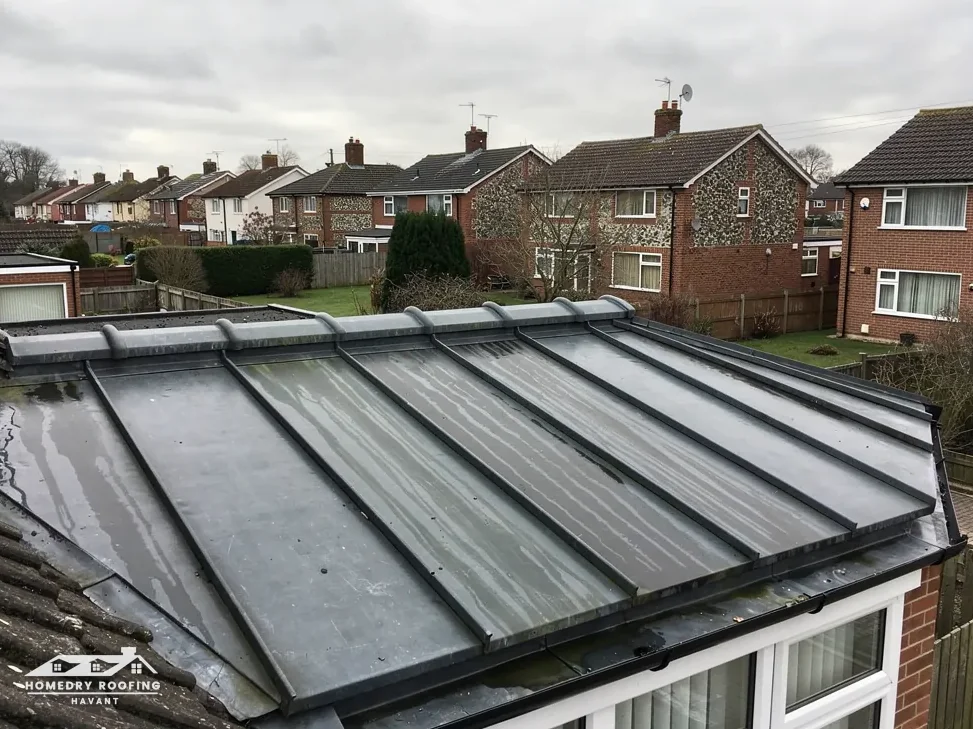
What sealant and tape do on lead
Sealant and flashing tape sit on the surface of the joint. They stick to the lead on one side and the brickwork on the other, and they have to stay stuck while two different materials move at their own pace through every warm day and cold night. Lead expands and contracts with the temperature, and a bead of sealant has to stretch with it.
A bead laid over a split bridges the gap for a while. It does nothing for the strain that tore the sheet, so the lead beside the patch can crack next. The same goes for a lifted step: tape across it stops rain running in at that one point, but the lead is still loose, and the wedges and mortar behind it are still open.
There is a second cost. A smear of mastic over a stepped flashing covers the mortar line, the wedges and the edge of the lead, which are the very things a roofer reads to work out why the joint failed. All of it has to be cut back before a repair can start, so a generous layer makes the proper job slower to begin and hides the clues about how long the water has been getting in.
When a stopgap is reasonable
A stopgap has its place when rain is coming through and the roof cannot be reached safely that week. It buys time, nothing more. Do not climb up to apply it yourself: HSE says all roofs should be treated as fragile until a competent person has confirmed they are not. A wet roof edge is a poor place to find out.
While you wait, these steps help the roofer when they arrive:
- Photograph the joint from the ground or a window, and the stain indoors, with a date on each picture.
- Put a bowl or towel under any drip, and note where the stain sits and how it changes after rain.
- Leave any tape or sealant where it is, and do not add more on top of it.
- Tell the roofer what was used and roughly how long ago it went on.
If the cover over the joint fails again within days, that is useful evidence too. It tells us the lead underneath is moving or open, and that the repair has to be made at the joint itself.
What a lasting repair involves
The repair depends on what the survey finds at the joint. Sound sheet that has slipped from its mortar line can often be dressed back, wedged again and repointed. Where the lead is split, worn thin or too short to reach the joint, a new piece is let in, cut from a code of lead chosen for that detail. Royston Lead's brochure lists codes 4, 5 and 6 for flashings, and code 3 for soakers only, so the code is read from the detail and not guessed from an offcut. Our answer on which lead code suits a flashing goes through them.
It also matters why the lead failed. If it was fixed too tightly or laid in too long a run, a replacement laid the same way will tear in turn, and why lead splits explains how we look for that. Our guide to lead flashing repairs sets out the patch, refix and renew choices at more length, and the lead roofing page shows the other joints we work on, from valleys to bay roofs.
Once the lead is sound, the pointing around it is checked and renewed where it has crumbled, because a sound flashing in a loose joint will lift again.
Published repair costs to set beside a stopgap
These are third-party UK guides, not our prices. They show the scale of a repair next to a stopgap that has to be repeated, and they are not a quote for your roof. Each source is named with its own wording and date, so the two are never added together.
- MyJobQuote: patching the lead flashing on a chimney typically costs around £200, and a full replacement averages around £570, on a page updated in September 2026.
- Checkatrade lists lead flashing repairs at £50 to £70 per metre, excluding VAT and access equipment, in a table updated in June 2026.
A rate per metre is a unit rate, which means it cannot become a price for a whole job. Neither guide knows your joint, how it is reached or the code of lead it needs, and either could sit well away from what your roof calls for.
The written quote from us is one total price, set after a survey. When you compare it with any other quote you hold, ask each one whether it includes VAT and scaffold, and what exactly it covers.