
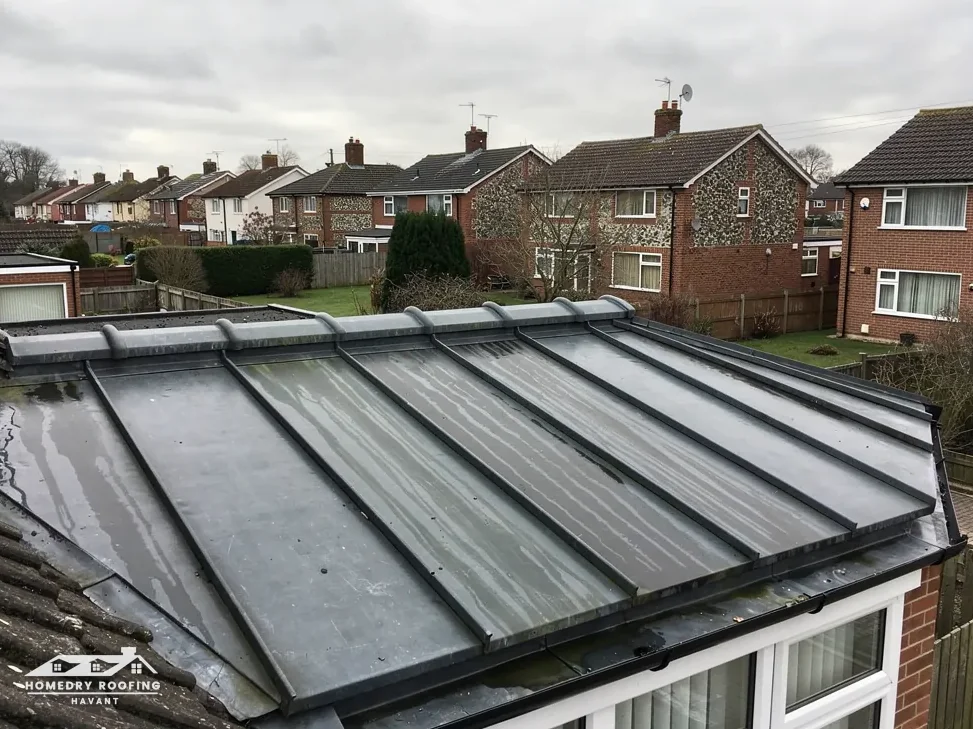
Lead is the metal that closes the awkward places on a roof: the line where a chimney meets the slope, the edge of a bay, the valley between two pitches. Each of those places is a different length, a different shape and a different height from the ground, which is why asking what leadwork costs rarely gets a single number back.
Two third-party sources publish figures that can be quoted accurately. MyJobQuote gives averages for repair and for replacement, and Checkatrade gives a repair rate of £50 to £70 per metre for lead flashing. Their units differ, and the figures are not the same sort of number, so this guide keeps each one with its source, its date and its unit.
None of these figures is our price. Our own price is one total, put in writing after a survey of the roof, and this guide explains what the third-party figures do and do not tell you. It sits under our lead roofing page, which covers the service itself.
What MyJobQuote publishes for lead flashing
MyJobQuote's page on replacing leadwork on a chimney, last updated on 22 September 2026, gives three figures that bear on the question. For a chimney, it puts a patch repair to the lead flashing at typically around £200, and a full replacement of the flashing at an average of around £570.
The same page says that a full leadwork replacement costs between £350 and £920, depending largely on whether scaffolding is required. That wording is worth reading closely. The range is wide, and the page itself puts scaffolding at the centre of the spread, which is a reminder that access can matter as much as the metal.
| Job | Figure as published |
|---|---|
| Chimney lead flashing, patch repair | Typically around £200 |
| Chimney lead flashing, full replacement | Averages around £570 |
| Full leadwork replacement | £350 to £920, depending largely on whether scaffolding is required |
MyJobQuote gives no VAT basis on its figures, so this page does not add one. They are averages across many jobs, and a single flashing on a low roof is a different job from lead on a three-storey house.
An average and a range are different kinds of figure, so the £570 and the £350 to £920 sit together without contradicting each other. Read them as a frame, not a forecast. A patch repair and a full replacement are different pieces of work, so a gap of several hundred pounds between them is expected.
Reading a rate per metre against a price per job
Checkatrade's repair-rate table, last updated in June 2026, lists lead flashing repairs at £50 to £70 per metre. The unit is the whole point. A rate per metre is a charge for each metre of flashing repaired, and nobody can turn it into a price for your roof without knowing how many metres of flashing are involved.
The page states that all costs are exclusive of VAT and will need to be added, and that the figures do not include access equipment costs. Both are common to the whole table, not only the lead row.
- Unit: per metre of flashing, not per square metre of roof and not per job.
- VAT: excluded, so add it where it applies.
- Access: scaffold or towers are not in the figure.
Two cautions follow. First, a rate per metre is not multiplied into a total here, and it should not be on your own sheet of paper either, because a repair rate does not carry over to a full replacement of the same length. Second, the per metre row is for repairs, and MyJobQuote's replacement averages sit in a different table with a different basis.
Put differently, the two sources do not contradict each other, and a reader who sets them side by side is comparing two different units. One counts pounds per metre of repaired lead, and the other counts pounds for a whole job. Neither says how long the flashing on a given chimney or bay is, which is the number a quote has to start from.
That is why the written price follows a survey: someone has to go up, measure the runs and see what condition the stonework or brickwork is in.
A rate per metre says nothing until someone has measured how many metres of flashing the roof has.
What moves the price of a leadwork job
Several things move the price of leadwork, and a quote that names them is easier to compare. The first is length: how many metres of flashing, valley or cover flashing the job involves, which differs between a single chimney and a whole terrace.
The second is access. MyJobQuote's own wording puts scaffolding at the centre of its replacement range, and the per metre rate leaves access equipment out altogether. A roof that can be reached from a ladder is not priced like one that needs a full scaffold, and a licence from the highway authority can be needed where the scaffold stands on the road or pavement. We arrange that with our scaffolder, and the written quote covers the scaffold.
Other points that shift a quote:
- The lead itself: the code, which sets the thickness, differs by detail (see the table in the next section).
- Whether the job is a patch or a replacement, which are different tasks with different published figures.
- What the lead sits against: how the lead is fixed to a wall changes the work involved.
- The condition of the roof beneath, since a repair to lead above rotten battens becomes a wider repair.
A quote is only as useful as its statement of what is covered, so ask the roofer to say which of these the price assumes, and ask the same question of every quote you collect, so that the answers can be compared side by side. We state what the survey found for each detail and give one written total, not a rate per metre.
Lead codes and what each is used for
Sheet lead comes in numbered codes, and the number fixes both the thickness and the weight. In its brochure for cast lead sheet, Royston Lead sets six codes against the details they suit. Its key is A for soakers, B for flashings, C for pitched valley gutters, D for parapets and for box or tapered valley gutters, and E for dormers.
| Code | Thickness (mm) | Weight (kg/m²) | Used for |
|---|---|---|---|
| 3 | 1.32 | 14.97 | A, soakers only |
| 4 | 1.80 | 20.41 | A, B, C, E |
| 5 | 2.24 | 25.40 | B, C, D, E |
| 6 | 2.65 | 30.05 | B, C, D, E |
| 7 | 3.15 | 35.72 | C, D, E |
| 8 | 3.55 | 40.26 | C, D, E |
The brochure's own note is that Code 3 is recommended for lead soakers only. Which code goes where is fixed by the specification for the job, so the code on your roof is a decision for the roofer who surveys it, not a number to pick from a table.
A heavier code means more lead for the same length, and metal is part of the cost of a job. That is a consequence of the weights in the table and is not a published price. Our answer on what lead code to use for flashing goes through the choice for a flashing.
One standard needs ruling out here. BS 6229:2025 is the code for flat roofs finished with continuously supported flexible membranes, so lead sheet roofs fall outside it.
How long lead is said to last
Lifespan belongs in a cost conversation, because a longer-lived material can justify a higher first price. The published figures come with hedges that should be kept. MyJobQuote says that lead flashing that is correctly installed can last for over 80 years. The words can last and correctly installed are part of the claim, and it is a statement about what is possible, not a floor or a minimum.
Lifespan figures vary with the subject they are given for. Two other sources give ranges for lead more widely, and the three do not match.
| Source | Subject | Figure |
|---|---|---|
| MyJobQuote | Correctly installed lead flashing | Can last for over 80 |
| HomeBuilding | Lead flat roof | 60-100 |
| Less | Lead, the longest-lasting option | 50 to 100 |
The sources describe different things: a flashing in one case, a flat roof in the others, and lead as a material in the third. For that reason they are set out side by side and never merged into a single number. Our answer on how long lead flashing lasts covers that question in its own right.
None of these is a pledge from us or from any maker. A lifespan figure describes lead fitted well and left undamaged, and it says nothing about a flashing that has been disturbed, pulled away or split. If lead has already moved or lifted, the question stops being how long it will last and becomes what has disturbed it, which our survey looks at before any price is given.
Party walls, notice and the written price
Lead flashing sometimes has to be fitted into a neighbour's wall. Section 2 of the Party Wall etc. Act 1996 allows a building owner to cut into a neighbour's building to insert a flashing, or other weather-proofing, where a wall has been built against it.
Serving the notice falls to the building owner, at least two months ahead for work to a party structure. The neighbour can agree in writing to an earlier start for work under section 2. A surveyor is needed only if the neighbour dissents, or does not reply within 14 days, and the Act then deems a dispute to have arisen. Our answer on party walls and lead flashing sets out the steps.
Raise the party wall question at the survey and not at the start of the job, so that the notice period is known before dates are agreed, and keep the written quote and the notice dates together. For a cost conversation, the party wall point means a leadwork job at a shared wall can involve time and paperwork that a detached house does not. That cost is not published as a figure by any source used here, so nothing on this page gives one.
What you receive from us is a single written total price after a survey. Check what any quote says about VAT and scaffold, and which lead details it names, so that you can see what the total covers.