
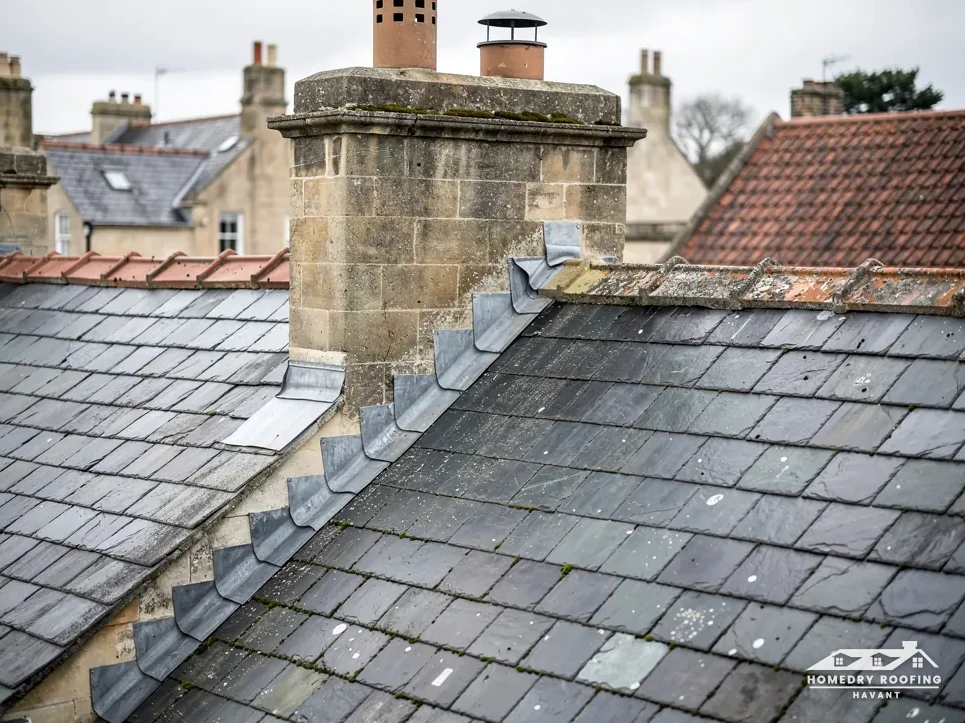
Lead flashing is the metalwork that bridges a roof covering and anything standing up out of it: a gable wall, a stack, a dormer cheek, a porch. Tiles and slates throw rain down the slope. The lead takes over at the edge where they have to stop. If that edge fails, the evidence turns up somewhere else, such as a brown tide-mark on a landing ceiling, or a damp corner on a chimney breast in the room below.
This guide deals with repair. It covers the outward signs of lifted and split lead, the trace from the stain back to the metal, the choice between a patch, a refix and a new flashing, the lead code, published cost and lifespan figures, and the consents that can arise.
For lead across the whole roof, from valleys to bay roofs, see our lead roofing and leadwork page. This one stays with the repair, from the first sign to the finished joint.
What each piece of lead is for
A flashing is built up from several pieces, each cut and bent for the spot it covers. Finding which piece let go is most of the repair, since a fix to a healthy piece leaves the real opening where it was.
| Piece | Position | Job |
|---|---|---|
| Apron | Along the bottom of a stack or wall, facing the eaves | Passes rain from the masonry out over the covering |
| Step flashing | Rising up the side of a wall in stages | Covers the gap between brick and roof along the rake |
| Soaker | Beneath the tiles or slates next to the wall | Takes rain from the step flashing and hands it to the covering |
| Cover flashing | Hanging over a short upstand such as a dormer cheek | Lets rain run down its outer face |
Each piece has two ends that matter. The top edge goes into the wall, in a groove or a raked joint, and is held there and repointed. The bottom edge rests on the covering or on the piece below it. At the wall end a fault starts with mortar giving way and the lead working loose. At the other end it starts with a lap that has crept short, so rain gets behind the metal.
Soakers lie under the tiles or slates and cannot be seen from the street. A neat flashing above them says little about their state, so a survey looks along the covering's edge as well as at the lead in plain view.
Mend the piece that failed. Work on a healthy piece leaves the real opening where it was.
Reading lifted and split lead from outside
Damp inside the house shows where water ended up, and the opening may be higher and some way along the wall. Outside, look for these.
- A visible gap along the wall, where mortar has crumbled away and the edge of the lead has curled out.
- A crack across a fold or a bend. It can be as thin as a hair and hard to see from the ground.
- Metal that has crept downhill on its fixings and stops short of the course below.
- A raised kink in the lead, pushed up by a slipped tile or a cushion of moss.
- Mastic or tape along the joint, a sign that an earlier visit tried to hide the fault.
- A stain running down the masonry under the lead, left by rain that has got behind it.
Tracing runs against the flow of the water. Start in the loft at any damp rafter or discoloured underlay and follow the dampness up towards the wall, then check the lead outside a section at a time. A single run can hold two or three faults.
Before a visit, a dated photo of the stain is worth having, along with one of the wall and roof taken from a window or the pavement. Leave the roof itself alone. HSE says all roofs should be treated as fragile until a competent person has checked that they are not, and there is little footing beside a wall.
Patch, refix or renew
Where the lead is sound and the fault is limited, a repair is the right call, and that is what we recommend first. Where it is not, you hear that, with the reason.
Cases a repair covers
- Mortar has fallen out of a joint and the lead beneath is intact: the joint is raked out, the lead is fixed firmly and the joint is repointed.
- Lead has lifted but still has its full thickness and its shape: it is dressed back and refixed.
- One step or one short length has cracked: that length is cut out and a new one is lapped in.
Cases that need a new flashing
When the lead has cracked in several places, worn thin, or been patched along most of its length, a new flashing is the sounder job. Lapping new lead onto tired lead keeps the tired part in service, and the next crack appears beside the repair. Starting afresh also lets the code be picked again, which the next chapter explains.
It is also worth asking whether the flashing is the only thing at fault. A lifted section may be the visible result of a joint that has moved or a tile that has slipped. Mend only the lead and the cause stays, so the lead can lift again. For that reason the survey notes the wall joint, the neighbouring covering and the lead together.
Sealant or tape across a crack does nothing about the path the rain follows. Our answer on whether sealant can mend lead goes into that, and the answer on why lead splits covers the cause a repair has to deal with.
Choosing the lead code for a repair
Each code number stands for a thickness of cast lead sheet. Royston Lead's brochure lists codes 3 to 8, each with a colour, a thickness, a weight per square metre and the details it suits. Codes 3 to 6 are the ones a flashing job meets, and the heavier codes 7 and 8 are listed for valleys, parapet gutters, box gutters and dormers rather than for flashings.
| Code, colour | Thickness | Weight | Brochure use |
|---|---|---|---|
| Code 3, green | 1.32 mm | 14.97 kg/m² | Soakers only |
| Code 4, blue | 1.80 mm | 20.41 kg/m² | Soakers, flashings, dormers, pitched valleys |
| Code 5, red | 2.24 mm | 25.40 kg/m² | Flashings, dormers, valleys, parapet and box gutters |
| Code 6, black | 2.65 mm | 30.05 kg/m² | Flashings, dormers, valleys, parapet and box gutters |
The brochure describes code 3 as "Recommended for lead soakers only", which rules it out for flashings, while codes 4, 5 and 6 are all listed for them. The specification gives each detail its own code. A repair beside old lead is treated the same way: the new piece takes the code its own joint calls for, not the code of the metal next to it.
No single standard decides this. BS 6229:2025 deals with flat roofs that have a continuously supported flexible covering, meaning membranes, and lead sheet falls outside it. If a quote names a code, ask which detail that code is meant for.
Published costs, and how long lead can last
Published guides give a feel for scale. They describe lead jobs in general, and none of them is a price from us. After a survey you get a written quote with one total for your own flashing.
- MyJobQuote: "A chimney lead flashing patch repair typically costs around £200, while a full replacement averages around £570."
- MyJobQuote also gives a wider band for a full leadwork replacement: "between £350 and £920, depending largely on whether scaffolding is required".
MyJobQuote's lead guide was last updated in September 2026. Checkatrade's repair table, dated June 2026, puts lead flashing repairs at £50 to £70 per metre, before VAT and without access equipment. A rate per metre is not a price for a joint. The length of lead is known only after the wall is measured at the survey, so we never multiply one into a total.
On lifespan, MyJobQuote says "Lead flashing that is correctly installed can last for over 80 years". Both hedges count. That is what a correctly installed flashing can do, and even a well-made one can be let down by the mortar or covering around it.
With two quotes in front of you, make sure each is clear on scaffold and on VAT, and what the patch or the replacement actually covers. Only then do the totals compare fairly. A low total that leaves out scaffold can cost more by the end than a higher one that includes it.
Access, a neighbour's wall and consents
The way to the lead depends on the building. A flashing on a low extension may be reached from a ladder, while one high on a stack or a gable needs scaffold around it. Scaffold is inside the one written total. If it has to go up over the public footway, we arrange the licence with our scaffolder.
- A neighbour's wall: where lead must be let into the wall of an adjoining owner's building, the Party Wall etc. Act 1996 lists the right "to cut into the wall of an adjoining owner's building in order to insert a flashing or other weather-proofing of a wall erected against that wall". It is the building owner who serves the notice. For work to a party wall the Act sets a lead time of at least two months, and a surveyor is appointed only where the neighbour objects or has not replied within 14 days.
- Re-covering: mending a flashing is not re-covering the roof. If the job grows into re-roofing, the Planning Portal's test is that no building regulations application is normally needed while less than 25 per cent of the building envelope and less than 50 per cent of the roof is affected.
- Listed homes: they keep their permitted development rights for roof work, but listed building consent is needed for anything that affects the building's character.
- Conservation areas: a house there can still be re-roofed as permitted development, though an Article 4 direction can remove further rights, so we check with the council first.
All of this applies to houses in England. Our guide to how much leadwork costs sets out what moves a lead price, and the survey settles which checks your wall needs.