
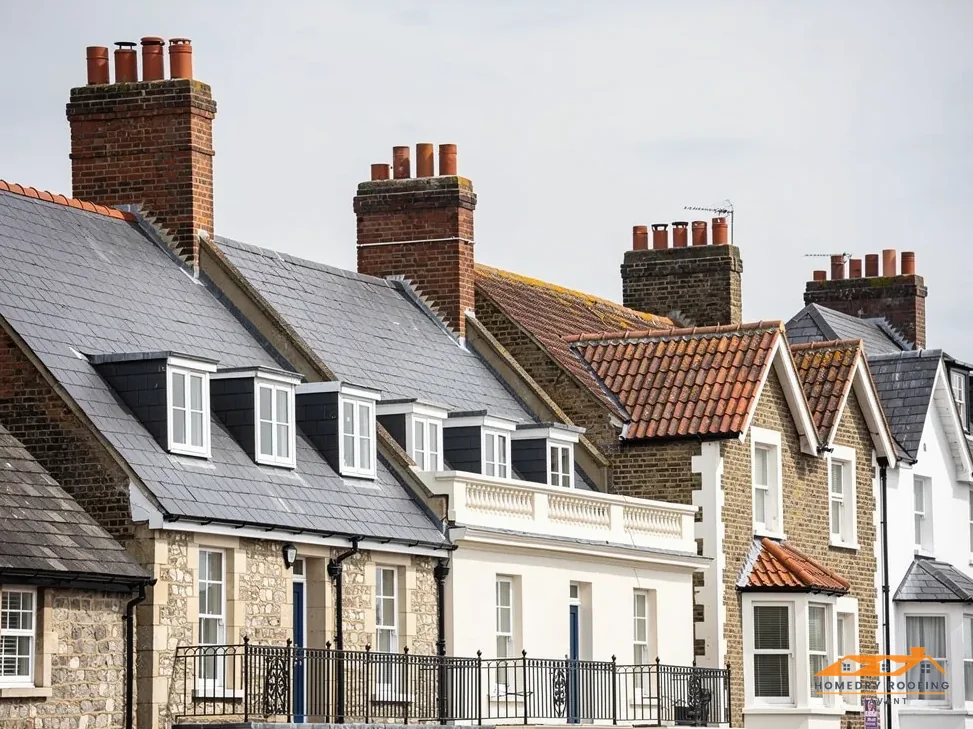
Why slate needs a kit of its own
Slate lies in overlapping rows, flat against the roof, where a profiled tile rises and falls across its width. A flashing kit has to follow whichever it meets, so each kit is built for one family of coverings, and a mismatch leaves a weak spot that driving rain can find. Our answer on what a flashing kit is and which you need explains how the choice is made.
On a slate roof the pieces step with the courses, so each course of slate laps over the metal below it and tucks under the metal above it. Water then runs down over each piece in turn and back onto the slate, and none of it is led into the gap round the frame.
The surround matters as much as the kit. Slate that has slipped, cracked or worked loose beside the opening gives water a path behind the metal, so the slates round the frame are read first, ahead of any order.
Whichever way the window is flashed, the slate is laid back over the top, so that covering and metal work together.
What the survey checks before cutting
A window relies on the slate round it. Before any slate is lifted, the survey looks at the following.
- The slates round the opening, for cracks, slips and slates that have worked loose.
- The nails and battens, if the loft allows access, for rust and softness.
- The pitch of the slope, which limits which window and kit can go in. Each data sheet states its range, so the pitch is measured on site.
- The underlay at the head of the opening, where rain that has crept under the slate runs down to the hole.
Slate itself can be long-lived. HomeBuilding gives approximate lifespans of 100+ years for Welsh slate and 75-100 years for Spanish natural slate, so sound slate is worth relaying and not replacing. HomeBuilding also gives 50-80 years for reclaimed Welsh slate, which is an option for matching where one or two slates break.
A slate roof has pitch limits of its own, because slate needs enough fall to shed water. If the slope is already near the edge of what the slate suits, a new opening is a good moment to say so and to price the answer.
Cutting the opening and relaying the surround
The work runs in the order water meets the layers. For a new opening in a slate roof it goes like this.
- The slates are lifted from the area of the opening and stacked by course so they can go back in the same order.
- The battens and underlay are cut back, and the rafters are trimmed with short cross timbers where a wider window takes part of one.
- The frame is fixed square, and the underlay is turned in and led past it.
- The kit is fitted from the foot upwards, then the sides, then the head.
- The slates are relaid course by course over the metal, and broken ones are replaced to match.
Some slates may break as they are lifted, so allowance is made for replacements in the survey. You are shown what was found when the covering is off, ahead of the new frame.
Please keep off the roof yourself, and send photographs taken from the ground. For a swap into an opening that already exists, our guide to replacing a Velux window covers the sequence.
Permissions and the written price
Whether a roof window needs a planning application depends on the house. Our planning guide sets out the tests, with the side-slope condition among them. A listed home needs listed building consent as well if the work would alter its character, and our answer on a roof window on a listed building explains that route. Where a council has made an Article 4 direction for a conservation area, further rights may be gone, and a flat has its own position, so the council for the address has the last word.
Building control confirms the energy figure. Until 24 March 2027, AD L 2021 Table 4.2 gives roof windows 1.4 W/m²K, or the Band B minimum on the Window Energy Rating scale, and the supplier states the figure for the size you order.
The total is written down as one figure after the survey. It should say how many slates are expected to be replaced, whether the flashing is new, who makes good the lining indoors and whether scaffold is in the sum. If the slate turns out worse than the survey could see, the change is explained to you with photographs before more work is done. Our roof windows and skylights page covers the wider service.