
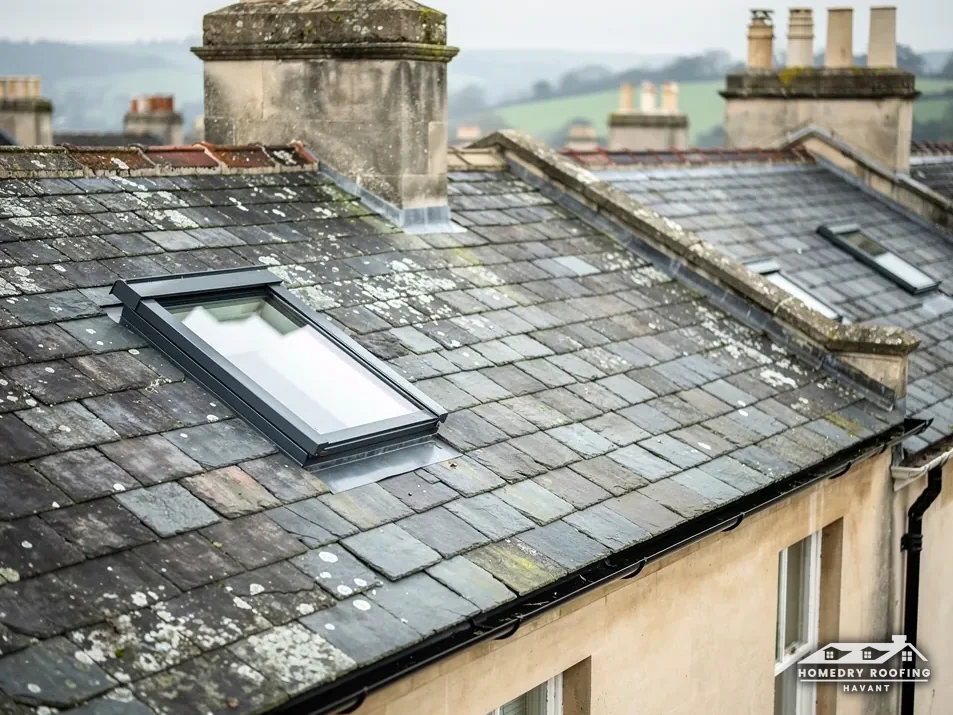
Searching for a Velux window cost returns one tidy number, and the tidy number hides most of what decides the bill. Two houses can order the same window and receive very different totals, because the window is only part of the job. What surrounds it matters just as much: the covering it sits in, the opening it fills, the finish inside the room and the access needed to reach it.
This guide starts with the third-party figures, named and dated, then lists what moves a total up or down. It separates a swap from a new opening, covers the energy rules that shape the glazing choice, flags the permissions that can add to the job and ends with what a written quote should say. It is not a price list, because the one written total comes after a survey of your own roof.
Our roof windows and skylights page covers the full service, from reglazing to new openings.
What third-party guides put on a Velux window
Two published sources are worth knowing, and both describe typical jobs and not yours.
- MyJobQuote: "Average cost for a standard mid-range Velux window is £1,100." Its page carries the date 22 September 2026.
- MyJobQuote also says a window replacement "costs around £100 less for a straightforward swap, as the opening is already in place".
- In June 2026, Checkatrade's repair-rate table showed "from £1,000" for replacing a rooflight such as a Velux, with VAT and access equipment left out of its costs.
The words matter. "Average" is a mean over many jobs, "standard mid-range" is the product tier MyJobQuote has in mind, and "from" is the bottom of a range, not a typical total. Neither source says what your roof, covering or room will need.
Treat the two figures as a marker for scale. A quote far above them is worth a question about what it includes, and one far below is worth the same question about what it leaves out.
A published rate is not multiplied into an estimate for your roof, and a comparison should not do it either. The total is set after the survey, when the opening, the covering and the room can be seen, and by then the figure has a reason behind each part of it.
Dates matter, because prices move. Both pages carry 2026 dates, and a figure from an older guide deserves more caution than one read this year. Keep that in mind when a search result quotes a bare number with nothing to say where it came from.
What moves the total on a roof window job
The window is one item among several. These are the factors that change a total, and each has to be looked at on site:
- the size and glazing of the unit, which are chosen to suit the room and the energy rules;
- the covering around the opening, because the flashing has to match it, whether that is plain tile, interlocking tile, slate or something else;
- whether the opening exists, which separates a swap from a new opening;
- the framing inside the roof, since cutting rafters for a new opening means new members to carry the load;
- the finish inside, such as the lining that takes light from the roof down into the room;
- access, including scaffold, which is part of the written total;
- the make and range of the window, since a maker offers several sizes and specifications.
None of these changes the headline price you see online. All of them change the price you pay.
A window above a staircase or over a double-height space needs its access planned from the start. A job in a loft conversion adds further points. The room's use affects the escape rules covered below, and the insulation next to the window is checked so that the work does not leave a cold edge. Ask a firm to name each factor in the quote. A quote that says only "supply and fit a Velux" tells you which window you are getting and little else, and it leaves the other items open to be charged later.
The sticker price is for the window. The total is for the job around it.
A swap compared with a new opening
MyJobQuote's "around £100 less" for a straightforward swap points at a real difference. A swap fits a new unit into an opening that is already framed, flashed and lined. A new opening has to be created first.
A like-for-like swap normally means:
- taking out the old sash and frame;
- fitting the new frame into the existing opening;
- replacing the flashing to suit the covering;
- reworking the lining only where the size or the sill has changed.
A new opening asks more of everyone. The tiles or slates are stripped back around the position, the roof structure is cut and re-framed, the unit is fixed, the covering is relaid against the flashing and the room below gets a new lining. The ceiling and the plaster inside the room are part of the work, and so is the decoration afterwards.
A swap is not always simple. If the old window sat in an opening that was framed poorly, or a different size or make is wanted, the swap becomes a partial new opening. The survey sets out which it is before you receive a price. Reglazing is a third route, when the frame is sound and the glass alone has failed.
Our guide to replacing a Velux window compares the three routes step by step, and our answer on how long Velux windows last helps to judge which suits an older unit.
Energy rules that shape the glazing choice
England's Approved Document L, Volume 1, in its 2021 edition, gives the glazing figure for a roof window as "1.4 or Window Energy Rating Band B minimum", while 2.2 W/m²K is reserved for rooflights. Both sit in Table 4.2, which covers new fabric elements in an existing home.
| Element | Figure | Where it comes from |
|---|---|---|
| Roof window | 1.4 (or WER Band B) | Table 4.2, 2021 edition |
| Rooflight | 2.2 | Table 4.2, 2021 edition |
The 2021 edition applies until 24 March 2027. From that date the 2026 edition's Tables 3.2 and 3.3 take over for ordinary building work, meaning work that is not classed as higher-risk.
For cost, the consequence is simple. A unit that meets the figure is the baseline for a new window, so a cheaper unit that falls short is not a saving, because it falls short of the standard. Ask for the declared figure on the maker's data sheet, and for the rating if Band B is the route that unit takes. Whichever figure applies, the data sheet is what counts, so the quote should name the product precisely enough for that sheet to be found.
Glazing options can move the price of the unit itself, so ask for the written total on the glazing you choose. Our guide to roof window energy rules goes through the table and what applies to a swap.
Permissions and approvals that can add to the job
Some jobs carry paperwork that affects timing and occasionally cost. The main points are these:
- Planning: on a house, Class C of the permitted development order covers roof alterations, with limits on how far a window may stand proud of the slope and the highest point it may reach. A window on a side slope carries extra conditions, which our planning guide for roof work sets out.
- Flats: Class C is written for dwellinghouses, and the order's definition leaves out flats, so a flat needs its own conversation with the council.
- Protected buildings: listed homes keep their permitted development rights, but listed building consent is needed for work "in any manner which would affect its character as a building of special architectural or historic interest". An Article 4 direction can also withdraw further rights.
- Building control: for Havant addresses, your building control body confirms the route. For Arun addresses, the council lists replacing roof coverings among alterations needing approval.
- Escape: an escape window serves storeys up to 4.5 m above ground. AD B asks for a minimum area of 0.33m2, a minimum height and width of 450mm, and no more than 1100mm from the floor to the lowest edge of the part that opens.
None of these is a charge by itself, but each decides whether the window you want can be fitted as drawn. It is cheaper to settle them before the order than after the opening is cut.
Framing for a new opening has to be sized for the load it carries, and that is part of what the survey and building control settle before any rafter is cut.
What to ask a written quote to say
The written total follows the survey, and scaffold is inside it. Compare any two quotes on the same points:
- the make, type and size of the window, with its declared energy figure;
- whether the job is a swap, a reglaze or a new opening;
- the flashing kit, and whether it matches your covering;
- the framing and the lining inside the room;
- whether VAT is shown, and whether scaffold is in the total;
- who makes good the plaster and the decoration.
Consumer rules also apply. A contract signed at your home after a survey carries a 14-day cancellation period, and work begins inside it only on your written request. An urgent repair visit that you asked for is outside that right, which does not describe an ordinary window order.
Treat any published figure as a check on scale. The two published references above both come from outside this firm. The number on your quote should fall out of the survey, the unit you chose and the roof it goes in.
Ask, too, what happens if the survey and the work differ: for example, if the strip shows a rafter that needs repair. A clear quote says who decides and who agrees the change in writing before it goes ahead.
Keep the survey notes with the quote. If a later invoice differs, the notes show which item changed and why. A change you asked for is one reason, and the notes record that request in your own words and the date it was made.