
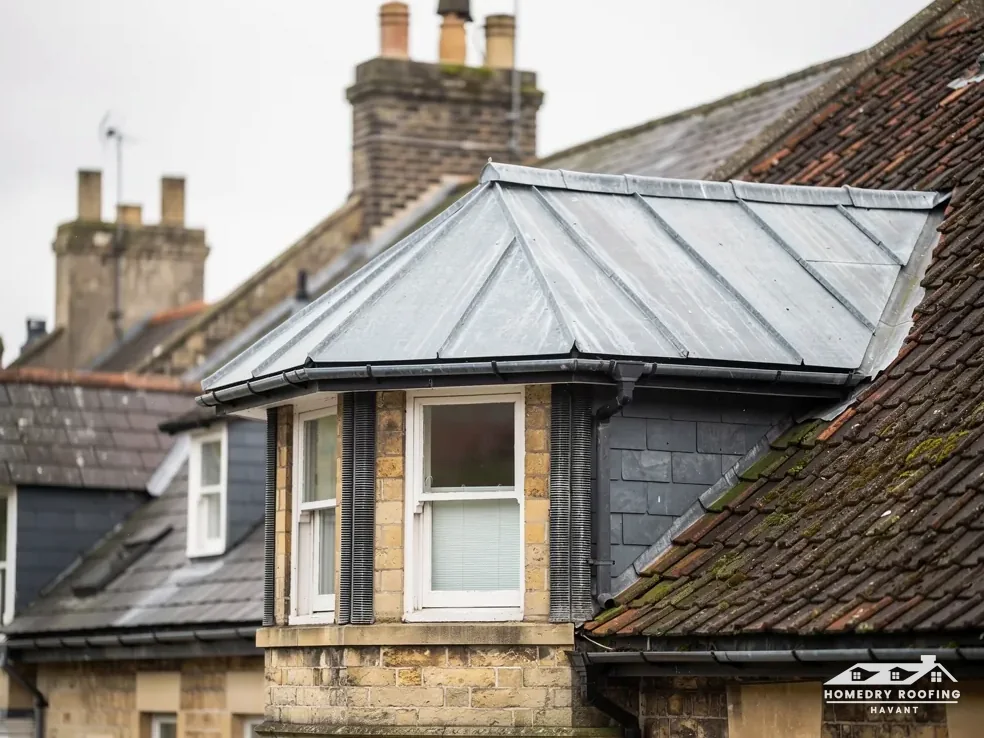
What patination oil is
Freshly cut lead is a bright, soft silver. In the open air it darkens and dulls to the grey of lead on an old roof, and that change is called patination. Patination oil is a product sold to roofers to guide that change. One supplier's page says it coats the sheet against carbonate formation, gives "an evenness of colour" and should go on newly installed lead "by the end of the working day", and it warns against contact with bituminous surfaces or polycarbonate sheets.
Products differ, and so do the instructions that come with them, so we treat the maker's data sheet as the authority on how a given oil is used and on what surfaces. We do not rely on a general rule of thumb, and we would not tell you a particular brand is right without reading what its maker says.
The treatment belongs to the finishing of a lead detail, after the sheet has been cut, dressed and fixed. It does not change the way the flashing is fitted, and it plays no part in the repair itself. A roofer can leave it out, and on many hidden joints nobody would notice.
Why new lead is treated
Patination oil has a few uses, and each of them is a question about looks and neighbouring surfaces:
- New lead can weather unevenly, with white carbonate marks across the grey, and the oil is used to even that out.
- Run-off from bare new lead can mark the wall, sill or tiles below it, and a treated sheet is used to cut down that marking while the lead settles.
- On the front of a terrace, a bay or a listed home, a bright new flashing beside old grey lead can look out of place for a while.
- A visible detail such as a bay roof or a porch may be judged more closely than a hidden one behind a stack, so the owner may want it to look settled sooner.
Matching counts where the lead can be seen from the street. Where the new lead will sit beside old, ask how the two are expected to look together while the new one weathers. On a listed building the question belongs to the council, and our answer on leadwork on a listed building explains when consent comes into it.
What it does not do
The oil is not a repair. It will not close a split, tighten a lifted step or keep out rain that is running behind a flashing lifting off the wall, and it cannot make up for lead that is too thin for its detail or fixed too tightly to move. Those faults come from how the lead was cut, fixed and supported, and they are put right with lead and pointing, not with a coating.
It does not set the life of the flashing either. MyJobQuote says correctly installed lead flashing can last for over 80 years, and the words correctly installed refer to the fitting. Our answer on how long lead flashing lasts goes through the published figures.
Nor does it matter on older lead that has already weathered. Grey lead that is sound needs nothing applied to it, and a roofer who suggests oiling an old flashing as a fix for a leak has missed the point. When we look at a leaking joint we look for what let the rain in: the sheet, the fixings, the wedges and the mortar around them.
What to ask your roofer
If a quote for new lead mentions a treatment, a few questions are worth asking:
- Which product is it, and what does its maker say about how it is applied?
- Is it wanted on every detail, or only on the ones that can be seen?
- Will the new lead sit beside old lead, and how will the two look together?
- Is it part of the written price, and does the quote say so?
A roofer should be able to answer each of those plainly, and the answers are worth having in writing. We read the product's data sheet before using any oil on a joint, and we tell you what we plan to apply and why. Once we have surveyed the roof, you receive a quote that gives a single total, with the work described in words.
If you would rather the lead is left to weather by itself, say so before the job starts and we will note it on the quote, since a choice made late is harder to carry out neatly. Our lead roofing page lists the rest of the leadwork we carry out, from flashings and soakers to valleys and bay roofs.