
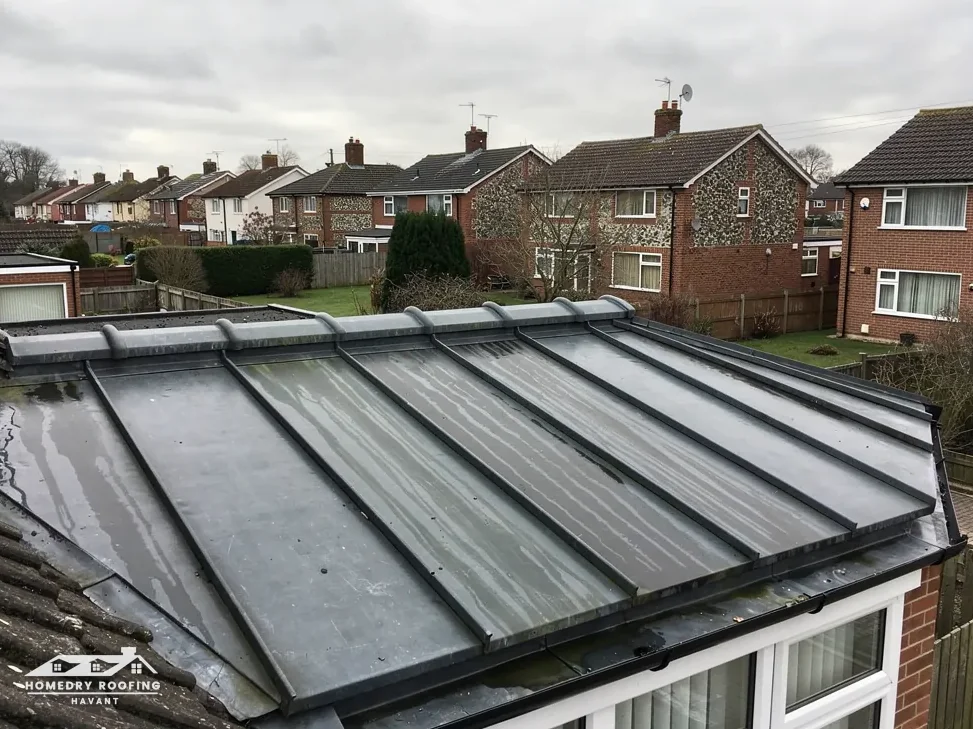
What to do from the ground
A flashing that has lifted may look minor from the garden, but it is worth acting on while the weather allows. Work through these steps without leaving the ground:
- Stay off the roof and off ladders. HSE's guidance on fragile roofs is the reason: nobody should step onto one until it has been checked.
- Photograph the lifted lead from wherever you can see it safely, using the zoom on a phone, and note the date.
- Look indoors under that part of the roof. Note any stain on a ceiling, the chimney breast or the wall, and whether it darkens after rain.
- Catch drips with a bowl or towel, and move belongings away from the wet patch.
- Ask a roofer to look, and send the photographs ahead.
If the lead is flapping loose, say so when you ring, because a loose sheet can be torn off in a gust and may need a temporary fix by someone safe at height. Please do not push it back or smear mastic over it yourself, because the mortar and wedges beneath are what the roofer needs to read.
Why a flashing comes away from a wall
Lead along a wall is held in place by a few small parts working together, and the flashing lifts when one of them lets go. The usual points to check are:
- The mortar line the lead tucks into has crumbled, so there is nothing left to grip.
- The small lead wedges that hold each step have dropped out or been pushed back.
- The sheet has been fixed too tightly, so that it pulled free as it moved with the temperature.
- The lead is thin for its job, or has been bent back on itself so often that it has fatigued.
- The wall has been repointed or cleaned in a way that disturbed the joint, or a past repair was made with sealant alone.
Wind can then lift lead that is already loose, which is why a flashing can seem to fail overnight when it had been working loose for a long time. The reason matters, because a flashing refixed without fixing the cause comes away again. If the lead has torn instead of lifting, movement in the sheet is the likely reason, and the roofer will look at how it was laid.
How a lifted flashing is put right
If the sheet itself is in good order and the joint is the problem, the repair is usually a refix. The old pointing is raked out, the lead is dressed back into the mortar line, new lead wedges are tapped in, and the joint is repointed. Where the sheet is split, thin or too short, a new length goes in, made from lead of the thickness the detail needs, with the code taken from the specification.
Along the side of a stack or a wall the lead also laps over the soakers, the small folded pieces under each tile or slate, and the two work as a pair. Our answer on soakers and stepped flashing explains the difference. If the soakers underneath have failed, refixing the lead above will not stop the stain, so the tiles beside the wall are lifted to look.
We trace the leak back from the stain to the joint before saying what the job is, and the written quote after the survey gives a single total. Our guide to lead flashing repairs sets out the choices, and the lead roofing page covers the wider work.
Storm damage, insurers and a neighbour's wall
If a storm lifted the lead, your insurer may need to hear about it before any permanent repair. The Financial Ombudsman Service says that for a storm complaint it will usually look at expert reports and photos of the damage. So record the lead as it is before anyone touches it, with dated pictures of the lifted section and the wall, and keep receipts for any temporary cover. The outcome of a claim rests with you and your insurer, and we take no part in it.
Check whose wall the flashing sits against. Where the lead is let into the wall of the house next door, the Party Wall etc. Act 1996 may apply, and party walls and lead flashing explains who serves the notice and when.
On an older building, or one that is listed, tell the roofer before anything is touched, since consent can be a question. Neither point is a reason to leave an open joint exposed. A temporary cover over the gap is a stopgap for the roofer to fit safely, and it can spare you a soaked ceiling and damp insulation while the proper work is arranged and priced.