
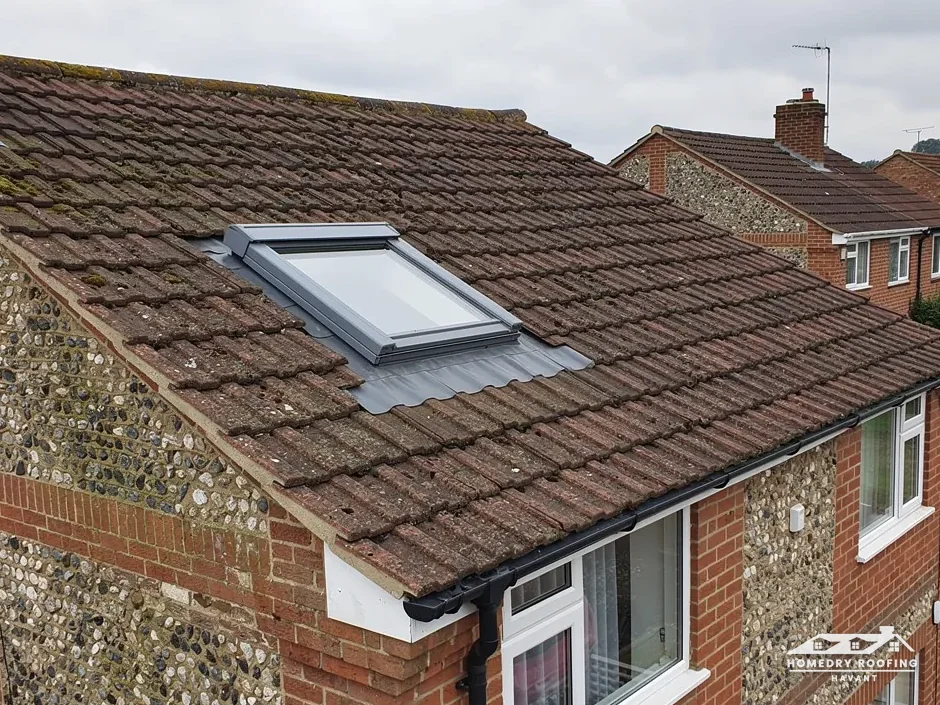
A damp patch beside a roof window sends people to the window itself. Sometimes that is right. Sometimes the window is only where the problem shows, and the cause sits higher up the slope, in the flashing around the frame, or inside the house altogether.
A roof window is an opening through every layer of the roof, fitted with a frame, a pane and a surround that leads water past it. If any one of those parts fails, water takes whichever route offers least resistance, and it may not come out at the point where it went in.
What follows takes the places a roof window can let moisture in, as the water reaches them: the flashing, the path past the frame, the seals and glazing, and condensation. It does not claim any window is immune from leaking. It says what each sign points to, and what to ask when someone comes to look.
Leak or condensation: reading the sign
Start by working out which kind of wet you have. Rain coming in and moisture condensing from inside can leave the same mark on a ceiling, but their causes and their cures are quite separate.
| What you see | Points towards |
|---|---|
| Wet after rain, dry after a dry spell | Water coming in from outside |
| Mist or droplets on the glass or frame | Moisture from inside the room |
| Mist trapped between the panes | A glazing unit that has failed |
| Stain on the ceiling beside the frame | Either; trace it before deciding |
A stain on its own proves nothing. Water can follow a rafter or a batten for some distance before it drops, so the wet patch may be well away from the point of entry. That is why a repair that closes the first spot anyone looks at does not always hold.
Before you call anyone, make three notes: the dates the staining appeared, what the weather was doing in the days before, and whether the glass was wet at the time. Take a photograph of the patch and of the frame with a coin or a ruler beside it for scale, and keep them to show whoever comes.
Our answer on why there is condensation on a roof window goes into the inside-air case. The rest of this post deals mainly with water from outside, and returns to condensation later, because the two get mistaken for each other.
The flashing around the frame
Flashing is the metal strip, or the moulded kit, that ties the window frame to the roof covering. It carries water down and over the covering on all four sides of the opening, so that none of it gets in at the frame's edge.
A flashing is made for one type of covering. A kit designed for a profiled tile does not suit a flat slate, and a mismatch leaves gaps at the corners and sides where one surface should lap over the next. Our answer on what a flashing kit is and which you need explains how to choose.
Lead flashing has a long published lifespan. MyJobQuote says correctly installed lead flashing can last for over 80 years. The two words that matter are correctly installed: lead that has lifted at an edge, been dressed too tightly or been nailed through can fail long before that.
- Check the corners of the frame, where two lengths of flashing meet.
- Check the sides, where water running down the slope arrives from above.
- Check the lower edge, which has to overlap the covering beneath it.
- Look for lifted lead, split sealant or a flashing that was cut short.
Sealant alone is not a flashing. A bead of it may plug a thin crack for a season, yet it can also conceal a lap that was never made, so a roofer should say what lies under the sealant before agreeing that a bead of it is the repair. Ask to see the edge of the flashing, not just the finished bead.
The route the water takes past the window
Rain that lands on the slope above a roof window runs down towards it. At the head of the frame that water has to split, travel round both sides, and rejoin the covering below. The window works only while that route stays clear and the layers beneath lead water out over the covering, not into the roof.
Three things can break the route.
- Moss, leaves and other debris that settle behind the head of the window and hold water against the frame.
- An underlay cut or lapped badly around the opening, so that water getting past the covering has nowhere to go.
- A covering around the window that has slipped or cracked, letting water behind the flashing.
This is where following the route of the rain pays off. A leak need not be a hole in the glass. It is a place where the route has been broken, and the visible wet patch is only the last stop along it.
A flat-roof rooflight sits on a kerb, an upstand that rises round the opening, and the same principle applies to it: the upstand has to be waterproofed to its full height. That is a separate matter from a roof window in a pitched slope, and a roofer working on a flat-roof rooflight should be asked how the kerb has been waterproofed.
If the covering around a window is in poor condition, swapping the window alone puts a new frame into the same problem. A survey should look at the slope above and beside the opening, not just at the frame itself.
Seals, glazing and the frame itself
The window carries seals of its own. One runs round the sash that opens, where it meets the fixed frame, and another holds the glass in place at its edge. They are made of rubber or sealant, and both age with sunlight, heat and movement.
When the seal around the sash hardens or splits, rain driven against the glass can get past it, and the water shows at the sill or along the frame. A seal that has shrunk away from a corner does the same. Such leaks appear in wind-driven rain, which is a clue: if the window drips only when rain is blowing at it, the sash seal is a candidate before the flashing is.
Glazing is a separate item. A double-glazed unit is sealed round its edge, and if that edge fails, moisture can enter the gap between the panes. Mist that sits inside the glass and cannot be wiped off points at the unit itself, not at the room or the roof. A unit can sometimes be replaced without replacing the whole window, and our answer on whether a Velux window can be reglazed says when that is possible.
The frame is the last piece. Timber and metal frames can fail at their joints, and a frame knocked out of square when it was fitted can leave a gap that no seal will close. If the window no longer shuts evenly against its seals, say so at the survey, because it changes what the repair has to be.
Condensation: moisture from inside the house
Air in a home carries water vapour, from breathing, cooking, washing and drying clothes. When that vapour meets a cold surface it condenses, and a roof window can be the coldest surface in a room. Droplets form on the glass and the frame, then run down and drip onto the sill or the floor.
BS 5250 covers moisture control in buildings, and BSI lists the 2021 edition as current but under review. In practice the points are simple: make less moisture, ventilate where it is made, and keep the room warm enough that surfaces do not run cold.
The energy rules for England give roof windows 1.4 W/m²K or Window Energy Rating Band B under Approved Document L 2021 Table 4.2, while 2.2 W/m²K belongs to rooflights only. That limit applies to a new window as a published standard. It is not a promise that a room will stay clear of mist.
The test is timing. A leak follows rain, while condensation shows on cold mornings and after a bath or a meal, fading as the room warms. If a window drips only on cold, dry mornings, rain is not the cause, and no amount of work on the flashing will change that.
Dealing with condensation
Where the problem is condensation, the cure sits in the room.
- A working extractor in the bathroom and the kitchen.
- A door closed while you cook or shower, so the moisture stays out of the loft room.
- Clothes dried somewhere other than that room.
A roofer can say whether the window is also contributing, but cannot fix a damp room from the roof.
Repair, replace, and what to expect on price
Once the cause is found, repair and replacement are the two options, and the survey should say which applies and why. A sound repair is chosen before a replacement.
- Flashing and covering work, where the route past the window is broken but the window itself is sound.
- New seals or a replacement glazing unit, where the window is sound but its edge has failed.
- A full replacement, where the frame is distorted or the covering must come off for other reasons.
Published figures give a feel for scale. On MyJobQuote (September 2026) a mid-range Velux averages £1,100, with a like-for-like swap put roughly £100 lower because the opening is ready made. Checkatrade's June 2026 rooflight replacement row starts from £1,000. Neither says what a leak repair costs, since that depends on the cause.
The written price that follows a survey is one total. It should state whether the covering around the window is included, whether the flashing is renewed or reused, and who deals with the ceiling below.
Roof window work, from a new unit to a repair around an old one, belongs to our roof windows and skylights service. A roofer who traces the route of the water before naming a fix is the one worth asking to quote.
Ask whoever calls how they will find the cause before they name a fix: looking at the flashing and the slope above it, checking the seals, and asking when the water appears. A quote that names a fix without naming a cause deserves another question.
Filed under Roof windows & skylights