
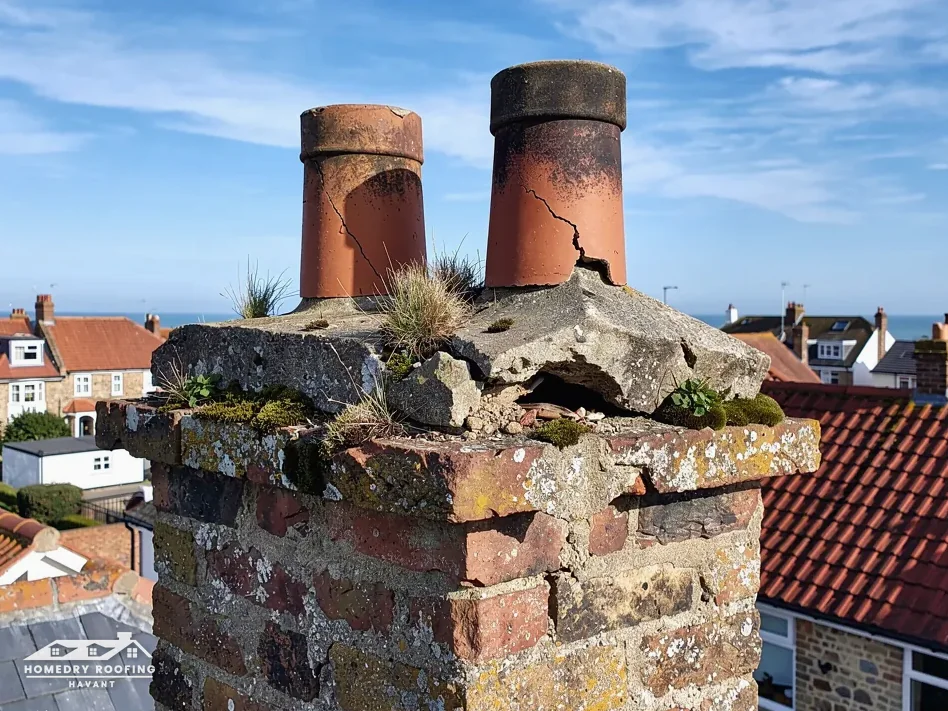
A stack that crumbles above the roof, or a stain that spreads across a chimney breast inside the house, leaves you with a small puzzle. Is this a job for a roofer, a bricklayer or the person who sweeps the flue? The answer depends on where the problem sits, and the dividing line is easier to draw than it looks.
Everything on the outside of the stack, from the pot at the top down to the point where the brickwork meets the slope, is roof work. That covers pointing in the joints between the bricks, the mortar bed that holds the pots, the lead that joins the stack to the tiles, and the stack itself if it has to come down and be built again. The inside of the flue is different work with different tools.
This post sets out how the two jobs divide, what a roofer looks at when the survey begins, which repairs bring in other rules or other people, and how to choose who to ring first.
Where a roofer works and where a sweep works
Think of a chimney as two jobs sharing one structure. The outside is masonry and weatherproofing: bricks, mortar, pots, lead and the joint where the stack meets the roof. The inside is the flue, the passage that carries smoke and gases from the fire or boiler up to the pot.
A roofer works on the outside, from scaffold or a roof ladder, and a roofer answers one question: where is the rain getting in? A sweep works on the inside and answers a different one: what is in the flue? From the living room the two can look alike, because a leaking stack and a neglected flue can both leave marks on the breast, but the causes sit in different places.
| Part of the chimney | Who deals with it |
|---|---|
| Pot, cowl and cap | Roofer |
| Flaunching and pointing | Roofer |
| Lead flashings round the stack | Roofer |
| Soot and deposits in the flue | Sweep |
| Damp patch on the breast inside | Trace the route first, starting at the top |
That last row needs a word. Damp on a breast is a symptom, and a symptom can start at the pot, the flaunching, a joint in the brickwork or the flashing. Nobody should price a cure until the route has been followed from the top down, and that is why a roofer's survey and a sweep's visit answer two separate questions about the same fireplace.
What a roofer repairs on a chimney
A roofer's survey starts on the roof, because that is where the stack meets the weather. The list below runs from the top of the stack to the bottom, in the order the rain travels.
- The pot or cowl, which can be refixed, replaced or fitted where there is none.
- The flaunching, the sloping mortar bed around the base of the pots that holds them and sheds the rain away from the flue.
- The pointing, meaning the mortar joints between the bricks, where loose or missing mortar is raked out and filled.
- The brickwork itself, where individual bricks have spalled, meaning the face has flaked away.
- The lead flashings, which seal the stack to the roof covering.
- The rebuild of the stack, taken down to sound brick and built back.
Each item can be the whole job or one part of a bigger one. A loose pot is a small repair. A stack that leans is a different matter, because the survey has to establish how far it has moved and whether the brickwork below is sound enough to build on.
Repointing deserves a note. Fresh mortar only helps if the old mortar is raked out to a proper depth and the new mix is right for the bricks, and neither shows from the ground. When you compare quotes, ask what depth is being raked out and what is happening at the flaunching, since a repointed stack with a cracked flaunching still lets rain in at the top.
None of this is guesswork once the stack has been looked at closely. The survey notes each of these parts in turn, so that the written price names what is repaired, what is rebuilt and what is left alone.
Lead flashings: the roofer's part of the stack
Flashings are the strips of lead that bridge the gap between the brick stack and the slates or tiles beside it. They are the part of a chimney most clearly in a roofer's territory, because they are cut, dressed and fixed as part of the roof covering, and a sweep or bricklayer would not normally work them.
Why lead
Lead is the usual material because it can be bent to the shape of the brickwork and the roof. A properly formed set of flashings has a stepped section where the stack meets the slope, an apron at the front and a back gutter behind the stack where the water has to turn and run away round both sides.
On lifespan, MyJobQuote says correctly installed lead flashing can last for over 80 years. The words "correctly installed" carry the weight there. Lead that has been tucked into a raked joint without being wedged and pointed, or stretched across a gap it was never cut for, will fail much sooner than lead that has been done properly.
Thickness and cost
On thickness, the Royston Lead brochure for cast lead lists code 4, at 1.80 mm, and code 5, at 2.24 mm, among the sheets used for flashings. Which code goes where is a matter for the specification, so ask what is going in rather than assuming.
MyJobQuote (September 2026) gives a chimney lead flashing patch repair as typically costing around £200, while a full replacement averages around £570. Those are third-party figures for the UK, with no scaffold or local conditions allowed for, so treat them as a rough sense of scale. Our guide to chimney flashing leaks follows the water along each part of the lead.
What a sweep covers, and what a sweep cannot see
A chimney sweep deals with the flue from the inside. The job is to clear the soot and deposits that build up in the passage, and from there the sweep can see the condition of the flue below the pot. That is useful, necessary work for a chimney in use, and it is separate from the weatherproofing on the outside.
The limits follow from the position. A sweep looking up from the hearth will not see a cracked flaunching, a hollow joint up on the stack or a lifted flashing, and will not be able to say whether the stack is moving. A roofer looking at the outside will not see what is in the flue. Between them, the two cover the whole chimney, and neither can stand in for the other.
In practice, three situations come up.
- Soot or smoke marks around the opening: start with the sweep, because the cause is likely to be inside the flue.
- A damp patch or peeling paint on the breast: start on the roof, because the route of the rain runs from the top down.
- Debris falling into the grate or loose material in the flue: tell both, since it can come from the pot, a damaged lining or a nest, and each person sees a different part of the cause.
If a bird has built in the stack, the law protects the nest while birds are using it or building it, and the section on rules below covers that. Do not wait for the problem to get worse before you ring a roofer.
Our short answer on damp on a chimney breast explains how the route from the pot to the plaster is traced.
When a chimney job brings in rules and neighbours
A chimney repair can be straightforward roof work. Some bring in a rule, a permission or a neighbour, and it is better to know about them before the scaffold goes up than after.
- Removing a breast: the Planning Portal says building regulations approval will always apply when chimney breasts come out, as they are part of the building's structure. Check with your building control body before any work starts.
- A shared wall: if the breast sits on a party wall, the owner of the building serves notice on the neighbour. For work to a party wall, such as cutting away a chimney breast, the neighbour must be served notice, and it has to arrive at least two months ahead of the work starting.
- A conservation area, an Article 4 direction or a listed building: ordinary re-roofing is normally permitted development, though an Article 4 direction can withdraw further rights, and a listed home needs consent where the work changes its character. Havant Borough Council's Langstone direction covers chimney, flue and roof work on elevations facing a public area, so check with the council.
- Bats and nesting birds: it is an offence to intentionally take, damage or destroy a wild bird's nest while it is in use or being built, and damaging or destroying a bat roost is an offence whatever the intent.
On a party wall, the neighbour can agree in writing to an earlier start, and a surveyor is needed only if the neighbour dissents or does not reply within 14 days. Our short answer on the party wall and a chimney breast sets out the steps.
How to decide who to call first
Start from where the symptom is. If it is outside, on the roof or the stack, or if it is a stain inside that shows up when it rains, call a roofer. If it is inside the flue itself, call a sweep. If you cannot tell, call the roofer, since a roof survey can rule out the weather quickly and then point you to the next person.
When you ring, give the roofer the same facts every time:
- Which room the mark is in, and which wall.
- Whether it appears only after rain or after wind as well.
- Whether the chimney is in use, and when the flue was last swept.
- Whether the stack is on a party wall, in a conservation area or listed.
With those answers the survey can be directed, and a quote can name what is being repaired and what is being left alone.
For chimney work we survey the stack from the roof, trace where the rain enters, and tell you whether a repair is sound or whether the brickwork needs rebuilding, and why. You get one written total price after the survey, covering everything named in it. The written quote includes the scaffold, and when it has to stand on the public highway we arrange the licence with our scaffolder.
You will find the full service on our chimney repairs page. If you would rather have the stack looked at before you decide, the quote form and the phone are on every page.
Filed under Chimney repairs