
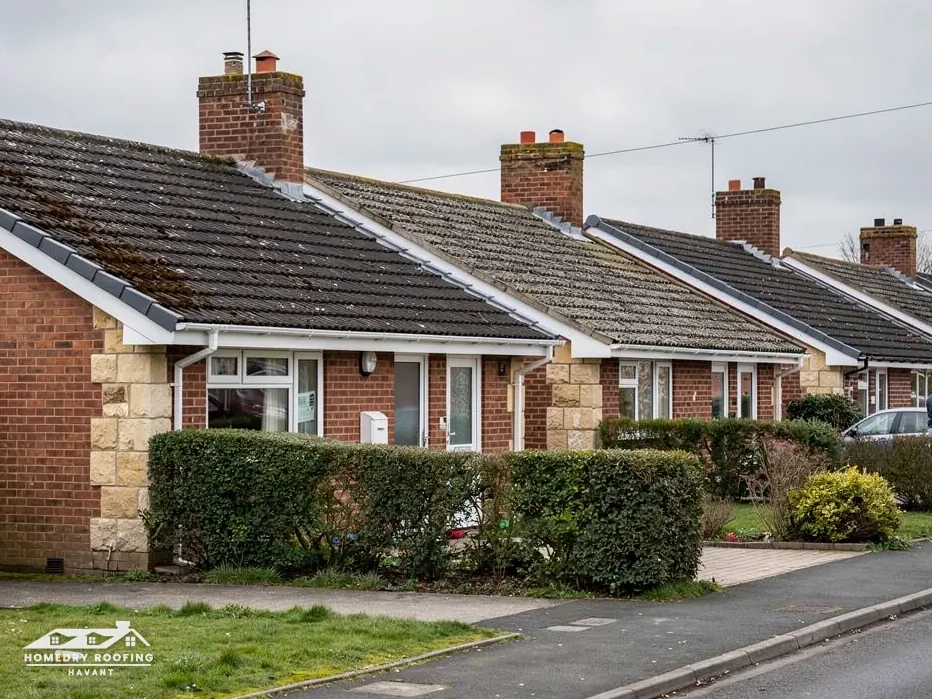
Slopes
The tilted faces of the roof, where overlapping rows of tiles carry rain downhill.
One cracked tile breaks an overlap, and the batten beneath takes the wet instead.
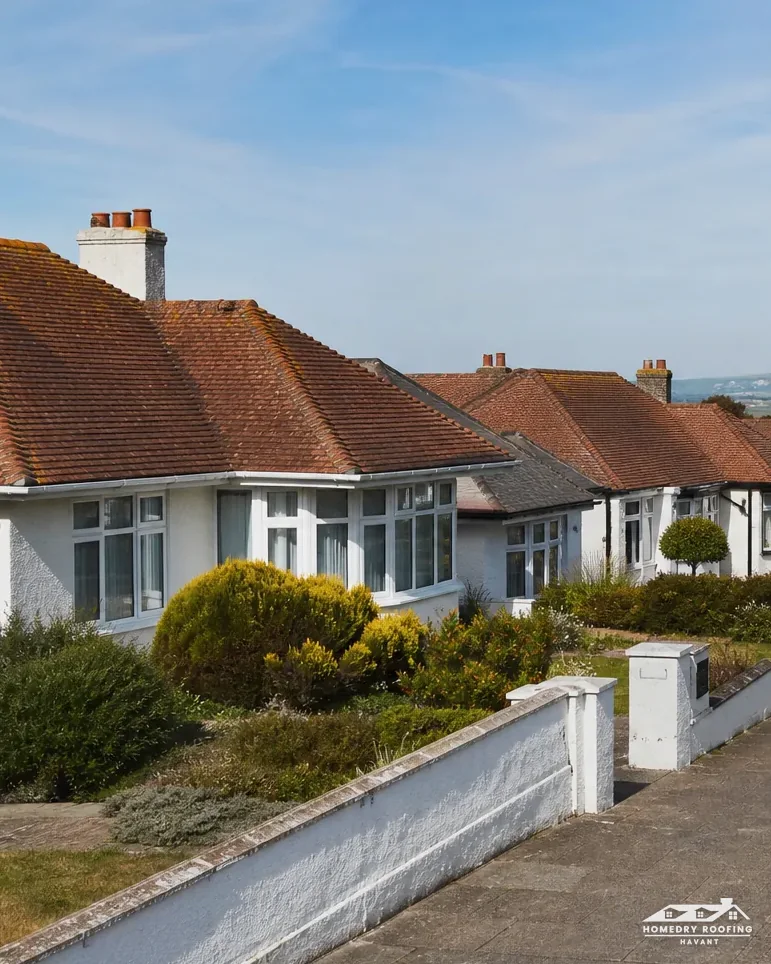
Selsey is 17.5 road miles south-east of Havant. Tiled slopes, flat roofs and hoppers close to the water are inspected first, then one written total price follows.
10-year workmanship guarantee, in writing
The tilted faces of the roof, where overlapping rows of tiles carry rain downhill.
One cracked tile breaks an overlap, and the batten beneath takes the wet instead.
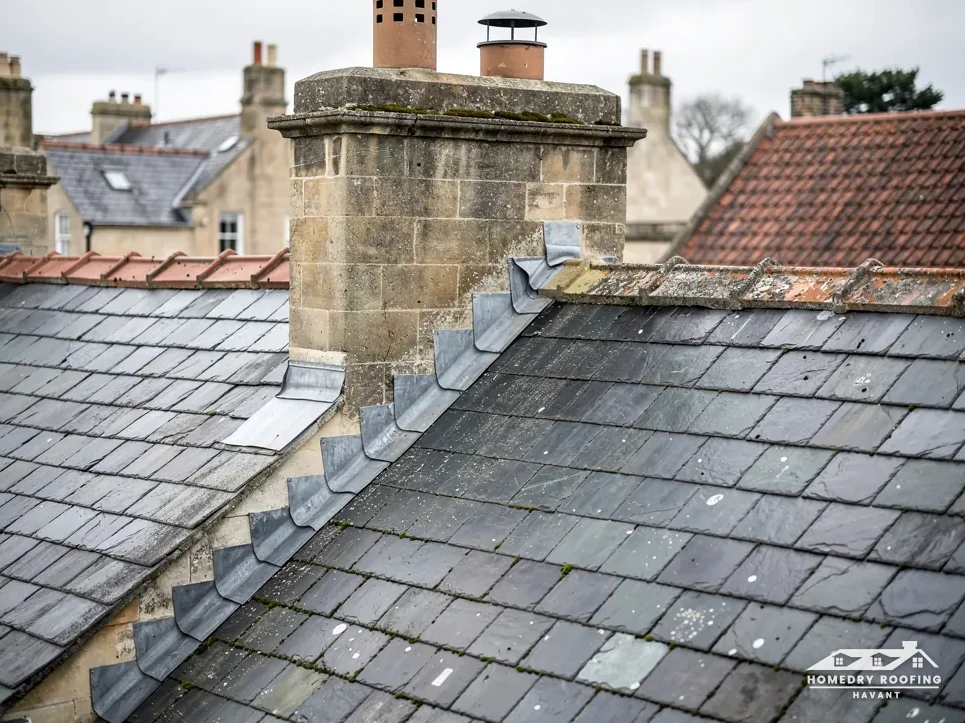
The wall-mounted box that gathers gutter water and funnels it into the downpipe.
Leaves silt it up, and a full hopper overflows down the brickwork in a downpour.
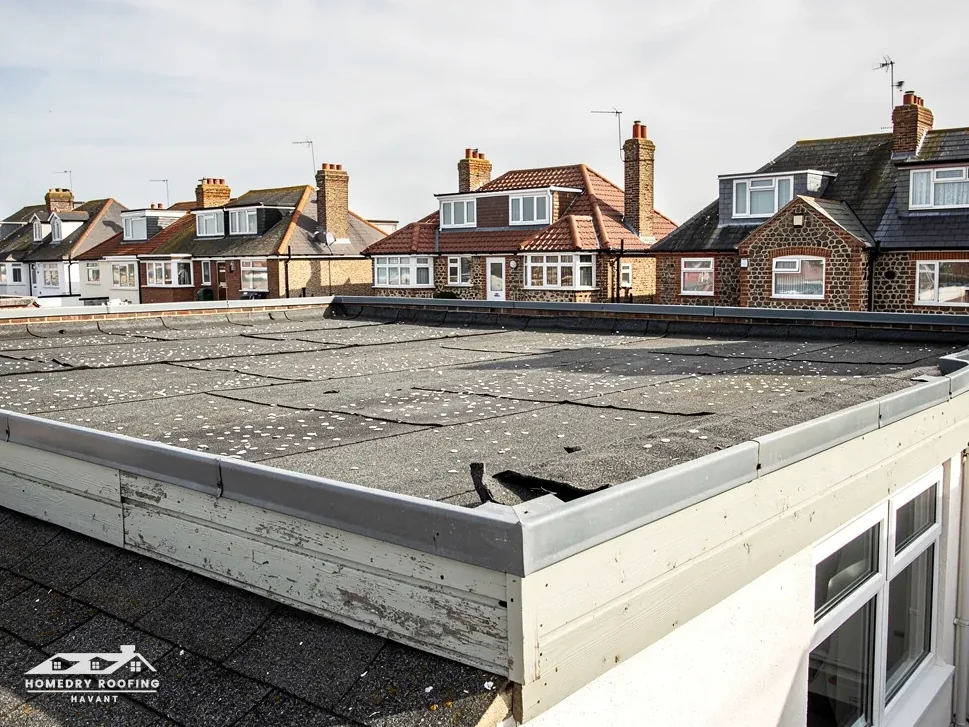
The band of a flat roof's covering turned up a wall to stop water creeping behind.
A split or a peeled edge there lets rain behind the covering.
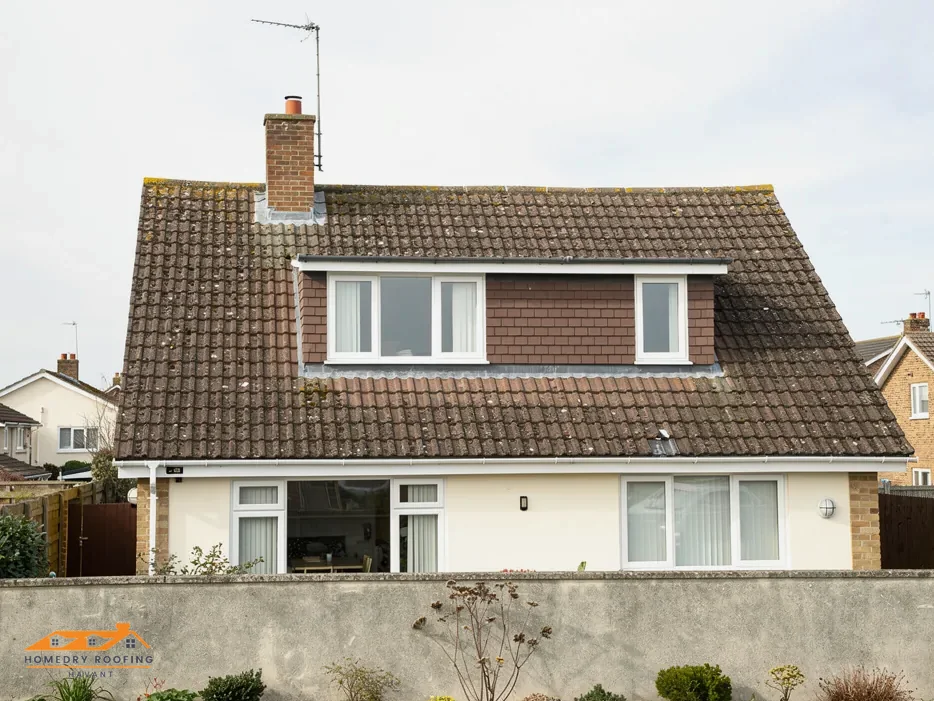
Rain crosses a slope by way of overlaps, and each one has to hold.
Every tiled slope gets two inspections: one standing on a ladder, one lying in the loft. On the ladder we are looking for cracked, slipped or absent tiles, and for any place where the rows no longer overlap. In the loft the questions change to light, stains and wet: does daylight show through the covering, are the battens marked, is the insulation cold and soaked? Cupa says coastal locations are graded with higher exposure, and for a Selsey roof that is re-covered the fixings are therefore calculated for the site under BS 5534. Our pitched roofing page explains how a covering is built up, and the survey decides whether repair or re-cover suits. Where a slope is sound, it is left alone. Where tiles are the problem, the broken ones are shown to you in photographs, so how much work there is stays plain before a price appears.
Several protected buildings stand in Selsey. The Methodist Church is listed Grade II (list entry 1026270) and still serves as a Methodist place of worship. Methodists are among the denominations whose churches in use sit outside the council's listed building consent and answer to their own system of control. The Neptune Public House (entry 1233080) and The Crown Public House (entry 1026276) are both listed Grade II, so roof work that touches their character needs listed building consent.
Selsey has a designated conservation area, which is useful to know before any covering is chosen. Only a council notice can say what a direction reaches. Whether an Article 4 direction reaches your part of the Selsey conservation area, and which alterations it would cover if one does, are matters Chichester District Council must answer, so raise it with Chichester District Council before choosing a covering. The planning guide for roof work sets out the general position.
A listing, a conservation area and an Article 4 direction are distinct questions, each with its own reply, and the replies can differ from one house to its neighbour. We ask for your address at the start and look at each question in turn. If any of them applies, the programme is planned around the reply, so that no tile is ordered and nothing is lifted before the right body has been heard.
A tea-coloured ring spreading on a bedroom ceiling after a long wet spell, or loft insulation that feels damp to the touch.
One broken or shifted tile that lets rain reach the batten below, which carries it sideways before it finally drips.

The gutter may be full of debris, the hopper may be blocked, or a bracket may have dropped and tilted the run the wrong way. We test the flow after clearing, since that shows whether the gutter is merely dirty or actually mis-set.
A flat roof is given a slight tilt so rain slides off it, and its covering is brought up the wall behind as an upstand. We inspect the surface a day after rain for pools, the upstand for splits or a peeling edge, and the outlet for leaves. If a pool lingers, either the tilt has gone or a blocked outlet is to blame, and the repairs are different. The flat roofing page explains the coverings.
Pitched or flat, rain finishes in a gutter. From the gutter it falls into a hopper, which funnels it into the downpipe and on to the ground. A hopper clogged with silt overflows against the wall, a bracket that has let go leaves a sagging run, and a cracked joint drips onto the render. Behind the gutter we press the boards to test for softness; a board that has been wet yields when pressed. A soft board holds a gutter badly, so it is replaced before a new run is hung. The gutters, soffits and fascias page sets out the repairs.
Paperwork matters too. The Planning Portal draws its re-roof line at under 25 per cent of the building envelope and under 50 per cent of the roof, inside which no building regulations application is usually needed, and a covering 15 per cent or more heavier must go for approval regardless. Chichester District Council's building control team is the contact, and we write to it before work starts, so the reply is in hand when the first tile is lifted. Selsey's highway authority, West Sussex County Council, charges £266 for one month of scaffold licence and asks for at least 10 working days' notice. For that step we arrange the licence with our scaffolder, and you pick the dates with us before poles are ordered, because a licence has a fixed length and the job should fit inside it.
Every roof ends in a pipe, and the pipe has to stay clear.
A hopper looks sturdy, yet its throat is narrow, and a handful of leaves and moss is enough to choke it. When that happens the water backs up, spills over the lip and runs down the wall. We clear the hopper, run water through to test it, and look at the pipe below. If the pipe is cracked or leaning, the findings tell you, and the repair is limited to the part that has failed.
Map of Selsey and the places around it, with the dashed line of our 30-mile service area from Havant. The same places are listed below the map.
In two passes. Outside, we look at tiles that are cracked, slid out of place or gone, and at ridge or verge tiles that have shifted. In the loft, we check for light coming through the covering, marks on battens and rafters, and insulation that has darkened or gone damp. Taken together, the passes tell you whether a handful of tiles can be swapped or the covering as a whole has run its course. A repair that would hold is done first, since replacing a sound covering is the costly mistake, and every finding comes with a photograph so the roof can be judged by you as well, from the ground or from the landing.
Nobody here can say whether a direction has been made for your part of Selsey, since that is for Chichester District Council to confirm, and the same goes for what it would cover, because only the notice sets out the alterations it reaches and the houses it names. Article 4 directions exist to remove further rights, and nobody outside the council can tell you which roofs are touched, so take your own address to Chichester District Council before choosing a covering, and file the reply where you can find it when the work is planned. The planning guide explains the wider rules, and we follow it when we advise on a particular address in Selsey.
No. The Methodist Church is listed Grade II and is still used for Methodist worship, and churches of that denomination in use fall outside the council's listed building consent and under a system of their own. The exemption covers the church while it is in use. Your house is another matter altogether, and the denomination's exemption does not stretch to it: if it carries a list entry, anything affecting its character needs consent from the council, and the listing defines what is protected. Look yours up first; what it says decides what can be offered.
The Methodist Church, The Neptune Public House and The Crown Public House are listed Grade II, and Selsey holds other entries besides. Another house's listing does not restrict yours. Only an entry for your own address does, and then consent from the council is required for work that alters the character the listing protects. Historic England's list will show if an entry exists for your house, and a search takes only a few minutes. Read it before any price is agreed, as early as you can, and pass the details to us ahead of the survey, and we will inspect with it in mind.
Perhaps, depending on the job. According to the Planning Portal, a re-roof affecting under 25 per cent of the building envelope and under 50 per cent of the roof stays beneath the threshold for a building regulations application. A heavier covering, by 15 per cent or more, must be approved first, since the rafters have to carry it. We measure your roof against both figures and ask Chichester District Council's building control team to confirm the route before work begins, so the position is clear on paper first and no one is surprised by a condition after the work has been done.
Section 169 of the Highways Act 1980 asks for a licence whenever scaffolding occupies the carriageway or footway. Selsey's highway authority is West Sussex County Council, which lists £266 for one month and asks for at least 10 working days' notice. Instead of passing the forms to you, we arrange the licence with our scaffolder and agree the dates with you in advance, so nothing stalls once the crew arrives, and the road is not blocked for longer than the licence allows. The licence is folded into the one written price, never tacked on later once the poles are up.
We clear the debris by hand, run water through the gutter and the pipe, and watch where it goes. A hopper that clears and drains freely needs nothing more. One that is cracked, or a pipe that leans away from the wall, is described with a photograph and priced for repair or renewal. Overflow marks on the wall below tell us how long the problem has existed, and green staining shows where water has run repeatedly, and those marks are noted as part of the findings, which are put in writing and photographed, so you can compare them after the repair.
A single figure on a single document, produced once somebody has inspected the roof. Next to it sit the survey findings, so the figure can be traced back to faults you have seen photographed. It lists the work, names the covering, and notes if VAT and scaffold sit in the figure. A repair is proposed in preference to a replacement wherever it would hold, and the reasons for any replacement are written down. Prices are good and fair, and a second quote can be checked against ours on the same terms.
You'll get one written total price.
Fill in what you like. It opens WhatsApp with your message ready to send.