
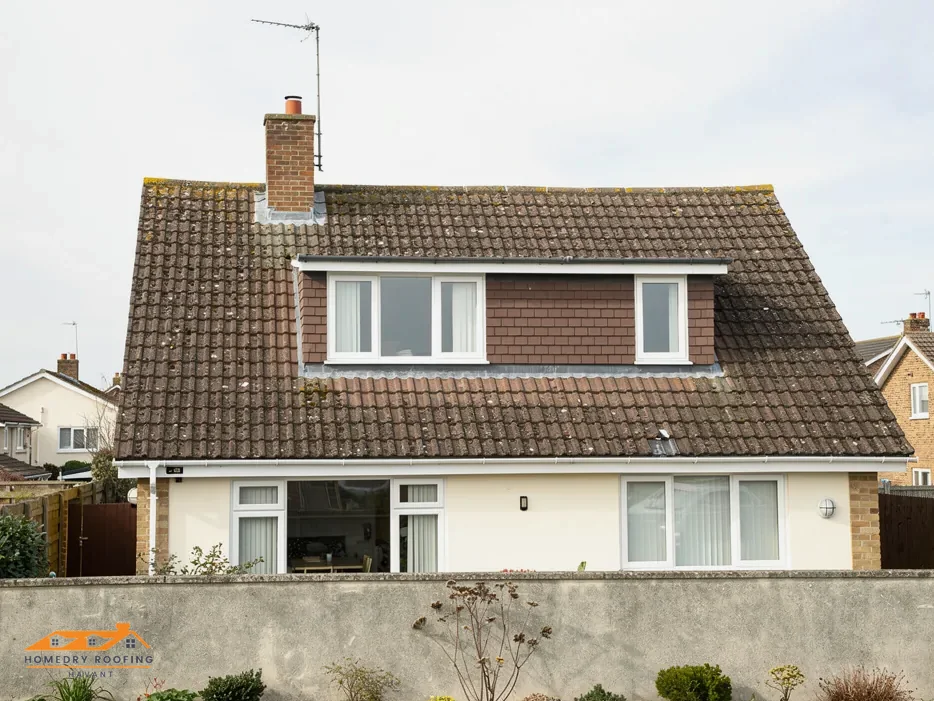
Underlay
A sheet draped across the rafters beneath the battens, hidden once the covering goes on.
When that sheet tears or slumps, the loft survey meets stained battens and damp rafters.

Pagham is 16.1 road miles south-east of Havant. Its roof timbers, gutter runs and flat extensions are surveyed from the ladder and the loft hatch before any price is written.
10-year workmanship guarantee, in writing
A sheet draped across the rafters beneath the battens, hidden once the covering goes on.
When that sheet tears or slumps, the loft survey meets stained battens and damp rafters.

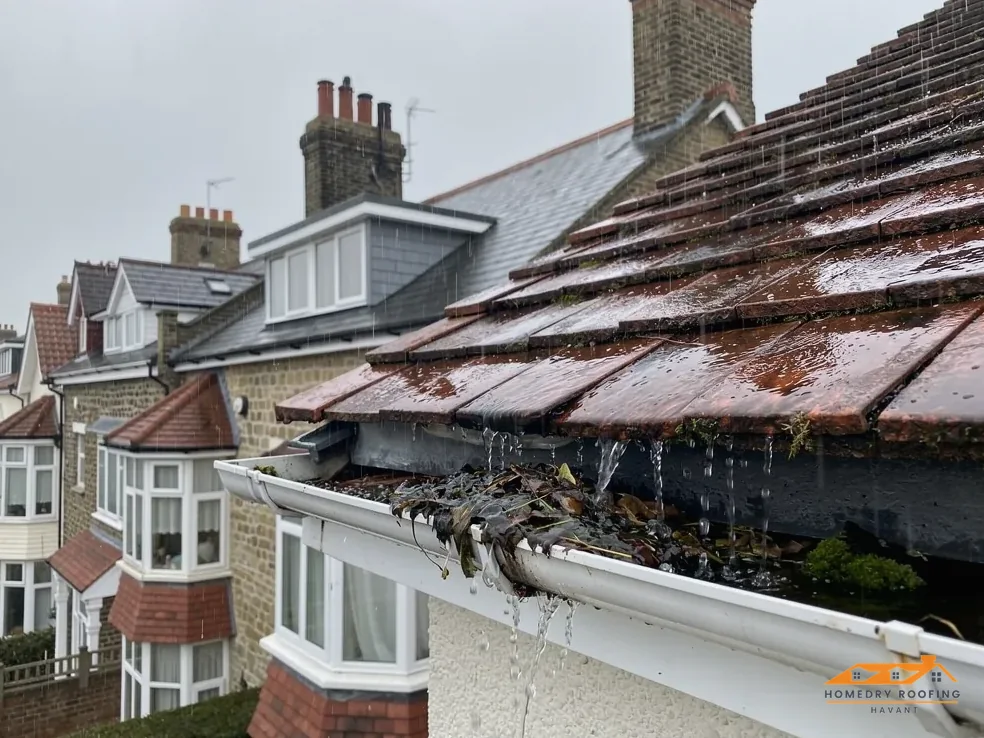
The foot of a slope, where the covering reaches out past the wall to meet the gutter.
A gap or a slumped last course drops run-off behind the gutter instead of into it.
The drain at the base of a downpipe, where a roof's rainwater reaches the ground.
Once a gully chokes, the water backs against the wall and the brickwork darkens.
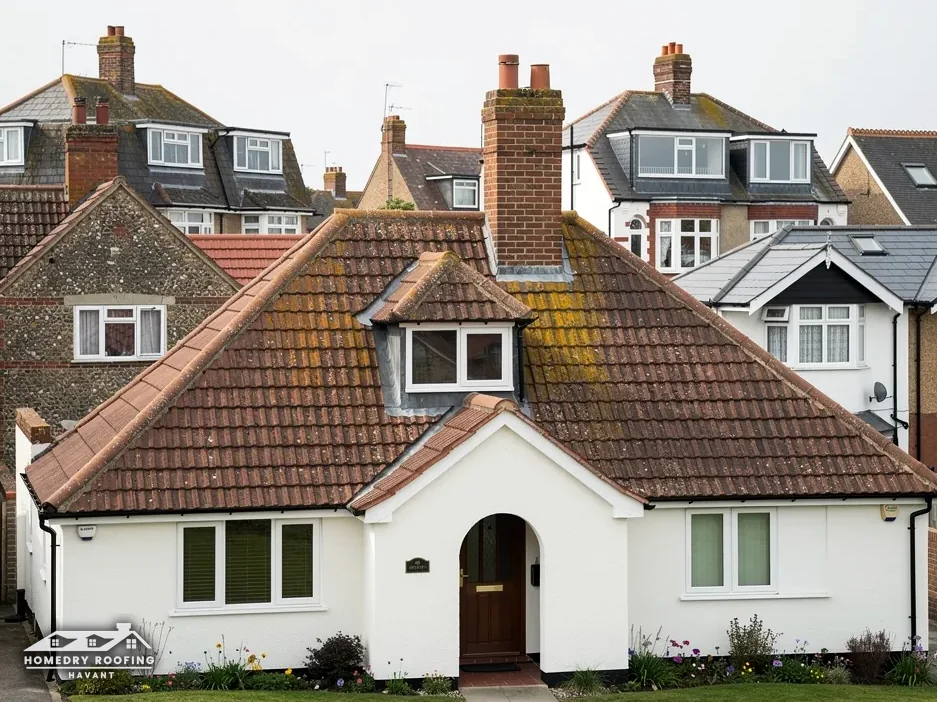
The fixing specification is calculated for the site under BS 5534, so batten size, nail type and the hold on ridge and edge pieces are decided per house and recorded, not copied from a standard sheet.
A roof surface shows only part of the story, so a Pagham survey goes up through the hatch as well. Under the covering sit the battens, the thin timbers that the tiles or slates hang from, and below them the underlay, a sheet draped across the rafters as a second layer against rain. From the hatch we look along the underside for stains, for darkened battens, for sheet that has torn or slumped, and for rafters that feel damp under the hand. A chink of daylight marks the place to begin outside. Our pitched roofing page covers the larger work that such a finding can lead to.
Pagham is a coastal village. Cupa, which makes slate, describes "coastal areas" as "graded with higher exposure", and the fixings of a roof are then specified for the individual site under BS 5534, a code of practice that Marley is clear is not law. For a Pagham house that work covers batten size, nail type and how the edge pieces are held, so the answer belongs to the house and not to the street. We record the outcome house by house, naming the existing fixings and saying whether they can stay where they are.
White Rock and Church Farm Club are Grade II listed buildings in Pagham, so any work touching their character needs listed building consent. Beckett's Barn and Adjoining Earthworks is a scheduled monument near the centre of Pagham, and section 2 of the 1979 Ancient Monuments and Archaeological Areas Act treats unauthorised works to a scheduled monument as an offence. A conservation area named Aldwick Bay lies nearby, and Article 4 directions can strip further rights, so the first call is to Arun District Council. The rules themselves sit in the planning guide for roof work.
The loft side of a roof keeps a record that the surface wipes out.
Seen from inside, a roof gives up things its surface hides. We follow the covering from beneath, then the sheet below it, noting stains, battens that have darkened and rafters that feel damp, because wet timber means the roof has been admitting water for some while. A photograph taken from the hatch lets you see what we see, and the findings say whether the fault is a single spot or runs along the slope.
A tea-coloured stain across a bedroom ceiling, widening after rain and shrinking to a faint mark through the dry weeks.
A tear in the sheet beneath the covering, or a slipped batten, where run-off reaches the plasterboard below.
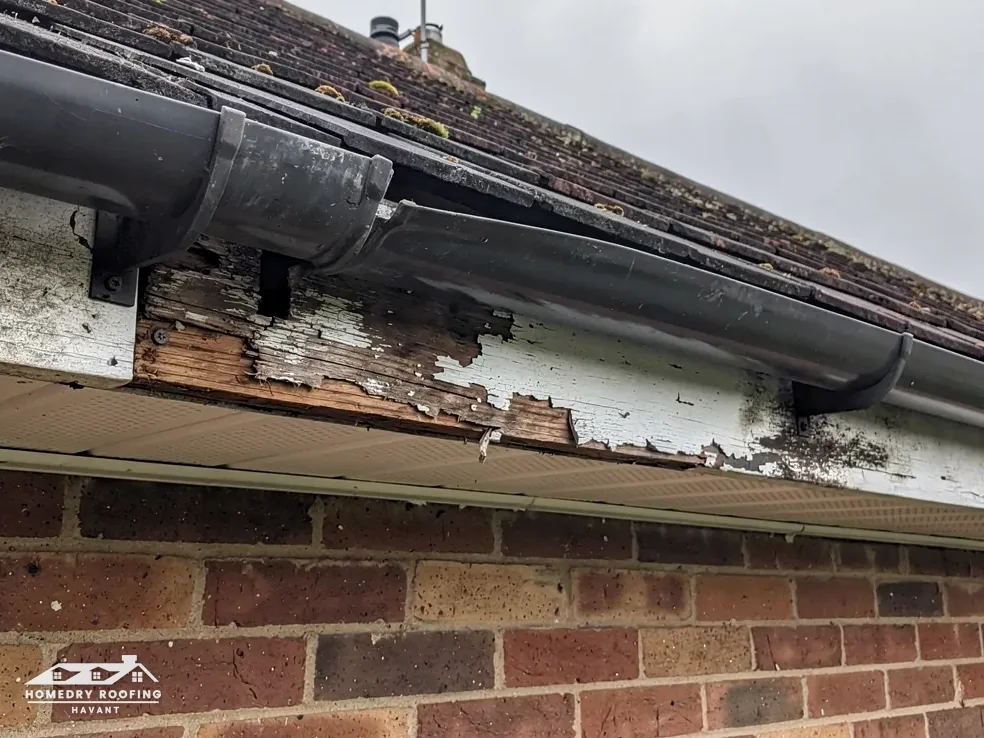
The foot of the downpipe is where a roof's work ends.
Once rain has crossed the roof, it meets the eaves. A gutter catches it, a hopper at the corner gathers it from the run, a downpipe carries it down the wall and a gully takes it into the drain. We check each link on a Pagham house in that order, because a fault in one hands the next a load it was never meant to take. Gutters are tested for fall, joints and brackets, since brackets that have pulled forward, or a run that dips between them, hold a pool that spills at every joint, and the boards behind them are pressed for soft timber, since a board that has gone spongy has been wet for a long while. Our gutters, soffits and fascias page sets out what a replacement run involves, and any porch or lean-to roof is read in the same sequence.
The Environment Agency's flood mapping puts land near Pagham in Flood Zone 3, which describes terrain and leaves roof repair untouched, yet it is a sound motive for keeping every gully clear and every downpipe discharging away from the wall. Where a flat roof sits on an extension, we read from the upstand at the wall across to the outlet, judging the fall by eye after rain, and our flat roofing page describes the covering work that follows.
Before a re-roof, the first call is to Arun District Council's own building control team on 01903 737756, because that is the body to ask about a Pagham address. We request the answer in writing where that helps, then lay the findings and one written total price out for you in plain language. Nothing is left behind once the scaffold is down, and the paths and borders are swept clear.
A downpipe that ends above its gully, or a gully clogged with leaves and silt, sends the water back against the brickwork. The wall below darkens or greens, and the damp is easily blamed on the wall itself. We follow each pipe from hopper to gully, run water through where that is safe, and note where the flow stops, so the findings name the true cause instead of the nearest symptom, with a photograph where the flow stops.
Green staining down an outer wall, or a puddle that lies beside the house after every spell of rain.
A leaking joint, a blocked hopper or a downpipe that ends in mid-air above its gully.
Map of Pagham and the places around it, with the dashed line of our 30-mile service area from Havant. The same places are listed below the map.
We go through the hatch and read the covering from beneath, then the battens and the sheet below them. Stains, darkened battens, tears or slumping in the sheet and rafters that feel damp each point to a different fault, and a chink of daylight shows where to start outside. Insulation is lifted gently where timber is hidden beneath it. Each find is photographed, then the findings state whether the cause is a single spot or runs along a slope, so the repair that follows answers the actual fault, and it is described to you before any price is written down.
Arun District Council's building control page lists replacing roof coverings on pitched and flat roofs among alteration projects that need approval. Pagham re-roofs are therefore raised first with Arun District Council's own building control team, on 01903 737756, before work starts. The Planning Portal's national guide gives two thresholds, under 25 per cent of the building envelope and under 50 per cent of the roof, the pair that decide whether an application is normally needed. Separately, a new covering 15 per cent or more heavier is a trigger for approval, however modest the job. You get the council's answer as it comes, and the choice stays yours.
Beckett's Barn and Adjoining Earthworks is a scheduled monument near the centre of Pagham. Section 2 of the 1979 Ancient Monuments and Archaeological Areas Act makes unauthorised works to a scheduled monument an offence. Historic England's list entry shows exactly what is protected, so read it first, and any doubt about the extent of the monument can be put to Arun District Council. If your house stands anywhere close, ask Arun District Council before booking roof work, and the survey can describe the roof's condition in detail so the council has exact facts to consider.
A conservation area named Aldwick lies close to the village. The boundary maps are kept by Arun District Council, whose staff will confirm if your own house falls within it, so put that question before any work is planned. A direction under Article 4 may take away further rights, which is a separate question for Arun District Council, because the answer can differ from one road to the next. The roof rules, with their sources, are collected in our planning guide, and the survey notes can record anything the council tells you, which keeps a paper trail for later.
Historic England lists both White Rock and Church Farm Club at Grade II. Anything affecting a listed building's character needs listed building consent, and each entry says what its listing covers, in words you can read. That duty rests on the listed building itself, so a neighbour's roof is a separate question: find the entry that covers your own house on Historic England's site, and bring any doubt to Arun District Council before anything is bought or a date is fixed, since an error here is costly to undo.
Section 169 of the Highways Act 1980 requires a licence for a scaffold that obstructs the highway, and in Pagham the body that issues it is West Sussex County Council. West Sussex County Council licenses scaffolding on the highway at £266 for one month and asks for at least 10 working days' notice. On our side, we arrange the licence with our scaffolder, and we agree dates with you ahead of the application, so the notice period is counted into the schedule before the scaffold is booked and it arrives on the agreed date. Dates can be confirmed in writing if you are planning around them, such as a family visit or a holiday.
The Flood Zone 3 land near Pagham comes from the Environment Agency's flood map, which describes land and not roofs, so no repair rule follows from it and repairs to the covering, fixings and timber follow the same method as anywhere else. What the map does bring forward is drainage: gutters, hoppers and gullies need to be clear so rainwater leaves the house quickly. During the survey each downpipe is followed down to its gully, and any that is blocked or ends short of the drain is reported with a photograph.
Expect the fixings, the covering and the work itself written out in words, with a note on VAT and on scaffold saying whether either one is in the figure. Our quote is a single written total price, issued once the survey is complete, and when a repair would do the job it is put first and replacement is not raised at all. Those prices are good and fair. To test any quote, request the same details from each contractor in writing; a lower headline figure may leave a cost out, and only a like-for-like comparison shows it, so keep the paperwork together.
You'll get one written total price.
Fill in what you like. It opens WhatsApp with your message ready to send.