
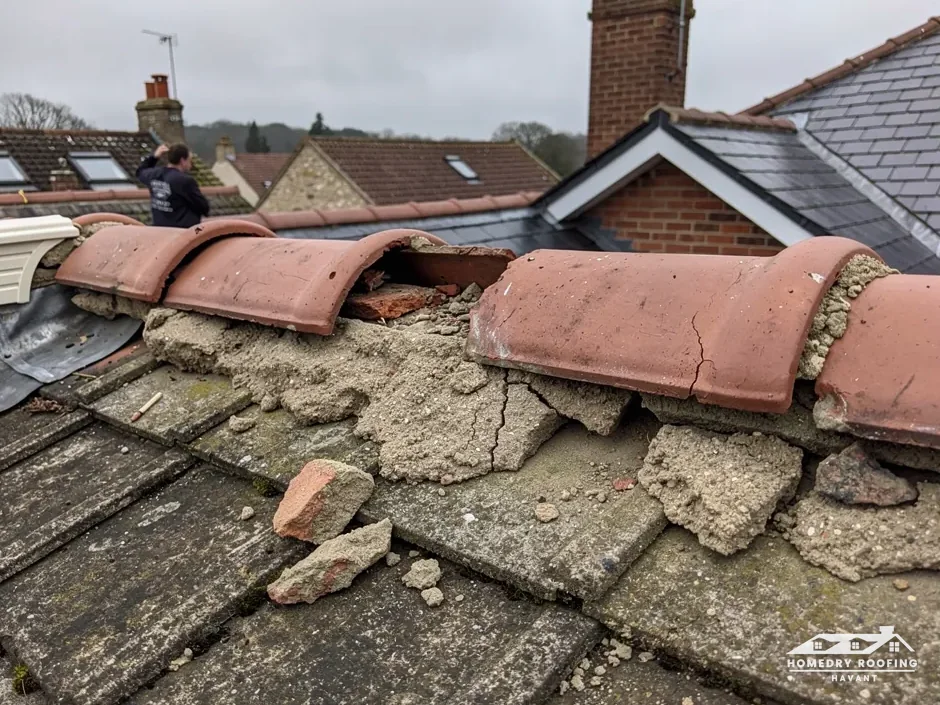
Battens
Where thin timber laths cross the rafters and each tile hangs from its own.
A batten gone soft lets the covering above it drop out of line.

North Bersted is 15.6 road miles east of Havant. Roofs here are read from the battens upward and the gutters downward before one written total price is given.
10-year workmanship guarantee, in writing
Where thin timber laths cross the rafters and each tile hangs from its own.
A batten gone soft lets the covering above it drop out of line.
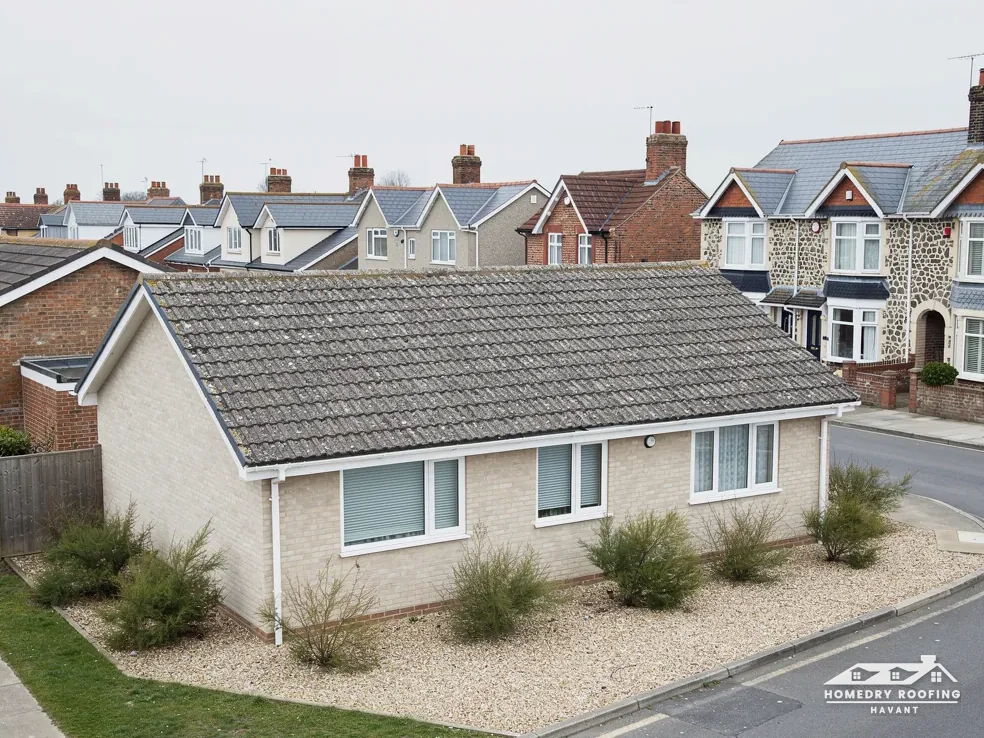
Where a membrane beneath the tiles catches whatever the covering lets through.
A tear or a slipped lap there shows as a damp patch in the loft.
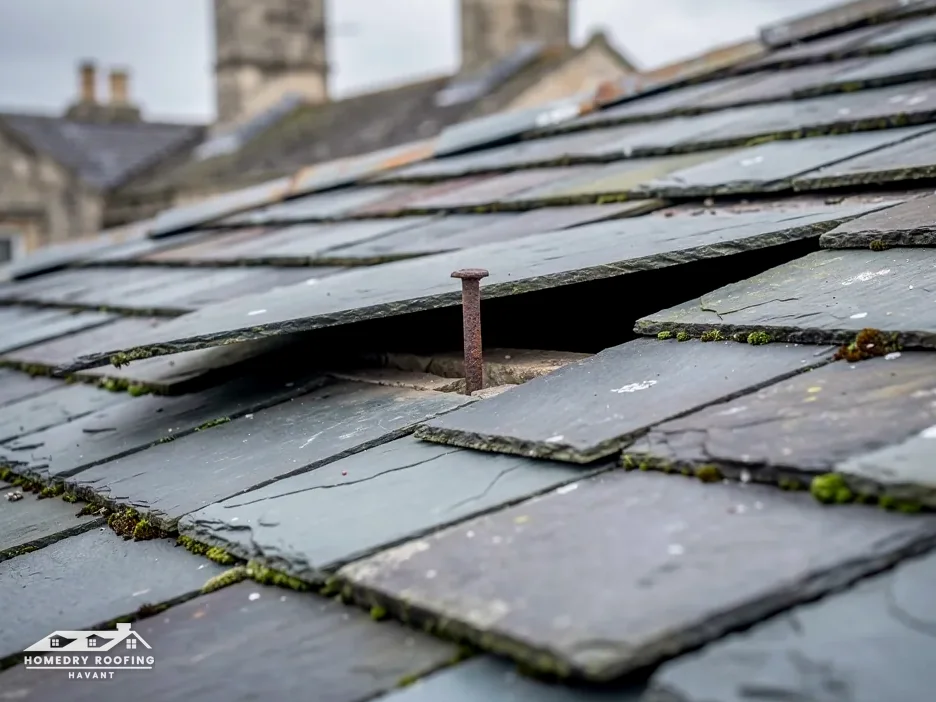
Where a gutter outlet feeds a pipe carrying the flow down to a drain.
A cracked joint or a silted shoe leaves the foot of the wall wet.
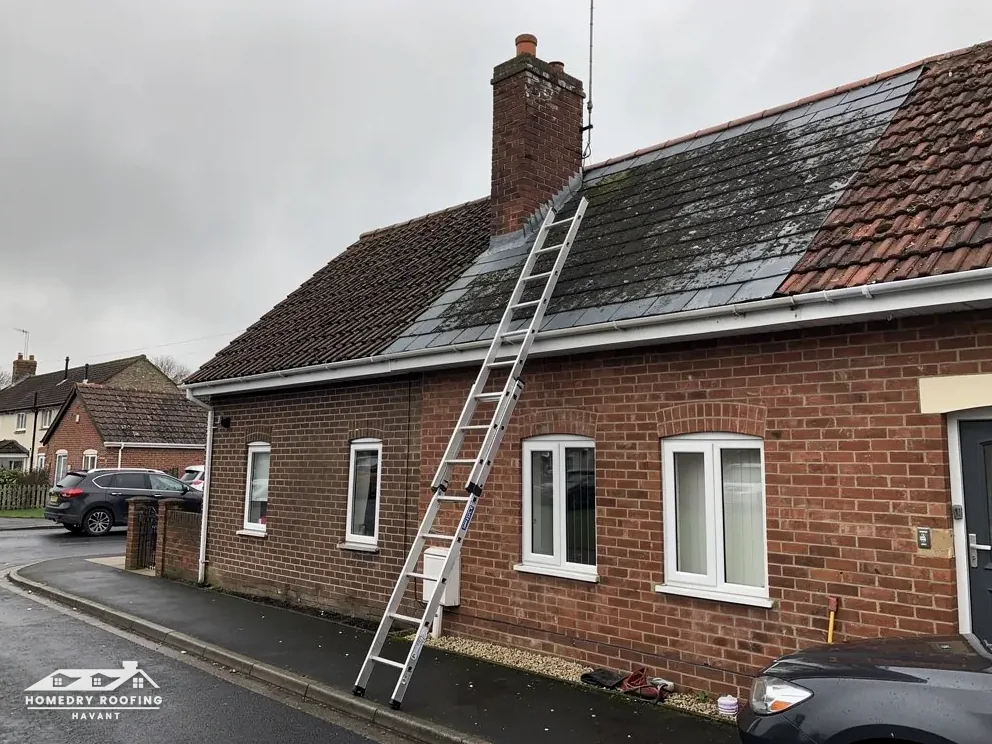
Fresh tiles can only be as secure as the battens they hang from.
When a roof is re-covered, the old tiles come off and the layers beneath them come into view. Battens are the thin timbers fixed across the rafters, and every tile hangs from one. Before any new covering goes on we press the battens for softness, look for splits and check that their spacing suits the tile that is going back. The underlay below them is read closely for tears and for laps that have slipped, and a sound sheet can stay while a torn one is replaced as part of the work. Where a roof turns out to have no underlay at all in places, the notes record that too, and say how the new covering will deal with it, with a photograph of the bare stretch. Our roof replacement and new roofs page explains what a re-cover involves, and our pitched roofing page covers the wider picture.
Arun District Council's building control page lists replacing roof coverings on pitched and flat roofs among alteration projects that need approval, which is why the council is asked about the route before any North Bersted re-roof. The Planning Portal's guide gives the national test alongside it, and the questions below set that test out in full.
Whether your address falls inside the North Bersted conservation area, close to the village centre, is a question for Arun District Council, which holds the boundary. Article 4 directions are also its business, so check with Arun District Council before planning work. Historic England lists Homing Cottage at Grade II*, and Randall Cottage and Rookery Farmhouse at Grade II, and any change to a listed building's character needs listed building consent. For the national rules, read our planning guide for roof work, where they are kept in one place.
A re-cover is the one moment when the whole roof structure can be read from above. We use it. Each batten and rafter end that has softened is marked and shown to you before it is covered again, and the underlay is laid with its laps facing the way the water runs. Your written price names the work, so a repair to the timber beneath is not a surprise on the day.
Daylight along a rafter in the loft, or a damp stain that has crept across several ceiling boards at once.
A torn stretch of underlay, or a run of soft battens where the covering above has slipped and left an opening.
The run may have dipped, so water stands in the middle, or its outlet may cope badly with the slope above. We check the fall and the outlet first, then tell you which of these it is.
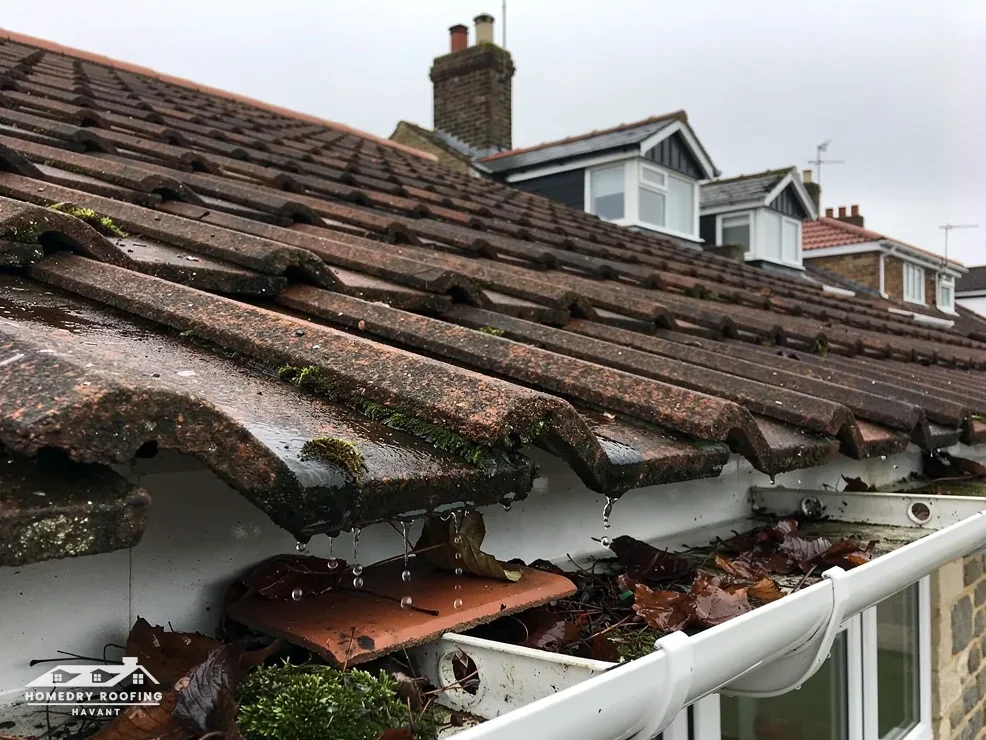
Every drop that lands on a slope ends up in the gutter, so the end of the route gets a survey of its own, taken from the ladder wherever it is safe to set one. From the ladder each run is checked by eye for a dip, the joints are tested for weeping and the brackets are examined for any that have pulled forward. The fascia board behind the gutter carries its weight; we press it in several places, and we check the soffit under it for gaps and stains. Our gutters, soffits and fascias page lists the repairs and the replacements that follow from what we find, and the notes name the ones your house needs.
Next come the downpipes, because a gutter that holds is only half of a drainage route. A cracked joint, a pipe that has come off its clips, a bend that has split or a shoe filled with silt sends the discharge down the wall instead of away, and a damp stain at ground level can be where it shows. We follow each pipe to the drain and record where the water goes when it leaves the wall. A pipe discharging onto a path or a step is noted too, since that is a slip hazard as well as a damp one.
The Environment Agency's own flood map marks Flood Zone 3 land close to North Bersted. The map describes the land and gives no instruction for a roof; every eave and pipe gets the same checks. West Sussex County Council licenses scaffolding on the highway at £266 for one month and asks for at least 10 working days' notice, so a job needing pavement scaffold is planned with that in mind, and we arrange the licence with our scaffolder.
A gutter that holds still carries the roof's work to the drain.
Overflow at the middle of a run points to a joint or a dip, while spill at the end points to an outlet that cannot take the flow. A dark splash line on the wall below tells us which. We follow that line up to its cause before recommending anything, and the notes show the cause in a photograph, so the work is directed at the part that failed and the rest of the run is left alone.
Map of North Bersted and the places around it, with the dashed line of our 30-mile service area from Havant. The same places are listed below the map.
Each batten is pressed for softness and looked over for splits, and the rafter ends are checked where they bear on the wall plate. The underlay is read for tears and slipped laps, and any timber that has gone soft is marked and shown to you before the new covering goes down. Battens are spaced to suit the tile being fitted, which the notes record, and the nails or clips that hold each one are looked at as well. The written price names this work, so the first day of stripping does not bring a bill for something the survey missed, and any hidden fault found later is shown to you in a photograph first.
Arun District Council's building control page lists replacing roof coverings on pitched and flat roofs among alteration projects that need approval, so we confirm the route with the council's own building control team, on 01903 737756, before a re-roof. The Planning Portal's guide adds the national test: re-roofing does not normally need a building regulations application if it affects less than 25 per cent of the building envelope and less than 50 per cent of the roof. Approval is needed, though, where a new covering is 15 per cent or more heavier, and the weight question is settled before ordering anything.
Putting scaffolding where it obstructs the highway calls for a licence, which section 169 of the Highways Act 1980 provides for, and West Sussex County Council is the issuing body for North Bersted. West Sussex County Council licenses scaffolding on the highway at £266 for one month and asks for at least 10 working days' notice. A job likely to run past that month is raised with you at the outset. We arrange the licence with our scaffolder, after the start has been agreed with you, so the paperwork is settled before any scaffold arrives at the kerb.
Historic England lists Homing Cottage at Grade II* and Randall Cottage at Grade II. Section 7 of the Planning (Listed Buildings and Conservation Areas) Act 1990 makes listed building consent the route for any change to the character of a listed building. A list entry names what it protects, so read it before assuming a neighbouring roof is caught. Find your own address among the entries, read the whole of yours, and take any doubt about an entry to Arun District Council before a covering is chosen or a date is booked, since the answer can change the whole plan for the roof.
The North Bersted conservation area sits near the heart of the village, and Arun District Council holds the boundary, so it can tell you whether your road falls inside. Replacing a house's covering generally stays within permitted development rights, but Article 4 directions are the exception, and whether one touches your road is not something this page can answer: check with Arun District Council. The survey notes can carry its reply, and the planning guide covers the national position, including what a conservation area changes. Nothing is ordered until the council has answered.
Spill at an end can mean the outlet there cannot take the flow, or that the run dips toward it more than it should. A pipe packed with silt below the outlet gives the same sign. We pour water along the run where it is safe and watch where it halts, then trace the pipe to the drain. Clearing an outlet, resetting a bracket and renewing a joint are three different jobs, and the findings say which of them applies, with a photograph of the spot, so the cost of the repair matches the fault found.
It appears only as local background. Flood Zone 3 land lies near North Bersted on the Environment Agency map, and that tells us about the ground, not about how a roof should be built or repaired, so no covering is chosen because of it. What matters for roofing is where each downpipe empties, and the notes record that for every pipe, so you can see whether the water leaves the wall or stays beside it. Protecting the building from flood is another subject altogether, and one outside what a roofing survey covers.
Look for one total, written after someone has been up to the roof and into the loft, with the findings attached. It should say what the work is, which covering is going on and whether the figure shows VAT and scaffold as in or out. If another quote is in your hands, put the two side by side on exactly those points. A repair that is sound goes first, and the written total is good and fair for what the roof needed, set out in terms you can follow, with the survey notes alongside to back each point.
You'll get one written total price.
Fill in what you like. It opens WhatsApp with your message ready to send.